

When ac is not blowing in the middle of a Mesa summer, the first reaction is usually panic. The outdoor unit may be running, the thermostat says cool, and yet the vents feel dead, weak, or uneven.
First Checks Before You Panic
You walk upstairs and one bedroom feels still and stuffy, but the rest of the house seems close to normal. That is common in Mesa homes with two stories, bonus rooms, or zoning dampers. Before you assume the blower quit, check the simple things that can kill airflow in one part of the house or make the whole system feel weak.

Start with the thermostat and the zone calling for cooling
Make sure the thermostat is set to Cool and the set temperature is below the room temperature. If your home has more than one thermostat or a zoned control panel, check the specific zone that is having trouble. I see plenty of calls where the main floor thermostat is calling, but the upstairs zone is set to off, held at a higher temperature, or stuck in a schedule.
If the screen is blank, the settings keep changing, or one zone will not respond, deal with that first. No airflow in just one area often starts with a control issue, not a failed blower.
Check the breaker panel
A tripped breaker can create mixed symptoms. The outdoor unit may still seem to run while the indoor blower or one part of the air handler does not.
Look for breakers labeled AC, furnace, or air handler. If one is tripped, reset it once. If it trips again, stop there. Repeated resets can turn a small electrical problem into a burned wire, damaged motor, or failed control board.
Check the filter before you do anything more involved
This is still the first hands-on check I recommend on airflow complaints.
A dirty filter can cut airflow enough to make some rooms feel dead first, especially the farthest bedrooms or upstairs spaces that already have longer duct runs. In Phoenix-area homes, dust, pet hair, and construction debris load filters faster than many homeowners expect. The U.S. Department of Energy notes that replacing a dirty filter can lower an air conditioner's energy use by 5% to 15%, which tells you how much restriction a clogged filter can add to the system.
If you are not sure where to find it, this guide on where your air conditioner filter is located will help you track it down.
What to look for on the filter
Pull it out and hold it up to the light. If light barely passes through, replace it.
Also check for these common problems:
- Wrong size: Air slips around the frame instead of through the filter.
- Backward installation: Follow the airflow arrow on the filter frame.
- Filter too restrictive for the system: Some 1-inch high-MERV filters are harder on older equipment or marginal duct systems.
- More than one filter: Some homes have a return grille filter and another at the unit.
That last one catches people off guard.
Check the room itself, not just the equipment
If only one room or one section of the house has weak airflow, inspect that area before assuming the whole system is failing.
Open the supply vent fully. Make sure a rug, bed, or sofa is not blocking a return grille. Check whether the bedroom door stays shut most of the day. In tighter homes, a closed door can reduce return air enough to make that room feel like the vent is barely blowing. In zoned systems, look for a zone damper issue if one floor gets air and another does not.
A quick order that saves time
Run through these checks in this order:
- Thermostat or zone setting: Cooling mode, lower setpoint, active schedule.
- Breaker check: Reset once if needed.
- Filter inspection: Replace it if it is dirty, bowed, or installed wrong.
- Vent and return check: Open registers, clear blocked grilles, open closed interior doors in problem rooms.
These steps rule out the easy misses fast and give you a better read on whether the problem is house-wide or limited to certain rooms.
Safe DIY Troubleshooting for Weak or No Airflow
You set the thermostat lower, hear the system kick on, and the bedroom upstairs still feels dead while the living room gets some air. That is a common call in Mesa, especially in newer two-story homes and houses with zoning. Before you remove panels or touch wiring, do the safe checks that tell you whether the problem is system-wide or limited to one area.
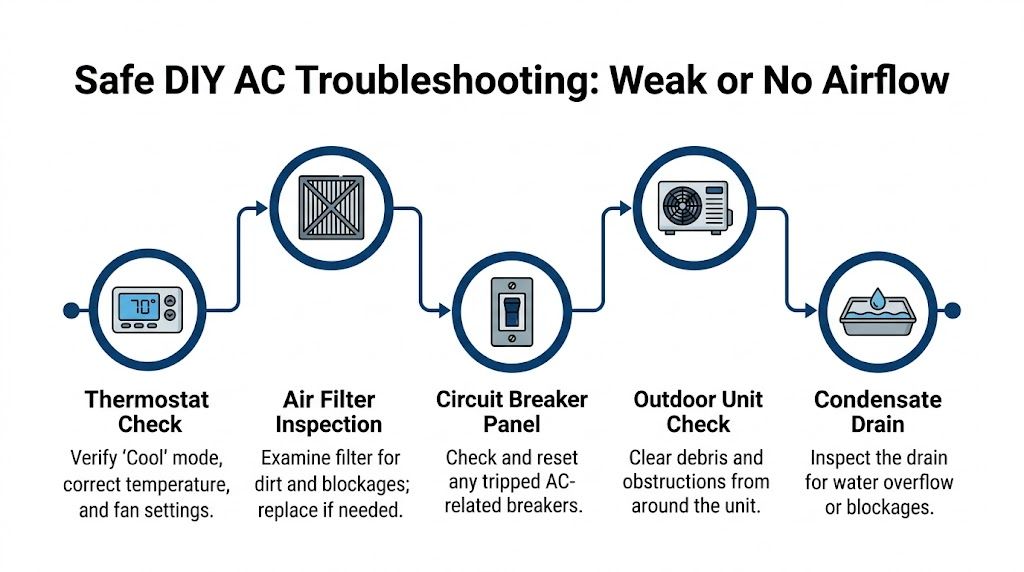
Shut it down before you inspect anything
Turn the system off at the thermostat first. Then shut off the breakers if you plan to look inside the indoor unit area.
Blower sections have moving parts, sharp metal edges, and live electrical components. A quick visual check is fine. Reaching into the cabinet with power available is not.
If you are sorting out a control problem at the same time, this guide on resetting an AC thermostat can help you rule out a stuck schedule or confused thermostat after you finish the safety steps.
Use sound and timing to narrow it down
Bring power back only for testing. Then listen for a minute before you touch anything else.
These patterns matter:
- No indoor sound at all: The blower may not be starting, or the air handler may not be getting power.
- A low hum with no air at the vents: The motor may be trying to run but failing to turn.
- Air starts strong, then drops off: The coil may be icing up, or a control may be shutting the blower down.
- Scraping, banging, or metal rattle: Turn it off and leave it off. That usually points to a mechanical problem, not a simple airflow restriction.
I pay attention to timing here. A system that never moves air points me one direction. A system that moves air for five minutes and then fades points me somewhere else.
Check airflow room by room, not just at one vent
A lot of guides treat airflow like it is all or nothing. In real homes, especially with zoned systems or multi-story layouts, the trouble may only show up in one branch of the duct system.
Walk the house and compare rooms. Is the weak airflow only upstairs? Only in one back bedroom? Only on the zone that runs at night? That pattern helps separate a blower problem from a damper issue, duct restriction, crushed flex duct, or a return air problem in that part of the house.
For safe DIY checking:
- Open supply registers fully while testing.
- Make sure return grilles are not blocked by furniture, boxes, or decorative covers.
- Check whether the weak room stays closed off most of the day.
- If you have zones, confirm the calling zone is open and serving the rooms that should be active.
Restricted return air can make the system look larger, more expensive to fix, or more serious than the actual fault.
Look for ice, water, or sweating lines
If you can see the refrigerant line or coil area without taking the system apart, look for frost, ice, or unusual moisture.
Ice means the system needs to be shut off and allowed to thaw. Keep the fan setting on if your setup allows that safely, because moving room air can speed up thawing. Do not chip at the ice. Do not keep forcing cooling.
A frozen coil is often tied to airflow restriction, but not always. That is one reason guessing gets expensive.
Inspect the blower area only for visible clues
If the access panel is easy to remove and power is off, look into the blower compartment. The goal is observation, not repair.
Look for:
- Dust packed on blower blades: That buildup cuts airflow.
- Insulation, pet hair, or construction debris: I see this often after remodeling or attic work.
- Standing water or signs of overflow: That can point to a drain issue or a past freeze-up.
- Burn marks or a sharp electrical smell: Stop there and call for service.
While you are in diagnostic mode, it also helps to know whether the system was sized correctly in the first place. Problems tied to airflow complaints sometimes overlap with duct design and proper BTU sizing, especially in additions, bonus rooms, and second floors that never cooled evenly from day one.
A simple decision table for safe next steps
| What you find | What it likely means | Safe homeowner action |
|---|---|---|
| Dirty blower compartment or visible debris | Reduced airflow | Leave power off and schedule cleaning if buildup is heavy |
| One room or one zone has weak airflow | Local duct, damper, or return issue | Open doors and registers, clear returns, note which rooms are affected |
| Ice on coil or refrigerant line | Freeze condition | Shut cooling off and let it thaw completely |
| Water in cabinet or drain pan | Drainage or freeze-thaw problem | Turn system off and monitor for overflow |
| Burn smell or metal noise | Mechanical or electrical fault | Stop running the system |
What to avoid
A few mistakes turn a manageable service call into a bigger repair bill:
- Do not keep dropping the thermostat setting to force more air.
- Do not reset a tripping breaker more than once.
- Do not spray water into the indoor unit.
- Do not assume low refrigerant is the cause just because airflow is weak.
- Do not close multiple vents in other rooms to push more air into one problem room.
That last one causes trouble in Phoenix homes more often than people expect. Closing vents can raise static pressure and make an existing airflow problem worse, especially on older duct systems or zoned equipment that is already touchy.
Safe DIY troubleshooting works best when you use it to gather clear symptoms. Once you find repeated icing, blower trouble, burnt smells, or one zone that never opens correctly, it is time for hands-on testing by a technician.
Understanding the Most Common Causes and Costs
A common Mesa call goes like this: the thermostat is set right, the outdoor unit is running, but the house still feels stuck. Sometimes the whole home has weak airflow. In a lot of Phoenix-area homes, the problem shows up in only part of the house, especially upstairs or in one zone. That detail matters because the cause, and the repair bill, can change fast depending on whether the restriction is system-wide or tied to one section of ductwork or one damper.
What the symptoms usually point to
No air from any vent usually points to the indoor side. I start with the blower section, control board, safety switches, evaporator coil, and anything that can keep the air handler from moving air even while the condenser outside still runs.
Weak airflow is a different pattern. That usually means the system is trying to move air but something is restricting it. A dirty blower wheel, a matted coil, crushed flex duct, a return problem, or a zone damper that is not opening all the way can all create that symptom.
System sizing can muddy the picture too. Poor airflow and poor comfort are not always the same problem, and proper BTU sizing helps explain why an upstairs room may stay uncomfortable even when the equipment is technically running.
AC airflow problem diagnostic chart
| Likely Cause | Common Symptoms | DIY Fix? | Estimated Pro Repair Cost |
|---|---|---|---|
| Clogged air filter | Weak airflow, warmer rooms, longer run times | Yes, usually | Usually limited to the cost of the filter if airflow returns after replacement |
| Frozen evaporator coil | Weak or no airflow, ice, water after thawing | Limited. Shut the system down and let it thaw | Cost depends on what caused the freeze, such as airflow restriction, blower trouble, or refrigerant issues |
| Failed blower motor | Outdoor unit runs but little or no air indoors, possible humming | No | Often one of the more expensive airflow repairs |
| Damaged or heavily restricted evaporator coil | Repeated icing, poor airflow, cooling drops off in hot weather | No | Repair cost varies widely based on whether the coil can be cleaned, repaired, or needs replacement |
| Refrigerant line issue that looks like an airflow problem | Cooling falls off, coil may freeze, one area may seem dead first | No | Diagnosis matters here because the final repair can range from a smaller leak repair to major component work |
| Zone damper motor or control issue | Some rooms have airflow, others do not | Basic setting checks only | Often lower than major equipment repairs if the problem stays limited to the damper or its controls |
The safest way to read that chart is this: symptom first, part second. Homeowners get into trouble when they jump straight to refrigerant, thermostat settings, or replacement without confirming whether the issue is the blower, coil, duct path, or one zone staying closed.
What repairs are usually minor, and what gets expensive
Filters, register obstructions, and some thermostat or zone-setting mistakes are the low-cost side of the list. Once you get into blower motors, control boards, evaporator coil problems, or refrigerant-related failures, costs climb because diagnosis takes longer and the parts are harder on the system.
Zone-specific airflow problems deserve special attention in newer Phoenix homes. If one bedroom or one floor has poor airflow while the rest of the house is comfortable, I do not treat that the same way as a whole-house no-air call. A stuck damper, disconnected branch duct, or return imbalance can mimic a bigger equipment failure. The repair may be much smaller, or it may expose duct design issues that keep showing up every summer.
That trade-off is why guessing gets expensive.
Clues that point away from DIY
These symptoms call for a service visit instead of more trial and error:
- Burning smell: Possible electrical overheating inside the air handler or blower section
- Grinding, scraping, or loud humming: Motor or wheel trouble
- Breaker keeps tripping: Stop resetting it
- Heavy ice buildup: The system needs testing after it thaws
- One zone never responds: Damper, board, or control wiring issue is likely
- Airflow changed after other vents were closed: Static pressure may now be too high
If you want a clearer budget range before scheduling service, this breakdown of the cost to fix AC problems gives useful repair examples tied to common AC faults.
The main goal is to catch the failure before a small airflow issue turns into motor damage, coil icing, or repeated hot spots in the same rooms.
What If Only Some Rooms Have No Airflow
You know what? A lot of online advice often falls apart here.
If the living room feels fine but the upstairs bedroom barely gets air, you're often dealing with a different category of problem. The main equipment may be operating normally while one zone, one branch duct, or one area of the house is being starved.

Zoned systems can fool you
Modern Phoenix-area homes often have zoned systems, multi-story layouts, additions, or mini-split setups. When one area loses airflow, homeowners sometimes assume the whole AC is failing.
That isn't always the case.
A stuck or closed zone damper can block airflow to one section while the rest of the house keeps cooling. That symptom can look serious if you don't know the system layout.
Many troubleshooting guides miss this, but this discussion of weak airflow and zoned systems notes that a closed damper can mimic a refrigerant leak. The repair costs are very different. A damper motor fix can be around $100 to $300, while a refrigerant line repair can exceed $800.
Signs the issue is local, not whole-house
A partial airflow problem usually has a pattern.
Look for signs like these:
- One floor suffers more than another: Often points to zoning, balancing, or duct routing.
- One bedroom has little air but nearby rooms feel fine: More likely a branch duct or damper issue.
- The thermostat area is comfortable but distant rooms aren't: The system may be satisfying the thermostat before problem rooms get enough air.
- A recent remodel or attic work happened: Ducts may have been shifted, disconnected, pinched, or blocked.
What you can check safely
Homeowners can still do a few useful checks without diving into technical repairs.
Start with the obvious:
- Open the supply vent fully: Sometimes someone closed it months ago.
- Check for furniture or rugs over returns: That can affect pressure and room airflow.
- Confirm thermostat schedules and zone settings: Some homes have more than one control point.
- Look for accessible damper controls only if you know your layout: Don't force anything.
If the problem keeps showing up in a specific area, duct leakage is worth considering. Reviews and explanations of Aeroseal duct sealing can help you understand how hidden duct leakage affects room-by-room comfort.
When partial airflow points to ductwork
Duct problems usually leave clues that differ from equipment failure.
You may notice one room always underperforms, airflow changes when doors open or close, or comfort worsens during the hottest part of the day even though the rest of the home feels acceptable.
That often points to leakage, crushed flex duct, disconnected sections, or balancing problems. In zoned homes, the damper operation also needs to be verified. A system can be "working" and still deliver poor airflow to one part of the house.
This is why generic advice about filters and thermostats only goes so far. Partial airflow needs a room-by-room mindset.
Proactive Care to Prevent Future Airflow Issues
Most airflow problems don't begin as emergencies. They begin as small restrictions, ignored maintenance, or a system that slowly gets dirtier until a hot day exposes it.
Preventing a repeat takes habit more than heroics.
Build a simple maintenance rhythm
In Arizona, filter maintenance isn't optional. Desert dust loads filters quickly, and airflow suffers long before many homeowners think to check them.
A practical routine looks like this:
- Check the filter regularly: Replace it when it shows real buildup, not just when you remember.
- Keep return grilles clear: Don't let furniture, storage, or décor block breathing space.
- Watch the outdoor unit area: Remove weeds, leaves, and debris that limit airflow around the condenser.
- Pay attention to changes: New noises, weaker air, or longer run times usually mean something is changing inside the system.
A general HVAC maintenance guide can be a helpful reference for building a seasonal checklist, especially if you like keeping home maintenance tasks organized.
Don't ignore the blower side
Homeowners usually notice the outdoor unit because it's visible. Airflow problems often start inside.
The blower compartment, evaporator coil area, drain system, and return side do most of the hidden work. When those areas collect dirt or develop drainage and airflow issues, comfort drops and the system strains harder to keep up.
That doesn't mean every homeowner should open equipment panels routinely. It means annual professional inspection has real value because a technician can see what the house can't.
What regular service helps prevent
Professional maintenance helps catch:
- Developing airflow restrictions
- Coil dirt and drain issues
- Loose electrical connections
- Blower performance problems
- Wear that can turn into a no-airflow call later
If you want a more detailed homeowner checklist, this HVAC preventive maintenance checklist is a useful place to start.
The real benefit of prevention
The biggest payoff isn't just efficiency. It's reliability.
When your AC is already under pressure from a long Mesa cooling season, every airflow restriction pushes it closer to a shutdown. Regular maintenance keeps the system breathing the way it was designed to breathe.
That's the kind of prevention people appreciate most on a brutally hot afternoon. Not theory. Steady airflow when they need it.
When It Is Time to Call the Experts
If you've gone through the safe checks and your ac is not blowing, or it's only blowing weakly after a brief improvement, it's time to stop troubleshooting and get it diagnosed properly.
Call for professional help if you notice a burning smell, loud metallic noise, repeated breaker trips, heavy ice buildup, or an indoor unit that won't move air. Running the system in that condition can turn a contained repair into a larger one.
A trained technician can separate a simple airflow restriction from a blower failure, frozen coil, control fault, or zone-related problem without guesswork. If you want a local diagnosis, our Mesa AC repair service is built for exactly this kind of no-airflow call.
Comfort matters fast in Arizona. If you want honest help from a local team, contact Comfort Experts by calling 480-207-1239 or schedule service online.