Chances are you spend over 90% of your time indoors—and with Arizona’s intense summers, who can blame you? But doesn't it make you wonder about the air you’re breathing day in and day out inside your own home? This is where indoor air quality testing comes in, serving as a comprehensive health check-up for the air your family breathes.
Why This Air 'Health Check-Up' Matters for Your Arizona Home
You know what? The air inside your Mesa or Phoenix home can be up to five times more polluted than the air outside. That sounds backward, but it’s true. Modern homes are built to be tightly sealed for energy efficiency, which is great for your power bill but not so great for air circulation. It means contaminants get trapped inside.
This is where professional indoor air quality testing comes in. It’s not about guessing what’s wrong; it’s about getting hard data. You can't see the biggest threats. We’re talking about microscopic dust, chemical vapors, and even mold that can get sucked into your HVAC system and spread through every room without you ever knowing.
“Poor indoor air quality is a significant contributor to headaches, congestion, allergies and other uncomfortable health issues. An air quality inspection can pinpoint these sources and document the changes needed to remedy the situation.”
The Goal of IAQ Testing
The main point of an IAQ test is to give you a clear, data-driven snapshot of your home's air. It’s about understanding what you’re really breathing so you can take smart, targeted steps to fix it. As a company with years of experience serving Arizona homeowners, we've honed our process to deliver trustworthy results.
The key goals are to:
- Find Invisible Pollutants: We identify and measure specific culprits like fine particulate matter (PM2.5), volatile organic compounds (VOCs), and mold spores.
- Pinpoint the Real Cause: We trace the problem back to its source, whether it's poor ventilation, a hidden water leak causing mold, or fumes from new furniture.
- Protect Your Family’s Health: We help connect the dots between nagging symptoms like chronic allergies, coughing, or headaches and specific airborne triggers in your home.
More Than Just Comfort
Good air isn’t just about feeling comfortable—it actually helps you think clearer and feel better. Did you know that poor indoor air quality can slash workplace productivity by as much as 12%? When the air quality drops below established indoor air quality standards, studies show people make more mistakes and feel more tired.
Ultimately, understanding these standards helps you see how your home’s air stacks up. Once we identify the hidden threats, we can map out a real plan for creating a healthier space for you and your family. You can learn more about the solutions we offer to achieve better indoor air quality in our detailed guides.
Identifying the Invisible Pollutants in Your Arizona Home
When you think of "air pollution," it’s easy to picture a hazy city skyline. The surprising truth is that the air inside your home can be far more polluted than the air outside. Professional indoor air quality testing is all about uncovering these invisible threats—the ones you can’t see, but your body definitely feels.
Honestly, knowing what you’re up against is the first and most important step. These aren’t just dust bunnies under the couch; they’re specific particles and gases that have real sources and real health effects. Here in Arizona, the way we live—constantly running the AC, sealing our homes up tight, and battling desert dust—creates a unique brew of airborne troublemakers.
This flowchart shows the simple but critical cycle: your home traps pollutants, and over time, that concentration starts to affect your family’s health.
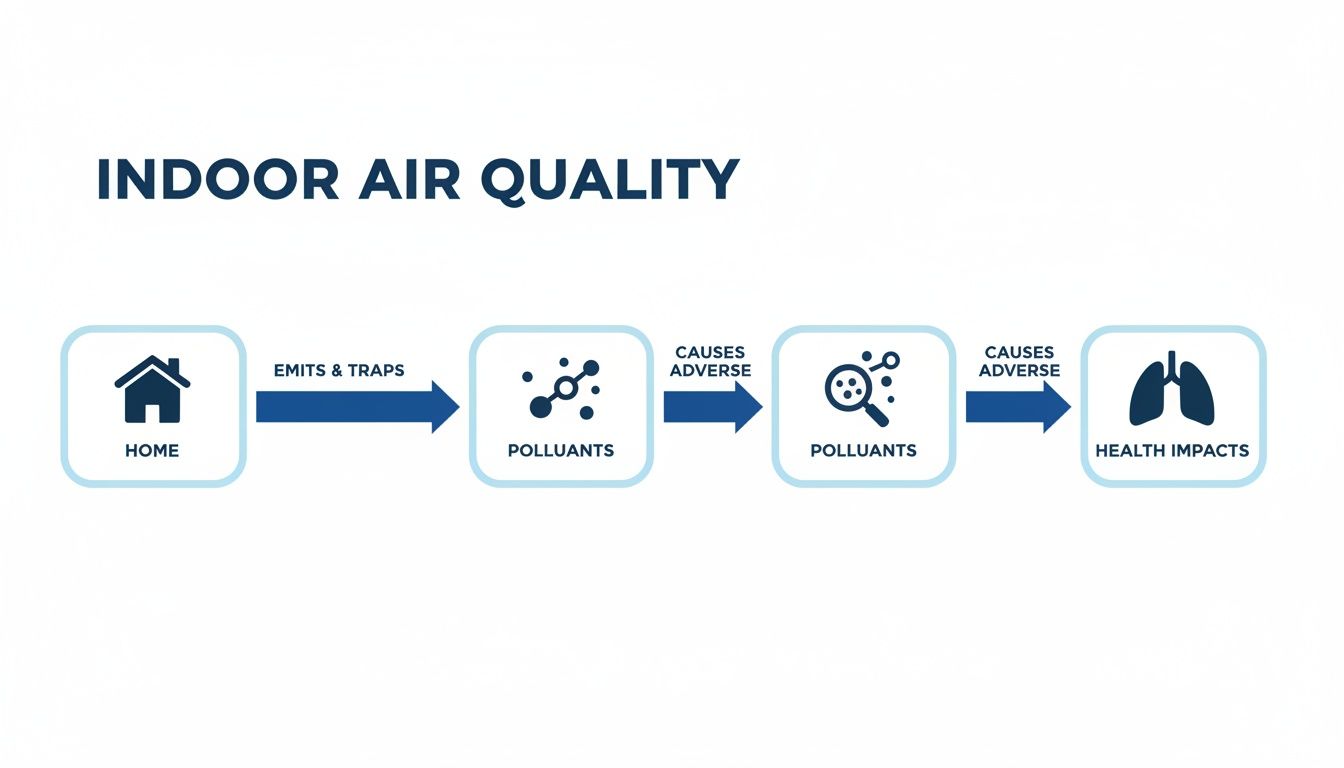
It’s a clear visual of how a sealed house can become a box for contaminants. Let's break down exactly what those culprits are.
The Most Common Airborne Intruders
Getting to know the "who's who" of indoor pollution helps you spot where problems might be coming from in your own home. While a professional test gives you the hard numbers, here’s a look at the usual suspects we find in Phoenix-area homes day in and day out.
- Particulate Matter (PM2.5): Think of a speck of dust. Now imagine something 30 times smaller. That’s PM2.5. These particles are so microscopic they can sail right past your body’s defenses and get deep into your lungs or even your bloodstream. In Arizona, they’re everywhere—kicked up by dust storms (haboobs), coming from vehicle exhaust, generated by cooking, and even released from burning candles.
- Volatile Organic Compounds (VOCs): You know that "new car" or "new paint" smell? That’s VOCs. These are chemical gases that "off-gas" from thousands of everyday products like furniture, flooring, cleaners, and air fresheners. In high doses, they can cause everything from headaches and dizziness to more serious, long-term health problems.
- Mold Spores: Our monsoon season is a gift and a curse. The humidity it brings can lead to hidden water leaks and mold growth inside walls, attics, or your HVAC system. Once it starts, mold releases tiny spores into the air that can hammer anyone with allergies or asthma.
- Carbon Monoxide (CO) & Carbon Dioxide (CO2): CO is the silent killer—an odorless, colorless gas produced by any appliance that burns fuel, like a gas furnace or water heater. CO2, while not as immediately dangerous, is a tell-tale sign of poor ventilation. High levels mean you’re breathing stale, recycled air, which is why you might feel tired, stuffy, or get headaches at home.
Common Indoor Air Pollutants Found in Arizona Homes
To make this easier to digest, we've put together a table that breaks down these common contaminants. This quick guide shows where they typically come from in an Arizona home and the symptoms they might be causing.
| Pollutant | Common Sources | Potential Health Effects |
|---|---|---|
| Particulate Matter (PM2.5) | Desert dust, cooking fumes, wildfire smoke, vehicle emissions | Respiratory irritation, asthma attacks, cardiovascular issues, coughing |
| Volatile Organic Compounds (VOCs) | New furniture, carpets, paint, cleaning products, air fresheners | Headaches, nausea, dizziness, eye/nose/throat irritation, organ damage |
| Mold & Mildew Spores | Hidden leaks from plumbing or roofs, poorly maintained AC units | Allergy symptoms, asthma flare-ups, sneezing, musty odors, respiratory infections |
| Carbon Monoxide (CO) | Malfunctioning gas furnaces, water heaters, attached garages | Fatigue, confusion, dizziness, and at high levels, it can be fatal |
| Radon | Naturally occurring gas seeping through foundations and cracks | The second leading cause of lung cancer in the United States |
This table makes it pretty clear why you can't just ignore that stuffy feeling or persistent cough. The problem is often hiding in plain sight.
The U.S. Environmental Protection Agency (EPA) has found that concentrations of some pollutants are often two to five times higher indoors than outdoors. This is exactly why identifying and fixing the source is so vital for your family's long-term health.
Dealing with these pollutants isn't a one-size-fits-all job. For those struggling with sneezing, itchy eyes, and other allergy-like symptoms, targeted air purification can bring incredible relief. If that sounds like you, check out our guide on the best air purifiers for allergies to see what solutions can start helping right away.
Warning Signs Your Home Needs Air Quality Testing
How can you really tell if the air inside your home is clean? Sometimes the signs are easy to miss, but other times they’re as obvious as a funky smell that just won't go away. Your body and your house will often give you clues that something is off.
We hear it all the time from families in Phoenix. The kids have a cough that seems to only show up at home. After a day playing at the park, it’s gone. That’s no coincidence—it’s a classic sign that the air quality issue is starting from inside the house. Learning to spot these patterns is the first step.
Physical Symptoms That Appear at Home
Your body is usually the first detector to go off when the air is bad. If you or your family are dealing with symptoms that mysteriously get better when you leave the house, that’s a huge red flag.
Keep an eye out for these recurring health issues:
- Persistent Allergy-Like Symptoms: Are you constantly sneezing, dealing with a runny nose, or suffering from itchy, watery eyes, but only at home? These reactions could easily be triggered by allergens like mold spores, pet dander, or dust mites circulating in your HVAC system.
- Unexplained Headaches and Fatigue: Feeling sluggish, foggy, or getting frequent headaches without a clear cause? This can point to poor ventilation and high levels of carbon dioxide (CO2). It could also be a reaction to chemicals off-gassing from new furniture or cleaning supplies.
- Increased Asthma or Respiratory Issues: If anyone in your home has asthma and their attacks or breathing troubles get worse indoors, it strongly suggests triggers like fine particulate matter (PM2.5) or hidden mold are present.
These symptoms are your body's early warning system. When they’re clearly tied to being at home, it’s time to call in a professional for indoor air quality testing to figure out what you’re really breathing.
Observable Clues Around Your House
Beyond how you feel, your home itself can show visible signs of poor air quality. You just have to know what to look for. These clues can point directly to an underlying problem that needs an expert eye.
The most common signs of bad indoor air quality are strong and persistent odors, visible mold growth, excessive dust, and condensation on your windows. These are direct indicators that your home’s air needs attention.
You can spot many of these issues with a quick walk-through. Notice a lot of dust settling right after you’ve cleaned? That might signal a problem with your HVAC system or leaky ductwork. A dirty filter is a common culprit, so checking its condition is key; learn more in our guide on where to find the air filter in your house.
Also, pay attention to any strange, persistent musty or chemical smells that don't have an obvious source. That musty odor often points to hidden mold or mildew, a common problem after our monsoon season. Finally, look for condensation or moisture building up on your windows. That’s a tell-tale sign of high humidity, which creates the perfect environment for mold to thrive.
DIY Test Kits vs Professional IAQ Services
When you start wondering about the air inside your home, grabbing a DIY test kit from the hardware store can feel like a smart, proactive move. They’re right there on the shelf, they seem affordable, and they promise quick answers. Here’s the thing, though: those kits often give you a very narrow, and sometimes misleading, glimpse of what’s really going on.
A simple store-bought kit might flag one thing, like mold or radon. The problem is, they almost never have the precision of professional-grade equipment. The results can be vague and hard to act on, and they completely miss the complex ways different factors interact inside your Arizona home.
You might get a test back that says "mold detected." Okay, but what kind of mold is it? How high are the levels? And the most important question of all: where is it coming from? A DIY kit just can't answer those critical follow-up questions, often leaving you with more anxiety than actual answers.
The Limits of Do-It-Yourself Testing
Think of a DIY air quality kit like taking your own temperature when you feel sick. It can tell you if you have a fever, but it can’t tell you why. Is it just a common cold, the flu, or something that needs a doctor's attention? For a real diagnosis, you need an expert.
It’s the same with air quality. DIY tests have some serious blind spots:
- Accuracy and Calibration Issues: The sensors in consumer-grade kits just aren't held to the same strict standards as the calibrated, high-sensitivity equipment a certified pro uses. This can easily lead to false negatives (making you think everything’s fine when it’s not) or false positives (causing a lot of unnecessary worry and expense).
- A Very Narrow Scope: Most kits are designed to look for just one or two pollutants. But your home’s air is a complex mix. You could have a serious issue with VOCs from new furniture right alongside high levels of PM2.5 dust, but a test that only looks for mold would never show you the full picture.
- No Real-World Context: A professional technician does so much more than just set up a sensor. We perform a visual inspection, understand how your home is built, check the condition of your HVAC system, and factor in local conditions—like recent dust storms or monsoon humidity. A plastic kit from a box can’t provide any of that crucial context.
The Definitive Advantages of Professional IAQ Services
Choosing a professional indoor air quality testing service, like the one we offer at Comfort Experts, is like getting that complete diagnostic workup from a specialist. Instead of one confusing number, you get a full, actionable health report for your home. We've built our reputation on providing clear, reliable results you can trust.
When you bring in a certified team, here’s what you’re really getting:
- Certified, High-Grade Equipment: We use advanced, multi-gas monitors that can simultaneously track a whole range of pollutants with scientific accuracy—from VOCs and mold spores to particulate matter and carbon dioxide.
- Technicians with Local Experience: Our team lives and works here. We know exactly how monsoon humidity encourages mold growth and how our tightly sealed modern homes can trap pollutants during the long, hot summers. This isn't just theory for us; it's our daily reality.
- Comprehensive, Actionable Reports: We don't just hand you a confusing sheet of lab data and walk away. We translate those scientific findings into a clear, easy-to-read report. It explains what we found, what it actually means for your family's health, and gives you a prioritized list of real solutions. That might mean better filtration, a new air purifier, or tackling issues inside your ductwork. If ducts are a concern, you can learn more about our process for duct cleaning in Mesa, AZ right here on our blog.
A DIY kit gives you a single puzzle piece. A professional IAQ assessment gives you the full picture on the box, showing you exactly how all the pieces fit together to create a healthy or unhealthy environment. It’s this 'big picture' clarity that empowers you to make truly effective changes.
Ultimately, professional testing takes all the guesswork out of the equation. It's an investment in certainty and a clear path forward. You’ll know that any solutions you choose are aimed directly at the real problems in your home's air, which is the best way to protect your family’s health and well-being for the long haul.
The Professional IAQ Testing Process Step-By-Step
So, you’re thinking about getting your home’s air tested. It can feel like a big, mysterious step, but the whole point of a professional indoor air quality test is to replace guesswork with real answers. We want you to feel confident, not confused.
Let me explain exactly what happens when one of our Comfort Experts technicians shows up at your door. Our process is designed to be straightforward, respectful, and give you a clear, data-driven picture of what’s going on inside your home.
It all starts with a simple conversation. This is one of the most important parts of the job. We need to hear what you’re experiencing. Are there funky smells? Is someone waking up with a stuffy nose? Did you just get new floors or paint the living room? This chat helps our technician start connecting the dots and figure out which specific pollutants we need to hunt for.
On-Site Inspection and Equipment Placement
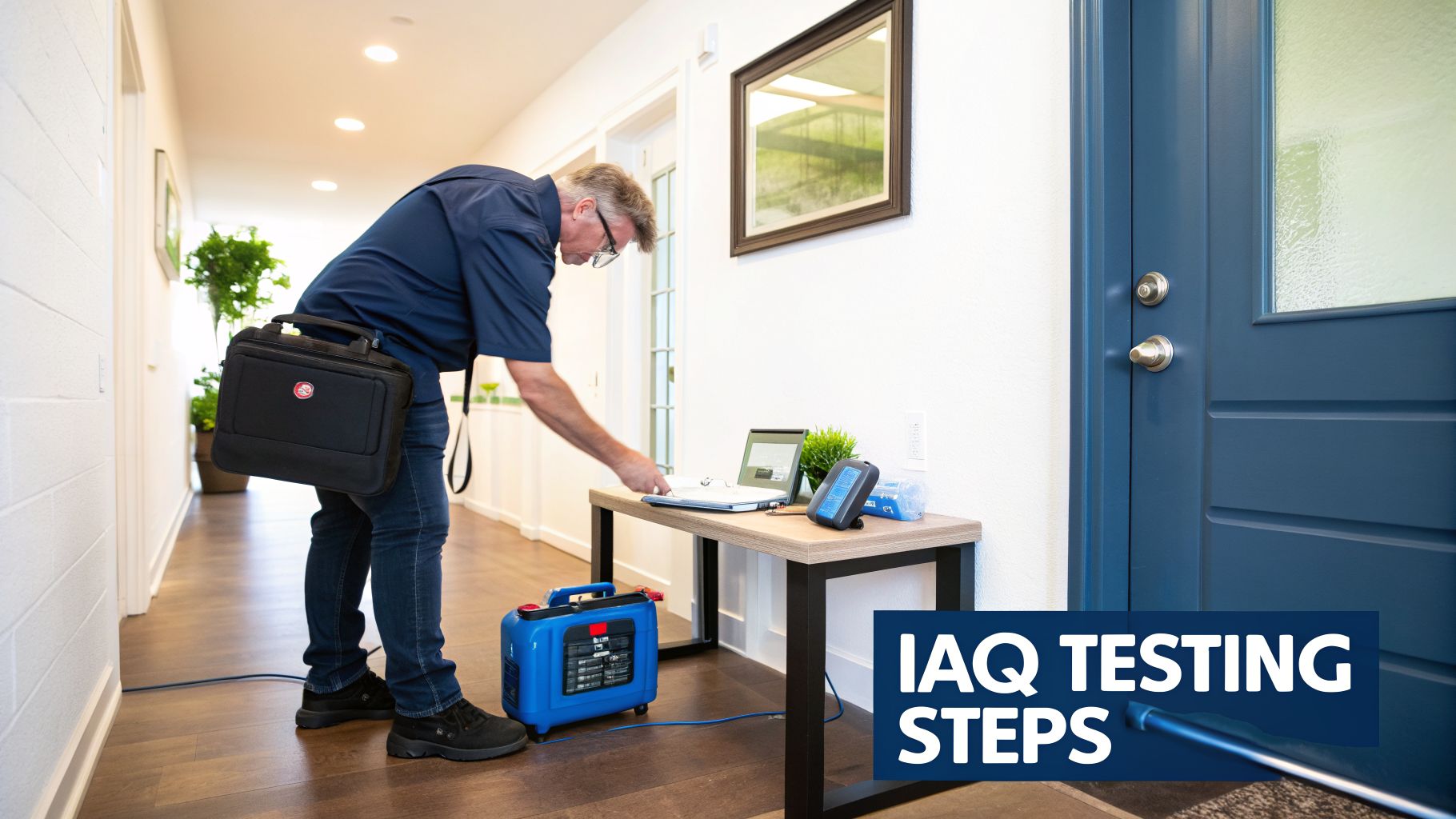
After we talk, our technician will do a thorough walk-through of your home. We're looking for the obvious and not-so-obvious clues—things like signs of moisture, the condition of your HVAC system, and other potential pollution sources. This is the kind of hands-on context a sensor alone could never provide.
Next, we strategically place our advanced monitoring equipment. This isn't random. Based on our walk-through and your concerns, we’ll set up a few small, quiet monitors in key spots. These locations might include:
- The main living area where the family hangs out most.
- Bedrooms, especially if anyone is having allergy-like symptoms or trouble sleeping.
- Areas near potential culprits, like a newly remodeled kitchen or a garage where you park the car.
- An outdoor location to get a baseline reading. This is crucial for comparing your indoor air to the air outside.
This careful placement ensures we’re getting a true snapshot of the air you and your family breathe day in and day out.
Data Collection and Sample Analysis
With the monitors in place, the data collection begins. Don't worry, this part is completely non-intrusive—the devices are silent and just do their thing in the background. They’ll typically run for 24 to 72 hours to gather enough information for a solid analysis. This longer timeframe lets us see how pollutant levels change throughout the day and night as your home's activities and HVAC system cycle on and off.
Sometimes, we also need to collect physical samples to get the full story. This might involve:
- Air Samples: We can capture a direct air sample in a canister or on a slide. These get sent to an accredited lab to identify very specific mold spores or chemical compounds.
- Surface Samples: If we see something that looks like mold, we can take a swab or a tape-lift sample from the surface to confirm what it is.
Combining real-time data with lab analysis gives us a complete, scientifically-backed view of your home's environment.
Interpreting the Data and Your Final Report
Once the collection period is over, we’ll come back to pick up our equipment and start analyzing the data. This is where expertise really matters. We take all those complex data points and translate them into a report that’s actually easy to understand. We won't just hand you a sheet of numbers—we’ll explain what they mean for your home and your health.
For example, we know from global data that different regions face different challenges. Some areas struggle with high TVOCs from new construction, while others see huge spikes in dust and PM2.5. This kind of regional insight, backed by data from thousands of monitors, is why a professional test tailored to our Arizona climate is so valuable. You can read more about global IAQ benchmarks and trends to see just how much these factors can vary.
Our final report is a clear roadmap to a healthier home. It outlines exactly what we found, explains the potential health implications, and provides a prioritized list of actionable recommendations—not just problems.
This whole step-by-step process is built to give you clarity and confidence. It takes you from wondering what's in your air to knowing exactly what to do about it.
From Diagnosis to Solution: Creating a Healthier Home
So, you’ve got the results from your professional indoor air quality test. That’s a huge first step, but it's really just the beginning of the story. Think of it this way: an accurate diagnosis is only powerful if it leads to the right treatment. This is where our expertise at Comfort Experts comes in, turning those numbers and charts from your report into real-world actions that make your home healthier and more comfortable.
We don’t just hand you a report and walk away; we build the bridge from problem to solution. Your IAQ report is the game plan, and our specialized services are how we execute it.
Matching the Solution to the Pollutant
Every home in the Valley is unique, and so is every air quality issue. A one-size-fits-all approach just doesn't cut it. The real value comes from crafting a solution that directly targets what your test results uncovered.
Here’s a quick look at how we connect specific findings to the right fix:
- For High Particulate Matter (PM2.5): If your report flags high levels of dust, pet dander, or other fine particles, the answer is better filtration. This usually involves upgrading your HVAC filter to a higher MERV rating and often installing a whole-home air cleaner designed to trap even microscopic intruders.
- For Mold Spores and Microbes: When mold is the problem, we attack it from a few different angles. It always starts with finding and stopping the moisture source. From there, a whole-home air purifier with UV light technology is a game-changer, actively neutralizing mold spores, bacteria, and viruses as they circulate through your HVAC system.
- For Volatile Organic Compounds (VOCs): If off-gassing from chemicals is polluting your air, the one-two punch is ventilation and purification. An air purification system armed with a carbon filter is fantastic at absorbing these gaseous pollutants, while we also ensure your home has a way to flush out the stale air and bring in fresh.
Our Comprehensive Remediation Strategies
Our expertise goes far beyond just testing. We’re fully equipped to install and maintain the systems that will get your home’s air back into the healthy zone.
Whole-Home Filtration and Purification
Instead of plugging in small, single-room units that only treat one area, we focus on solutions that clean the air in your entire house. A whole-home system integrates directly with your HVAC, purifying the air every single time your system kicks on. Once problems are found, understanding how professional decontamination improves indoor air quality long term is the key to lasting results.
If you’re looking to get serious about clean air, you can learn more about our options for whole-home air purifiers and see which one fits your home.
By treating the air at its source—your HVAC system—you ensure that every room receives cleaner, healthier air, providing consistent protection for your entire family.
Duct Cleaning and Aeroseal Sealing
Your air ducts are basically the lungs of your home. If they're dirty or leaky, they become a superhighway for dust, allergens, and other gunk. Professional duct cleaning scours out years of built-up debris. But just as importantly, we use Aeroseal duct sealing to close off tiny leaks from the inside out, stopping pollutants from getting sucked into your airstream in the first place.
Humidity Control Solutions
Here in Arizona, managing humidity is a bigger deal than most people think. Too much moisture, especially during our monsoon season, creates a five-star resort for mold and mildew. We can install whole-home dehumidifiers that work in tandem with your AC to keep humidity at the perfect level, making your home less friendly to mold and a lot more comfortable for you.
This kind of targeted approach, all driven by your unique indoor air quality testing results, is what puts you back in control of your home’s environment.
Frequently Asked Questions About IAQ Testing in Arizona
It’s completely normal to have questions before you dive into professional indoor air quality testing. For most homeowners in Phoenix and Mesa, it’s a new process, and you want to know what to expect.
We get it. Here are straight answers to a few of the most common questions our team hears every day.
How Long Does a Professional Indoor Air Quality Test Take?
The initial visit to your home is pretty quick, usually taking just 1 to 2 hours. During that time, one of our technicians will do a visual walk-through, listen to your concerns, and set up our small, quiet monitoring devices in a few key spots.
The real work happens over the next 24 to 72 hours. The equipment stays in your home to collect continuous data, which gives us a true picture of your air quality—not just a single snapshot. This helps us see how pollutant levels change as you go about your day.
Is Indoor Air Quality Testing Disruptive to My Home?
Not in the slightest. We designed the whole process to be as low-impact as possible. Our monitoring equipment is compact, totally silent, and placed out of the way in discreet locations.
Honestly, most of our clients tell us they forget the monitors are even there. You and your family can carry on with your normal routines without any disruption. We promise to treat your home with the same care we’d treat our own.
Can I Just Open My Windows to Improve My Air Quality?
Opening your windows can help for a few minutes, but it's not a real solution here in Arizona. For most of the year, it's just too hot. Worse, you're inviting in a whole new set of problems—dust from a haboob, desert allergens, and other outdoor pollutants.
Professional testing gets to the root cause of the problem. It allows us to recommend targeted, long-term solutions like filtration and air purification that actually work year-round, no matter how hot it gets outside.
This is the real difference: instead of a band-aid fix, testing helps you make a permanent improvement to your home's health.
Ready to stop guessing and get real answers about the air in your home? The team at Comfort Experts is here to provide clear, data-driven insights and create a healthier environment for your family. Give us a call at 480-207-1239 or schedule service online today to book your professional indoor air quality test.