

If you're in Phoenix, you probably already know the feeling. You dust the furniture, run the AC, and somehow your house still feels gritty, stuffy, or sneeze-inducing by the end of the day. Carrier air purifiers come up a lot for homeowners who want more than a basic filter, but the right choice depends on what your air is dealing with.
Why Your Phoenix Air Might Be Dirtier Than You Think
Phoenix air has a way of sneaking into the house even when the windows stay shut. Dust from the driveway, fine particles from traffic, pollen, smoke from regional wildfire events, and fumes from cleaning products or new materials can all end up circulating indoors. A lot of homeowners assume that once they're inside, they're protected from most of it.
That isn't always how it works.
Your HVAC system moves air all day. If the ductwork has leaks, if the filter is too basic, or if particles keep getting tracked inside, the same contaminants can cycle through the house again and again. That's why people often notice a pattern. The home looks clean, but the vents get dusty fast, the bedroom feels stuffy at night, or allergy symptoms flare up most when they're indoors.
The pollutants you can see and the ones you can't
The visible problems are easy to recognize:
- Dust buildup on surfaces: Phoenix dust settles fast, especially during windy stretches and monsoon season.
- Haze after a smoke event: Wildfire smoke can linger indoors even after outdoor conditions improve.
- Debris around supply vents: That usually means your system is moving particles through the house, not fully removing them.
The less visible issues matter just as much:
- Allergens: Pollen, pet dander, and fine dust don't need to be visible to bother your sinuses.
- Odors and VOCs: Paints, cleaners, cooking, and household products can affect indoor air quality.
- Fine airborne particles: These are the particles that often slip past low-efficiency filters.
Many Phoenix homeowners aren't dealing with one air problem. They're dealing with dust, allergens, and odors at the same time.
Why a standard AC filter often isn't enough
A basic HVAC filter protects equipment first. It helps keep larger debris out of the blower and coil. That's important, but it isn't the same thing as actively cleaning indoor air at a higher level.
A screen door offers a good comparison. It keeps the big stuff out, but plenty of smaller stuff still gets through.
If the home has dusty ductwork, that can add to the problem. That's one reason some homeowners pair purification with professional duct cleaning in Mesa. Cleaning the distribution path matters when you're trying to improve the air moving through it.
Why Phoenix homes feel worse during certain seasons
Phoenix doesn't give you one neat “allergy season.” It gives you waves of air quality stress. Spring can bring pollen. Summer can bring heat, dust movement, and heavy AC runtime. Monsoon season can stir up particles fast. Smoke events add another layer.
That means the system you choose needs to work in real conditions, not just on paper. If your home feels better after changing a filter for a few days and then slides back to dusty and irritated, that's usually a sign the house needs more than a standard throwaway filter.
Understanding Carrier's Approach to Clean Air
A Phoenix homeowner usually notices the problem in everyday ways. The bedroom gets dusty two days after cleaning. Someone with allergies feels worse at night even with a fresh filter in the return grille. The AC runs for hours, but the house still does not feel clean.
Carrier's approach is built around the idea that air cleaning should work with the HVAC system, not sit off to the side as a separate gadget. That sounds simple, but it matters. If a purifier cleans well on paper and chokes airflow in a real house, the result is a system that works harder and a homeowner who paid for the wrong fix.
Carrier has been in heating and cooling for generations. That long history helps explain why its indoor air products are tied closely to airflow, filtration, and equipment compatibility, as outlined in Carrier's history of innovation.
Carrier looks at clean air as a system decision
Homeowners often ask one fair question first. What will it catch?
That matters, but in Phoenix I also look at where the air is moving, how often the system runs, how much dust the house takes on, and whether the equipment can handle a higher-efficiency solution without airflow problems. A purifier is only part of the answer. Return design, filter cabinet size, duct condition, and fan performance all affect the result.
That is why Carrier's air-cleaning products make more sense as part of a larger indoor air plan. Whole-home options treat the air every time the system circulates it. Portable units can help in a bedroom, office, or nursery where one problem area needs extra attention. Homeowners comparing options can see how those pieces fit together through our Phoenix indoor air quality services.
What "Captures and Kills" means in a real house
Carrier uses "Captures and Kills" to describe a two-step approach in certain whole-home products.
Step one is particle capture. Air passes through the cabinet, and the media collects fine material that would otherwise keep circulating through the duct system. Step two is treatment after capture. Carrier says some of its systems are designed to inactivate select pathogens once they are trapped. For a homeowner, the practical point is straightforward. The product is trying to do more than act like a basic filter.
The trade-off is that integrated purification works best when the HVAC system is sized and configured correctly. Good technology cannot make up for poor airflow, an undersized return, or neglected maintenance. That is one reason Carrier products tend to perform better with careful installation than with a quick swap-and-go mindset.
Why that matters more in Phoenix than Carrier's brochure explains
Phoenix homes deal with a heavy dust load, long cooling seasons, and periods when outdoor air quality drops fast. In that setting, an air purifier is not just a comfort extra. It is part of how you keep indoor air from getting worse every time the blower comes on.
Carrier's approach fits homeowners who want air cleaning tied directly to daily system operation. That can be a smart move for families dealing with recurring dust, allergy irritation, or smoke drifting indoors during bad air days. It is not automatically the cheapest route, and it is not the right answer for every house. But for many Arizona homeowners, integrated purification makes more sense than buying a room unit and hoping it solves a whole-home problem.
How Carrier Purifiers Compare to Other Technologies
Not every air-cleaning product solves the same problem. That's why homeowners get frustrated. They buy one device expecting it to handle dust, smoke, allergens, odors, and biological concerns all at once. Some technologies are strong at particle capture. Some are better as add-ons. Some help in one room but not across the house.
A side-by-side comparison makes the trade-offs easier to see.
IAQ Technology Comparison for Phoenix Homes
| Technology | What It Targets | Pros | Cons / Limitations |
|---|---|---|---|
| Standard HVAC filter | Larger airborne debris and basic dust load | Protects equipment, simple to replace, common in most systems | Doesn't provide the same level of particle control as dedicated purification, often too limited for allergy-heavy homes |
| High-MERV media filter | Smaller particles than basic filters, including more dust and allergen material | Better particle capture than entry-level filters, passive and straightforward | Can add airflow resistance if the system isn't designed for it, doesn't address gases or odors by itself |
| Portable HEPA purifier | Room-level particles such as dust, pollen, and smoke | Good for bedrooms, offices, and targeted use, easy to deploy without ductwork | Only treats the room where it runs, coverage depends on placement and runtime |
| UV light add-on | Surface and air-treatment support in specific HVAC applications | Useful as part of a layered strategy, especially where coil hygiene matters | Doesn't replace filtration, doesn't remove dust from the air by itself |
| Electronic air cleaner | Fine airborne particles | Can be effective in some setups and may capture smaller particles | Performance depends heavily on design and maintenance, some homeowners worry about byproducts with certain technologies |
| Activated carbon focused purifier | Odors and some VOC-related concerns | Helpful for smell control and chemical odors | Doesn't replace particle filtration, carbon eventually saturates |
| Carrier whole-home purifier | Whole-home airflow treatment through the HVAC system | Integrated approach, treats air moving through the system, designed for daily household operation | Requires professional installation and depends on the home's duct and airflow conditions |
What usually works best in real homes
Most Phoenix homes do better with a layered setup than a single magic-box solution.
For example:
- If dust is your main complaint: Better filtration through the HVAC system usually matters more than a decorative room purifier in the corner.
- If one bedroom is the problem area: A portable unit can make sense, especially if the occupant has allergies or sleeps with the door closed.
- If smoke and odors bother the whole house: Filtration plus some carbon support is often more practical than relying on one technology alone.
- If your HVAC system already struggles with airflow: You have to be careful about upgrading filtration without checking system compatibility.
That's also why homeowners often compare purifier options with filtration first. A good starting point is understanding which HVAC filters help most with allergies, because filtration quality affects what any purification strategy can realistically achieve.
What doesn't work as well as people hope
A few common mistakes show up over and over:
- Buying for the ad, not the house: A strong-sounding feature list doesn't guarantee whole-home performance.
- Ignoring airflow: If the system can't move air properly, even premium filtration can become a problem.
- Using one room unit to solve a full-house issue: That's like putting one bucket under a roof leak and expecting the attic to stay dry.
- Skipping maintenance: Any purifier loses value if the filter is loaded up and overdue.
If the house has multiple problem sources, one technology alone usually won't cover all of them.
Carrier fits into this comparison as a brand offering both integrated and portable paths. That gives homeowners flexibility, but it also means the right answer depends on whether your problem is local or house-wide.
A Look at Whole-Home vs Portable Carrier Models
It is 9 p.m. in Phoenix. The AC is running, the bedroom door is shut, and one person in the house is still waking up stuffy while the rest of the home feels fine. That is usually the point where model choice gets practical. Are you trying to clean the air in one room, or are you trying to treat the air your whole HVAC system keeps recirculating?
Carrier gives homeowners both paths. The Infinity Air Purifier is the built-in option that ties into the central system. Carrier also sells portable room purifiers for spot treatment. On paper, both are air cleaners. In real homes, they solve different problems.
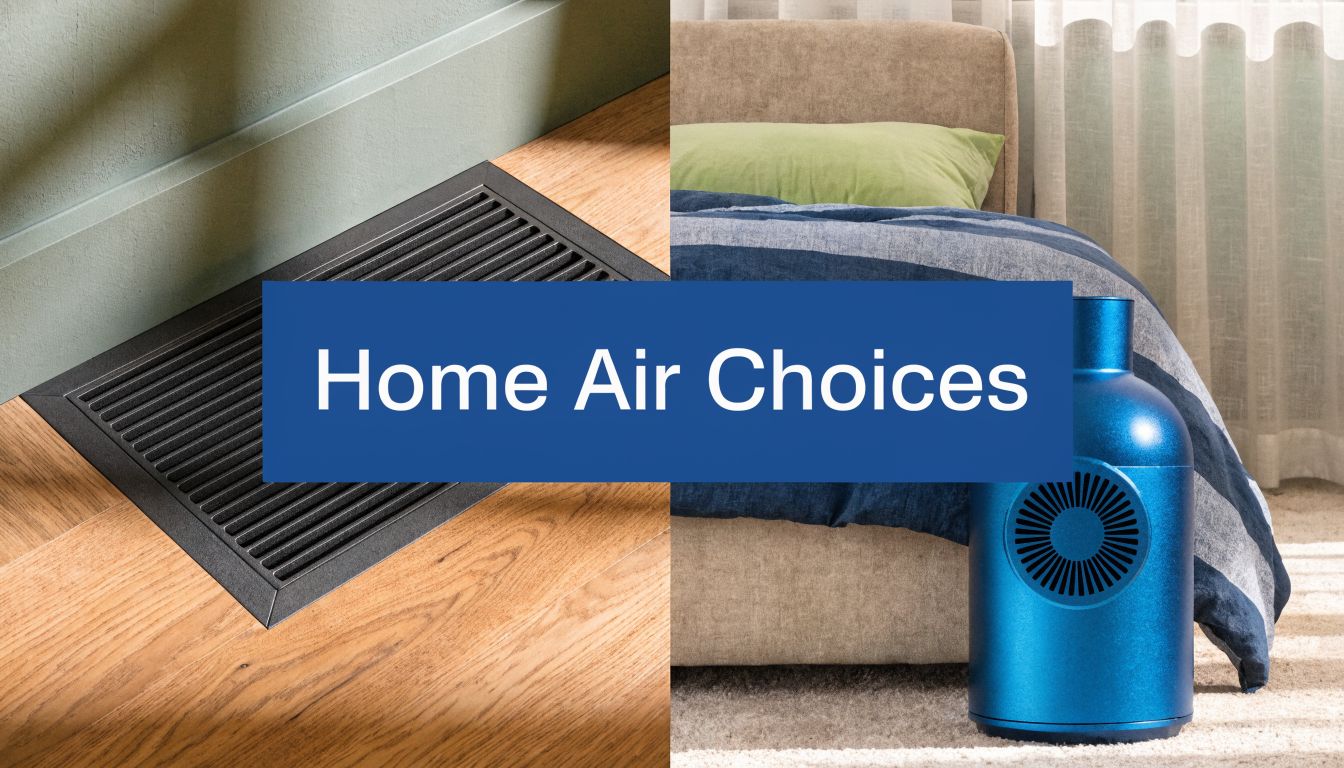
The whole-home Infinity model
The Infinity unit installs in the HVAC airflow path, usually on the return side. That means it cleans air as the system circulates it through the house. If the home has decent duct design and the blower is moving the right amount of air, this approach covers much more ground than a room appliance sitting in a corner.
This is usually the better fit for homeowners who deal with dust across the house, not just in one room. It also makes sense for families who run air conditioning much of the year, which describes a lot of Phoenix homes.
There is a trade-off. A whole-home purifier only performs as well as the system around it. Poor return design, low airflow, a mismatched filter cabinet, or installation shortcuts can hold it back. I have seen homeowners spend good money on indoor air upgrades when the bigger issue was that the system was not moving air evenly to begin with.
For homeowners comparing central options, whole-home air purifier solutions are the right category to review first.
The portable Carrier models
Portable Carrier purifiers make more sense when the problem has a clear location. A bedroom with allergy symptoms. A nursery. A home office where someone spends ten hours a day. A portable unit can help in those spaces without touching the ductwork.
That simpler setup is the main advantage. Plug it in, place it correctly, and run it where you need relief most. Renters also tend to prefer this route because it moves with them.
The limitation is coverage. One room unit only cleans the air that passes through that one unit, in that one area. In an open floor plan, or in a house where the HVAC fan keeps mixing air between rooms, a portable purifier can improve one zone while the rest of the house still carries dust, odors, or smoke particles. During smoke events, homeowners often learn that room-by-room strategy gets expensive fast. If you are trying to clear lingering odor after smoke exposure, Onsite Pro Restoration's smoke tips give a good overview of what purifiers can and cannot handle on their own.
Which type fits your situation
A quick comparison helps.
| Model type | Best fit | Main strength | Main trade-off |
|---|---|---|---|
| Whole-home Carrier Infinity | Homeowners who want system-wide treatment through central HVAC | Cleans air across the home's normal circulation path | Needs professional installation and an HVAC system that can support it |
| Portable Carrier Smart Air Purifier | Renters or homeowners targeting one room | Flexible placement and focused room treatment | Limited reach unless you buy and maintain multiple units |
Where Phoenix homeowners usually make the wrong call
The mistake is usually a sizing mistake, not a brand mistake.
A portable unit is a good answer for one bedroom with a sleeping issue. It is a weak answer for a 2,400-square-foot house that pulls in dust every time exterior doors open. A whole-home purifier is a strong answer for house-wide particle control, but it can be more system work and more upfront cost than a homeowner needs if the complaint is isolated to one room.
The better question is simple. Follow the air path. If the issue shows up all over the house, the HVAC system is part of the solution. If the issue stays in one closed-off space, portable may be enough.
That is the part Carrier's product pages do not spell out for Phoenix homeowners. Here, long cooling seasons and constant system runtime make whole-home equipment more useful than it might be in milder climates, but only if the installation is done right.
Performance for Phoenix Dust Smoke and Allergens
Phoenix gives air cleaners a tougher job than many markets. We deal with fine dust, high AC runtime, seasonal pollen, and smoke events that can turn a normal house into a stale-smelling box in a hurry. That's why generic product pages often leave homeowners wanting more. They describe capture ability, but they don't tell you what ownership looks like in a desert city.
Carrier's public information has a real gap here. There is no public data on filter saturation rates during Phoenix dust storms or wildfire seasons, which means local guidance matters when you're trying to keep a purifier effective in high-particulate conditions, as noted in Carrier's wildfire-related story about purifier support in Los Angeles communities on Carrier's wildfire air purifier article.
Dust storms and fine particle load
Monsoon dust isn't just dirt you sweep off the patio. Some of it becomes suspended fine material that gets into return air, settles into fabrics, and keeps recirculating. In that situation, higher-efficiency filtration has a real advantage over a standard filter because the target isn't only visible dust. It's the fine airborne stuff that keeps the home feeling dirty.
During dust events, practical habits matter:
- Keep windows and exterior doors closed as much as possible
- Replace overloaded filters instead of trying to stretch them
- Check return grilles for buildup
- Use your purifier consistently, not only after symptoms start
Smoke events need a different mindset
Smoke is trickier because it's not just one thing. There's fine particulate matter, odor, and lingering residue concerns. Filtration can help with the airborne particle side, while carbon support can help with odors, but homeowners still need realistic expectations. If a house took on heavy smoke, air cleaning may need to be part of a broader cleanup approach.
For practical post-smoke cleanup steps beyond filtration alone, Onsite Pro Restoration's smoke tips are a useful reference.
Run your HVAC fan strategically during a smoke event if your system is equipped for the filtration load. The goal is to move more air through the cleaning stage, not just cool the house.
Allergens don't take a season off here
Phoenix allergy complaints aren't always dramatic, but they're persistent. That low-grade irritation matters. People sleep worse, wake up congested, and assume it's just “the desert.” Sometimes it is. Sometimes it's indoor air that needs better control.
The challenge is that homes differ. Tile floors, pets, old ductwork, attic leakage, and how often doors open all affect results. That's why local expert guidance matters more than generic national advice. In one home, a portable purifier by the bed changes everything. In another, only whole-home filtration makes a noticeable dent because the HVAC system is spreading particles house-wide.
Installation Maintenance and Long-Term Costs
A lot of Phoenix homeowners ask the same practical question after they learn what a Carrier purifier can do. What will this cost me to install, keep running, and maintain over the next few years?
That answer depends less on brochure language and more on your house, your HVAC system, and what problem you are trying to solve. A bedroom unit for smoke sensitivity has a very different cost profile than a whole-home purifier tied into a central system that runs through our long cooling season.
Whole-home installation affects more than the purifier itself
A Carrier Infinity purifier connects to the HVAC system, so installation is really an airflow and fit job, not a simple add-on. In Phoenix homes, that matters because many systems are already working hard for much of the year. If the purifier cabinet is installed poorly, if the duct transition is sloppy, or if nobody checks static pressure, you can end up with reduced airflow, extra strain on the blower, or dirty air slipping past the filter section.
The common trouble spots are predictable:
- Cabinet gaps or poor sealing: air bypasses the cleaning stage
- Bad fit with the existing system: performance drops because the setup is mismatched
- Added restriction without testing: airflow can fall off enough to affect comfort
- No commissioning check: the homeowner assumes it is working as intended when nobody has verified it
I tell homeowners to treat purification upgrades the same way they would treat a new set of tires on a truck with alignment problems. The new part can help, but only if the rest of the system is in shape. If your equipment has not had a recent checkup, start with how often HVAC equipment should be serviced and make sure the base system is worth building on.
Portable units cost less to start, but coverage is limited
Portable Carrier units are easier to get into the house and easier to budget for upfront. There is no duct modification, no cabinet work, and no need to tie into the air handler. For one problem room, that can be the smart buy.
The trade-off is coverage and user behavior. A portable unit only helps the air that reaches that room purifier. Put it behind a chair, close doors all day, or run it inconsistently, and results drop. In real homes, that matters more than the spec sheet.
Filter replacement is also part of the ownership cost. As noted earlier in the article, Carrier lists replacement guidance and filter pricing for its portable models. The exact timing depends on pollutant load, and Phoenix dust can shorten that interval compared with a cleaner, tighter home.
Long-term cost is really a maintenance question
Whole-home systems are usually more discreet day to day. They clean air in the background and do not take up floor space. But they still need attention. Filters need replacement. Access panels need to be reachable. The system should be checked for airflow and seal quality over time, especially in homes with high dust load or older duct systems.
Portable systems are simpler mechanically, but they ask more from the homeowner. Someone has to keep an eye on placement, runtime, and filter changes. If that does not happen, performance slips unnoticed.
That is the primary cost issue. Neglect.
How Phoenix homeowners should judge value
Skip the fake ROI math. There is no clean universal formula that tells every Arizona homeowner whether a portable or whole-home Carrier purifier will pay off better.
Judge it by these four questions:
- Where is the problem? One bedroom, the main living area, or the whole house
- How often is the problem happening? Year-round dust, seasonal allergens, or occasional smoke events
- Will you keep up with maintenance? A good product still needs regular filter changes
- Is the HVAC system ready for it? Purification works better when airflow and duct condition are already in decent shape
For some Phoenix homes, a portable unit in the bedroom gives the biggest improvement per dollar. For others, especially homes where dust moves through the entire return system, whole-home purification makes more sense because it treats the air wherever the system circulates it.
There are also cases where a purifier should wait. If the house has major duct leakage, airflow problems, or an HVAC system that is overdue for service, fix those issues first.
One local detail is worth keeping in mind. Comfort Experts offers the Carrier & Bryant PGAPXCAR2020 20" x 20" x 3" Performance Preferred Air Purifier Filter, MERV 13, which matters for homeowners who already have compatible Carrier or Bryant purification hardware and need the correct replacement filter.
Why Your HVAC Partner Matters for Air Purification
A high-end purifier can still disappoint if the installer treats it like a simple accessory. Air purification depends on airflow, cabinet sealing, return design, filter access, and whether the rest of the system is in good enough shape to support the upgrade. Those details decide whether the homeowner notices real improvement or just ends up with a pricier filter.
That's why the HVAC partner matters as much as the product.
What a qualified installer should look at
A good contractor doesn't start with, “Which purifier do you want?” They start with the house.
They should be evaluating things like:
- System condition: If the blower, coil, or duct system has issues, purification alone won't solve them.
- Airflow path: Return location and duct layout affect how much air gets treated.
- Household needs: Pets, allergies, smoke sensitivity, and room usage all change the recommendation.
- Maintenance reality: A solution only works long-term if the homeowner can maintain it.
Why local experience matters in Phoenix
You know what? Phoenix is hard on HVAC equipment and indoor air strategies. Dust load, long cooling seasons, and sudden smoke events create conditions that a generic national recommendation doesn't fully address. A contractor who works here regularly is more likely to offer clear perspectives on filter loading, fan operation during poor outdoor air days, and whether a room unit or a whole-home system makes more sense for your layout.
That local lens matters because public guidance from manufacturers doesn't always answer desert-specific questions. Someone has to bridge the gap between lab performance and real homes in Mesa, Gilbert, Chandler, Tempe, and the rest of the Valley.
A purifier should be matched to the home, not just the square footage on a brochure.
What homeowners should ask before saying yes
Before moving forward, ask a few direct questions:
- Will this affect airflow through my current HVAC system?
- Where will it be installed, and how will you seal it?
- How will I know when maintenance is due?
- Is this solving a whole-home issue or just one room's problem?
Straight answers matter. If the contractor can't explain the trade-offs in plain English, keep looking.
Breathe Cleaner Air in Your Phoenix Home Today
Cleaner indoor air in Phoenix isn't about chasing hype. It's about choosing the right tool for the kind of dust, smoke, and allergen load your home experiences. Carrier offers useful options, especially if you understand the difference between a whole-home Infinity system and a portable room purifier, and if the installation and maintenance plan match your house.
If you'd like practical guidance from Comfort Experts, call 480-207-1239 or schedule service for a no-pressure conversation about what fits your Phoenix home.