
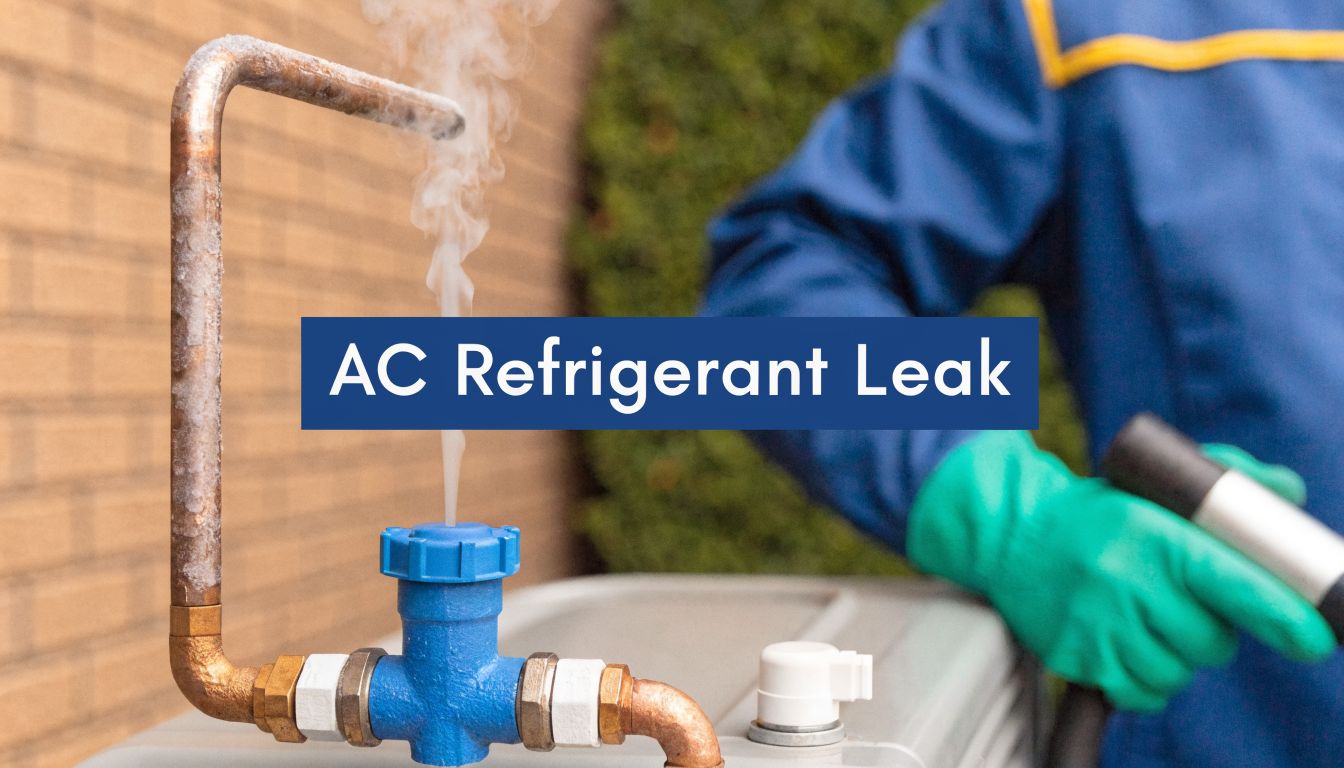
If your house in Mesa or anywhere across the Phoenix Valley suddenly feels sticky, warm, and impossible to cool, an ac refrigerant leak may be the reason. This is one of those problems that often starts subtly, then shows up fast when your system is working its hardest.
What an AC Refrigerant Leak Actually Is
Refrigerant is the heat-transfer fluid inside your air conditioner. It circulates through a sealed loop, absorbing heat from inside your home and releasing it outdoors. If that loop stays intact, refrigerant stays in the system.
That’s why low refrigerant is never a normal maintenance item. Your AC doesn’t “burn through” refrigerant the way a car uses fuel. If the charge is low, refrigerant escaped somewhere.
Why this matters more than most homeowners realize
A lot of people hear “your unit is low on Freon” and assume a quick refill solves the issue. Sometimes a recharge is part of the repair, but adding refrigerant without finding the leak is like inflating a tire with a nail in it. You might get temporary relief, but the problem is still there.
If you want a plain-English refresher on the term itself, this overview of what Freon means in home AC systems is a helpful starting point.
Practical rule: If an AC technician says the system is low, the next question should be, “Where is it leaking?”
EPA research makes clear that refrigerant leaks are a primary cause of HVAC failures. In commercial refrigeration records, 59.8% of technician visits involved over-temperature incidents, and about 50% of those failures implicated refrigerant leakage as the root cause, according to EPA research on refrigerant emissions and system failures.
That research is commercial-focused, but the lesson applies directly to residential systems. When refrigerant leaves the circuit, cooling performance drops, system stress goes up, and the chance of bigger damage rises.
Refrigerant is part of a closed system
Think of refrigerant like blood in the body. It has to circulate at the right pressure and in the right amount for the whole system to work properly. When it leaks out, the rest of the equipment has to struggle with conditions it wasn’t designed to handle.
Here’s what low refrigerant does in real life:
- Weakens cooling performance so rooms take longer to pull down
- Forces longer run times because the system can’t move heat efficiently
- Raises stress on major components especially the compressor
- Creates a legal and environmental issue because refrigerants must be handled and documented properly
Why a “top-off” isn’t the real fix
A proper repair means finding the leak, correcting it, confirming the system is sealed, evacuating moisture and air from the lines, and then charging the system to the manufacturer’s specification. Skipping those steps usually leads to repeat breakdowns.
Homeowners don’t need to memorize the chemistry. You just need to know this: if refrigerant is missing, something is wrong, and that wrong thing won’t fix itself.
Telltale Signs Your AC Is Leaking Refrigerant
Most homeowners don’t spot a leak by seeing refrigerant come out. They notice the effects first. The house doesn’t cool like it should. The AC runs and runs. The air coming from the vents feels off.

What it feels like inside the house
In Phoenix, the first complaint is often simple. “The AC is on, but it’s not really cooling.” That usually means the system still has enough charge to run, but not enough to remove heat effectively.
You may notice:
- Air that feels lukewarm or less cold than normal coming from supply vents
- Long cooling cycles where the thermostat setting never seems satisfied
- Indoor humidity that feels higher than usual even if the unit is technically running
- Higher electric bills because the system keeps trying to catch up
People often lose time assuming the AC is just struggling because it’s hot outside. In Phoenix, that’s an easy mistake to make.
Sounds and visible clues that deserve attention
Some leaks announce themselves. A hissing sound near the outdoor unit or refrigerant line can mean pressurized refrigerant is escaping through a crack or pinhole. Bubbling can also point to a leak in the line set or coil.
Other times, the clue is ice.
When refrigerant charge drops, the evaporator coil can get too cold. Moisture on the coil freezes. That ice blocks airflow, which makes the cooling problem worse. Homeowners then notice weak airflow, warm rooms, and sometimes water around the indoor unit after the ice melts.
If you’re trying to sort out whether the issue is refrigerant, airflow, or something else, this guide to how to diagnose AC problems at home can help you narrow it down before service.
If you see ice on the indoor coil or suction line, don’t assume the system is “cooling extra hard.” Ice usually means something is wrong.
Why acting early matters
A leak doesn’t just reduce comfort. It can trigger a damaging chain reaction. As described in this explanation of compressor damage from refrigerant loss, low charge can freeze the evaporator coil and force the compressor into conditions that may lead to slugging, oil starvation, and eventual failure. The same source notes pressure spikes can exceed design specs by 300 to 500 PSI, and energy bills may rise by 15% to 30% as the system struggles.
That’s why the symptom list matters. These are not “wait until next month” warnings.
A quick homeowner checklist
If several of these are happening at once, refrigerant loss moves high on the suspect list:
- The thermostat is set correctly, but the house still won’t cool
- The AC runs for long stretches without getting comfortable
- You hear hissing or bubbling near the equipment
- You find frost or ice on refrigerant lines or the indoor coil
- Cooling feels uneven and sticky instead of crisp and dry
Common Causes of Refrigerant Leaks in Arizona Homes
Not every refrigerant leak has the same cause. Some come from age. Some come from vibration. Some start in the coil. In older systems around Phoenix, one cause shows up often enough that homeowners should know its name.
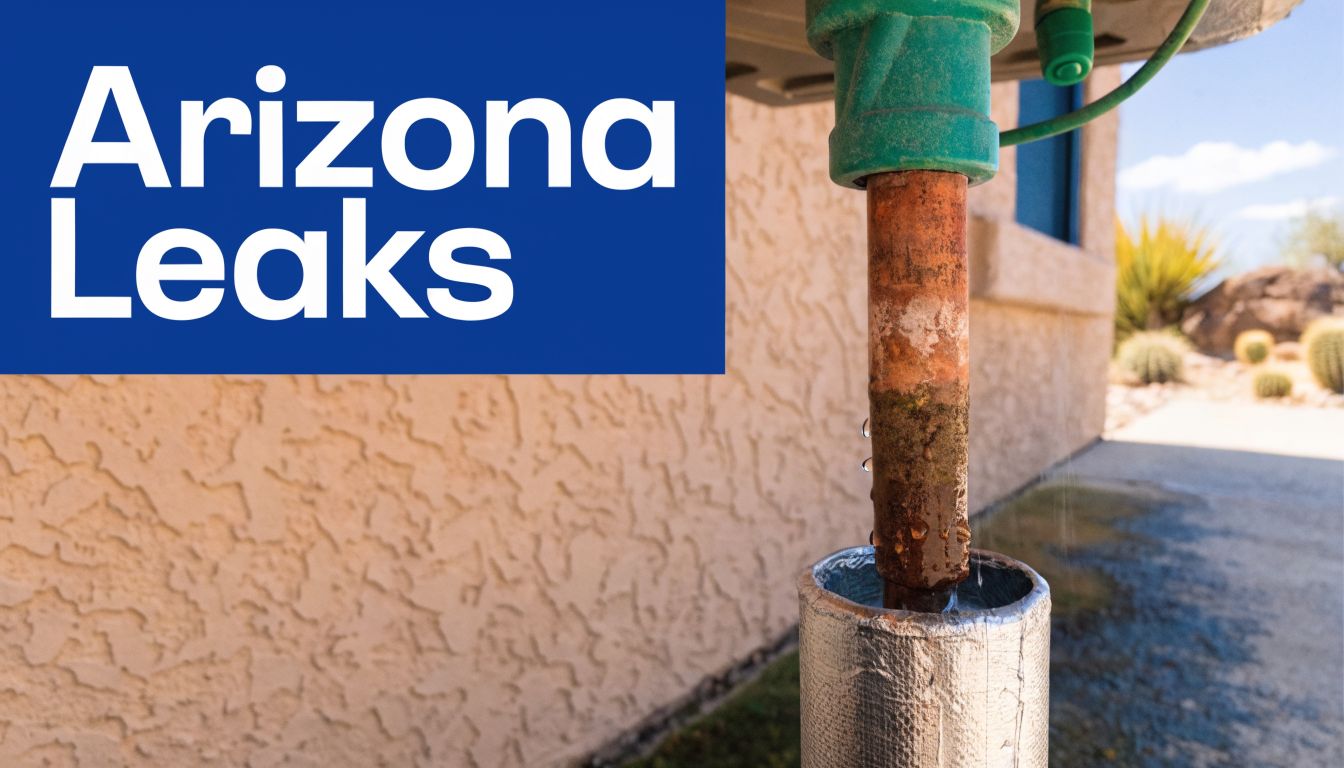
Formicary corrosion in copper lines
A primary cause of leaks in copper refrigerant lines is formicary corrosion. This is a chemical process where naturally occurring formic acid attacks copper and creates tiny pinhole perforations. According to this explanation of refrigerant leaks and formic acid corrosion, it’s especially common in systems over 10 to 15 years old and can be accelerated in high-humidity environments like the Phoenix Valley.
That last part surprises people. Phoenix is dry overall, but indoor moisture conditions, localized humidity, and repeated condensation cycles still create opportunities for corrosion. The result is often multiple microscopic leaks instead of one obvious break.
Why pinhole leaks are hard to catch
Pinhole leaks don’t always create a dramatic failure. They can seep slowly for a long time. The system cools a little less each month, run times get longer, and the homeowner adapts until one very hot week pushes the unit over the edge.
That’s also why stop-leak products are such a bad bet in many situations. A distributed pinhole pattern usually points to broader material breakdown, not one isolated defect.
Small leak doesn’t always mean small repair. If corrosion has affected a section of tubing or a coil, replacement is often the reliable fix.
Other real-world causes technicians see
Arizona systems also deal with constant thermal expansion and contraction. Metal lines heat up, cool down, vibrate, and flex through long cooling seasons. Over time, joints and fittings can weaken.
A few common causes include:
- Vibration at joints and fittings that loosens connections over years of operation
- Wear in aging evaporator or condenser coils where thin metal finally gives way
- Physical damage from previous work, landscaping, or accidental impact near the line set
- Installation-related stress when tubing is bent sharply or left rubbing against another surface
In other words, a leak doesn’t automatically mean somebody did something careless. Sometimes it’s just what an older system does after years of hard service in desert heat.
How Technicians Find and Repair Refrigerant Leaks
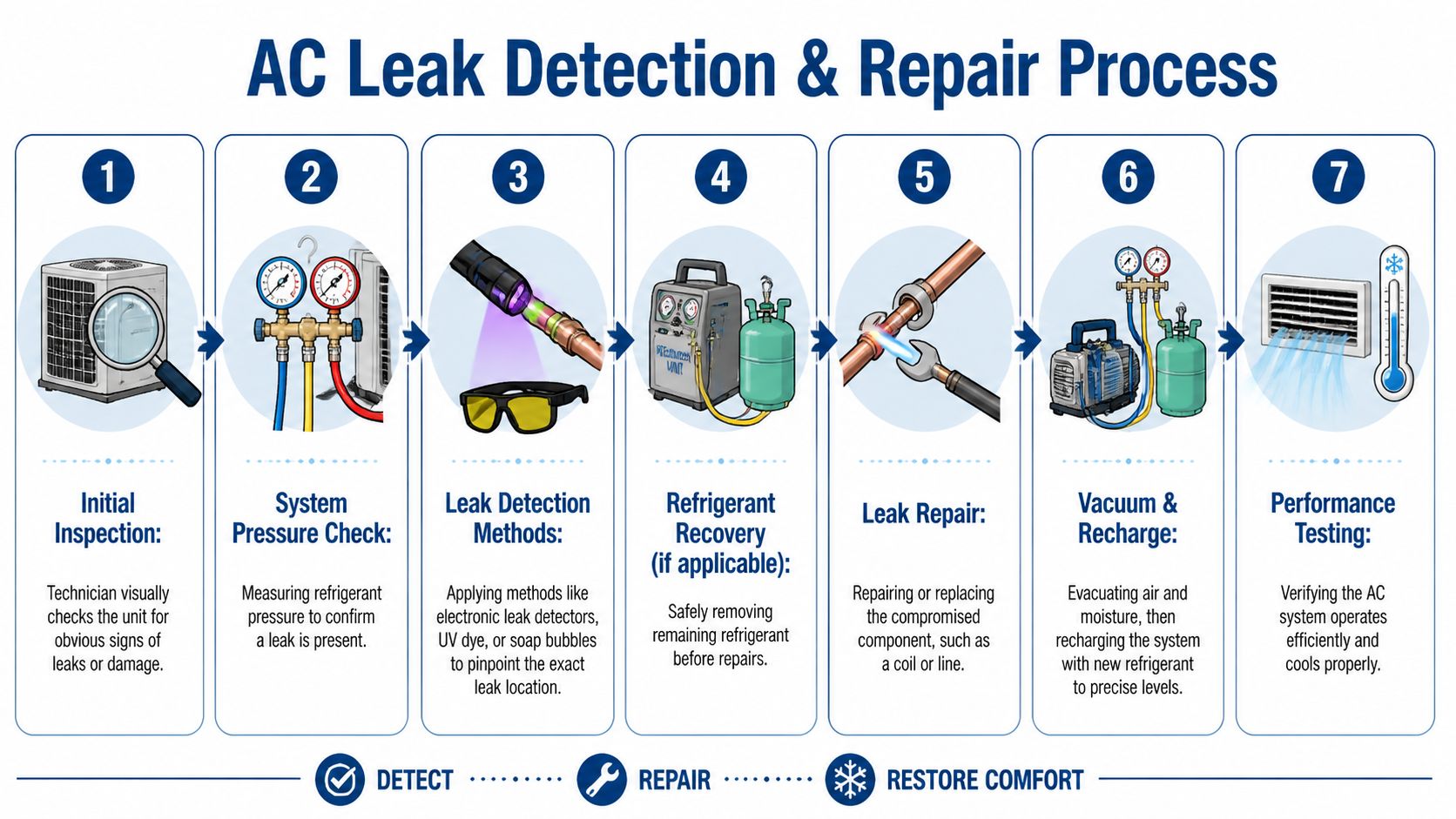
Homeowners usually see the final diagnosis. They don’t always see the method behind it. A proper leak repair follows a sequence, and each step matters.
What a thorough visit looks like
A technician starts by confirming the symptom pattern. Pressures, temperature split, line condition, coil condition, and system behavior all help separate a refrigerant leak from airflow or electrical issues.
From there, the search gets more precise. The goal isn’t just to prove the system is low. It’s to find exactly where refrigerant is escaping.
If you want to know what a full service call typically includes beyond the leak itself, this page on local AC repair service options lays out what homeowners should expect.
The tools that actually locate leaks
Technicians commonly use a mix of methods because one tool won’t catch every problem.
Electronic leak detector
Often called a sniffer, this tool senses refrigerant vapor around coils, fittings, valves, and line sets.UV dye and blacklight
Dye circulates with the refrigerant. Under UV light, the leak path becomes visible.Soap bubble solution
Still one of the simplest ways to confirm a precise point leak on an accessible joint or fitting.Pressure testing
This helps verify that the sealed circuit won’t hold proper pressure.
A good diagnosis is specific. “Low on refrigerant” is a symptom. “Leaking at the indoor coil return bend” is a diagnosis.
What the repair itself involves
Once the leak is located, the repair depends on the part and the extent of damage. A compromised braze joint may be repaired. A corroded coil or damaged line section may need replacement.
The work usually includes:
- Recovering refrigerant properly before opening the system
- Repairing or replacing the failed component
- Pressure testing the repair
- Pulling a vacuum to remove moisture and contaminants
- Recharging with the exact refrigerant type and amount specified by the manufacturer
- Testing performance so the system leaves operating correctly
This process is why DIY leak repair almost always goes sideways. Without proper recovery equipment, gauges, vacuum pump, and leak detection tools, you’re guessing. And guessing on a sealed refrigeration circuit gets expensive fast.
AC Refrigerant Leak Repair Costs in Phoenix
A refrigerant leak in July hits Phoenix homeowners two ways at once. You get the repair bill, and you pay more to run an AC that cannot cool the house properly in 110 degree heat.
Most leak repairs in residential systems fall somewhere between $250 and $1,600, according to ASHRAE’s analysis of refrigerant use and maintenance. Where your job lands in that range depends on the leak location, how hard it is to access, the part that failed, and the refrigerant your system uses.
What pushes the price up or down
A leaking Schrader valve or accessible fitting is usually a smaller repair. An evaporator coil leak inside the air handler is often much more expensive because labor goes up and the part itself may need replacement.
Phoenix adds its own wrinkle. Long cooling seasons and harsh operating conditions can expose weak spots faster, especially in older indoor coils. I also tell homeowners to pay attention to age. A ten-plus-year-old system with a coil leak is a different conversation than a newer system with a leaking braze joint.
Refrigerant type matters too. Older systems may use R-22, and that creates a tougher repair decision because supply is limited and expensive. Many newer systems use R-410A, but that refrigerant is also being phased down as the industry shifts toward lower-GWP options. If your unit is older, the leak repair itself may be only part of the decision. The bigger question is whether the money goes into a system with years left, or into equipment already heading toward a replacement window.
Efficiency loss adds to the total cost
Waiting has a price.
ASHRAE also noted that many residential systems do not maintain correct refrigerant charge, and undercharged equipment loses efficiency. In practice, that means longer run times, higher electric bills, and more strain on the compressor while the house still feels warm in the late afternoon.
That pattern is especially expensive in Phoenix, where AC systems run hard for months. A small leak can look manageable in spring and turn into a much bigger financial problem by midsummer.
DIY checks versus professional work
Homeowners can spot warning signs. Repairing the sealed system still requires licensed HVAC work.
| Task | DIY Homeowner | Certified HVAC Technician |
|---|---|---|
| Check thermostat setting | Yes | Yes |
| Look for ice on lines or indoor coil access area | Yes | Yes |
| Notice hissing or bubbling sounds | Yes | Yes |
| Replace a dirty air filter | Yes | Yes |
| Confirm refrigerant pressure | No | Yes |
| Perform electronic leak detection | No | Yes |
| Recover refrigerant legally | No | Yes |
| Braze refrigerant lines or replace coil components | No | Yes |
| Evacuate system with vacuum pump | No | Yes |
| Recharge to manufacturer specification | No | Yes |
If you want a wider pricing picture beyond leak repairs alone, this guide on what it can cost to fix an AC helps put labor, parts, and replacement decisions into context.
Property owners managing several homes often look at service agreements to reduce surprise breakdowns. VerticalRent for HVAC plans offers a useful look at how those plans are structured.
What not to do
Do not keep topping off refrigerant without finding the leak. Do not use stop-leak products sold as a shortcut. And do not let a contractor treat repeated recharges like normal maintenance.
A sealed system should stay sealed. If it does not, the smartest next step is a clear diagnosis and an honest repair-versus-replace recommendation based on system age, refrigerant type, and Phoenix operating conditions.
Prevention Tips and Your Next Steps
In Phoenix, a small refrigerant leak can turn into a no-cooling call fast. Our AC systems do not get long breaks in June, July, or August, so anything that reduces strain and catches problems early carries more weight here than it would in a milder climate.

You cannot prevent every leak. Age and material failure are inevitable, especially in older equipment that has spent years running through Phoenix summers. What you can do is lower the chance of finding the problem only after the house is warm and the compressor is already under stress.
A good prevention routine includes:
- Changing filters on schedule so airflow stays steady and the indoor coil is less likely to run too cold
- Keeping the outdoor unit clean and clear so the system can reject heat properly during extreme desert temperatures
- Watching for early changes like longer cooling cycles, weaker airflow at the vents, or indoor humidity that feels off
- Scheduling professional maintenance before peak summer so coil condition, refrigerant performance, and overall system operation get checked at the right time
If you want a simple homeowner reference, this HVAC preventive maintenance checklist is a useful place to start.
Why maintenance matters more in Phoenix
Long runtimes expose weaknesses sooner. In Arizona homes, I often see older evaporator coils and line sets show wear that might take much longer to surface in cooler parts of the country. That is one reason annual inspections matter here, especially on systems with a history of repairs or signs of formicary corrosion.
Refrigerant type also affects your next step. If an older unit uses R-22, leak repair decisions deserve a careful look because the refrigerant is expensive and getting harder to justify on aging equipment. If the system uses R-410A, repair may still make sense, but only if the leak can be found, fixed correctly, and the rest of the equipment is in solid shape.
For landlords or property managers comparing service agreement ideas, this guide on VerticalRent for HVAC plans is useful because it treats maintenance as an operating cost decision, not just a repair bill.
When to call and what to expect
If the AC starts blowing warmer air, forms ice, or makes a hissing sound, schedule service sooner rather than later. Waiting through a Phoenix heat wave usually raises the risk of compressor damage, higher electric bills, and a harder repair-versus-replace decision.
A homeowner can inspect symptoms and handle simple upkeep like filter changes. A licensed technician should confirm the leak, recover refrigerant legally, repair the failed component, evacuate the system, and recharge it to specification. That process protects the equipment and gives you a clear answer on whether repair is still a good investment.
If you suspect a refrigerant leak, contact Comfort Experts for a fast, honest diagnosis before a small problem turns into major compressor damage. Call 480-207-1239 or schedule service online.