

The AC runs most of the day, the windows stay shut, and there's still a film of dust on the furniture by evening. That's why indoor air quality in Mesa AZ isn't just a comfort topic. It's a practical home performance issue tied to dust, ventilation, humidity swings, and the way Arizona homes operate for much of the year.
Why Indoor Air Quality in Mesa Is a Unique Challenge
Indoor air quality means the air people breathe inside the home. In Mesa, that air is shaped by more than a dirty filter or an occasional dusty day. The local pattern is tougher than generic indoor air advice accounts for. Fine desert dust gets in, long stretches of extreme heat keep homes closed up, and monsoon moisture can push indoor conditions in the wrong direction fast.
The first problem is simple. People spend most of their lives indoors. The EPA says Americans spend about 90% of their time indoors, and concentrations of some pollutants are often 2 to 5 times higher than typical outdoor concentrations, which is linked to irritation of the eyes, nose, and throat, headaches, dizziness, fatigue, and serious long-term conditions (EPA indoor air quality data). For a Mesa homeowner, that means a decent outdoor air day doesn't automatically mean healthy air inside the house.
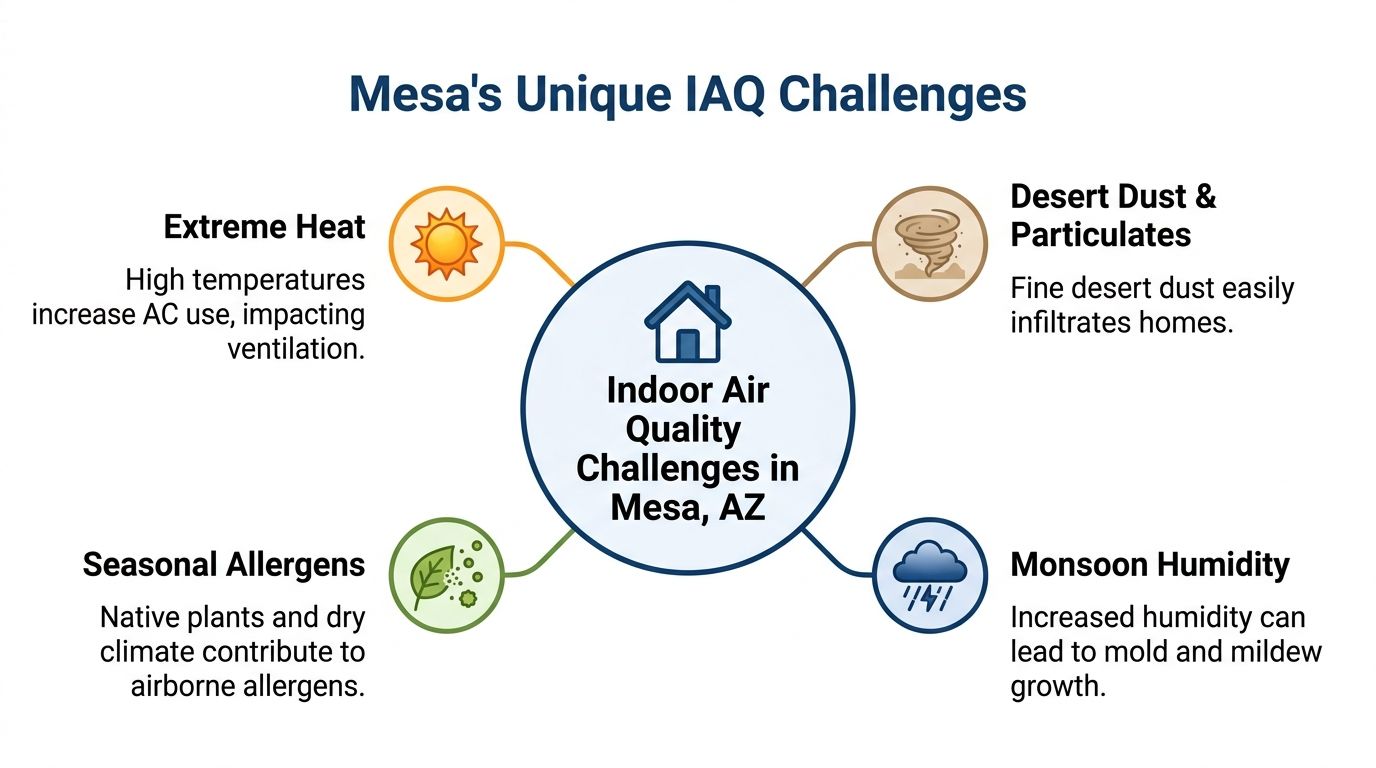
Desert dust doesn't stay outside
Mesa homes deal with constant particulate intrusion. Some of it comes in through doors, windows, screens, and attic bypasses. Some of it gets pulled in through duct leakage, especially in older homes and houses with worn return connections. Some of it starts indoors, then keeps recirculating because the filter setup isn't catching enough of the smaller particles.
Dust also behaves differently here than in wetter climates. It settles on supply grilles, ceiling fan blades, shelving, and around baseboards, then gets stirred back up by foot traffic and airflow. Homeowners often clean it, then see it right back the next day.
For homeowners fighting that cycle, Comfort Experts' guide to dust elimination is a useful starting point because it ties the dust problem back to filtration, duct leakage, and housekeeping habits that affect HVAC performance.
Extreme heat changes how the home breathes
Mesa homes stay sealed for long periods because they have to. When summer heat hits hard, doors and windows stay closed and the AC becomes the main air mover for the entire house. That keeps conditioned air in, but it also means whatever is already inside gets recirculated again and again.
Practical rule: If a house is closed up most of the day, the HVAC system isn't just cooling the air. It's managing everything suspended in that air.
That's why indoor air quality problems in Mesa often show up as a combination issue, not a single issue. A basic filter might catch larger debris but miss much of the fine material that makes eyes itch or surfaces look dusty again within hours.
Monsoon season changes the equation
Mesa is dry most of the year, but the monsoon season creates a very different indoor air pattern. Humidity climbs, the AC runs under different load conditions, and any weakness in the duct system, condensate handling, or airflow setup can show up as odor, clammy rooms, or even mold risk in problem areas.
Seasonal allergens add another layer. Native plants, disturbed soil, and wind events make the air outside more reactive. Then the house traps part of that burden inside.
The result is a local trifecta. Dust, closed-up cooling season, and humidity spikes. That's what makes indoor air quality in Mesa AZ a persistent home issue instead of a one-time fix.
Common Symptoms of an IAQ Problem in Arizona Homes
Most homeowners don't start by saying the house has an indoor air quality issue. They start with smaller complaints. The bedroom feels stuffy at night. The house smells a little off after a storm. Dust shows up again right after cleaning. Someone wakes up congested, then feels better after leaving the house for a while.

Signs the house is giving off
A Mesa home with poor indoor air often shows clues before anyone connects them.
- Dust buildup that returns quickly means particles are still entering or recirculating through the system.
- Musty smells after monsoon weather can point to moisture issues in ductwork, around coils, near drains, or in wall cavities.
- Supply vents with dark streaking or dusty edges can suggest filtration gaps, dirty ducts, or airflow patterns that keep carrying debris.
- Uneven room feel matters too. One room may feel dry and irritated while another feels slightly clammy. That can happen when airflow and humidity control are both off.
Older homes in the East Valley tend to hide these issues well. A house can cool acceptably and still move low-quality air.
Symptoms people notice first
The human side of the problem usually gets attention faster than the house symptoms.
The American Lung Association ranks the Phoenix-Mesa area as having the 4th worst ozone pollution nationally, and notes that ozone can penetrate homes, aggravating allergies and respiratory issues while many standard air filters aren't designed to capture it effectively (American Lung Association Arizona ozone findings). That matters because Mesa homeowners may feel the effect indoors even when they assume the problem is only outside.
Common complaints include:
- Morning throat irritation
- Dry eyes or irritated sinuses
- More sneezing indoors than outdoors
- Headaches that build through the day
- Fatigue in closed-up rooms
- Worsening respiratory irritation during dusty or high-ozone periods
If symptoms improve after leaving the house for work, school, or errands, the building itself may be part of the problem.
The pattern matters more than one bad day
One dusty afternoon doesn't prove anything. Neither does one odd smell after rain. The bigger warning sign is repetition.
A common Mesa pattern looks like this:
| What keeps happening | What it may point to |
|---|---|
| Dust returns right after cleaning | Infiltration, duct leakage, weak filtration |
| House smells musty during or after storms | Humidity control or moisture buildup |
| Allergy symptoms are worse indoors | Fine particulates, allergens, ozone intrusion |
| Certain rooms feel stuffy or stale | Airflow imbalance or poor return performance |
When those signs stack up, the issue usually isn't solved with a candle, a room spray, or the cheapest filter on the shelf.
Assessing Your Home's Air Quality DIY vs Professional
A homeowner can learn quite a bit without special tools. That's worth doing first, because simple checks often reveal obvious problems. But it's also easy to miss what is driving the issue, especially in Mesa where outdoor readings and indoor conditions don't always line up.
Current Mesa outdoor readings can look moderate while the bigger concern indoors is fine particulate buildup. That indoor PM2.5 accumulation often requires advanced testing to identify clearly (Mesa air quality dashboard).
What to check yourself first
These are the first things worth checking before scheduling a visit.
- Look at the filter, not just the thermostat. If the filter is overloaded, poorly fitted, or the wrong type for the system, air quality usually suffers before comfort drops enough to trigger concern.
- Inspect supply and return grilles. Dust rings, fuzz buildup, or discoloration around vents can signal recirculation or leakage problems.
- Pay attention to timing. If symptoms or odors worsen after the AC starts, after a storm, or only in specific rooms, that detail helps narrow down the source.
- Check indoor humidity behavior. The house shouldn't feel sticky during monsoon season or painfully dry in cooler months.
- Note any recent trigger. Remodeling dust, a roof leak, attic work, pest activity, or long gaps between maintenance all matter.
A simple notebook on the kitchen counter often tells the story better than memory does. Date the odor. Write down which room feels off. Note whether it happened during a storm or after a filter change.
Where DIY checks stop helping
DIY inspection is good at spotting clues. It isn't good at measuring hidden particulate load, identifying leakage behind finished surfaces, or confirming whether the air handling side of the system is part of the problem.
That's where insights on air quality from Comfort Experts become useful. The value in professional testing isn't just a report. It's tying symptoms to causes, then sorting out what's worth fixing first.
Worth knowing: A home can smell clean and still have an air quality problem. Fine particles and some pollutant loads aren't obvious without testing.
A side by side decision guide
| If this describes the situation | DIY may be enough | Professional assessment makes more sense |
|---|---|---|
| Filter is overdue and vents are dusty | Yes, start there | If dust returns quickly after correction |
| One brief odor after a storm | Maybe, monitor it | If odor repeats or spreads |
| Family notices ongoing irritation indoors | Limited help | Yes |
| House had water intrusion or duct concerns | No | Yes |
| Air feels off but source is unclear | Partial clues only | Yes |
Good judgment beats random upgrades
The most expensive mistake isn't always neglect. Sometimes it's buying the wrong solution first. A portable purifier won't fix duct leakage. Duct cleaning won't solve a humidity control problem by itself. A better filter won't handle every odor issue.
The smart move is to use DIY checks to narrow the field, then call for diagnostics when symptoms persist, spread, or don't match what basic maintenance should have solved.
A Practical Guide to IAQ Solutions for Mesa Homeowners
You can feel Mesa air quality problems in cycles. June brings fine dust that slips past weak filters and leaky returns. Monsoon season adds moisture the house was not built to handle well. Then long stretches of extreme heat keep windows shut and the AC running, so whatever gets into the system keeps recirculating.
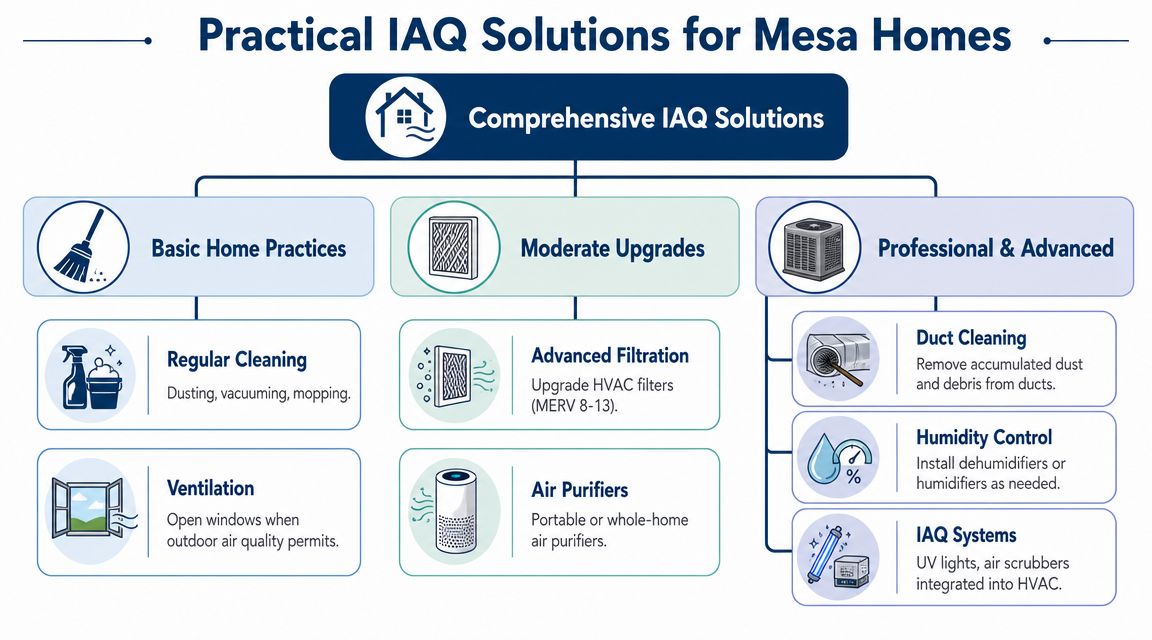
That cycle is why generic IAQ advice misses the mark here. The fix is usually a sequence, not a single product. Start with filtration and airflow. Fix duct leakage and contamination if they are present. Add purification or humidity control only where the symptoms and system behavior justify it.
Start with filtration that matches Mesa dust
A lot of homes here still use basic filters that catch the big stuff and let too much fine dust keep circulating. ASHRAE Standard 62.1 recommends MERV 13 or higher filtration in HVAC systems, and IQAir Mesa air quality and filtration guidance notes the value of stronger particle control in dusty conditions.
That does not mean every system should get the highest-rated filter on the shelf. A restrictive filter can choke airflow if the blower, return duct, or filter cabinet is undersized. I see that mistake often. The homeowner upgrades the filter, then wonders why airflow drops off in the back bedrooms.
A practical way to choose:
- Basic 1-inch filters protect the equipment more than the people in the house.
- Quality pleated media filters do a better job on fine dust and everyday particulate.
- Higher-efficiency whole-home filtration makes sense when allergies, heavy dust load, pets, or high occupancy keep the house under constant particle stress.
Fix duct problems before buying add-ons
If ducts are leaking, dirty, or pulling air from the attic, the house never gets ahead of the problem. In Mesa, attic duct leakage is a common source of dust, insulation fibers, and hot air getting pulled into the system. During monsoon season, those same leakage points can also contribute to musty smells and moisture trouble.
Duct cleaning has a place, but only when there is an actual reason for it. Visible buildup, remodeling debris, pest contamination, or dust blowing from registers are solid reasons. A sales pitch with no evidence is not.
Sealing matters just as much as cleaning. A clean duct system that leaks still drags in unwanted air and wastes cooling capacity. The result is more dust, longer run times, and rooms that never feel quite right.
Use purification for the jobs filters do not handle well
Filters are for particles. They are not the answer to every odor, VOC, or irritation complaint.
If the house has recurring odor issues, high sensitivity concerns, or stubborn airborne contaminants that keep bothering people even after filter and duct issues are addressed, in-duct air cleaning can help. Options include UV-based devices and whole-home air purifiers, which treat air through the HVAC system instead of working on one room at a time.
Comfort Experts offers these system-based indoor air quality options as part of larger HVAC and duct solutions. That matters because purification works best when it is matched to the house, the equipment, and the source of the complaint.
Tighten up the house where outside debris keeps getting in
Some IAQ fixes are simple. If damaged screens, worn door sweeps, or unsealed exterior gaps are letting in dust and debris, the HVAC system has to keep dealing with fresh contamination.
For small exterior fixes, this DIY guide to window screen repair is a useful resource. Screens will not solve an indoor air quality problem by themselves, but they do cut down on debris and insect entry when doors or windows are opened during cooler hours.
Pay attention to humidity swings, even in the desert
Mesa is dry for much of the year, but indoor air does not stay dry and stable year-round. Monsoon weather can push moisture into the house fast, especially if the duct system leaks or the AC is oversized and short-cycles. Then later in the year, some homes swing the other direction and feel overly dry.
ASHRAE identifies 30% to 60% as the ideal indoor relative humidity range. Inside that range, homes are generally less likely to feel clammy, overly dry, or supportive of mold growth. In practical terms, sticky air during monsoon season usually points to a system issue, not just bad luck with the weather.
Watch the rooms that get less airflow first. Closets, back bedrooms, and corners near exterior walls tend to show odor and moisture problems before the main living area does.
What usually helps, and where each fix falls short
| Solution | When it helps most | Where it falls short |
|---|---|---|
| Better HVAC filtration | Fine dust, everyday particulates, allergy support | Does not fix odor sources, leakage, or moisture by itself |
| Duct cleaning | Visible buildup, construction debris, contamination in duct runs | Does not solve duct leakage or poor humidity control |
| Duct sealing | Dust intrusion, attic air pull, comfort imbalance, monsoon-related leakage issues | Works best after the leakage points are actually identified |
| Whole-home purification | Ongoing odors, sensitivity concerns, broader air-cleaning needs | Should support filtration, not replace it |
| Humidity control strategy | Seasonal moisture swings and dry-air discomfort | Has to match equipment size, airflow, and house leakage |
The houses that improve the most usually get several small fixes done in the right order. That is the Mesa part of the problem. Dry dust, monsoon humidity, and closed-up homes during extreme heat keep feeding the same cycle unless you break it at the source.
What to Expect from a Professional IAQ Consultation
A Mesa IAQ visit should answer a simple question. Why does this house keep feeling dusty, stale, or irritated even when the AC is running all day?

A good technician starts with the pattern inside the home. In Mesa, that pattern often follows the season. Fine desert dust shows up during the long dry stretch. Monsoon moisture exposes weak spots in ducts, drains, insulation, or airflow. Then extreme summer heat keeps the house closed up, so whatever gets in tends to stay in circulation longer.
The first conversation
The first few minutes matter more than many homeowners expect. A technician should ask when the issue shows up, which rooms are affected first, whether the problem changes during monsoon season, and what the home feels like at different times of day.
That tells us where to look.
If a back bedroom gets stuffy every afternoon, a hallway smells musty after rain, or dust collects around one return faster than the rest of the house, those are not random complaints. They usually point to airflow imbalance, attic leakage, poor return performance, moisture carryover, or more than one issue at the same time.
What gets checked on site
A useful consultation covers the house and the HVAC system together. It should include filter condition, return and supply airflow, accessible duct connections, coil and drain condition, vent discharge, insulation gaps near registers, and visible signs of moisture or contamination around the air handler and nearby building surfaces.
In Mesa homes, duct leakage often matters for two reasons. During the dry season, leaks can pull in dusty attic air. During monsoon season, those same weak points can contribute to odor and moisture problems. That is why a real inspection goes past the thermostat and the grille covers.
A technician evaluating home air quality should also rank the findings. A clogged filter is one level of problem. A disconnected return, wet insulation near a boot, or a drain issue affecting humidity is another. Homeowners need to know what should be handled now, what can wait, and what is optional.
Some homes need better filtration. Some need duct repair or sealing. Some have a moisture problem that will not improve until the airflow problem is corrected first.
How recommendations should be presented
Good recommendations match the house, not a preset package. The explanation should be plain. What was found, why it matters in this home, and what each fix is likely to change.
That usually means talking through factors such as:
- Home layout, especially split bedroom plans, additions, or rooms with weak return paths
- Equipment type and condition, including whether the system is moving air properly and draining correctly
- Duct location and access, because repairs in an open attic are different from repairs buried behind finished spaces
- Moisture history, including roof leaks, past drain backups, or seasonal odor complaints after storms
- Occupant sensitivity, such as allergies, asthma, or irritation that gets worse indoors
What influences the investment
Price depends on what the inspection finds. A house that only needs a filtration upgrade is a different job from one that also needs duct repair, airflow correction, drain work, or a targeted air-cleaning add-on.
The trade-off matters here. The lowest quote often treats the symptom only. The better approach is to fix the source first, then decide whether extra filtration or purification still makes sense. That is how you avoid paying for upgrades that never had a fair chance to solve the problem.
Your Next Step for Healthier Air in Mesa
Indoor air quality in Mesa AZ usually comes down to a recognizable pattern. Desert dust keeps entering the house, long cooling seasons keep that air recirculating, and monsoon humidity exposes any weak spot in ducts, airflow, or moisture control. If the home smells stale, dust returns fast, or family members feel worse indoors, those are real signals worth taking seriously.
The good news is that most homes don't need guesswork. They need the right sequence. Start with what can be observed. Check filters, vents, humidity behavior, and room-by-room patterns. Then move to professional diagnostics when the problem keeps repeating or doesn't match what basic maintenance should have fixed.
For homeowners and property decision makers who want a local starting point, a Mesa HVAC company that works in indoor air quality, duct systems, filtration, and cooling performance can help narrow down the cause before money gets spent in the wrong place.
The next step should be simple. Identify the source, fix the fundamentals, and add targeted improvements only where they'll make a measurable difference in the way the home feels and operates.
If the house feels dusty, stale, or harder on allergies than it should, Comfort Experts can help evaluate the problem and recommend practical next steps for Mesa and East Valley homes. Call 480-207-1239 or schedule service.