

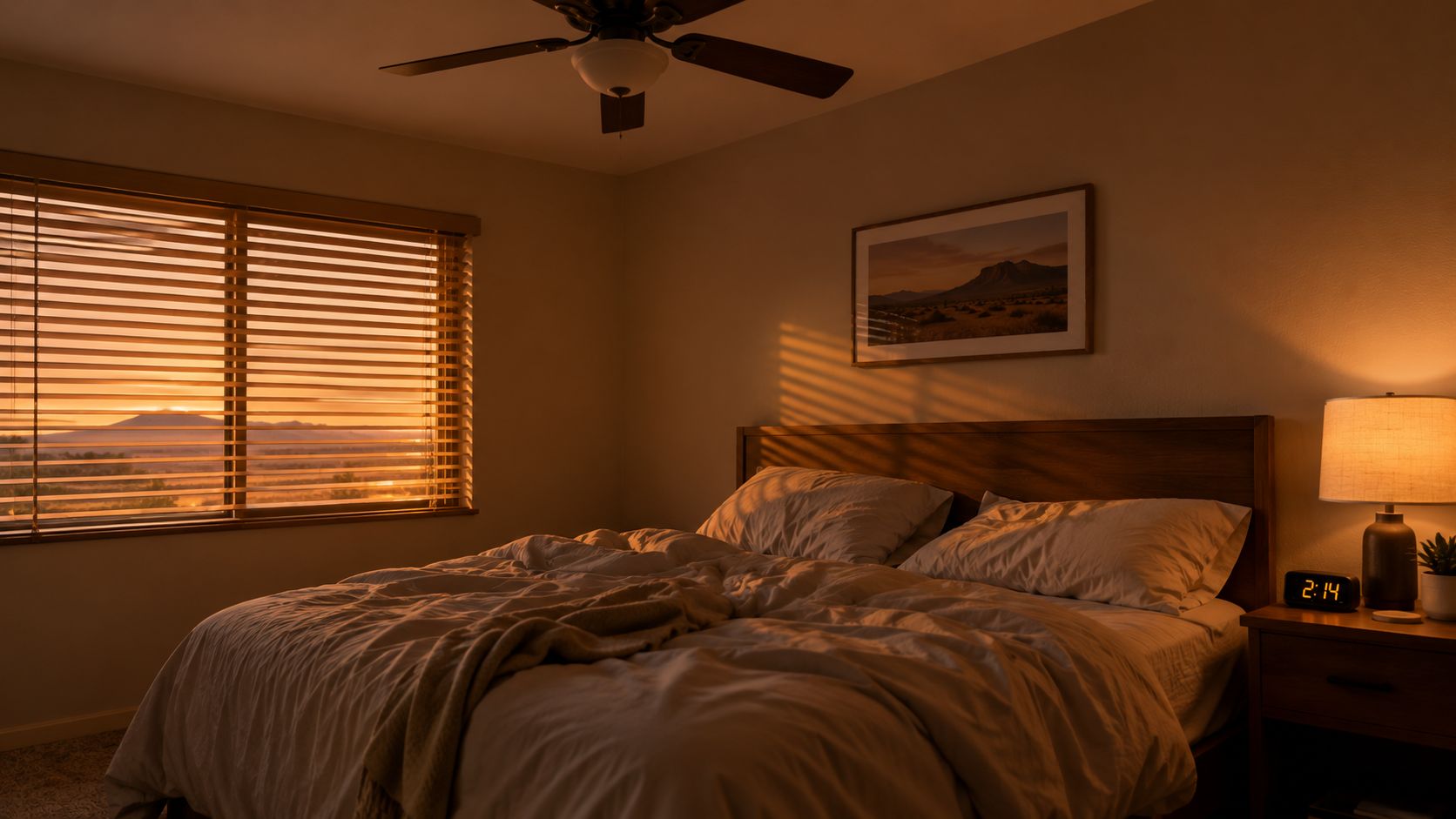
A Mesa homeowner may find the living room comfortable while the back bedroom feels like an oven. The thermostat says the house is cool, but afternoon sun, attic heat, or weak airflow can leave one room warmer than another long after the air conditioner starts running.
The Frustration of Uneven Cooling in Mesa Homes
By late afternoon, one Mesa bedroom may feel several degrees warmer than the rest of the house even though the thermostat says the system is cooling. The cause might be direct desert sun, a long duct run, or pressure imbalance that limits how much conditioned air reaches the room.
That uneven comfort affects daily life. A hot bedroom can disrupt sleep, while an overheated office becomes difficult to use. Lowering the thermostat usually makes the central system run longer, increasing energy use without addressing the room with the greatest heat load.
Mesa homes face several contributors at once. Intense solar exposure affects west-facing rooms, while aging attic insulation and roof heat raise temperatures below the ceiling. Older East Valley neighborhoods may also have leaking, crushed, or disconnected ducts. Long runs, rooftop package units, clogged filters, and restricted return grilles can create airflow pressure problems. During monsoon season, wind-driven dust can collect around outdoor equipment, filters, and grilles, reducing performance further.
The air conditioner may be functioning within its normal range while the room remains uncomfortable. Equipment service can help when capacity or airflow has declined, but it cannot block heat entering through an unshaded window or restore a duct that has separated above the ceiling.
ASHRAE describes HVAC zoning as dividing a building into separately controlled spaces, allowing different conditions to be maintained at the same time. Rooms vary by orientation, floor level, window area, and use, so one thermostat cannot measure every room accurately (ASHRAE zoning and comfort guidance).
Practical rule: Determine whether the room is gaining excess heat, receiving too little conditioned air, or lacking a proper return path before replacing equipment.
Common Causes of Room Temperature Differences
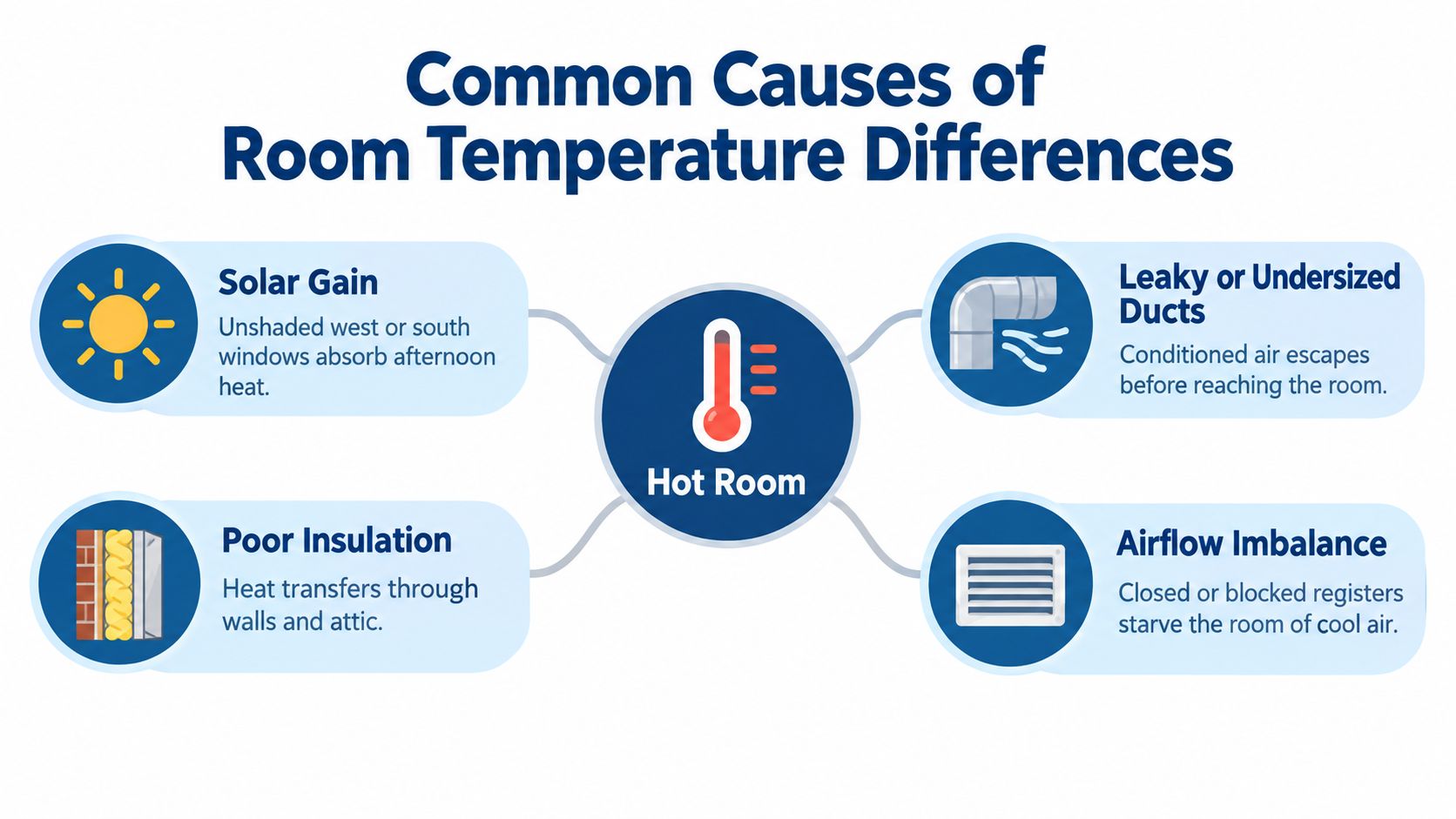
A hot room usually reflects a mismatch between local heat gain and the room's ability to remove that heat. In Mesa, three causes deserve attention first: solar gain, envelope problems, and air distribution.
Solar gain reaches the room before the AC can respond
A room with large west- or south-facing windows can absorb intense afternoon heat, especially when blinds, curtains, exterior shades, or nearby landscaping provide little protection. The timing offers a useful clue. If the room feels acceptable in the morning but becomes uncomfortable as the sun moves across the glass, the windows and room orientation may be contributing more than the air conditioner.
A west-facing bedroom can remain warm into the evening because the floor, walls, furnishings, and ceiling absorb heat during the afternoon. Running the AC longer may reduce the air temperature, but it won't prevent the surfaces from continuing to release stored heat.
The building envelope lets desert heat in
Older East Valley homes may have settled or incomplete attic insulation, air leaks around ceiling penetrations, and windows or doors with aging seals. A room beneath a hot roof can gain heat faster than an interior room, even when both receive conditioned air from the same system.
Building measurements show how much location and insulation can matter. In one monitored building, winter room-to-room differences reached 2°C, while another building-science source found a room directly under the roof was 1.6°C warmer than a ground-floor living room and a bedroom there was 2.2°C warmer. Ceiling insulation reduced daytime indoor temperature by 6.9°C in that source's testing (building temperature differences and insulation findings).
That doesn't mean every Mesa home has the same result. It does show why a room under the roof, beside an unconditioned garage, or behind sun-exposed windows can behave differently from the rest of the house.
Airflow and return paths can leave a room short of cooling
A supply register may be open but still deliver weak airflow because of a kinked, disconnected, undersized, or leaking duct. Duct leakage also changes system pressure and airflow balance. Lawrence Berkeley National Laboratory notes that leaks in a constant-volume system can contribute to warmer rooms or force the system to operate with lower-than-necessary cold-deck temperatures (duct leakage and cooling-system behavior).
Return air matters just as much as supply air. A closed bedroom door, blocked return grille, or furniture placed over a return can prevent the air loop from completing. The room may become pressurized, which reduces the amount of additional conditioned air entering through the supply register.
Homeowners comparing thermostat readings should also consider thermostat location. A thermostat in a shaded hallway can't sense the heat load in a west-facing bedroom. These thermostat location issues can make a system stop cooling before the warm room catches up.
Simple DIY Checks You Can Perform Today
Start with checks that don't require opening ductwork, climbing onto a roof, or handling electrical components. The purpose isn't to diagnose every possible fault. It's to separate an obvious airflow obstruction from a problem that needs testing.
Check the hot room's supply register
Move furniture, rugs, curtains, and storage items away from the supply register. Confirm that the damper is fully open and hold a tissue near the grille while the system is running. Compare the airflow with a register in a room that feels comfortable.
A weak stream in the hot room points toward a duct, damper, or pressure problem. Strong airflow with a room that still heats up during the afternoon points more toward solar gain or the building envelope.
Inspect the filter and returns
A visibly loaded filter can restrict airflow throughout the system. Replace it with the correct size and type for the equipment, then check whether return grilles are clear of furniture, boxes, curtains, and dust buildup.
Don't remove a filter permanently to improve airflow. That can allow monsoon dust and other particles to reach the blower, coil, and duct system. If dust returns quickly after a filter change, an HVAC technician may need to examine filtration, duct leakage, or indoor air quality conditions.
Test the room at different times
Record how the room feels in the morning, late afternoon, and evening. Note whether the door is closed, whether blinds are open, and whether the system is running continuously. A late-afternoon spike supports a solar-load theory, while an all-day problem with weak airflow supports an air-distribution concern.
In cooling mode, supply air should typically be 15 to 20°F cooler than return air. Larger deviations can point to restricted airflow, leaks, or imbalance rather than normal variation (airflow temperature check guidance).
Homeowners can use a reliable thermometer for a rough comparison, but a single reading isn't a complete diagnosis. Supply-air temperature doesn't reveal whether a duct is leaking in the attic or whether the room lacks an effective return path.
Try the thermostat reset only when the control seems confused
If the thermostat display is frozen, unresponsive, or behaving unusually, a controlled reset may restore normal communication with the equipment. Follow the manufacturer's instructions rather than switching breakers randomly. The reset AC thermostat guide can help with basic steps.
A reset won't repair a hot attic, a leaking duct, a blocked return, or a west-facing window. If the room remains warm after the simple checks, repeated resets only delay the useful diagnostic work.
When to Call a Professional for HVAC Service
DIY adjustments make sense when a register is closed, a return is blocked, or a filter is dirty. They stop making sense when the room has weak airflow after those corrections, the system runs constantly, or the temperature difference returns every afternoon.
A professional should evaluate the system when any of these signs appear:
- Persistent weak airflow: The hot room receives noticeably less air than nearby rooms even with the register open.
- Visible duct damage: Duct insulation is torn, connections are separated, or flex duct is compressed in an attic.
- Continuous operation: The system runs for long periods without bringing the home to the thermostat setting.
- Unusual equipment sounds: Rattling, scraping, buzzing, or loud airflow changes can indicate a mechanical or duct problem.
- Recurring imbalance: The room improves briefly after a filter change or thermostat adjustment, then becomes hot again.
- Safety concerns: Burning odors, refrigerant concerns, exposed wiring, or equipment access problems require professional attention.
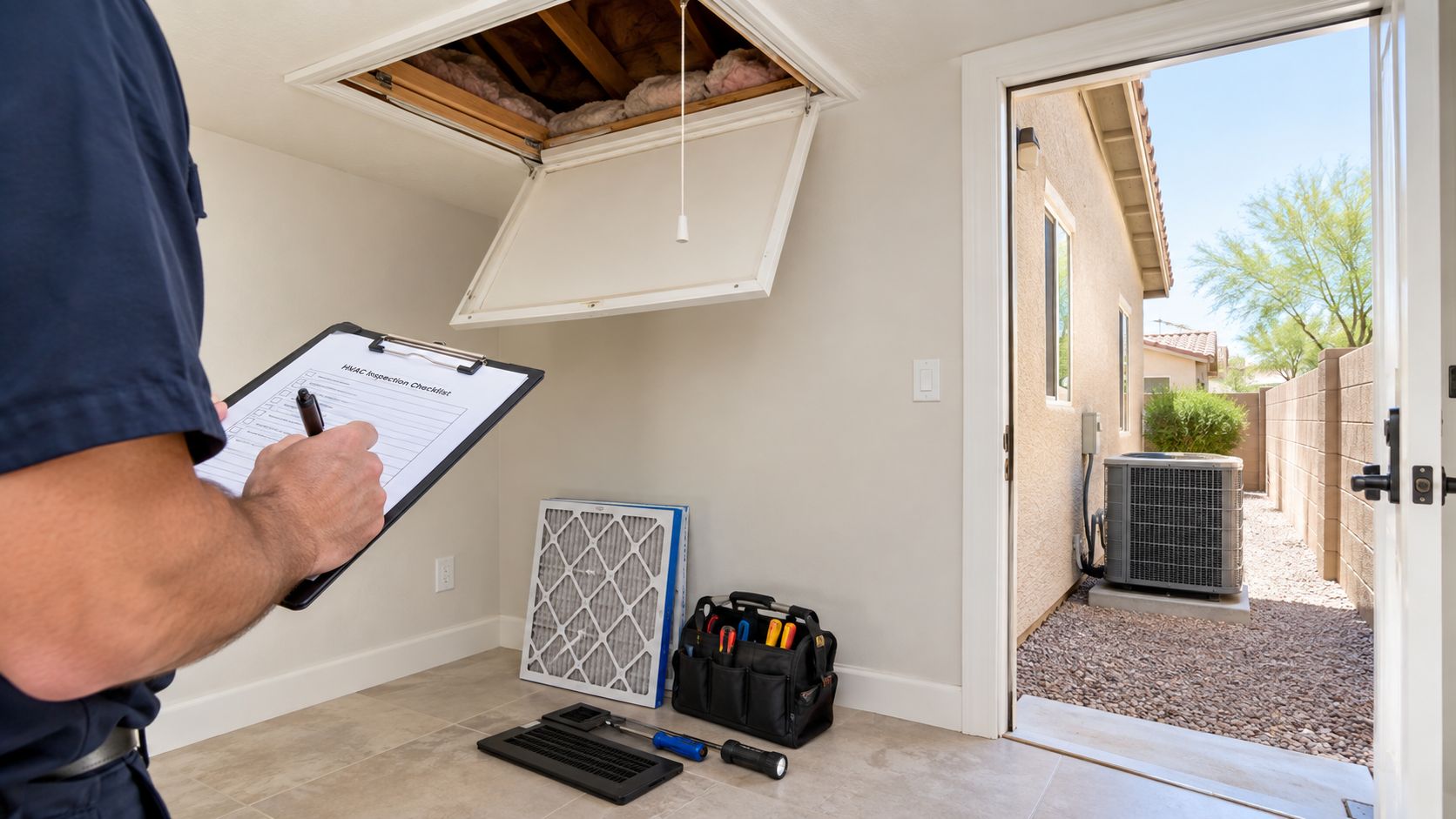
A technician can measure static pressure, compare airflow at registers, inspect accessible ductwork, and evaluate supply and return temperatures. Those tests help identify whether the central issue is equipment performance, duct delivery, room pressure, or heat entering through the envelope.
Do not close multiple supply registers to force air into one room. That can raise system pressure and create new airflow problems instead of balancing the home.
DIY fixes versus professional diagnosis
| Situation | Reasonable homeowner action | Professional next step |
|---|---|---|
| Closed or blocked register | Open it and clear nearby objects | Confirm airflow if comfort doesn't improve |
| Dirty filter | Replace it with the correct filter | Check for persistent restriction or coil contamination |
| Strong afternoon heat | Close blinds and reduce direct solar exposure | Assess windows, insulation, and HVAC load separately |
| Weak airflow | Compare registers without entering the attic | Test static pressure and inspect ducts |
| No return path | Keep the door open temporarily | Evaluate transfer grilles, jump ducts, or return design |
| Constant cooling demand | Check filter and thermostat setting | Test equipment capacity and duct performance |
A proper diagnosis also prevents spending money in the wrong place. A tune-up won't correct missing insulation, and duct sealing won't eliminate solar gain through a large unshaded window. For readers comparing ducted-system design and airflow principles in another market, this resource on energy efficient ducted AC Australia offers useful background, though Arizona homes and climate conditions require local assessment.
When the system starts and stops too often, or the thermostat reaches its setting while a room remains hot, an AC short-cycling diagnostic visit can help distinguish equipment control problems from room-specific heat gain.
Professional Solutions for Persistent Hot Rooms
A persistent hot room needs a repair matched to its heat and airflow pattern. A leaking duct requires ductwork attention. A west-facing room may need better shading or envelope improvements. An addition, converted garage, or room outside the original system design may need its own cooling source.
Duct sealing and balancing address delivery problems
A technician can inspect accessible duct connections, check for leakage, and adjust dampers so conditioned air reaches rooms more evenly. Proper duct sealing helps when air escapes before reaching a distant bedroom or when pressure problems reduce delivery. In older East Valley homes, monsoon dust, attic heat, and aging connections can make these losses harder to spot from inside the room.
Ductwork is a strong suspect when several rooms have weak or inconsistent airflow, or when the hot room is far from the air handler. It will not correct a room that receives strong airflow but gains substantial afternoon heat through west-facing glass or an exposed ceiling.
Balancing requires more than closing vents around the house. A technician should measure total airflow and system pressure, then adjust dampers without creating register noise, restricted airflow, or strain elsewhere. The goal is to improve the problem room while keeping the rest of the home operating properly.
Zoning separates different comfort loads
One thermostat measures conditions near its location, so it cannot respond equally to every room. A zoning system uses multiple temperature sensors and motorized dampers to direct conditioned air toward areas with different cooling demands. It can suit two-story homes, additions, west-facing bedrooms, and rooms used on different schedules.
Homes do not need identical temperatures in every room for occupants to remain comfortable. Zoning makes sense when rooms have different loads, but it cannot repair a crushed duct, a major attic leak, or inadequate insulation. Those conditions need correction first.
Ductless mini-splits target the stubborn room
A ductless mini-split can provide dedicated cooling for a converted garage, addition, sunroom, or bedroom that the central system cannot serve effectively. It avoids running a long duct through a hot attic and gives the room independent control.
The trade-off is added indoor equipment, outdoor equipment, controls, and maintenance. The installation plan should account for the room's windows, insulation, orientation, and use. A load calculation helps prevent installing equipment that is too large or too small.
Equipment replacement comes after diagnosis
Replacement may fit an aging or poorly matched system when testing shows deteriorated performance, incorrect sizing, or extensive repair needs. A new unit will not automatically cool a room made hot by an unshaded window, poor insulation, or uneven duct delivery.
A sound replacement plan reviews room orientation, window area, attic conditions, duct performance, and zoning needs. Comfort Experts can assess AC repair, replacement, ductless mini-splits, thermostats, zoning, and duct sealing separately or in combination, based on the findings.
Maintaining Comfort Throughout the Arizona Summer
Consistent room comfort comes from controlling both heat entering the home and cool air moving through it. Closing blinds before the strongest afternoon sun reaches west-facing glass can reduce the load on the room. Homeowners choosing window coverings can also review options to choose shades for privacy while considering how much direct sunlight the room receives.
Mesa's dry heat, roof exposure, and monsoon dust make seasonal attention worthwhile. Keep outdoor equipment clear of debris, replace a loaded filter, and make sure returns and supply registers remain unobstructed. If a room has always been warmer, track the pattern before the hottest part of summer so a technician can compare airflow, equipment operation, and room conditions.
Preventive service should focus on the actual system. AC maintenance in Mesa can help identify restricted airflow, dirty coils, loose electrical connections, and other conditions that reduce cooling performance. Maintenance won't correct a window or insulation problem, but it can prevent equipment deterioration from adding another source of uneven comfort.
The next step depends on the pattern:
- Afternoon-only heat: Start with blinds, shading, and an envelope assessment.
- Weak register airflow: Request duct and pressure testing.
- Hot room with a closed door: Check the return-air path.
- Several uneven rooms: Consider balancing, duct sealing, or zoning.
- Persistent heat after basic checks: Schedule a professional diagnostic instead of lowering the thermostat repeatedly.
Comfort Experts provides Mesa and East Valley homeowners with AC diagnostics, repair, replacement, maintenance, duct sealing, zoning, thermostat, and ductless mini-split services for rooms that won't cool evenly. Call 480-207-1239 or visit Comfort Experts to review the hot-room pattern and request service before the next stretch of extreme Arizona heat.