
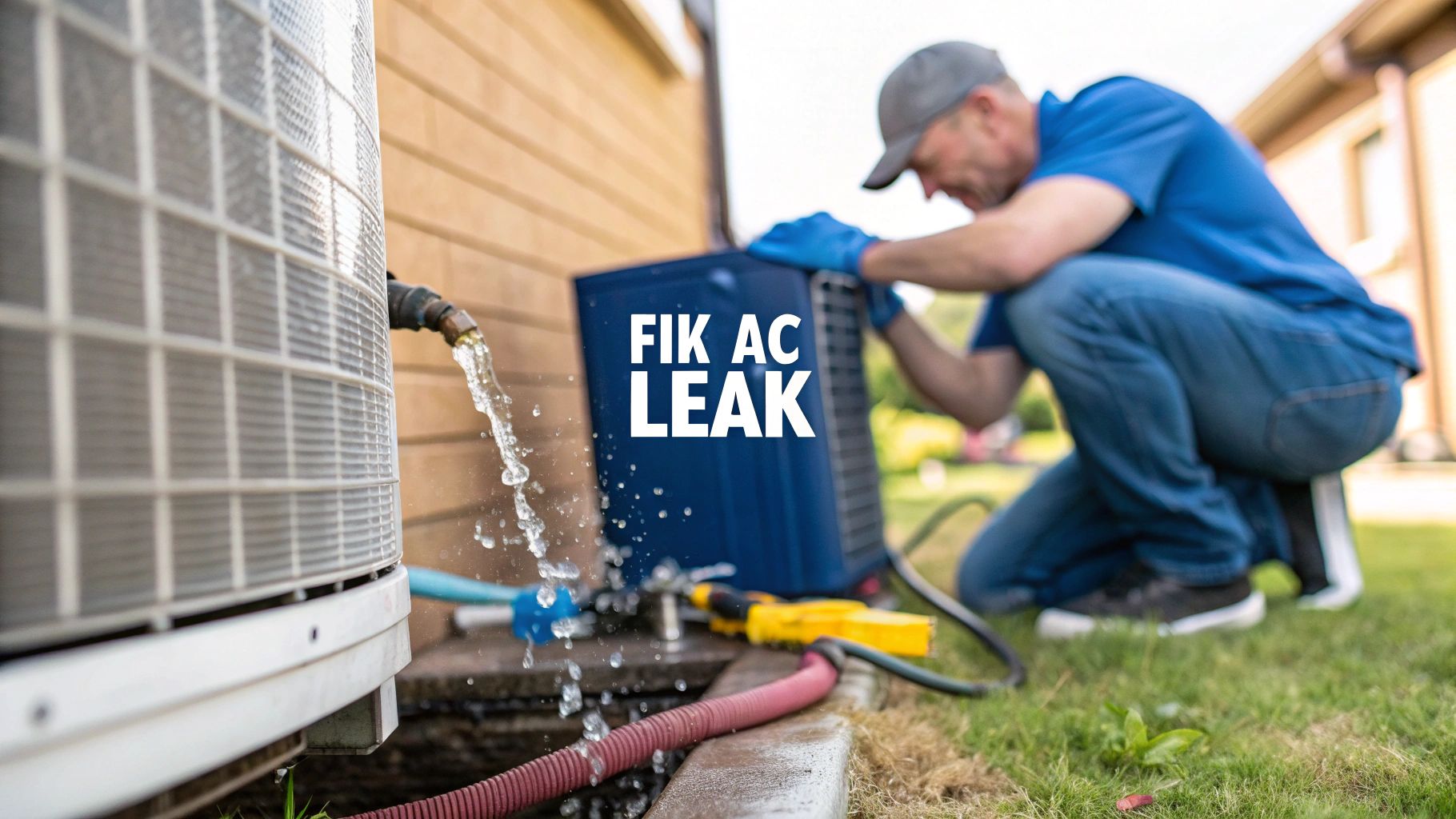
Finding a puddle near your air conditioner is always alarming, but figuring out how to fix ac leak usually starts with a few simple steps. Before you do anything else, kill the power to your AC unit at both the thermostat and your home's circuit breaker. This simple step is critical for preventing any electrical hazards while you investigate the source of the leak.
Your First Steps When an AC Leak Appears
Honestly, that moment you see water pooling where it shouldn't be can send a jolt of panic through any homeowner, especially during a scorching Phoenix summer. But before you start worrying about massive repair bills, take a deep breath. What you do in the first few minutes is crucial for safety and makes diagnosing the problem much easier.
Your absolute number one priority is safety. Water and electricity are a dangerous mix, so turning off the power at both the thermostat and the breaker is non-negotiable. It protects you from shock and your system from short circuits. Once you’re sure the unit is dead, you can put on your detective hat.
Identifying The Type Of Leak
The next step is to figure out what is actually leaking. This one piece of information points you in the right direction. Generally, you’ll be dealing with one of two things: a water leak from normal condensation, or a much more serious refrigerant leak.
- Water Leaks: This is by far the most common culprit. The liquid will be clear, have no smell, and feel just like plain water. It’s almost always caused by a clog in the condensate drain line, which is designed to pipe moisture away from your indoor unit.
- Refrigerant Leaks: This is a much bigger deal. The substance might have a slightly sweet, chemical odor and feel oily or greasy to the touch. You might even hear a hissing or bubbling sound coming from the unit.
The key takeaway here is simple: a water leak is often a plumbing issue you might be able to handle yourself, but a refrigerant leak is a sealed-system problem that always requires a licensed professional. Refrigerant is a hazardous material that needs special training and equipment to handle safely.
Sometimes, the first sign of an AC leak isn't a puddle on the floor but a mysterious water spot on your ceiling. Understanding the common reasons your ceiling may be leaking can help you connect the dots. More often than not, a backed-up AC drain line in the attic is the hidden cause of that ugly stain.
Quick Leak Diagnosis Guide
To help you sort things out quickly, here's a simple responsive table to guide your next move.
| Symptom | Potential Cause | Recommended Action |
|---|---|---|
| Clear, odorless water dripping from the indoor unit or pipes. | Clogged condensate drain line or cracked drain pan. | DIY Potential: Turn off the system and try clearing the drain line. |
| Oily or greasy substance with a chemical smell near coils or lines. | Refrigerant leak from a damaged coil or fitting. | Call a Pro: Shut down the system immediately and call a licensed technician. |
| Hissing or bubbling sound coming from the unit. | Active refrigerant leak. | Call a Pro: This is a serious issue. Turn off the AC and get help. |
| Water stains on the ceiling below the attic unit. | Overflowing drain pan due to a clog or float switch failure. | DIY / Pro: Turn off the unit. Check the pan and drain line; call for help if you're unsure. |
This guide should give you the confidence to know whether you're facing a simple fix or a job for an expert.
To help you visualize the decision-making process, this flowchart breaks down the immediate steps based on what you find.
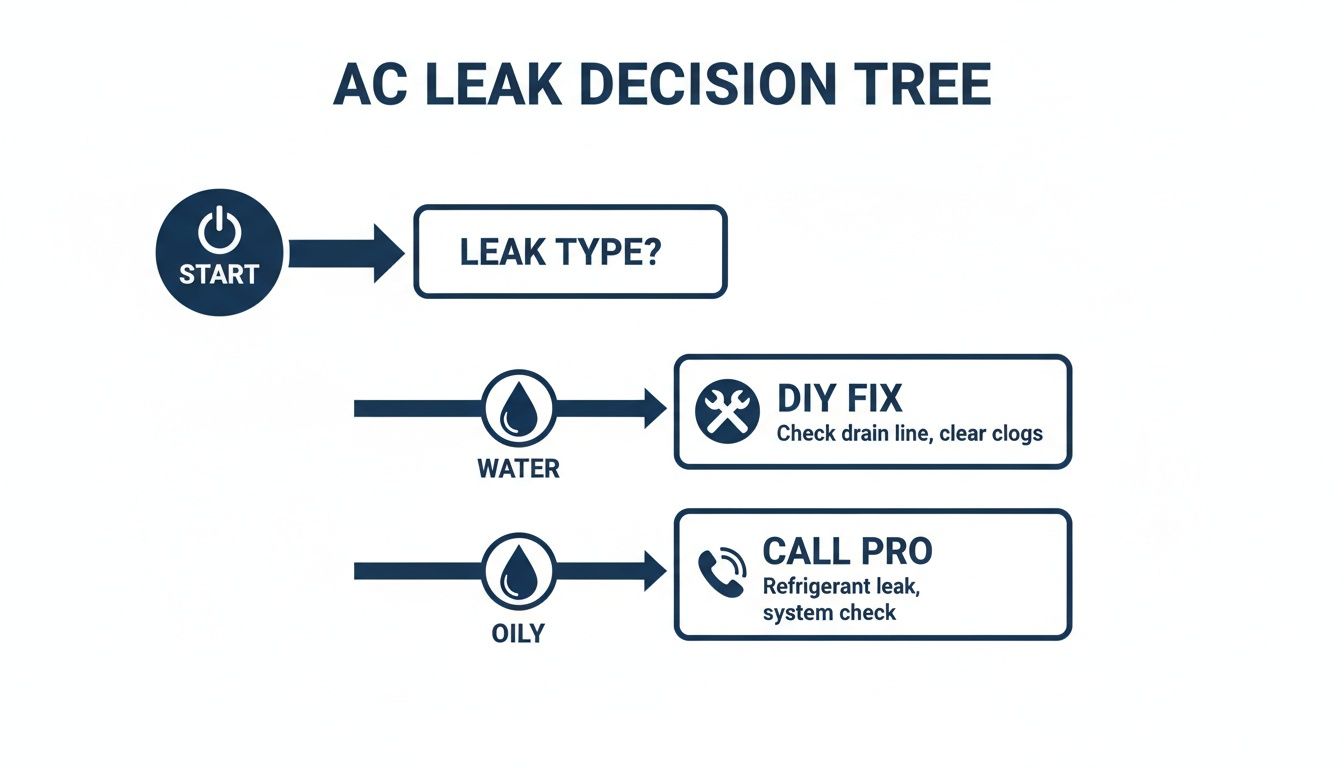
As you can see, the path forward really depends on whether you’re dealing with simple water or an oily refrigerant leak. If you've confirmed it's just water, you can dive deeper into the common causes by checking out our guide on why your AC is leaking water.
Solving Common AC Water Leaks Yourself
You’ve done the initial check and confirmed it’s just water—that's good news! More than 90% of the time, a water leak points to a simple plumbing issue that a handy homeowner can often tackle without a service call. The number one culprit we see, especially in our dry and dusty Arizona climate, is a clogged condensate drain line.
Let me explain what's happening. Your indoor AC unit pulls warm, humid air across a set of frigid evaporator coils. This makes moisture condense out of the air, kind of like a cold glass of iced tea sweating on a hot day. All that water drips into a collection pan and is supposed to flow safely outside through a PVC pipe called the condensate drain line.
But over time, that drain line can get choked with dust, algae, and other gunk. When that happens, the water has nowhere to go. It backs up, overflows the pan, and suddenly you've got a puddle around your indoor unit or a nasty stain spreading across your ceiling.
Locating and Clearing the Condensate Drain Line
First things first, you need to find that drain line. Look for a white, grey, or black PVC pipe, usually about ¾ to 1 inch thick, coming out of your indoor air handler (the unit typically tucked away in a closet, attic, or garage). It will run from the unit all the way to the outside of your house, often poking out of a wall near your outdoor condenser.
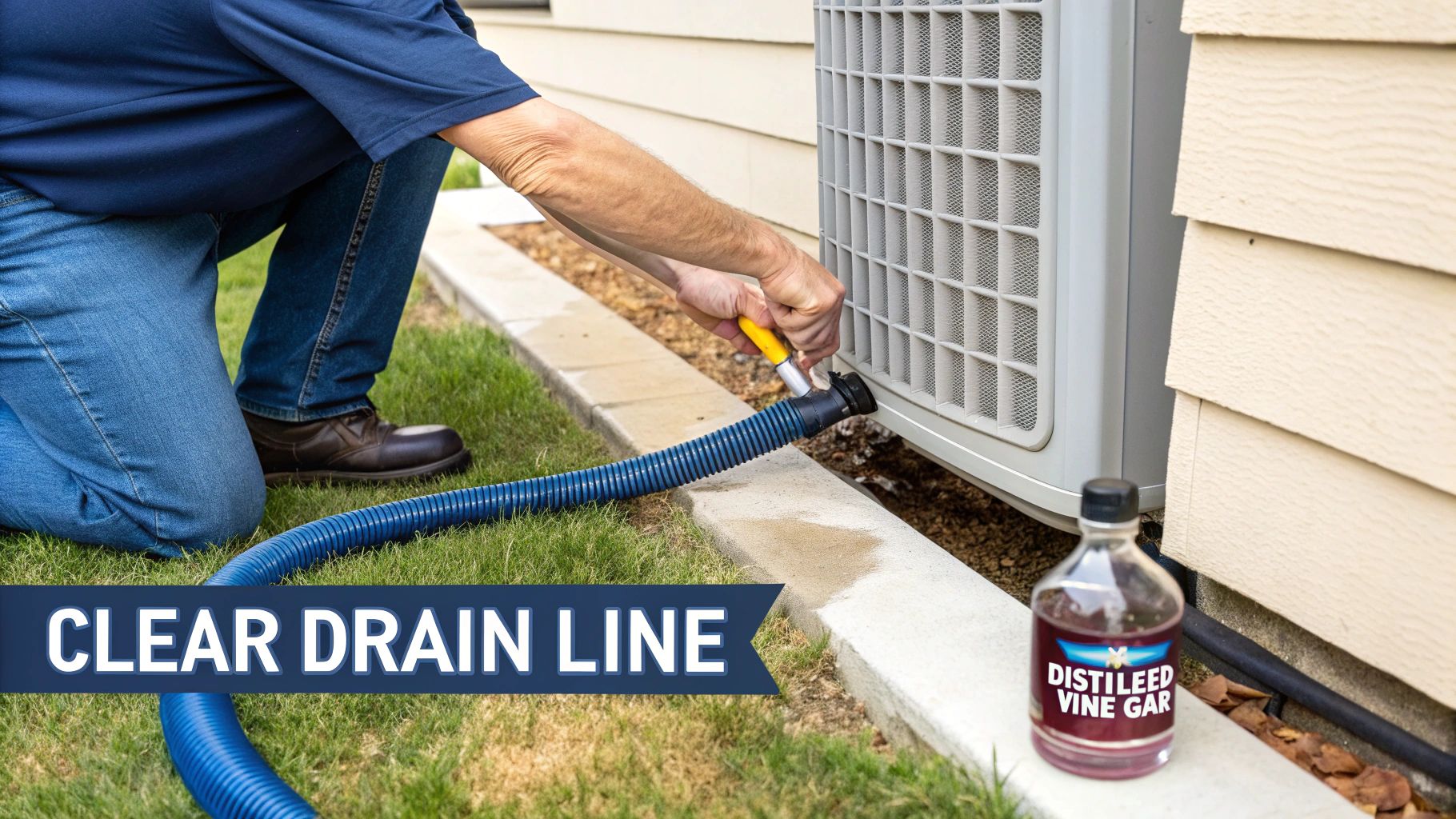
Once you’ve found the exit point, a wet/dry vacuum is your best friend for clearing the clog.
- Get the vac ready: Set your wet/dry vac to the "vacuum" or "suck" setting. You'll need to create a tight seal between the vacuum hose and the end of the PVC pipe. Cupping your hand around it or wrapping it with a thick rag works well.
- Let it run: Switch the vacuum on and let it pull for a few minutes. You're trying to yank that whole blockage out of the line. If you hear a sudden "thump" or see a nasty gush of dirty water and sludge fly into your vacuum canister, that’s the sound of success!
- Test your work: After you're done, head back inside. Carefully pour a cup of water into the drain pan and watch to see if it flows away freely. If it drains without any trouble, you've likely fixed the problem.
As HVAC professionals with decades of experience serving the Phoenix area, we always give our customers a pro tip: do a preventative flush every few months. Just pour about a cup of distilled white vinegar down the drain line. You can usually find a T-shaped access port with a cap near the indoor unit. This little five-minute task helps kill off any algae or bacteria trying to grow in there and prevents future clogs.
Other Potential DIY Water Leak Fixes
What if you've cleared the drain line and the leak is still there? Don't panic. There are a couple of other common issues you can check out before you need to call for backup.
Cracked Drain Pan
The pan sitting right under your evaporator coils is ground zero for catching all that condensation. After years of service, these pans—especially older metal ones—can rust out, corrode, and develop small cracks or holes.
- How to Check: With the power to the AC still off, grab a flashlight and get a good look at the primary drain pan. You're searching for any visible cracks, rust spots, or standing water that just isn't draining.
- The Fix: If you spot a small crack, you might be able to buy some time with a temporary patch of water-resistant sealant like epoxy. But honestly, that's a short-term fix. The real solution is to replace the pan, which can be a tricky job depending on how your unit is built.
Condensate Pump Failure
If your indoor unit lives in a basement or any spot where the drain line can't use gravity to empty, you'll have a little box called a condensate pump. This device collects water in a reservoir and automatically pumps it out when it gets full. If that pump dies, the reservoir just overflows.
- How to Check: Take a look at the pump's reservoir—is it full of water? You can test it by slowly pouring a little more water in. A working pump should kick on automatically.
- The Fix: Sometimes, the pump's float switch just gets stuck. A gentle tap or cleaning the gunk off the switch can often get it moving again. If it's still dead, the motor has probably burned out, and you'll need a new pump.
Another sneaky cause is a dirty air filter. A clogged filter can restrict airflow, causing the evaporator coils to get too cold and freeze over completely. When all that ice finally melts, the sudden rush of water can easily overwhelm your drain pan. Knowing how often to change air filters is a simple but critical part of keeping these kinds of leaks at bay.
For a quick reference, here’s a responsive table that breaks down these common DIY fixes.
DIY Fixes for AC Water Leaks
| Problem Area | Common Symptom | Required Tools | DIY Difficulty |
|---|---|---|---|
| Clogged Drain Line | Water pooling around the indoor unit. | Wet/Dry Vacuum, Distilled Vinegar | Easy |
| Cracked Drain Pan | Slow, persistent dripping from the indoor unit. | Flashlight, Epoxy (for temp fix) | Moderate |
| Faulty Condensate Pump | Water overflowing from the pump's reservoir. | Bucket, Screwdriver | Moderate |
| Frozen Evaporator Coil | Dripping after the unit cycles off, poor cooling. | New Air Filter, Patience for thawing | Easy |
By methodically working through these common culprits, you can often solve the mystery of your AC water leak on your own, saving yourself both time and money.
Why Refrigerant Leaks Are a Job for Professionals
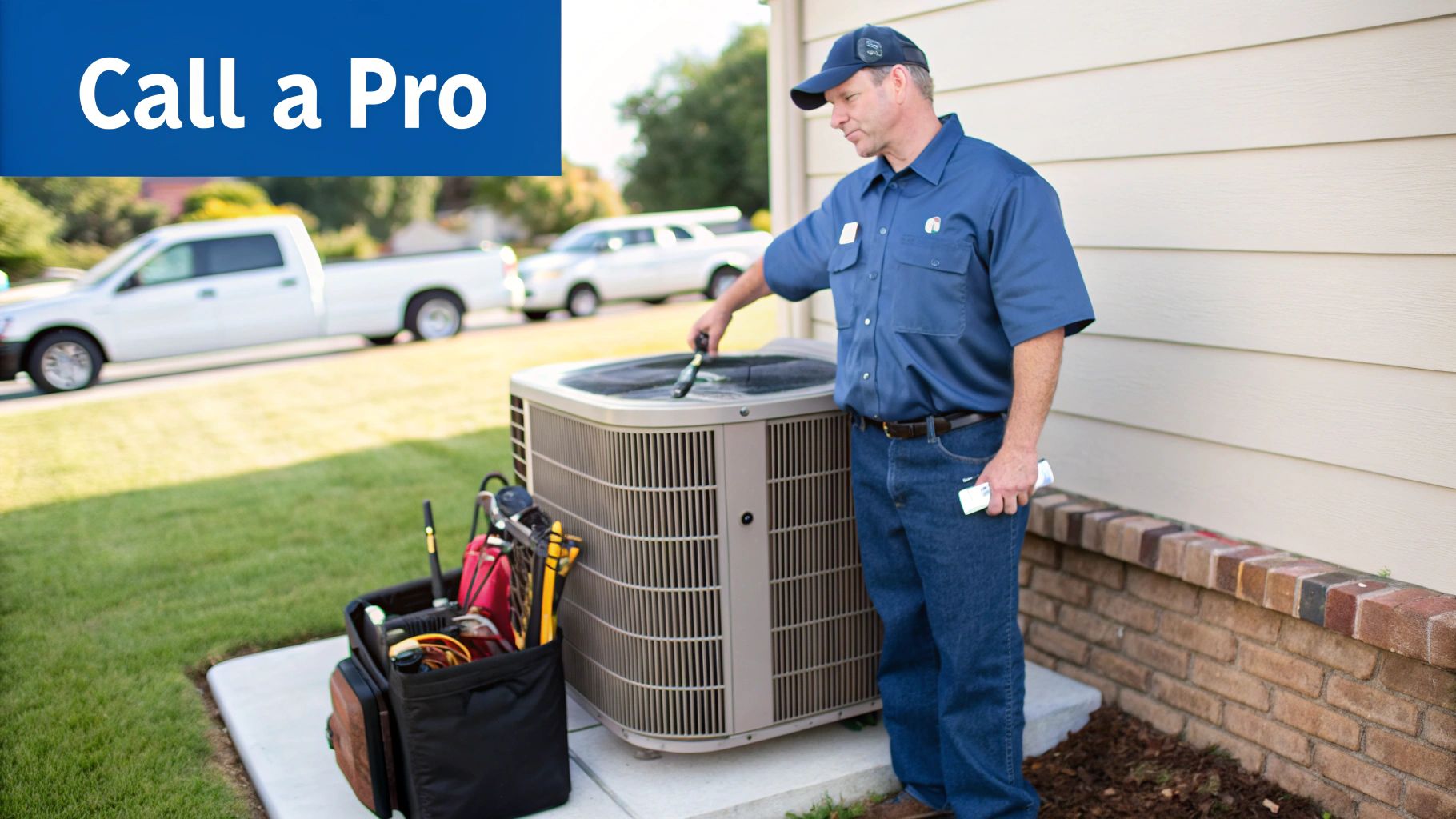
Here’s the thing: while a water leak from your AC is mostly an annoying mess, a refrigerant leak is a genuine hazard. If you’ve found that oily residue or hear a distinct hissing sound, your next step isn’t grabbing a wrench—it’s picking up the phone. Trying to fix a refrigerant leak yourself isn't just a bad idea. It's dangerous, often illegal, and can absolutely wreck your HVAC system.
Look, I get it. The urge to tackle a home repair yourself is strong. But refrigerant is a completely different animal. This isn't like patching a drip under the kitchen sink. We're talking about a specialized chemical inside a highly pressurized system, and federal law prohibits unlicensed handling for some very good reasons.
The Health and Environmental Dangers
The number one reason to leave refrigerant to the pros is safety. The chemicals in most home AC systems, like R-410A, can cause real harm if handled improperly.
- Health Risks: Direct contact can cause frostbite or chemical burns. If you inhale it in a confined space, it can displace the oxygen in your lungs, leading to dizziness, breathing problems, or even asphyxiation.
- Environmental Impact: These chemicals are also powerful greenhouse gases. Releasing just one pound of R-410A into the atmosphere is like driving your car for thousands of miles. It does serious damage.
Trusting a licensed expert ensures the job is done safely, legally, and correctly the first time. Professionals are EPA-certified to handle these chemicals, protecting your health, your home, and the environment from unnecessary risks.
These leaks happen more often than you'd think. EPA estimates suggest that residential AC systems in the U.S. leak at an average annual rate of 5-11%. Over a system's 10-15 year lifespan, that adds up fast—it could lose up to 80% of its charge. For a typical home unit holding 5-20 pounds of R-410A, even a small leak equates to a massive amount of CO2 emissions.
The Need for Specialized Tools and Training
Fixing a refrigerant leak is a precise, multi-step job that requires expensive, specialized equipment that only certified technicians carry. It’s a lot more complicated than just slapping some sealant on a pipe.
Here’s what a professional has to do, by law:
- Pinpoint the Leak: We use tools like electronic "sniffers," ultrasonic detectors, or fluorescent UV dyes to find the exact source. The leak could be a microscopic pinhole in a coil or a tiny crack in a weld.
- Safe Refrigerant Recovery: Before any repair, all the remaining refrigerant has to be safely pumped out of the system and stored in a certified recovery tank. It’s illegal to just vent it into the air.
- Make the Repair: With the system empty, the technician can fix the line. This often involves brazing—a high-temperature soldering process that creates a permanent seal on the copper or aluminum lines.
- System Evacuation and Recharge: After the repair, a vacuum pump removes all air and moisture from the lines. This is a critical step to prevent contamination and future damage. Only then is the system recharged with the exact manufacturer-specified amount of refrigerant, measured by weight.
If you're curious, we have a great post that does a deep dive on what Freon is and why it's so important for your AC system.
Why "Topping Off" Is Never the Solution
A common myth is that you can just "top off" a system with more refrigerant, like adding oil to your car. This is one of the worst things you could do. Not only is it illegal to add refrigerant to a system with a known leak, but it also ignores the root cause.
Adding more refrigerant is like pouring water into a bucket with a hole in it. It’s a temporary fix that wastes your money and keeps harming the environment. Even worse, an incorrectly charged system—either too full or too low—makes the compressor work way too hard. This spikes your energy bills and can lead to the premature failure of the most expensive part of your entire AC unit. Fixing the leak is the real solution; adding refrigerant is just the final step.
The Hidden Costs of Ignoring an AC Leak
It's tempting to put off an AC repair. You see a little drip, think "I'll get to it later," and hope it goes away. But that mindset almost always ends up costing homeowners way more in the long run.
That tiny leak you've decided to "live with" is silently starting a chain reaction of problems that are a lot bigger than just a damp spot on your garage floor.
Let's break down what's really happening behind the scenes, starting with what looks like a simple water leak.
The Domino Effect of Water Damage
Even a slow, steady drip from a clogged condensate line can do an incredible amount of damage. Water is persistent—it will soak into your home’s most vulnerable materials, quietly causing chaos where you can't see it.
- Drywall and Ceiling Damage: Waterlogged drywall gets soft, stained, and eventually starts to crumble. What begins as a faint discoloration can quickly become a massive, ugly patch that needs professional drywall repair and repainting.
- Harmful Mold Growth: The dark, damp spaces inside your walls or attic are a perfect breeding ground for mold and mildew. Not only does mold smell awful, but it can also trigger serious health issues, especially for anyone in your family with allergies or asthma.
- Structural Rot: If left for long enough, constant moisture can rot out the wooden joists and structural supports of your home. This is the worst-case scenario, capable of compromising your home's integrity and leading to unbelievably expensive repairs.
Ignoring a water leak is a gamble you don't want to take. The bill for replacing drywall, remediating mold, or fixing rotted wood will always be exponentially higher than the cost of a simple drain line cleaning.
The Financial Drain of Refrigerant Leaks
As bad as water damage is, an unchecked refrigerant leak is even harder on your wallet. When your system is low on refrigerant, it’s put under constant stress, kicking off a countdown to catastrophic failure.
An AC low on refrigerant simply can't cool your home efficiently. To try and keep up, the compressor—the heart of your unit—is forced to run longer and work much harder to hit the temperature on your thermostat. This translates directly into a painful spike in your monthly power bills.
It's a vicious and expensive cycle. A single small leak left for three months could waste an extra 10kW of energy, potentially adding up to thousands per year. Leaky units can use 20% more electricity, and data from industry studies shows that systems with a persistent leak have up to a 40% chance of total compressor failure. You can read more about these leakage rate findings on coolingpost.com.
From a Small Drip to a Complete System Meltdown
By far, the most expensive part of your entire HVAC system is the compressor. When a refrigerant leak makes it run nonstop, it will eventually overheat and burn out. This isn't a simple fix; it's a major system transplant.
Replacing a dead compressor can cost anywhere from $3,000 to $7,000, depending on the size and model of your unit. For many older systems, the cost is so high that it makes more sense to replace the entire air conditioner. Suddenly, a leak that might have been a few hundred dollars to fix has spiraled into a five-figure headache. This is exactly why it pays to understand the typical AC repair costs in Arizona before you're in an emergency situation.
At the end of the day, being proactive is always the smarter financial move. Fixing a leak early protects your home, keeps your energy bills from getting out of control, and—most importantly—saves the life of your expensive HVAC equipment.
Preventing Leaks with Proactive Maintenance
Let’s be honest: the best way to deal with an AC leak is to make sure it never happens in the first place. Shifting from a reactive, "fix-it-when-it-breaks" mindset to a proactive one is the single smartest move any homeowner can make. A little bit of preventative care really does go a long way in keeping your AC system healthy and your floors dry.
This isn't about doing complicated, technical work yourself. It starts with simple, crucial tasks that catch potential problems before they escalate into a full-blown emergency call on a sweltering Phoenix afternoon.
Your Simple At-Home Checklist
Maintaining your AC doesn't have to be a huge chore. Just a few minutes of attention every month or two can make a massive difference in preventing the most common causes of AC leaks and breakdowns.
Here are the two most important things you can handle yourself:
- Change Your Air Filters Religiously. A clogged air filter is the root of so much evil in an HVAC system. It chokes off airflow, forcing your unit to work harder and often causing the evaporator coils to freeze solid. When all that ice eventually melts, it can easily overwhelm the drain pan and spill water everywhere.
- Keep the Outdoor Unit Clear. Your outdoor condenser needs to breathe. Make sure you have at least two feet of clear space all the way around the unit. Trim back any bushes, pull weeds, and sweep away leaves or debris that could get sucked into the fins and block airflow.
These two habits are your first and best line of defense. For a more detailed guide, check out our essential AC maintenance tips for Arizona residents.
The Undeniable Value of an Annual Professional Tune-Up
While those DIY tasks are essential, they simply can't replace the deep-dive inspection a trained professional provides. An annual professional tune-up is the single best investment you can make in your HVAC system’s longevity and reliability.
A professional maintenance visit is much more than a quick once-over. Our technicians get into the guts of the system to spot weak points and potential leaks before they fail.
During a tune-up, a technician will clean critical components like the evaporator and condenser coils, test refrigerant pressures to check for slow leaks, inspect electrical connections, and lubricate moving parts. This isn't just about preventing leaks; it's about boosting your system's efficiency and extending its lifespan.
A well-maintained system doesn't just avoid disastrous water damage; it runs more efficiently, which shows up as real savings on your monthly energy bills.
The environmental impact is significant, too. It's estimated that up to 90% of refrigerant from old AC units in the U.S. is just vented into the atmosphere. Leaks from bad installations or simple wear and tear are a major source of greenhouse gas emissions. Some data even suggests a poorly maintained system can leak 20% of its charge every year, slashing its efficiency by 11%. You can discover more insights about how chilly refrigerants warm the earth on ecology.wa.gov.
By scheduling routine maintenance, you ensure your system runs cleanly, efficiently, and with minimal environmental impact—saving you money and giving you priceless peace of mind.
When It's Time to Call an HVAC Pro in Phoenix
You've done the detective work. You shut the system down, cleared the drain line, and gave the drain pan a thorough inspection, but that puddle just keeps reappearing. Maybe you found the tell-tale oily residue of a refrigerant leak. This is the moment when the DIY mission ends and you need to bring in a professional.
Knowing when to put the tools down is just as crucial as knowing how to troubleshoot in the first place. Persistent water leaks that defy the simple fixes, any sign of a refrigerant issue, or strange new noises are all clear signals it’s time to call a licensed HVAC technician. These are usually symptoms of deeper problems that demand specialized tools and certified know-how to fix right.
The Telltale Signs You Need an Expert
It's tempting to keep trying one more thing, but some problems are simply out of a homeowner's league. Pushing a malfunctioning AC unit can quickly turn a manageable repair into a catastrophic system failure.
These are the non-negotiable signs that you need a professional technician on the double:
- You Suspect a Refrigerant Leak: If you see an oily substance near the coils, smell a faint chemical odor, or hear a hissing sound, turn off the AC immediately. Refrigerant is a controlled substance, and handling it without an EPA certification is both illegal and hazardous.
- The Water Leak Just Won't Stop: You’ve cleared the condensate line and the pan is clean, but the water keeps showing up. This could point to a cracked coil, a major internal blockage, or an airflow problem that requires professional diagnostic tools.
- You Hear Strange New Noises: Grinding, clanking, or loud buzzing are cries for help from your AC's mechanical parts. Ignoring them is a fast track to a burned-out motor or a seized compressor.
- Your Home Isn't Actually Getting Cool: Is the AC running constantly but your house is still muggy and warm? This is a classic symptom of either low refrigerant or a failing compressor.
You know what? Peace of mind is priceless. If you've tried the basic fixes and you're still not sure what's wrong, that's the perfect time to call for help. A professional can quickly find the source of the problem, preventing further damage and restoring your comfort.
Choosing the Right Phoenix HVAC Partner
When you're struggling to locate the source of an AC leak or suspect it's beyond a simple DIY fix, it's often best to consult professional leak detection and repair services to prevent further damage. In the Phoenix Valley, you need a team that gets the brutal demands our climate puts on an air conditioning system. You need technicians who are not only licensed and insured but also committed to honest diagnostics and reliable service.
At Comfort Experts, we treat your home like it’s our own. Our team is trained to do more than just fix the immediate problem; we look for the root cause to ensure the repair lasts. We believe in explaining your options clearly and providing fair, upfront pricing, so you can make an informed decision without any pressure.
When you need fast, trustworthy service for an AC leak, you can count on Comfort Experts to get the job done right. Don't let a small leak turn into a major headache. Give our local team a call at 480-207-1239 or schedule service online to have one of our certified technicians restore your peace of mind.