
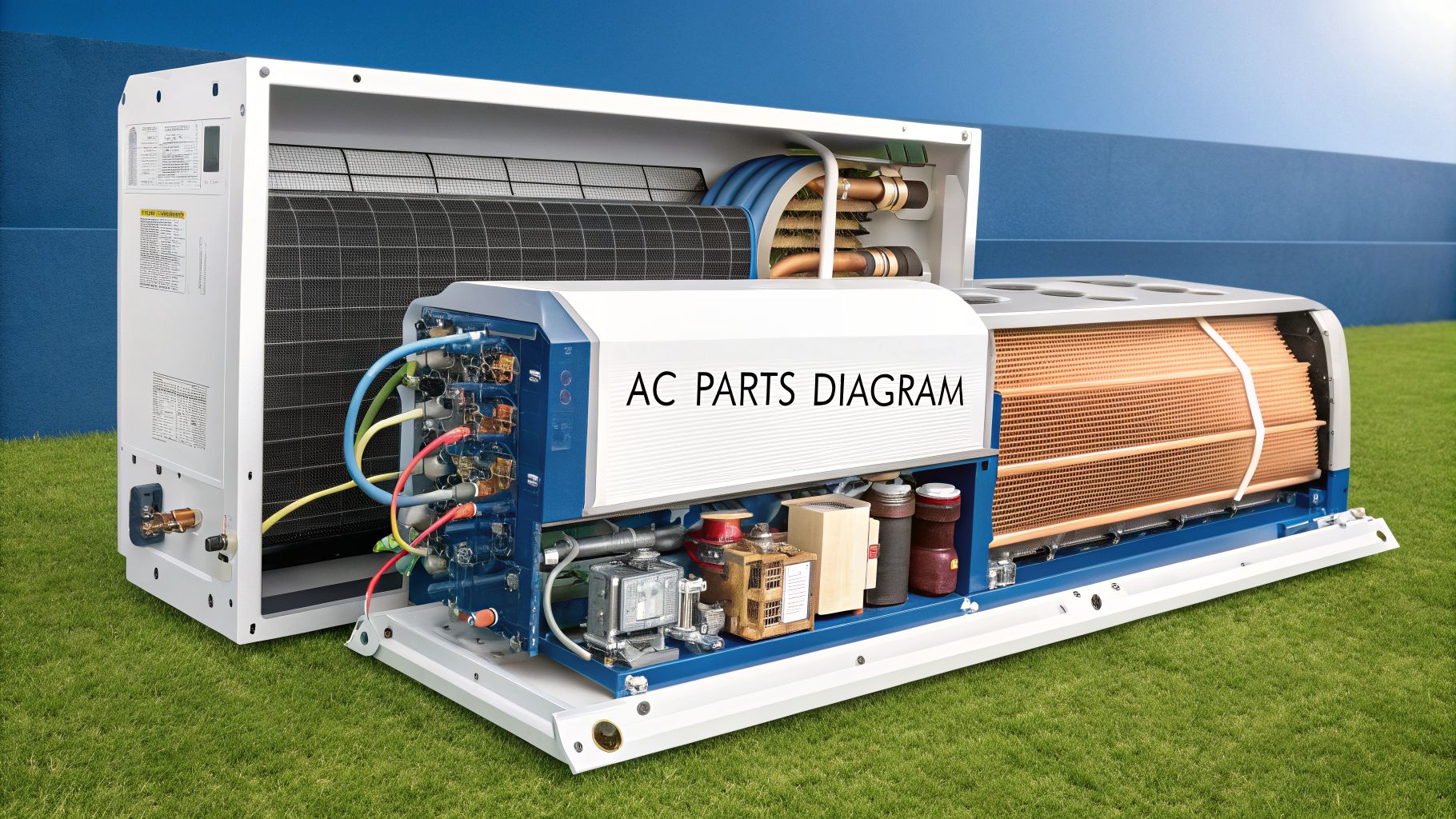
Ever wondered what's really going on inside that humming metal box outside your house, especially when the Arizona sun is beating down? You're not the only one, and knowing the basics can save you a lot of stress and money. This parts of an air conditioner diagram will be our map to understanding how your AC system works together to keep you cool and comfortable.
Your Air Conditioner Demystified: A Visual Guide
Most homes here in the Phoenix area use what’s called a split-system air conditioner. That just means the system is "split" into two main units: an indoor unit that grabs the heat and an outdoor unit that gets rid of it. Understanding how these two halves work together is the first step to really getting how the whole cooling process works.
The magic happens in something called the refrigerant cycle. Think of the refrigerant like the blood in your home’s circulatory system—it’s constantly moving between the indoor and outdoor units, carrying heat along for the ride.
The most important thing to remember is that your AC doesn't actually create cold air. It's a heat mover. It takes heat energy from inside your home and dumps it outside, leaving you with that cool, comfortable air you love.
So, the process flows from your indoor unit, through the refrigerant cycle, and out to the outdoor unit. This diagram shows that basic concept perfectly: heat gets absorbed inside, moved by the refrigerant, and then released outside.

As you can see, cooling your home is all about moving heat from one place to another, not destroying it.
The Basic Cooling Loop
Getting this simple loop down is key before we get into the nitty-gritty of each component. Every single part we’re about to discuss plays a critical role in making this heat transfer happen. Here’s a quick breakdown of the main idea:
- Heat Absorption: The indoor unit pulls in warm air from your house and uses a super-cold evaporator coil to soak up the heat. It works just like a cold glass of sweet tea absorbs heat on a hot day, leaving condensation on the outside.
- Heat Transport: Now carrying all that heat, the refrigerant travels through copper lines to the outdoor unit.
- Heat Rejection: The outdoor unit takes that hot refrigerant and blasts the captured heat into the Arizona air, getting the refrigerant cool again so it can head back inside and repeat the whole process.
With this foundation in place, you’re ready for a closer look at each specific part. Now that you have this basic framework in mind, the technical details of what makes each part tick will make a lot more sense.
The Outdoor Unit: The Heart of the Cooling System
That unit sitting outside your home is the power center for your entire cooling system. Its whole job is to take all the heat your AC has absorbed from inside your house and dump it outside. This is where the heavy lifting happens.
Inside that metal cabinet are three key players that work in perfect harmony to make your home comfortable. Think of it like a car's radiator system—it’s designed specifically to get rid of heat as efficiently as possible, especially during a brutal Arizona summer. The main parts doing the work are the compressor, the condenser coil, and the condenser fan.

The Compressor: The Engine of Your AC
The compressor is truly the engine of your air conditioner. Its one and only job is to take the low-pressure, gaseous refrigerant that just soaked up heat from your home and squeeze it. Hard. This compression process dramatically increases the refrigerant's pressure and temperature, turning it into a very hot gas.
This step is absolutely critical. For heat to move, it has to go from a hotter place to a cooler one. By making the refrigerant hotter than the outside air, the compressor ensures all that unwanted indoor heat has a place to go—out.
Today's compressors are miles ahead of the originals. Early systems from 1902 were clunky, but by 1922, new designs made large-scale cooling more reliable. By the late 1950s, more efficient scroll and screw compressors took over. Modern units are far quieter and more energy-efficient, which is why a new AC can dramatically lower your power bills compared to a system from just a decade ago.
Compressor Trouble Sign: Hear a loud buzzing, clanking, or rattling from your outdoor unit when it tries to start? That often points to a failing compressor, which is a serious issue. If your unit struggles to turn on or keeps tripping the breaker, it's time for a professional diagnosis. Check out our guide on what to do when considering an air conditioner compressor replacement.
The Condenser Coil and Fan: The Heat Release Team
Once the compressor does its job, that superheated refrigerant gas flows into the condenser coil. These are the thin metal fins you can see wrapped around the outside of your unit. Their purpose is simple: create a massive surface area for heat to escape.
Working right alongside the coil is the condenser fan. That big fan blade, usually on top of the unit, pulls outside air through the condenser fins. This constant airflow whisks the heat away from the refrigerant, causing it to cool down and condense back into a high-pressure liquid.
Essentially, the coil and fan are a team dedicated to expelling the heat from your home into the surrounding air. It’s why you feel that blast of hot air coming from your AC unit when it’s running.
- Condenser Coil Problem: If the fins on your coil get covered in dirt, dust, or debris, it’s like wrapping your AC in an insulating blanket. This makes it much harder to release heat, forcing the unit to work harder, use more electricity, and eventually break down.
- Condenser Fan Issue: If the fan motor fails, the fan won't spin. Without that critical airflow, the heat can't escape, and the compressor will quickly overheat and shut itself down on a safety overload.
Outdoor AC Unit Common Problems and Solutions
When your outdoor unit acts up, it helps to know what you might be looking at. This quick table breaks down common symptoms and whether you can tackle it yourself or need to call in a pro.
| Component | Symptom | Possible Cause | Next Step |
|---|---|---|---|
| Compressor | Loud buzzing, clanking, or grinding noises; unit trips breaker | Failing motor, bad capacitor, or internal mechanical failure | Call a Pro. Compressor issues are complex and require a technician. |
| Condenser Fan | Fan blades aren't spinning, but you hear a humming sound | Failed fan motor, bad capacitor, or loose wiring | Call a Pro. Replacing motors and capacitors involves high voltage. |
| Condenser Coil | AC runs constantly but doesn't cool well; high energy bills | The coil is clogged with dirt, leaves, or cottonwood fluff | DIY or Pro. You can gently hose it down, but a pro cleaning is best for deep grime. |
| Entire Unit | The unit won't turn on at all | Tripped breaker, thermostat issue, or a failed contactor | DIY First. Check your circuit breaker. If that's not it, it's time to call for service. |
Remember, while some basic cleaning is homeowner-friendly, most repairs on the outdoor unit involve high-voltage electricity and pressurized refrigerant. When in doubt, it’s always safest (and often cheaper in the long run) to let a certified technician handle it.
The Indoor Unit: Where the Cooling Magic Happens
Alright, let's head inside. The other half of your split-system AC is usually tucked away in a closet, attic, or garage. This indoor unit—often called an air handler or built into your furnace cabinet—is where the cold air is actually created before it travels through your home. It’s the quiet partner to the noisy outdoor unit, but it's just as critical to your comfort.
While the outdoor unit is busy dumping heat, the indoor unit’s job is to absorb it. It pulls in the warm, sticky air from your house, runs it across a series of components to cool and dehumidify it, and then sends that refreshing air back out. This is the heart of the whole operation, especially during a sweltering Phoenix summer.

The Evaporator Coil: The Heat Sponge
The undisputed star of the indoor unit is the evaporator coil. The best way to think of it is as a super-chilled, metal sponge. When the refrigerant arrives here from the outside unit, it has transformed into a very cold, low-pressure liquid, ready to get to work.
This frosty refrigerant snakes its way through the maze of tubing in the evaporator coil. As the warm air from your home gets pulled across these cold fins, the coil does two things at once: it soaks up heat and grabs humidity.
The heat gets absorbed by the refrigerant, causing it to "boil" and change back into a gas. At the same time, moisture from the air condenses onto the coil’s chilly surface—just like the water droplets that form on a glass of ice water. That’s how your AC acts as a dehumidifier, which is a huge part of feeling comfortable in Arizona. If you're curious about this component, you can learn more about where the evaporator coils are located in our guide.
Common Evaporator Coil Problem: A thick layer of ice forming on the coil is a classic sign of trouble. This usually points to restricted airflow (often from a clogged air filter) or low refrigerant. A frozen coil can’t absorb heat, which means your AC stops cooling and you risk serious damage to the compressor.
The Expansion Valve: The Precision Controller
Right before the refrigerant flows into the evaporator coil, it has to pass through a tiny but crucial part called the expansion valve (sometimes a simpler component called a fixed orifice tube is used). Honestly, this little device has a massive impact on your system's efficiency and overall health.
Its one job is to act as a gatekeeper, precisely controlling how much liquid refrigerant enters the evaporator coil. By creating a bottleneck, it forces a sudden drop in pressure, which is what makes the refrigerant intensely cold just before it hits the coil.
This control is absolutely vital. If it lets too much refrigerant through, it won’t all evaporate, and you risk sending damaging liquid back to the compressor. Too little, and the system just won't cool your house effectively.
The Blower Motor: The Air Mover
Once the air has been cooled and dehumidified by the evaporator coil, it needs a way to get back to your rooms. That's where the blower motor comes in. This powerful fan is what pulls warm air into the system from your return vents and then pushes the newly chilled, comfortable air out through your home’s ductwork.
The blower motor is literally what creates the airflow you feel coming from your vents. If something’s wrong with it, you’ll know pretty quickly.
- Weak Airflow: If the air trickling out of your vents feels weak or non-existent, the blower motor could be on its last legs.
- Loud Noises: Any screeching, humming, or banging noises coming from your indoor unit often points to a worn-out motor or a failing component.
- No Power: If the indoor fan doesn't kick on at all when the AC is supposed to be running, it could be a bad motor, a faulty capacitor, or a simple electrical issue.
The Essential Connectors That Tie It All Together
Your AC’s indoor and outdoor units are the heavy hitters, but they're completely useless on their own. They need a whole support system of pipes, wires, and ducts to do their job. These components are the circulatory and nervous systems for your entire cooling setup, making sure refrigerant, air, and commands get exactly where they need to go.
Think of it this way: without these connectors, even the most powerful compressor is just a heavy, expensive box sitting in your yard. Understanding your home's air conditioning pipes, from refrigerant lines to condensate drains, is key to seeing the whole picture.

Refrigerant Lines: The Circulatory System
Often called a "line set," these are the copper tubes that connect your indoor and outdoor units, forming a closed loop for the refrigerant to travel. You'll see two of them running together:
- The Suction Line: This is the bigger, insulated pipe. It carries cool, low-pressure refrigerant gas from the evaporator coil inside your house back to the compressor outside. That insulation is crucial; it keeps the refrigerant cool on its trip and prevents the pipe from sweating all over your walls.
- The Liquid Line: This is the smaller, bare copper pipe. It carries warm, high-pressure liquid refrigerant from the outdoor condenser coil to the expansion valve inside.
A tiny leak in either of these lines is the number one reason an AC stops cooling. If the refrigerant escapes, the whole heat-transfer cycle falls apart.
Ductwork: The Air Delivery Network
If the refrigerant lines are the veins and arteries, your ductwork is the respiratory system. It's the network of channels that moves all that nice, cold air throughout your home.
Your blower motor pushes chilled air through the supply ducts into each room. At the same time, return ducts pull warm, stale air back into the system to get cooled down and sent out again.
You know what? Leaky, poorly designed, or undersized ductwork is one of the biggest energy vampires in a home. The EPA estimates that the typical home can lose 20% to 30% of conditioned air through leaks in the duct system, forcing your AC to run longer and harder.
That's a massive amount of wasted energy and money. Making sure your ducts are properly sealed and insulated is just as important as having an efficient AC unit itself. It's a key part of the system that often gets overlooked in a basic parts of an air conditioner diagram.
The Thermostat: The Brain of the Operation
Finally, you have the thermostat. This little box on your wall is the command center for the entire operation. It’s constantly monitoring the temperature, and when it senses the room is warmer than your setting, it sends the signal for the AC to kick on.
Once your home reaches that perfect, cool temperature, the thermostat tells the system to shut off, saving energy. Simple, right?
Modern smart thermostats take this to a whole new level. They learn your family’s schedule, adjust the temperature automatically when you leave, and let you control everything from an app on your phone. If you want to dive deeper, you can learn more about how to get the most out of a smart thermostat installation guide on our blog. These devices are more than just a convenience—they can lead to serious energy savings by making your system run smarter, not harder.
DIY Air Conditioner Maintenance vs When to Call a Pro
Knowing the name of every part in an air conditioner diagram is a great start, but understanding what you can safely handle—and what you can't—is what really protects your investment. Some jobs are perfect for a weekend afternoon, while others absolutely require the training and tools of a certified pro.
Drawing that line is the key to keeping your system humming along without putting yourself or your AC at risk.
Air conditioning wasn’t always a given. Early window units in the 1930s could cost the equivalent of $200,000 in today’s money. By 1947, more affordable models led to 43,000 sales, and by the late 1960s, central air was becoming a standard feature in new home construction.
Today, 87% of U.S. households—nearly 100 million homes—rely on AC. It’s the technology that fueled population booms in hot states like Arizona, transforming from a luxury into essential infrastructure.
Safe DIY Maintenance Tasks
You don't need a toolbox full of specialized gear to make a real difference in your AC's health and efficiency. A few simple tasks can go a long way. These are the jobs that don't involve high-voltage wires or pressurized chemicals.
- Change the Air Filter: This is the single most important thing you can do. A dirty, clogged filter chokes your system, making it work harder and driving up your energy bills. Check it monthly and plan to replace it every 1-3 months.
- Clear the Outdoor Unit: Your condenser needs to breathe. Keep bushes, weeds, and grass trimmed back at least two feet in every direction. Clear away any leaves, dirt, or debris that’s piled up against it.
- Clean the Condenser Fins: You can give the outside of your condenser a gentle rinse with a regular garden hose. Just spray it down to wash away dust and cottonwood buildup. Never use a high-pressure washer—it will bend the delicate metal fins in an instant.
- Check the Condensate Drain Line: That little PVC pipe running from your indoor unit carries away condensation. A quick visual check to make sure it isn't clogged can prevent a nasty water backup and potential damage to your home.
When to Call Comfort Experts
Some jobs are strictly for the pros. We're talking about tasks that involve dangerous electrical currents, pressurized refrigerant, and complex diagnostic equipment. Trying to tackle these yourself can lead to serious injury or a fried AC system.
Handling refrigerant, messing with high-voltage capacitors, or trying to figure out why your compressor is screaming are not weekend DIY projects. For your own safety and the health of your system, always leave these complex repairs to a trained technician.
Here are the situations where you absolutely need to pick up the phone:
- Refrigerant Issues: Low on refrigerant? That means you have a leak. Topping it off or handling refrigerant requires an EPA certification and specialized recovery tools.
- Electrical Repairs: This covers anything from replacing a capacitor (which can hold a serious charge even when off) to swapping out a fan motor or contactor.
- Deep Coil Cleaning: While you can rinse the outdoor coil, a deep chemical cleaning of the evaporator or condenser coils is a pro’s job. To see what that involves, check out our guide on how to clean an evaporator coil.
- Diagnosing Major Failures: If your system just won't cool or you're hearing loud, clanking noises from the compressor, a technician has the diagnostic tools to find the root cause without just guessing.
Frequently Asked Questions About AC Parts
Once you start looking at a parts of an air conditioner diagram, a few common questions always seem to pop up. Let's tackle some of the ones we hear most often from homeowners around the Phoenix Valley, so you can feel a little more confident about what’s happening with your system.
What Is the Most Common Part of an AC Unit to Fail?
Hands down, the two parts we replace most often are the capacitor and the contactor, both living in the outdoor unit. Here’s the thing: think of the capacitor as a small battery that gives the compressor and fan motors a powerful jolt to get them started. Our intense Arizona heat just bakes these components over time, causing them to degrade and fail, often without warning.
The contactor is basically an electrical switch that gets the signal from your thermostat and tells the big outdoor unit to kick on. After thousands and thousands of cycles, its connection points can wear down or get pitted, which eventually keeps the unit from starting at all. A clogged condensate drain line is another incredibly common culprit that can cause serious water damage inside if it isn't cleared out.
How Can I Tell If My AC Compressor Is Bad?
A failing compressor usually isn't subtle. You might hear some pretty alarming noises coming from the outdoor unit when it tries to start—loud banging, clanking, or a severe, angry buzzing sound are all bad signs. Another classic symptom is your AC’s circuit breaker tripping over and over again.
But the most obvious giveaway? The system is running, you can hear the fans blowing, but the air coming out of your vents is lukewarm or just plain warm. A bad compressor is one of the most serious and expensive problems an AC can have, so it's something that absolutely requires a professional diagnosis from a certified technician.
A healthy AC system is critical, but don't forget about the air it's circulating. Understanding where your air conditioner filter is located and how to change it is the single most effective way to improve airflow and indoor air quality.
Can I Replace Just the Outside AC Unit?
Technically, it's sometimes possible, but is it a good idea? Almost never. Let me explain. Modern air conditioning systems are engineered as matched sets. This means the indoor evaporator coil and the outdoor condenser unit were designed from day one to work together perfectly for the best efficiency, performance, and lifespan.
Putting a brand-new outdoor unit with an old, worn-out indoor coil is a recipe for trouble. This kind of mismatch can slash your efficiency (hello, higher power bills), put a huge amount of strain on the new compressor, and lead to a premature system failure. For the best long-term results and peace of mind, you should always replace both the indoor and outdoor units together.
As we've seen, a modern air conditioner is a pretty complex machine. While knowing the basics from this guide gives you a huge advantage as a homeowner, actually diagnosing and fixing these systems takes serious expertise—especially when you’re dealing with high-voltage parts or pressurized refrigerant. Trying to tackle complex repairs without the right training isn't just a risk for your AC unit; it's a genuine safety hazard. That's where a professional diagnosis from a team like Comfort Experts is so important, both for your investment and your family’s well-being. Of course, beyond just fixing what’s broken, managing your cooling costs in our desert climate is key. A great next step for any homeowner is to run through a home energy audit checklist to find simple ways to seal up your home and lower those utility bills.
If the diagram points to a real system problem, start with professional AC repair in Mesa. If the system is still running but needs preventive attention, our AC maintenance and tune-up service is the better fit.
If you’re staring down AC troubles or it's just time for a professional tune-up, don't hesitate to give our local team at Comfort Experts a call. You can reach us at 480-207-1239 or schedule service online to get your home cool and comfortable again.