
If your AC kicks on, blasts for a few minutes, shuts off, and then starts right back up, that’s not your system “working hard.” It’s a warning sign. HVAC short cycling is one of those problems Phoenix homeowners often notice too late, after comfort drops and repair bills start creeping up.
What is HVAC Short Cycling and Why Is It a Big Deal
A healthy air conditioner doesn’t behave like a light switch. It should come on, run long enough to cool and condition the air, then shut off and stay off for a reasonable stretch.
Short cycling is when that process gets chopped into little bursts. Instead of a proper run, the system starts, runs briefly, shuts down too soon, and repeats the pattern over and over. It's like driving in stop-and-go traffic all day instead of cruising on the freeway. The hardest part on your car is the repeated starting and stopping. HVAC equipment works the same way.
What normal operation looks like
In normal operation, an HVAC system typically starts and stops 6 to 8 times per day, and healthy cycle times are usually 15 to 20 minutes per cycle so the equipment can settle into efficient steady operation, according to Get Cooled’s short cycling overview.
When a system short cycles, it can jump to 30 to 50 times or more daily, which is a 400 to 600% increase in wear-inducing events, and that same source notes utility bills can rise by 20 to 30% while a typical 10 to 15 year HVAC lifespan may be cut in half.
Why the startup phase matters
Most homeowners focus on whether cold air is coming out of the vents. Fair enough. But the expensive part is what happens behind the scenes.
Startup is one of the most demanding moments for the system. Motors, compressors, and contactors all take a hit every time the unit fires up. In a normal cycle, that stress happens, the unit gets up to speed, and then it runs efficiently. In a short cycle, the equipment keeps returning to that high-strain phase before it ever settles down.
That repeated stress is why short cycling is a real equipment problem, not just an annoyance.
- Higher operating cost: The unit spends too much time in the high-energy startup phase.
- More wear on parts: Compressors and motors don’t like repeated rapid starts.
- Reduced comfort: The home may hit the thermostat setting without feeling comfortable.
- More breakdown risk: Frequent cycling can push already weak components over the edge.
Why this matters so much in Phoenix
In the Phoenix area, AC systems already work hard for long stretches of the year. When a unit short cycles in that environment, the downside gets magnified. You’re asking expensive equipment to do one of the toughest jobs in the house, then forcing it to do it inefficiently.
For homeowners, that usually shows up in three places first. Your house feels off. Your electric bill looks wrong. Your system sounds busier than it should.
The Telltale Signs Your HVAC is Short Cycling
A lot of homeowners don’t identify short cycling by timing the equipment with a stopwatch. They feel it first.
The bedroom is cool, but the hallway isn’t. The living room feels okay until late afternoon, then suddenly sticky. The AC starts, stops, starts again, and you keep hearing that familiar click outside. It’s subtle at first, then it becomes one of those things you can’t unhear.
What you might notice around the house
A healthy system should run for about 15 to 20 minutes per cycle, and short cycles are often under 10 minutes, which means the equipment doesn’t stay on long enough for proper dehumidification and filtration, as explained in Envigilance’s guide to HVAC short cycling.
That shows up in ways homeowners describe every day:
- Frequent on and off sounds: You hear the outdoor unit kick in, stop, and restart more often than usual.
- Hot and cold spots: One room feels comfortable while another never quite catches up.
- Air that feels dirty or dusty: Short runs can leave more dust and pollutants circulating because the system isn’t filtering long enough.
- Bills that don’t match your comfort: You’re paying for cooling, but the house still feels uneven.
If you’re trying to sort out whether this is short cycling or another AC problem, this guide on how to diagnose AC problems can help you compare symptoms before a service call.
The Phoenix humidity issue people overlook
This is the part many homeowners miss.
Phoenix is dry outside, so people assume indoor humidity can’t really be an AC comfort issue. But your home makes its own moisture. Showers, cooking, laundry, pets, and just normal daily living add humidity indoors. Your AC removes that moisture when it runs long enough.
When the system short cycles, it may lower the temperature near the thermostat quickly, then shut off before it has time to pull enough moisture out of the air. That leaves the house feeling clammy, sticky, or just strangely uncomfortable even when the temperature number looks right.
Why it can affect air quality too
Short cycling doesn’t just affect temperature and moisture. It also cuts down the amount of time air moves through the filter and across the system the way it should.
That can mean:
- Less effective filtration
- More lingering dust
- Stale-feeling air in certain rooms
- A home that feels less fresh overall
For families dealing with allergies, that matters. For anyone working from home, it matters too. Comfort isn’t just about getting from 78 to 74. It’s about whether the whole house feels livable.
Uncovering the Root Causes of Short Cycling
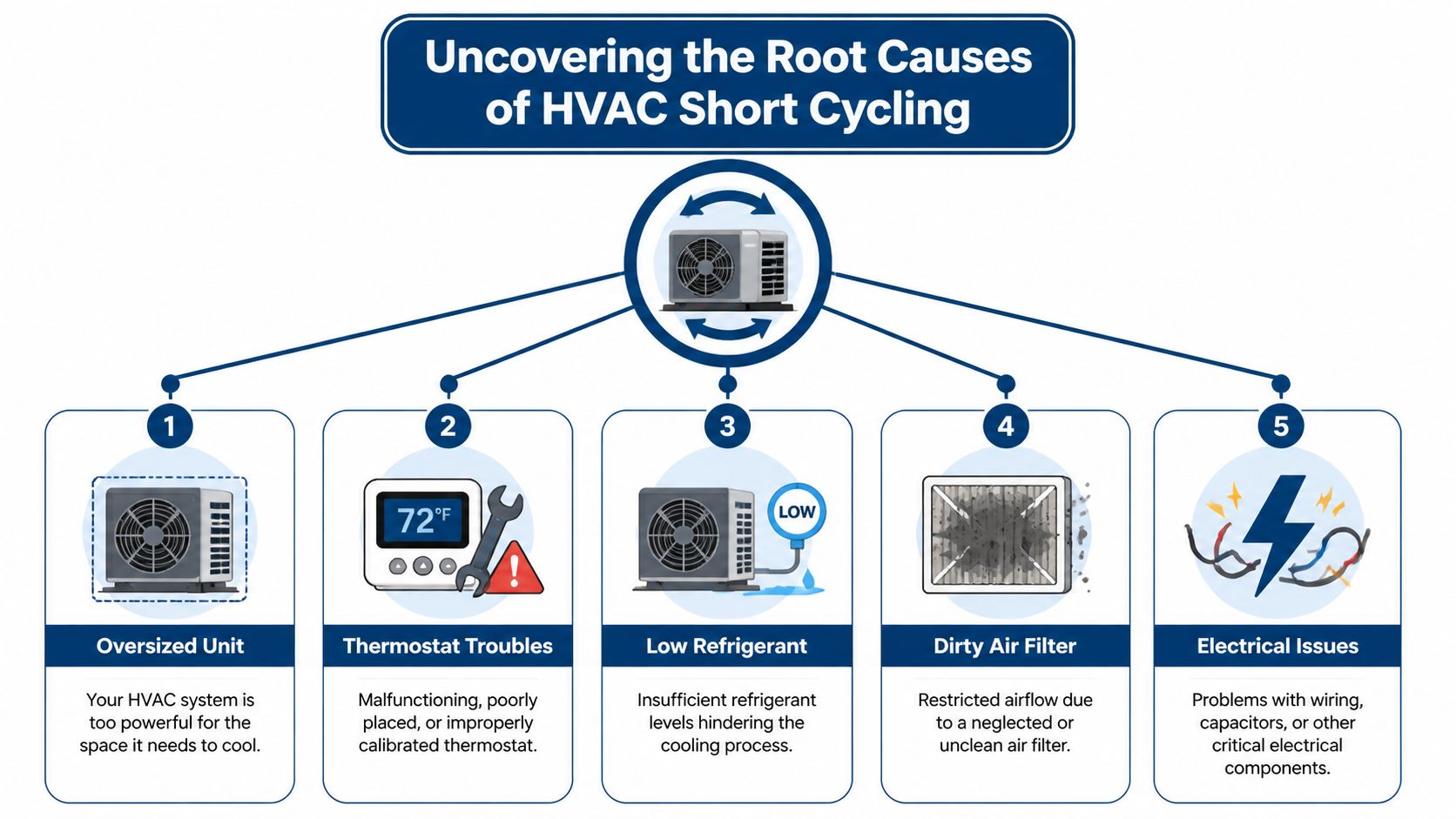
Short cycling is a symptom. The essential job is finding out what’s making the system behave that way.
Some causes are simple. Others are expensive if they’re ignored. The reason good diagnosis matters is that the same on-off pattern can come from very different problems, and each one needs a different fix.
Oversized equipment
This is one of the biggest causes, especially in homes that have been remodeled, added onto, or had an old unit swapped for a new one without a proper load calculation.
An oversized unit is like using a firehose to water one plant. Yes, water gets there fast. No, it doesn’t mean you did the job well.
According to Trane’s explanation of HVAC short cycling, equipment that’s 20 to 50% too large can satisfy the thermostat setpoint in under 10 minutes, causing 10 to 20% efficiency losses and missing the ideal indoor relative humidity range of 40 to 50%.
That last part matters in Phoenix. The oversized system may cool fast near the thermostat, but it often doesn’t run long enough to even out temperatures across the house or handle indoor moisture well.
A proper system sizing load calculation is what separates guesswork from actual sizing. Square footage alone isn’t enough. Window exposure, insulation, duct layout, occupancy, and renovations all affect what size system a home really needs.
Refrigerant issues
Low refrigerant or a refrigerant leak changes how the system transfers heat. When that happens, pressures get out of range, the coil may get too cold, and the compressor can overheat or shut down on safety controls.
Homeowners usually notice this as short runs, weak cooling, or ice where ice definitely shouldn’t be. This is also where a misdiagnosis gets expensive. Topping off refrigerant without finding the leak is not a real repair.
If the compressor has been stressed for a while, it’s worth understanding what replacement involves. This article on air conditioner compressor replacement gives a clear picture of why early diagnosis matters.
Thermostat problems
Sometimes the equipment is fine and the thermostat is making bad decisions.
That can happen when the thermostat is:
- Poorly placed: Near a sunny window, kitchen heat, or a supply vent
- Out of calibration: Reading the room inaccurately
- Improperly configured: Settings don’t match the equipment
- Failing electronically: Sending erratic calls for cooling
A thermostat that reads a warmer or cooler condition than the rest of the home can trigger short, uneven cycles. In larger homes, zoning or better thermostat placement often makes a bigger difference than homeowners expect.
Airflow restrictions
Restricted airflow is one of the most common service-call causes because it sneaks up on people.
Dirty filters, clogged coils, blocked return air, crushed duct runs, or too many closed supply vents can all choke airflow enough to trip protections or cause poor system behavior. The unit starts, can’t move air the way it should, gets stressed, and shuts down early.
Common airflow trouble spots include:
- Neglected filters
- Furniture blocking returns
- Closed interior doors in homes with pressure imbalance
- Dust-loaded evaporator coils
- Registers shut in rooms people don’t use
This is also where indoor air quality work can overlap with system performance. Duct sealing, airflow balancing, and filtration upgrades can help when the root issue goes beyond a simple filter swap.
Control board faults
Electrical problems are less visible, but they’re very real.
Loose connections, failing relays, weak capacitors, damaged wires, and control board faults can interrupt the normal sequence of operation. The result can look exactly like short cycling to the homeowner. The system tries to start, drops out, resets, and starts again.
When there’s concern about wiring condition or related electrical troubleshooting, homeowners sometimes benefit from outside electrical context too, such as this resource on Riverside electrical upgrades and repairs from Stay Grounded Electric. HVAC and electrical issues can overlap more than people realize.
These faults need testing, not guessing. Swapping parts until something works is how repair bills get inflated.
What Homeowners Can Safely Check and Diagnose
Before anyone opens a panel or touches wiring, there are a few safe things you can check on your own. These steps won’t fix every short cycling problem, but they can rule out simple causes and give a technician better information if you do need service.
Start with the basics. Check the thermostat setting, make sure the fan mode isn’t set oddly, and see whether the system is short cycling every time it runs or only during certain parts of the day.
Then look at airflow.
Safe checks that are worth doing
A clogged filter is the first thing I’d want a homeowner to inspect because it’s simple, safe, and commonly overlooked. If you’re not sure where yours is, this guide on where your air filter is in your house can help you find it.
Also walk the house and look for obvious restrictions.
- Check supply vents: Make sure rugs, furniture, and curtains aren’t blocking them.
- Check return grilles: These need open airflow too, not just the supply side.
- Check the thermostat area: If it’s near a lamp, sunny window, or heat-producing appliance, note that.
- Listen to the startup pattern: Does it click on, run briefly, then shut off the same way every time?
DIY checks vs professional diagnostics
| Symptom/Check | DIY Action (Safe for Homeowners) | Call a Pro When… |
|---|---|---|
| System turns on and off rapidly | Time a few cycles and write down what you observe | It repeatedly runs only briefly or the pattern is getting worse |
| Dirty air filter suspected | Inspect and replace the filter if needed | A fresh filter doesn’t change the behavior |
| Rooms feel uneven | Open all registers and clear blocked vents | Some rooms still stay hot or stuffy after airflow checks |
| Thermostat seems off | Confirm settings and replace batteries if applicable | The reading seems inaccurate or the system responds unpredictably |
| Air feels sticky indoors | Note when it happens, such as after showers or cooking | The home keeps feeling muggy even though cooling is running |
| Outdoor unit makes clicking or buzzing sounds | Observe from a safe distance and note the timing | The sound is frequent, harsh, or paired with poor cooling |
| Ice or frost is visible | Turn the system off and let it thaw | Ice returns, cooling is weak, or refrigerant issues are suspected |
Writing down what you see helps more than people think. A good symptom history often shortens the repair process.
Professional Fixes and Long-Term Prevention
Once the easy checks are done, the right fix depends on the root cause. For this reason, professional diagnosis earns its keep, because short cycling is one of those problems where the wrong fix wastes time and money.
What a technician should actually do
For an oversized system, the answer isn’t “tweak it and hope.” It’s verifying load and equipment match. That may involve reviewing past installation choices, checking duct performance, and using a system sizing calculation before recommending replacement or equipment changes.
For refrigerant problems, a real repair means locating the leak, repairing it if practical, evacuating properly, and charging the system to spec. For thermostat issues, the work may include relocation, recalibration, or upgrading to a control that better matches the system.
Electrical and board-related issues require meter-based diagnosis, inspection of contactors and capacitors, and checking the control sequence. That’s especially important when the symptom appears random.
One local option homeowners use for this kind of work is Comfort Experts, which handles cooling diagnostics, smart thermostat upgrades, zoned systems, IAQ improvements, and repair work across the Phoenix Valley.
Why variable-speed and two-stage systems help
Single-stage systems are more prone to that hard on-off behavior because they only know one speed. Full blast.
Two-stage and variable-speed systems can run longer at lower output, which helps with temperature consistency and indoor moisture control. In a climate like ours, that longer steady run is often what makes the house feel better, not just colder.
That’s also why thermostat choice matters. If you manage a rental or multi-property setup, it can help to choose smart thermostats for landlords with features that support better scheduling, alerts, and control habits. A thermostat won’t fix an oversized unit, but the right one can reduce control-related issues.
Prevention beats repair
The cheapest short cycling repair is the one you never need.
Seasonal maintenance catches the stuff homeowners usually don’t see. Coil buildup, airflow problems, weak electrical components, thermostat drift, drainage concerns, and early refrigerant symptoms often show up before the system completely fails.
A good maintenance visit should include more than a glance and a filter sale. It should involve actual inspection and testing. If you want to know what that should look like, this HVAC preventive maintenance checklist is a useful benchmark.
- Before summer: Check cooling operation, airflow, controls, and coil condition
- During service: Verify the system is completing proper cycles
- After repairs: Confirm the original symptom is gone, not just temporarily masked
That last point matters a lot. A short cycling problem that “seems better” for a week isn’t necessarily fixed.
When to Call Comfort Experts for Help
Some short cycling situations can wait a day. Others shouldn’t.
If your system won’t stay on for more than a couple of minutes, if you hear buzzing or rapid clicking from the outdoor unit, if you see ice on the refrigerant lines, or if the house keeps getting more uncomfortable while the system seems busier than ever, stop trying to nurse it along. Those are signs the problem may be moving past minor maintenance and into compressor, refrigerant, or control trouble.
Phoenix homeowners also get burned by waiting too long because the unit still produces some cool air. That partial operation fools people. They think, “It’s still running, so maybe it’s fine.” It may not be. Short cycling often means the system is working in a way that increases stress every time it starts.
This is also the point where online symptom-checking stops being enough. If you want more context on what a local repair visit typically involves, this page on AC repair service near me can help you understand what to expect.
The main takeaway is simple. If the system is noisy, erratic, icing up, shutting off too fast, or leaving your home cool-but-sticky, it’s time for professional diagnosis. That’s especially true in a Phoenix summer, when small AC problems don’t stay small for long.
If your system is showing signs of short cycling and you want a clear diagnosis instead of guesswork, contact Comfort Experts by calling 480-207-1239 or schedule service online.