
When you step into your garage in a Phoenix summer and the air hits you like an open oven, the usual advice can feel pretty useless. How to cool a garage in Arizona starts with understanding why garages here overheat so badly, and why the fix usually isn't “just add a fan.”
Stop the Heat at the Source Before You Add Cooling
By 4 p.m. in Mesa, a garage can feel hotter than the driveway outside. The sun has been beating on the door for hours, the attic above is cooking, and the concrete is holding heat like a storage battery. If you skip straight to adding a fan or AC, that heat still wins.
The first job is cutting the load.
Start with the garage door
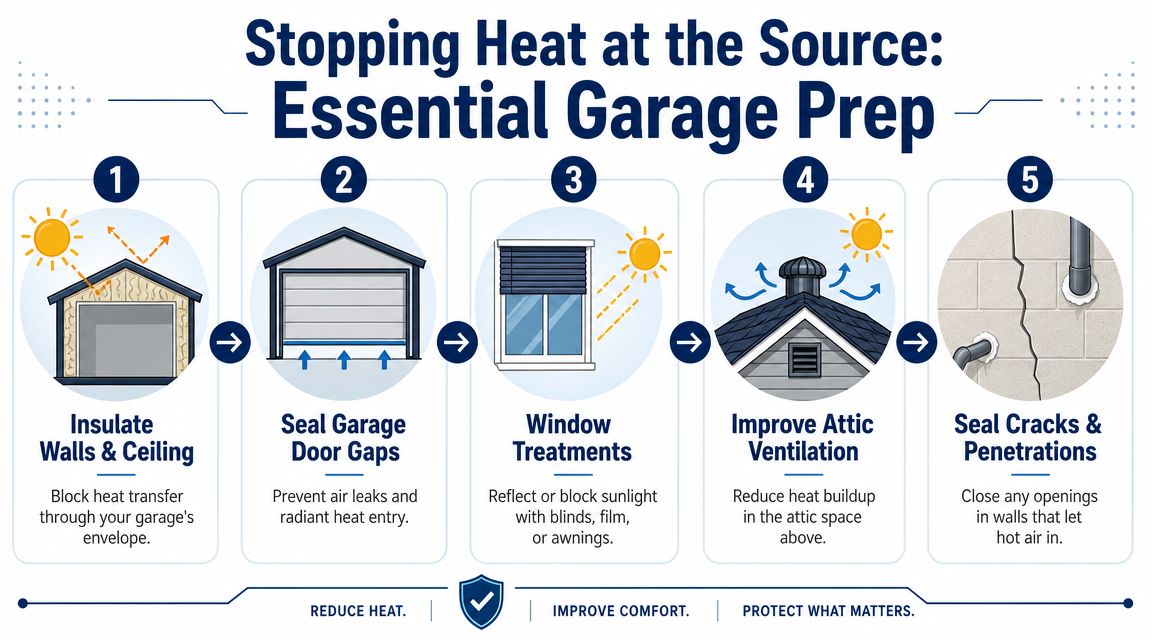
In Phoenix-area homes, the garage door is often the biggest source of heat gain. A thin steel door in direct west sun turns into a hot panel that keeps radiating inward well into the evening. Hunter's guidance on sun-exposed garages makes the same point. Sun exposure on the door can drive garage temperatures far above what most homeowners expect.
That does not automatically mean you need a new door. Sometimes the best return comes from a door insulation kit, fresh perimeter weatherstripping, and a proper bottom seal. If the door is warped, rattling, or near the end of its life, replacement starts making more sense. This overview of energy-efficient garage doors for Cleveland homes is useful for comparing insulated and non-insulated door construction, even though Arizona heat puts a different kind of stress on the garage.
Insulate the surfaces that are actually getting cooked
A lot of homeowners focus on one wall and miss the bigger problem. In our climate, the ceiling under a hot attic can be just as bad as the garage door, and sometimes worse. If the attic above the garage is poorly insulated or full of superheated air, that ceiling keeps sending radiant heat down all afternoon.
Look at the whole shell:
- Garage door: Usually the first weak point in west- and south-facing garages.
- Ceiling: A major heat source if there is attic space above.
- Exterior walls: Worth insulating if they take hard afternoon sun.
- Shared wall to the house: Important for comfort inside the home, even if the garage itself is not air conditioned.
Garage Living points out that garages are often under-insulated, and that matches what I see in older Valley homes. The problem in Arizona is not just keeping warmth in during winter. It is slowing brutal heat gain long enough for any cooling strategy to have a chance.
Seal the leaks before you spend money on cooling
This part is not exciting, but it saves money.
If daylight shows around the door, hot air is coming in. If dust collects along the threshold after a windy day, air is moving there too. In desert garages, small gaps matter because the outside air is already so hot.
Check these spots first:
- Top and side door seals
- Bottom seal and threshold
- Pipe, conduit, and cable penetrations
- Window trim and frame gaps
- The door from the garage into the house
Sealants, foam, and weatherstripping are cheap compared with running mechanical cooling against constant heat infiltration. Before adding any active system, it also helps to review practical HVAC energy saving tips so the garage project fits into the larger cooling load of the house.
Reduce direct sun if the garage faces west
Arizona sun control is different from the advice you see in milder climates. A little shade can help in Seattle. In Mesa or Phoenix, west sun on an unshaded garage door can overwhelm everything else you do.
Exterior shade works best because it stops heat before it reaches the door surface. Awnings, shade sails, solar screens, and even well-placed landscaping can lower the load. The trade-off is cost, appearance, and HOA limits. But if that door gets blasted every afternoon, shade often does more than people expect.
If you do these upgrades first, every cooling option that comes later works better and costs less to run.
Improve Airflow with Smart Ventilation
By mid-afternoon in Mesa, a garage can feel top-heavy. The floor is hot, the ceiling is worse, and the air just sits there. Before you spend money on more cooling, give that trapped heat a way out.
Ventilation lowers the temperature load inside the garage and makes every other cooling method work better. In Arizona, that matters more than a lot of national advice suggests. If you only stir the air around in a 115 degree garage, you do not solve much.
Use passive airflow first
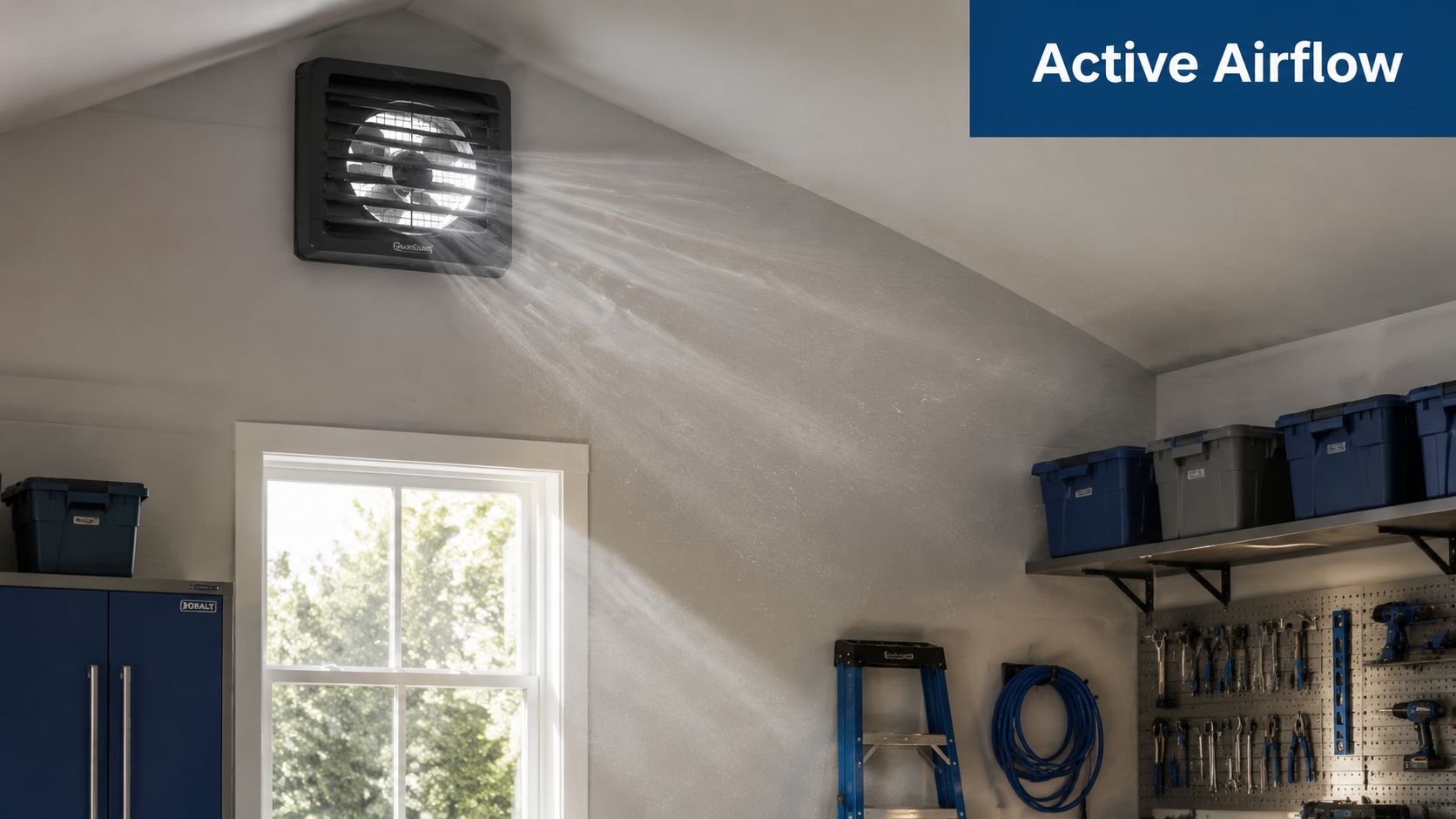
Good airflow starts with direction. Hot air collects high, so the goal is to let it leave high and pull replacement air from lower down. If both openings are high, heat hangs around. If the garage is packed with storage bins and cabinets, air gets trapped in dead zones and the whole room stays uneven.
A workable passive setup usually includes:
- High exhaust points: Gable vents, roof vents, or high wall vents where the hottest air collects
- Low intake points: Lower openings that let outside air replace what is exhausted
- Clear interior paths: Space for air to move across the garage instead of hitting stacked boxes and stopping
That last point gets overlooked all the time. I have seen garages with decent vents that still felt miserable because the upper corners were jammed with storage and the air had nowhere to travel.
Add mechanical ventilation when passive airflow falls short
For a larger garage, a workshop, or any space where you spend time, passive venting often needs help. A wall-mounted or ceiling exhaust fan can pull out the hottest air near the roofline, while a box fan or louvered intake on the opposite side brings replacement air across the room.
That setup works best when there is an actual path for the air to cross the space. A fan blowing into a closed, badly vented garage just recirculates heat. In Phoenix-area summers, that is the difference between air movement that feels useful and air movement that feels like a hair dryer.
If you are planning a full comfort upgrade later, it helps to understand how ventilation fits with equipment sizing. This guide to garage mini split costs and BTUs gives a good picture of what active cooling has to overcome if the garage still holds heat.
What fans help with, and what they do not
Fans improve skin-level comfort. That matters if you are working at a bench, lifting weights, or pulling a car in after sunset. But in extreme desert heat, a fan alone has limits. If the intake air is brutally hot, the fan still moves brutally hot air unless it is paired with exhaust and shade.
Ventilation also affects dust and air quality, especially in garages used for woodworking, grinding, or storing landscaping gear. If dust is getting pulled toward the house or into nearby rooms, garage-adjacent duct cleaning and airflow cleanup considerations are worth looking at.
Choose Your Active Cooling System
After insulation, sealing, and ventilation are handled, active cooling starts making sense. Homeowners in Phoenix, for instance, often seek a simple answer. The right system depends on how you use the garage.
A storage garage has one comfort target. A workshop where you spend hours building cabinets has another. A home gym in July has another.
For regularly occupied garages, HVAC-grade cooling like a mini-split is often necessary, but poor insulation significantly undermines any AC system. That's why sealing and insulating should happen before sizing and installation, as explained in AC Direct's garage AC guidance.
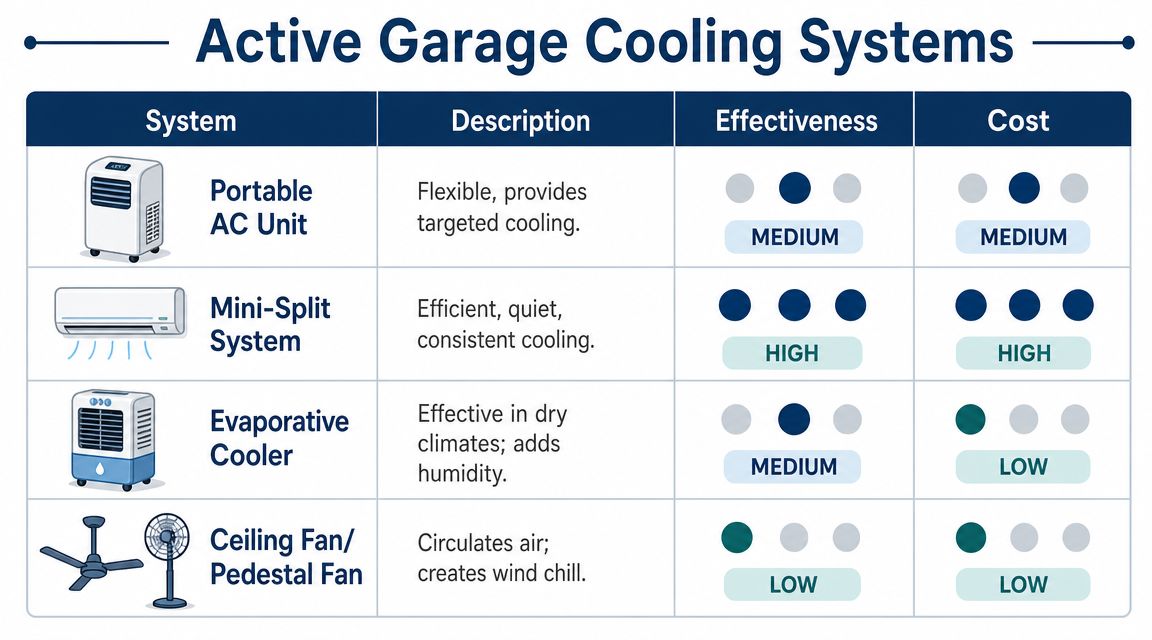
Garage cooling options compared
| Cooling Method | Best For | Upfront Cost | Operating Cost | AZ Climate Notes |
|---|---|---|---|---|
| Ceiling fan or pedestal fan | Spot comfort while working near one area | Low | Low | Helps you feel cooler, but doesn't lower air temperature |
| Evaporative cooler | Dry conditions and garages with decent airflow | Low | Low | Can work well in dry Arizona heat, but it adds moisture |
| Portable AC unit | Smaller garages or temporary cooling needs | Medium | Medium | Often underwhelming if the garage is leaky or poorly vented |
| Mini-split system | Regularly occupied garages, gyms, workshops | High | Medium | Best fit for steady comfort if the envelope is properly prepared |
Fans are comfort tools, not cooling systems
Floor fans, pedestal fans, and ceiling fans are cheap to run and easy to set up. They're useful when you need relief at a workbench or treadmill, but they don't change the actual air temperature.
Evaporative coolers fit Arizona, with limits
In hot-dry climates, evaporative coolers can be a smart middle ground. They often make sense in Arizona because our air is dry much of the year, especially before monsoon moisture rolls in.
But there's a catch. They add humidity to the air. If the garage is closed up tight or the weather shifts muggy, comfort can drop fast.
Portable AC units are common, but often disappointing
A portable AC sounds like the easy answer. Wheel it in, vent it out, plug it in, done. In practice, they're often the option people regret when the garage wasn't prepped first.
If the walls, ceiling, and door are still dumping heat into the room, the unit spends its time fighting infiltration and surface heat instead of making the space comfortable. Some garages also need electrical upgrades or dedicated breakers before adding active cooling equipment.
Mini-splits are the serious option
If you use the garage often and want reliable comfort, a ductless mini-split is usually the cleanest solution. It cools consistently, avoids ductwork, and gives much better control than trying to force conditioned air from the main house into the garage.
That's also where proper sizing matters. Square footage alone doesn't tell the full story in Arizona. Solar gain, door orientation, insulation quality, and how often the garage opens all affect performance. If you're comparing systems and trying to understand the planning side, this guide to garage mini split costs and BTUs is a helpful outside resource.
For homeowners weighing a garage system against whole-home equipment, this comparison of ductless mini-split vs central air is worth reading because the trade-offs are very different once a garage is part of the conversation.
One practical note. Comfort Experts does service and install ductless mini-split systems in the Phoenix area, and that type of system is often the straightforward answer when the garage is being used as real occupied space rather than just car storage.
Manage Humidity and Air Quality
A lot of garage cooling advice stops at temperature. That's only half the job.
Here's the thing. Comfort is also about how the air feels, what you're breathing, and whether the space starts smelling musty or chewing up your tools during monsoon season.
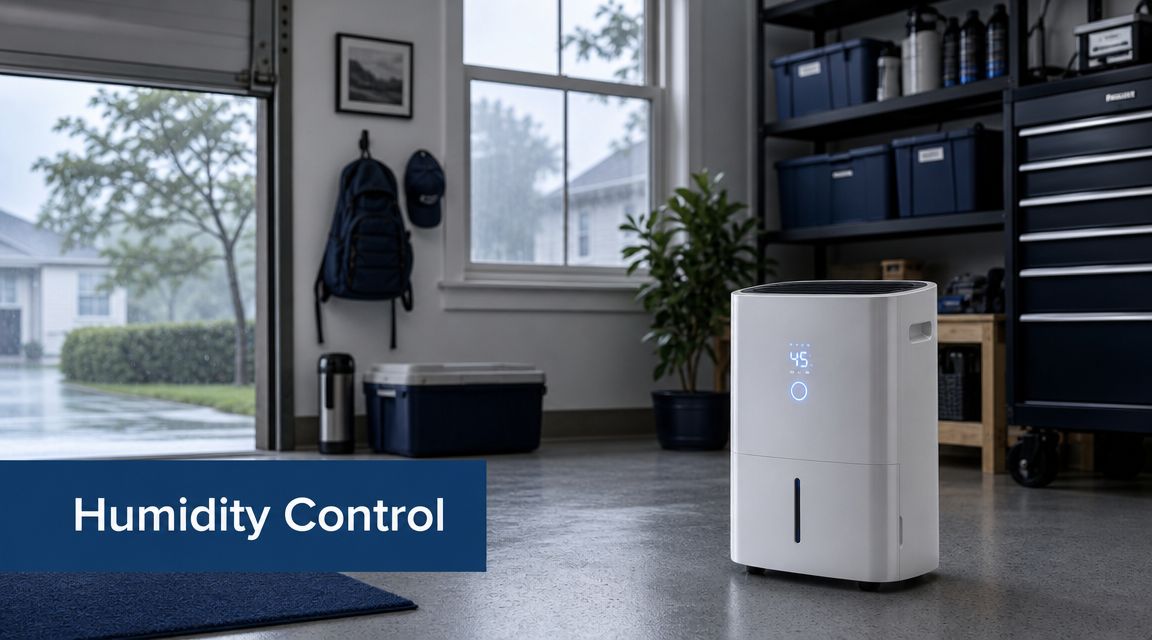
Many guides overlook humidity management, but it's essential for comfort. In humid climates, exhaust-only ventilation can pull in warm, moist air and create moisture problems, while a dehumidifier or mini-split is often a better fit than an evaporative cooler, as noted by This Old House in its garage cooling guidance.
Why monsoon season changes the equation
In dry spring conditions, an evaporative cooler may feel great. In a sticky August pattern, that same approach can leave the garage feeling clammy.
That matters if you keep any of this in the space:
- Tools and metal storage: Moisture encourages rust.
- Cardboard, fabric, or seasonal décor: Damp air can lead to musty odors.
- Workout gear: A muggy garage feels harder to use even when the thermostat number looks acceptable.
- Paints and chemicals: Air quality concerns get worse in a sealed, poorly managed space.
Air quality deserves the same attention as heat
A garage isn't a neutral air environment. Cars, lawn equipment, solvents, dust, and off-gassing all collect there. If you tighten the envelope without thinking about ventilation and filtration, you can create a more comfortable temperature but worse air.
That's why the right answer depends on how the garage is used.
- If it's mostly storage: Basic ventilation and moisture awareness may be enough.
- If it's a gym or hobby room: Filtration and controlled cooling matter more.
- If it's a workshop: You need to think about both heat and airborne particles.
If allergies or airborne irritants are part of the problem, these recommendations on the best air purifiers for allergies help frame what cleaner air requires beyond just moving air around.
DIY vs Pro What to Know for Cost and Safety
Some parts of a garage cooling project are very DIY-friendly. Some absolutely are not.
The dividing line is pretty simple. If you're sealing gaps, adding weatherstripping, installing insulation, or setting up a fan, a handy homeowner can often do that work safely. Once electrical capacity, large ventilation cuts, or refrigerant equipment enters the picture, the risk changes.
Bull Buildings frames the proper sequence clearly. Control heat gain with insulation and sealing first, remove trapped heat with ventilation second, and add active cooling last. Reversing that order is a common and costly mistake because a powerful AC in a leaky garage will underperform and waste energy, according to their garage cooling article.
Good DIY jobs
These usually make sense for homeowners who are comfortable with basic tools:
- Weatherstripping the garage door
- Caulking cracks and penetrations
- Adding a threshold seal
- Installing insulation kits where appropriate
- Setting up pedestal fans, box fans, or portable evaporative coolers
- Decluttering to improve airflow paths
These jobs have a strong payoff because they improve every cooling method that comes later.
Jobs that should stay on the pro side
Mistakes here get expensive, unsafe, or both:
- Adding a dedicated electrical circuit
- Installing a mini-split system
- Making major wall or roof penetrations for powered ventilation
- Equipment sizing for a regularly occupied garage
- Solving nuisance breaker trips or panel capacity issues
A bad install can leave you with poor performance even if the equipment itself is fine. That's what frustrates homeowners. They spent real money and still don't like the result.
The cost trade-off is real
DIY saves money upfront. No question.
But if a portable AC is fighting an unsealed garage, or a mini-split is installed without proper sizing and electrical planning, you can end up paying twice. Once for the wrong solution, then again to correct it.
If you're trying to weigh repair, upgrade, or install decisions against the rest of your HVAC budget, this breakdown of the cost to fix AC helps put those decisions into a broader context.
Your Garage Cooling Questions Answered
Is cracking the garage door open a good cooling strategy
Usually, no. It can help temporarily if you're actively exhausting hot air with a fan, but by itself it's inefficient and can create security, pest, and dust problems. In Arizona, it also invites in more heat during the worst part of the day.
Can I tie my garage into my home's existing central AC
In most cases, that's a bad idea. Garages have different load conditions, frequent door cycling, and possible fume concerns. Even when it seems convenient, it can throw off system balance and create comfort problems elsewhere in the house.
Will cooling the garage raise my electric bill
Yes, it can. But the amount depends heavily on the prep work and the equipment choice. A sealed and insulated garage is much more manageable than a leaky one, and a system matched to actual use is usually a better investment than trying to brute-force comfort with undersized or temporary equipment.
What if I only want the garage cooler when I'm working out there
That's a different target than all-day conditioning. Spot airflow, ventilation, and a system you can run only when needed may be enough. If you want the space to feel like a finished room every day, you're usually in mini-split territory.
Is an evaporative cooler always a good idea in Phoenix
Not always. It can be a solid option in dry weather, but monsoon humidity changes how it feels. If the garage already feels damp or you're worried about rust, odors, or sticky air, a dehumidifying cooling method often makes more sense.
What's the most common mistake people make
Buying cooling equipment before fixing the garage shell. If the door, ceiling, walls, and air leaks are still working against you, almost any cooling method will feel weaker than expected.
Enjoy Your Cool Comfortable Garage
A garage in Arizona doesn't have to stay brutally hot. If you stop heat at the source, vent trapped air intelligently, and choose the right cooling method for how you use the space, you can turn that oversized oven into a functional part of the house.
That might mean a better place to park, a workshop you'll use in summer, or a garage gym that doesn't feel punishing by mid-morning. The right answer is rarely the flashiest one. It's the one that matches the garage, the sun exposure, and your comfort expectations.
If you want an honest plan for your garage, Comfort Experts can help you sort through insulation, airflow, and cooling options without guessing. For a professional assessment, you can call 480-207-1239 or schedule service online.