
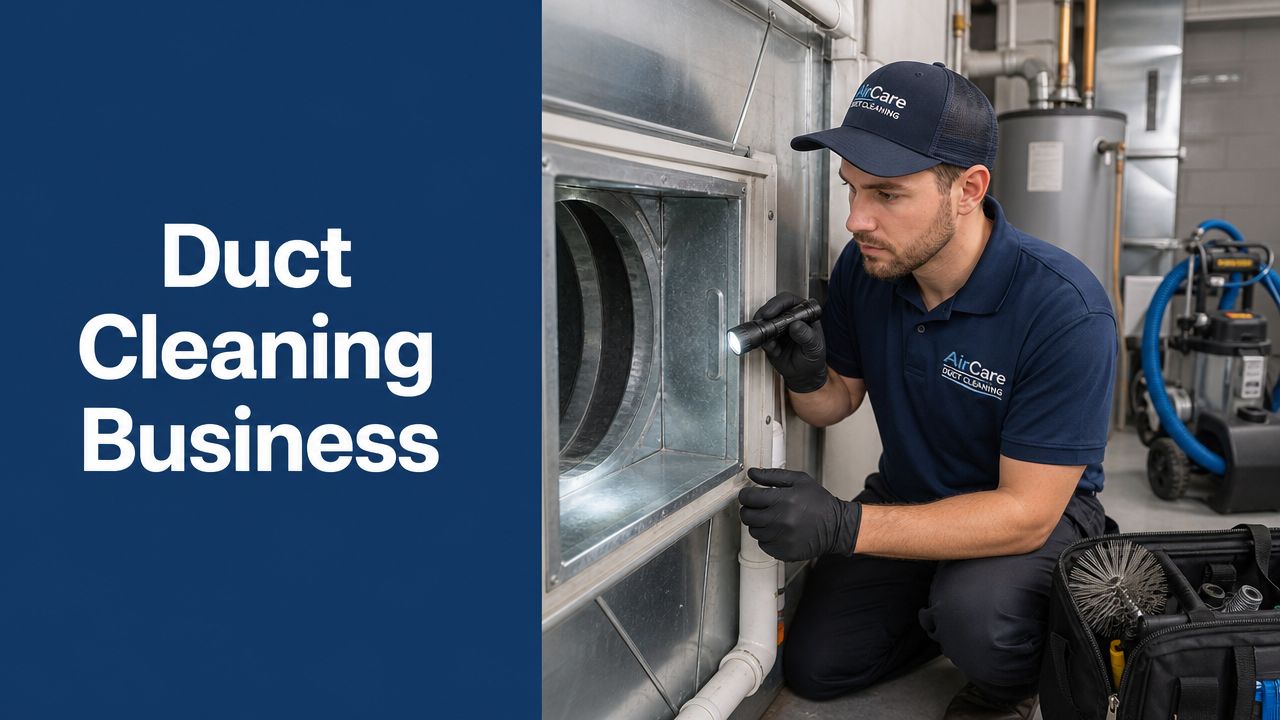
If you're looking at a duct cleaning business for sale right now, you're probably asking the same question most buyers ask: is this a solid service business or just a shiny listing with weak fundamentals? In Phoenix and Mesa, that answer depends less on the headline price and more on how the company wins jobs, performs the work, and keeps customers trusting them in a dusty, competitive market.
The Market Opportunity in Duct Cleaning Today
Phoenix is a practical market. Homeowners deal with dust, long cooling seasons, remodel debris, rental turnover, and indoor air quality concerns that don't disappear on their own. That doesn't mean every duct cleaning company is automatically valuable. It means the right operator, with the right process and reputation, has room to build a durable local business.

A lot of buyers get pulled in by the simple idea. One truck, some equipment, a few techs, and steady residential demand. Sometimes that works. Sometimes it doesn't. The businesses that hold up are usually the ones that combine route density, disciplined operations, and a reputation that keeps the phone ringing even when ad costs rise or a slow season hits.
A real example makes that clearer. A documented Charlotte, North Carolina duct and dryer vent cleaning business was listed at a $200,000 asking price with $130,000 in reported profit, $356,000 in revenue, 3 employees, about $2,500 in inventory, and $65,000 in furniture, fixtures, and equipment included. It was also described as founded in 2023 and already having 575+ five-star Google reviews, according to this documented duct cleaning business listing example.
That example isn't Phoenix, but the lesson applies here. In the Valley, buyers should care about whether the company has clustered service areas, strong Google visibility, and a clean customer experience. A duct cleaning company that bounces all over the metro with no route logic burns time and fuel. One that owns a few neighborhoods or city clusters can run tighter schedules and protect margins.
Why Phoenix gives this niche a real shot
The local market has traits that can help a buyer if the business is built correctly:
- Dust-heavy conditions: Homes collect buildup faster than many owners expect, especially after remodeling, roof work, or extended HVAC runtime.
- IAQ-focused homeowners: Families dealing with odor, visible debris, airflow complaints, or allergy concerns often want inspection and cleaning from a company that explains the work clearly.
- Cross-sell potential: Duct cleaning often sits next to dryer vent cleaning, inspection work, filtration upgrades, and duct sealing opportunities.
- Commercial demand: Property managers, light commercial spaces, and tenant improvement projects can create steadier work than pure one-off residential jobs.
That last point matters more than many listings admit. A duct cleaning company with only coupon-driven residential calls is much different from one with property management relationships and repeat maintenance work.
What works and what usually doesn't
I've seen buyers get excited about businesses that look busy online but have no real operating discipline underneath. That's dangerous in Phoenix, where homeowners expect fast scheduling, clear communication, and crews that don't leave a mess.
What tends to work:
- Defined service area: Dense routes in Mesa, Gilbert, Chandler, Tempe, or selected Phoenix pockets.
- Strong review profile: Customers trust local service brands with visible proof of good work.
- A broader IAQ conversation: A company that can discuss inspection findings and system condition tends to sell better than one that only pushes a basic clean.
- Operational credibility: Techs show up with real equipment, not a vague promise and a shop-vac approach.
What usually disappoints buyers:
- Owner-dependent sales: If every booked job comes from the seller's personality, that's a fragile asset.
- Discount-heavy lead flow: Low-quality leads often turn into price-shopping customers and weak retention.
- No process documentation: The handoff after closing gets messy fast.
- Thin local positioning: If the company has no clear foothold in a market segment, growth is harder than the listing suggests.
For broader deal-screening context, this expert guide on acquiring cleaning businesses is useful because it helps buyers think beyond the listing summary and into transferability, risk, and operating reality. If you want local service context, this look at duct cleaning in Mesa, AZ shows how homeowners in this market typically think about the service.
How to Properly Value a Duct Cleaning Business
An asking price is only a starting point. Buyers get in trouble when they treat it like proof of value instead of an opening number in a negotiation. The right question isn't "What is the seller asking?" It's "What am I buying, and how stable are those earnings after the seller leaves?"
Start with owner earnings, not vanity revenue
For small service businesses, buyers often focus on Seller's Discretionary Earnings, or SDE. That's the money available to a working owner after adjusting the books for expenses that may not continue under new ownership. You don't need a finance degree to use that concept well. You do need clean records and the discipline to challenge what's in them.
BizBuySell reports that in the U.S. resale market for established cleaning businesses, the median asking price is about $289,950, with median annual sales of $499,348 and median annual owner earnings of $152,000, according to these cleaning business resale benchmarks. For a duct cleaning buyer, those numbers are useful as a rough market reference point, not a shortcut to valuation.
A Phoenix buyer should compare the target company against those benchmarks and then ask harder local questions. Is the revenue tied to duct cleaning only, or does it include dryer vent work, inspections, and related IAQ services? Are those owner earnings real, or are they padded by deferred maintenance, underpaid labor, or personal expenses running through the business?
Read the P&L like an operator
You don't need to become a CPA. You do need to read a profit and loss statement like someone who may have to make payroll next month.
Look for these pressure points:
- Owner add-backs: Some are legitimate. Some are wishful thinking. If the seller adds back too much, the business may not support the price.
- Marketing spend: If booked work depends on heavy ad spend, that cost belongs in your real model.
- Vehicle and equipment expense: Aging vans and undermaintained negative air equipment can hide future replacement costs.
- Payroll structure: Cheap labor can make earnings look better on paper than they will in actual operation.
A lot of first-time buyers overvalue the equipment and undervalue the customer base. In reality, both matter, but not equally in every deal.
Separate hard assets from goodwill
A duct cleaning company usually includes a mix of tangible and intangible value. Treat them differently.
| Value Component | What It Includes | What to Test |
|---|---|---|
| Hard assets | Trucks, vacuums, agitation tools, compressors, office equipment | Condition, maintenance history, age, transfer rights |
| Digital assets | Website, Google Business Profile, phone numbers, CRM, call recordings | Ownership access, login control, policy compliance |
| Market goodwill | Reviews, local reputation, repeat customers, referral relationships | Whether trust transfers after the seller exits |
| Revenue base | Residential jobs, commercial contracts, maintenance-style work | Repeatability, seasonality, concentration risk |
That middle layer matters a lot in Phoenix. The company may have a recognizable local brand, but if the seller personally answers every call and closes every estimate, the goodwill is weaker than it appears.
One more point. If the company also offers related air-distribution services, understand how those revenues are priced and fulfilled. This discussion of Aeroseal duct sealing reviews is useful because it highlights how buyers should think about specialized duct services differently from standard cleaning. They don't carry the same labor pattern, equipment expectations, or customer decision process.
A simple valuation gut check
Before you get fancy, ask:
- Can I explain where the earnings come from?
- Would those earnings survive if the seller took a month off?
- Do the reviews, phone numbers, and customer records transfer?
- Will I need immediate reinvestment in equipment, labor, or marketing?
If you can't answer those clearly, the price isn't the problem yet. The uncertainty is.
Your Financial Due Diligence Checklist
Deals get real. Sellers talk about "great margins" and "steady demand" all the time. Buyers need to verify how revenue is produced, how stable it is, and how much disappears if the current owner walks away.
The biggest blind spot in many duct cleaning acquisitions is lead quality. Existing content often assumes demand is stable, but acquisition value depends heavily on how the company acquires leads. Buyers should ask for channel mix, customer retention, average ticket size, and the percentage of revenue from recurring maintenance agreements versus one-time cleanings to understand the business's true stability, as noted in this industrial cleaning business marketplace context.
Financial Health Check
| Metric | What to Ask For | Why It Matters |
|---|---|---|
| Channel mix | Lead source breakdown by phone, website, referrals, Google Business Profile, paid ads, property managers | Shows whether demand is diversified or fragile |
| Customer retention | Repeat customer records and rebooking behavior | Indicates whether service quality creates lasting value |
| Average ticket size | Job invoices by service type | Helps you see if revenue comes from healthy jobs or low-value volume |
| Recurring maintenance agreements | Service agreement list and renewal records | Repeat work is more dependable than one-time cleaning calls |
| Customer concentration | Top accounts and revenue by customer type | A business can look stable until one account leaves |
| Accounts receivable quality | Aging report and collection history | Slow-paying customers can squeeze cash flow after closing |
What to demand before you move forward
Ask for records in a way that makes manipulation harder. Don't just accept screenshots or a spreadsheet built for the sale. Ask for bank statements, tax returns, invoices, merchant processing records, and a customer export from the field service platform or CRM.
Review the business in layers:
- Revenue layer: Match deposits to invoiced work.
- Customer layer: Identify one-time jobs versus repeat relationships.
- Lead layer: Find out what caused the phone to ring.
- Margin layer: Check whether jobs are priced well enough to survive rising labor and marketing costs.
In Phoenix, I'd pay extra attention to referral concentration. Some duct cleaning companies get a large share of work from a few HVAC shops, restoration firms, or property managers. That can be excellent if the relationships are documented and likely to stay. It can also collapse quickly if those referrals were personal favors to the seller.
Revenue quality beats headline volume
A company doing a lot of one-off residential jobs can still be worth buying. But that model needs stronger marketing systems, stronger review velocity, and stronger call handling. A business with some commercial repeat work or ongoing property relationships usually has a firmer floor.
Don't ignore financing pressure either. If you're using debt, your margin for error gets smaller. You need enough working capital to absorb slower months, staffing changes, and equipment repairs without panicking. This page on HVAC financing options is geared toward service affordability on the customer side, but it also reminds buyers of a bigger truth in this trade: cash flow discipline matters because HVAC-related work rarely stays perfectly smooth month to month.
Questions that expose weak listings fast
Use direct questions:
- Which leads come from the owner personally?
- What happens to booked volume if paid ads are paused?
- How many customers are commercial, property-managed, or repeat?
- Which services have the strongest close rate and least callbacks?
- What does the calendar look like without promotional discounts?
Weak sellers get uncomfortable here. Strong sellers usually have answers, reports, and examples.
A Deep Dive into Operational Due Diligence
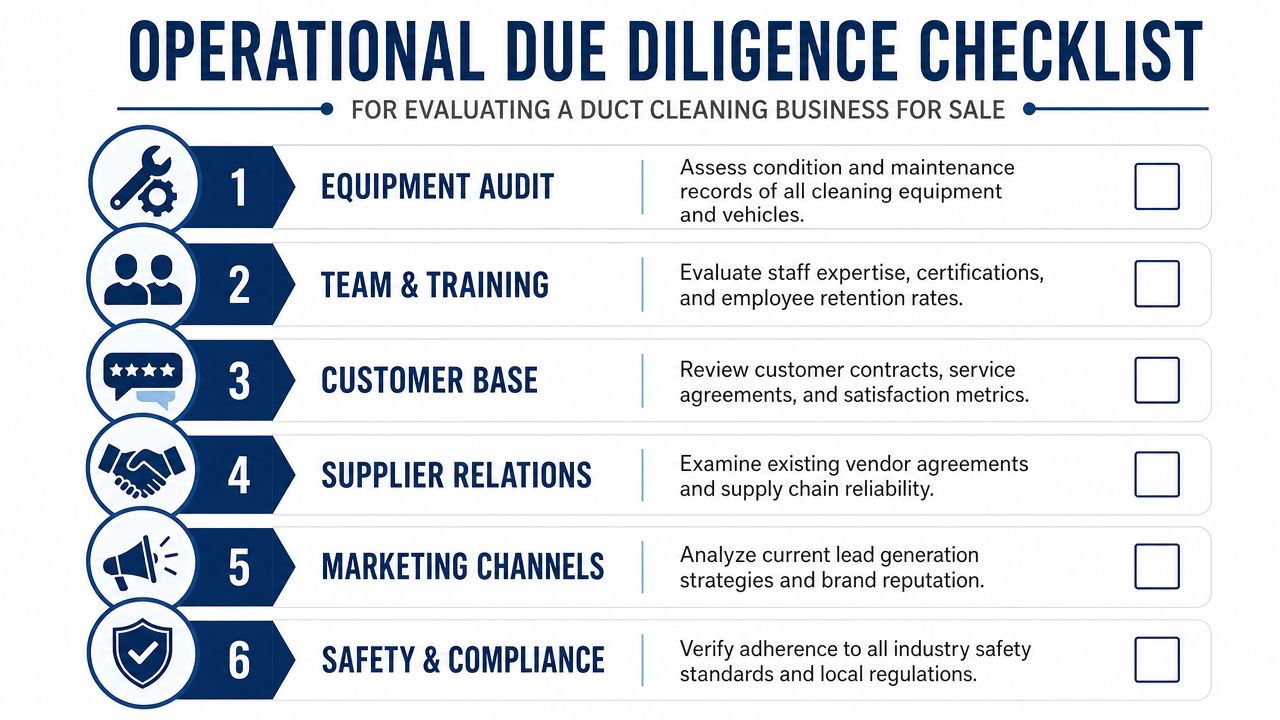
A duct cleaning business can have decent books and still be a poor buy. That's common when the company has weak field standards, inconsistent staffing, or equipment that can't support professional source-removal cleaning. Buyers who skip operational diligence usually inherit callbacks, employee turnover, and review problems.
The cleaning standard matters more than the sales pitch
A practical due-diligence method is to verify the business follows the NADCA source-removal standard, requiring negative-pressure containment and mechanical agitation. Buyers should confirm the business owns the right tools, like rotary brush systems and high-performance vacuums, not just basic equipment, based on this duct cleaning equipment and standards overview.
That one point eliminates a lot of weak operators.
If the crew's process is basically "show up, vacuum what they can reach, and leave," you're not buying a credible duct cleaning company. You're buying a reputation problem waiting to happen. Customers in Phoenix may not know every technical term, but they know when a crew looks prepared, protects the home, and explains what they're doing.
What to inspect in the field
Don't rely only on the asset list in the purchase agreement. Put your eyes on the actual tools, vehicles, and workflow.
Check these areas:
- Equipment condition: Look at the vacuums, agitation tools, hoses, access tools, compressed-air devices, and vehicle setup.
- Maintenance habits: Ask for service records, replacement patterns, and backup equipment plans.
- Crew workflow: Watch how the team sets up containment, protects floors, manages registers, and documents the job.
- Dispatch quality: Review route planning, arrival windows, and how reschedules are handled.
- Job documentation: Look for before-and-after records, checklists, photos, and customer signoff.
The people can carry the business or sink it
In a small duct cleaning operation, one lead technician often defines service quality. If that person leaves after closing, the business may lose more than labor capacity. It may lose process discipline, customer trust, and training continuity.
Ask direct staffing questions:
- Who knows how to perform the work well?
- What training has each technician completed?
- How are crews paid, and does pay encourage rushed jobs?
- Who handles customer complaints and callbacks?
- Would key employees stay through a transition?
A seller may describe the team as "solid" or "loyal." That isn't enough. You need names, roles, pay structure, and a sense of who keeps the operation stable day to day.
Operational maturity also shows up in adjacent services. A company that can discuss system cleanliness, airflow concerns, and broader HVAC maintenance usually has better customer conversations than one that only sells a basic cleaning package. For buyers looking at commercial crossover, this commercial HVAC maintenance checklist helps frame how disciplined service companies document work and manage system condition.
A weak process leaves clues
Red flags tend to show up in plain sight:
- No standard job checklist
- No photo documentation
- No clear script for educating customers
- Dirty or disorganized trucks
- Techs improvising instead of following a repeatable method
- No distinction between inspection, cleaning, and upsell work
One factual local example worth knowing: Comfort Experts offers duct-system inspection and source-removal cleaning as part of its air duct cleaning process. That matters because buyers should look for operations built around defined inspection and cleaning steps, not just vague service descriptions.
Navigating Licenses, Insurance, and Financing in Arizona
In Arizona, compliance isn't paperwork theater. It's part of what you're buying. A duct cleaning listing can look attractive until you find out the business has loose insurance records, unclear licensing status, or a history of making claims the service can't support.

A key due diligence angle is verifying regulatory compliance and legitimacy. The EPA and NADCA have specific guidelines, and buyers should investigate a company's service-compliance records, certifications, and insurance history, because many listings focus only on price and EBITDA, as discussed in this duct cleaning deal due diligence commentary.
What Arizona buyers should verify early
In the Phoenix and Mesa area, don't wait until the end of the deal to sort out legal and insurance details. Do it near the front.
Focus on:
- License position: Confirm whether the business's services overlap with work that requires contractor licensing and whether the existing structure supports legal operation after transfer.
- Insurance stack: Review general liability, commercial auto, workers' compensation where applicable, and any claims history.
- Business entity records: Confirm the seller owns the assets, trade name, phone numbers, website, and customer records being sold.
- Compliance language: Check what the company promises in ads, estimates, and website copy. Exaggerated health claims can create risk fast.
If you're buying in Arizona, call the relevant state and local offices yourself. Don't outsource all of that judgment to the seller, broker, or even your lender.
Asset purchase or entity purchase
Most small buyers are better protected in an asset purchase. That's because you're selecting the assets you want and reducing the chance of inheriting hidden baggage. An entity purchase can still make sense in some situations, but it deserves tighter legal review.
A basic comparison helps:
| Deal Structure | Typical Appeal | Main Caution |
|---|---|---|
| Asset purchase | Cleaner transfer of selected equipment, customer list, branding, and goodwill | You still need to verify what can legally and practically transfer |
| Entity purchase | May preserve contracts or operating continuity more directly | Can carry forward obligations and risks you didn't expect |
Financing needs realism, not optimism
Most buyers underestimate post-close cash needs. They budget for the acquisition, then get surprised by truck issues, payroll timing, ad spend, and software changes. That's one reason I tell people to budget the transition, not just the purchase.
Seller financing can help align incentives if the seller believes in the business staying healthy after closing. Bank financing can work too, but lenders will care about records, deal structure, and your ability to operate the company. If you need a practical primer on planning compliance-related startup and transfer costs, this guide to business license fees and budgeting is a useful place to organize your thinking.
Ensuring a Smooth Transition for Future Growth
The closing isn't the finish line. It's the handoff. Buyers who treat transition like an afterthought often lose employees, fumble customer communication, and spend the first few months reacting instead of operating.
The first priority is retention. Keep the team calm, keep the phones answered, and keep the customer experience familiar enough that nobody feels the business has been disrupted. If the seller has key referral relationships with property managers, HVAC companies, or commercial accounts, those introductions need to happen early and directly.
Protect the handoff
Put the transition in writing. Don't rely on a handshake and a vague promise that the seller will "be around if needed."
Your transition plan should cover:
- Seller involvement: Define how long the seller stays available and what they must help transfer.
- Employee communication: Tell the team what is changing and what isn't.
- Customer messaging: Notify major accounts carefully. Smaller residential customers may just need continuity in phone handling and branding.
- System access: Secure logins, call tracking, CRM access, website ownership, and review platform controls immediately.
You know what? This is also where a lot of hidden value is realized. Once the business is stable, the growth path usually becomes clearer than it looked in the listing.
Grow from adjacent services, not random expansion
The easiest early wins usually come from tightening execution and expanding services that already fit the customer base. In Phoenix, that can mean better inspection practices, stronger dryer vent workflows, duct sealing conversations where appropriate, cleaner commercial outreach, or more disciplined follow-up after completed jobs.
A few practical growth moves stand out:
- Retain and train key staff: Stability buys you time to improve systems.
- Standardize the job experience: Consistent checklists, photos, and customer education reduce callbacks.
- Target repeatable accounts: Property managers and commercial clients can smooth the ups and downs of purely residential demand.
- Create a service ladder: Inspection, cleaning, airflow concerns, filtration discussions, and maintenance conversations can fit naturally when the need is real.
For buyers thinking beyond one-time jobs, a structured HVAC maintenance plan is a useful model for recurring customer relationships. The lesson isn't that every duct cleaning company should copy that exact structure. It's that recurring contact and system-based service relationships are far more durable than chasing one-off calls forever.
A good acquisition should leave you with a cleaner runway, not a mess to untangle. If the people stay, the process holds, and the lead flow is transferable, you've got something worth building on.
If you're weighing a duct cleaning acquisition in Phoenix or Mesa and want input from a local HVAC team that understands duct systems, source-removal cleaning, and what customers here expect, contact Comfort Experts at 480-207-1239 or schedule service.