
See that metal box humming away in your yard? That's the unsung hero of your Phoenix home, your outside air conditioning unit. Let me explain: this is the heart of your entire cooling system, working tirelessly to pump the brutal Arizona heat out of your house, especially when the temperatures really start to climb. Understanding this piece of equipment is the key to staying comfortable, keeping your energy bills in check, and—most importantly—avoiding a catastrophic breakdown during a 115-degree July afternoon.
The Unsung Hero of Your Phoenix Home
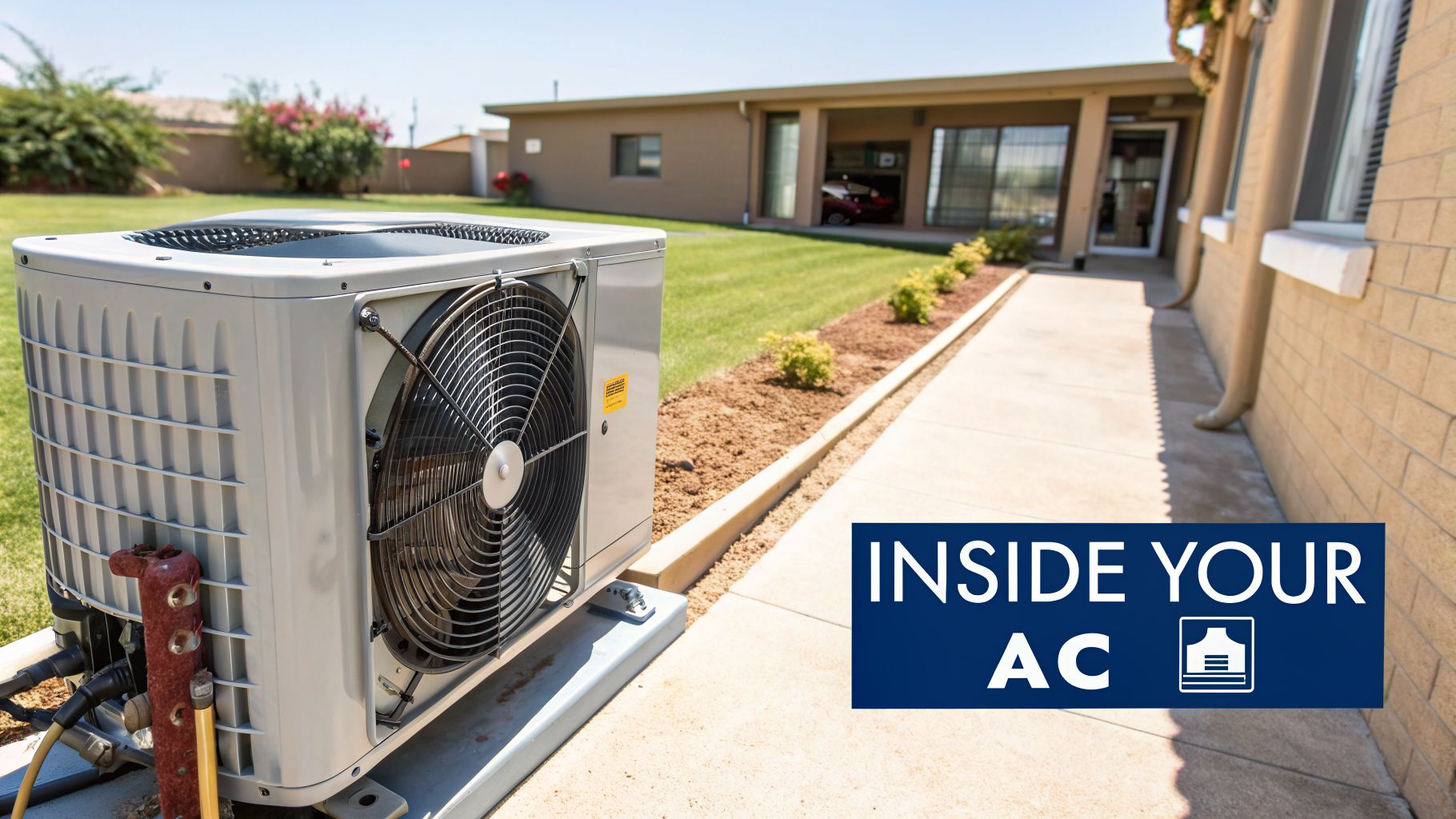
In the scorching Phoenix heat, your air conditioner isn't a luxury; it's a lifeline. The most visible part of this whole setup is the condenser unit, which is the proper name for that outside box. It's the workhorse that battles triple-digit temperatures day in and day out, and giving it the attention it deserves is non-negotiable for survival in the Valley of the Sun.
This guide, put together by the local team here at Comfort Experts, is written specifically for homeowners in the Phoenix area. We've been servicing AC units in this climate for years, and we're going to skip the confusing technical jargon and give you practical, real-world advice to help you understand, maintain, and even troubleshoot your system. Forget the generic tips you'd find online—we’re talking about solutions built to stand up to haboobs, relentless sun, and all the unique challenges our desert climate throws at our cooling equipment.
Why Your AC Unit Matters More Than Ever
You know what? The data confirms it: the demand for reliable cooling is only going up. The global air conditioning market is expanding at a breakneck pace, projected to grow from $146.5 billion in 2026 to an estimated $251.8 billion by 2036. This massive growth is fueled by rising global temperatures and more people moving into cities. Discover more insights about these air conditioning market trends if you're curious about the bigger picture.
So, what does this global trend mean for you, right here in Phoenix? It means manufacturers are pouring money into developing more durable, efficient, and smarter AC units. And that innovation translates directly into better options for your home.
For Phoenix residents, this means access to cutting-edge technology designed to handle extreme heat more efficiently, ultimately leading to better comfort and lower energy bills during our intense summer months.
This market boom has some real, tangible benefits when you're looking to upgrade or replace your system.
What You Can Expect
- Advanced Cooling Technology: Newer units are just plain better at handling the sustained, high temperatures we see all summer long in Arizona.
- Greater Energy Efficiency: Modern systems come with much higher SEER2 (Seasonal Energy Efficiency Ratio 2) ratings. Think of it like MPG for your car—a higher number means it uses less electricity to do the same amount of cooling, which saves you money.
- Smarter Controls: The latest systems integrate seamlessly with smart thermostats. This gives you incredibly precise temperature control, lets you monitor energy use from your phone, and even allows for remote adjustments. It's an unprecedented level of command over your home’s comfort.
Getting to know your outside air conditioning unit is the first real step toward a cooler, more comfortable, and more cost-effective summer. In the next few sections, we'll dive into exactly how this vital piece of equipment works, how to spot the early signs of trouble, and what you can do to keep it running smoothly.
What's Inside Your Outside AC Unit
That big metal box humming away in your yard does the heavy lifting to keep your home cool through a Phoenix summer. It might look complicated, but once you know the handful of key parts working inside, you’ll have a much better handle on how your AC works. As technicians with years of field experience, we find that homeowners who understand the basics are better at spotting small problems before they become big, expensive ones.
Let's walk through the four main players inside your condenser unit. Think of them as a four-person crew. If one person doesn't do their job, the whole team—and your home's comfort—falls apart.
Key Components of Your Outside AC Unit
Here’s a quick look at the essential parts inside your condenser unit and what they do. We'll break down each one in more detail below, but this responsive table gives you the at-a-glance version.
| Component | Primary Function | Simple Analogy |
|---|---|---|
| Compressor | Pressurizes refrigerant to heat it up. | The heart of the system, pumping refrigerant. |
| Condenser Coils | Release collected heat into the outside air. | The radiator of a car, getting rid of heat. |
| Fan | Pulls air through the condenser coils. | A giant fan blowing on the radiator to cool it. |
| Contactor | Controls the power to the compressor and fan. | A light switch that turns the system on and off. |
Now that you have the cheat sheet, let's look at how this crew works together to move all that heat from your living room to the great outdoors.
The Compressor: The Heart of the System
The compressor is the single most important—and most expensive—part of your outdoor unit. Its job is to take the cool, low-pressure refrigerant gas coming from inside your house and squeeze it. Hard.
This process dramatically increases the refrigerant's pressure and temperature, turning it into a super-hot gas. It’s the true workhorse of the system, acting like a heart that pumps the refrigerant (the lifeblood) through the copper tubing (the veins). When a compressor fails, it’s a major repair, which we cover in our guide to air conditioner compressor replacement.
The Condenser Coils: The Heat Radiator
After leaving the compressor, that hot refrigerant gas flows into the condenser coils—those thin metal fins that wrap around the outside of the unit. Their entire purpose is to get rid of all the heat your AC pulled out of your home.
As the fan pulls our hot Phoenix air across these coils, the heat transfers from the refrigerant to the outside air. This causes the refrigerant to cool down and condense back into a liquid, ready for its next trip inside. It’s the exact same principle as the radiator in your car, which uses airflow to cool the engine.
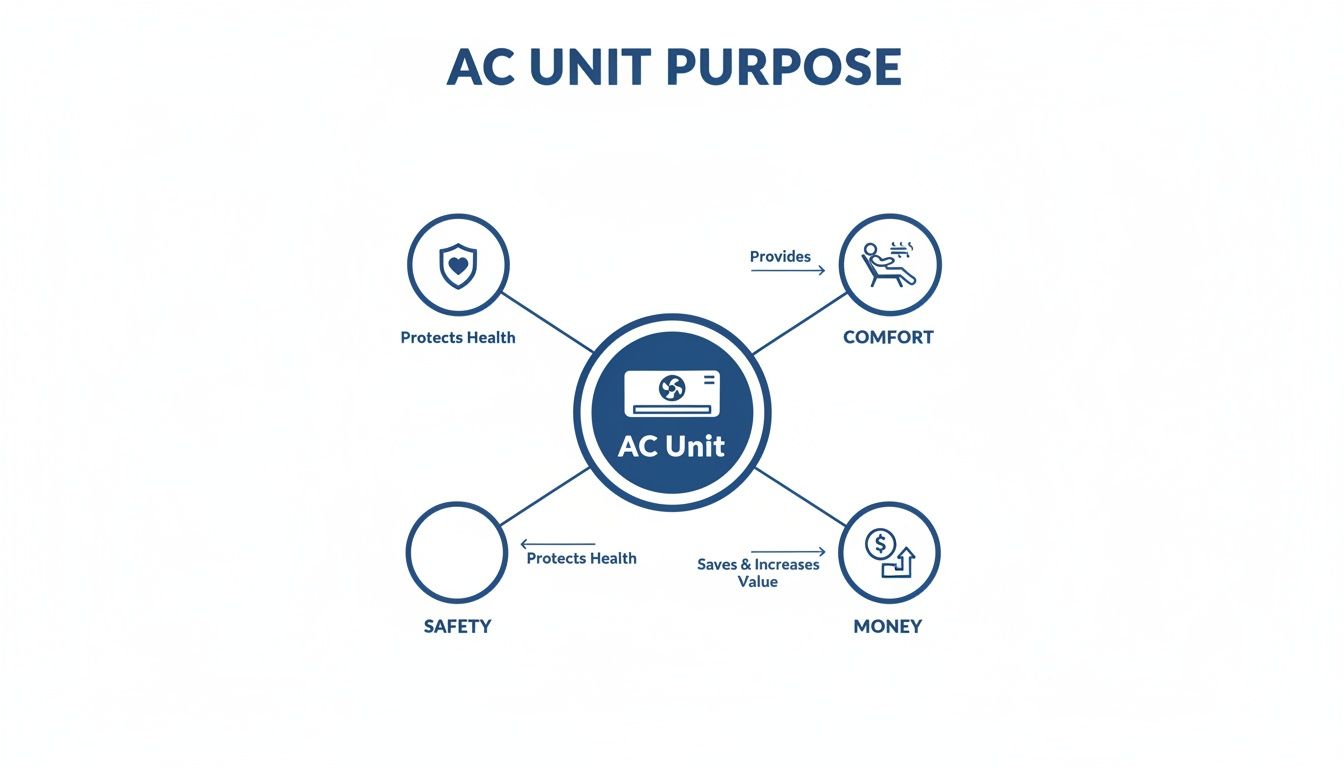
It’s easy to forget, but a well-running AC does more than just make you comfortable. It saves you money on your electric bill, protects your family from dangerous heat, and keeps your home safe.
The Fan and The Contactor
The last two key parts are the fan and the contactor. They're simpler, but the system is dead in the water without them.
- The Fan: You can’t miss it—it's the big blade on top of the unit. This fan is what pulls air through the condenser coils. Without that constant airflow, the heat would be trapped, and the refrigerant would never cool down enough to do its job.
- The Contactor: This is basically a heavy-duty electrical switch. When your thermostat calls for cooling, it sends a low-voltage signal to the contactor, telling it to close a circuit. This action sends the high-voltage power needed to fire up the compressor and the fan motor.
Warning Signs Your AC Unit Is in Trouble
Your outside AC unit is a tough piece of machinery. It’s built to withstand the brutal Phoenix sun. But even the toughest systems will send out distress signals before they completely give up the ghost.
Learning to spot these warnings—using your own eyes and ears—can be the difference between a simple fix and a total system failure right in the middle of a July heatwave. Honestly, catching these problems early is your best defense against a sweltering house and an emergency service call.
Most people think an AC either works or it doesn't, but that’s rarely how it goes. A struggling unit will often limp along for weeks or even months, giving you plenty of clues that something is wrong. Let's walk through the common signs you should never, ever ignore.
Strange and Unsettling Noises
Your AC unit should operate with a consistent, low hum. When new and weird sounds start popping up, it’s a dead giveaway that a component is failing. Don't just crank up the volume on the TV; listen closely. Different noises point to different problems.
- Loud Buzzing or Humming: A gentle hum is normal. A loud, angry buzz is not. This usually points to an electrical issue, like a failing contactor relay, an aging capacitor that can't give the motor the jolt it needs to start, or even a problem inside the compressor.
- High-Pitched Squealing or Screeching: This is an alarming sound, and for good reason. It almost always means a motor is in trouble. We often find it's the sign of failing bearings in the condenser fan motor (the one on top of the outside unit).
- Grinding or Metal-on-Metal: If you hear grinding, it's serious. Shut your system down immediately. This often means the bearings in your expensive compressor motor have worn out, and letting it run will only cause more catastrophic damage.
- Clanking or Banging: This sound usually means a part has come loose and is rattling around, like a fan blade hitting another component. In a worst-case scenario, it could signal that the compressor itself is failing internally.
Visual Clues Something Is Amiss
Sometimes the most obvious signs of trouble are the ones you can see with your own eyes. A quick walk around your outside unit can tell you a lot about its health. Just keep an eye out for anything that looks out of the ordinary.
One of the most common—and confusing—sights for Phoenix homeowners is ice building up on the copper lines or coils during the summer. Isn't it strange that something could freeze in this heat? But it's a classic symptom of either restricted airflow (think a clogged filter or blocked vents) or low refrigerant. Your unit is trying its best to cool, but something is preventing it from working right, causing parts to freeze solid.
Don’t try to scrape the ice off with a tool! The best first move is to turn your system off at the thermostat and switch the fan to "On." This will circulate air and help it thaw naturally. If the problem comes back after you've checked your filter, it’s time for a professional diagnosis.
Other visual red flags include pools of water around the base of the unit, which could be a clogged condensate drain line, or visible damage to the delicate metal condenser fins. While it's tempting to poke around yourself, our detailed guide on how to diagnose AC problems can help you figure out when it's safe to DIY and when you need to call for backup.
Changes in Performance and Efficiency
The final set of warning signs has to do with how well your system is actually doing its job. These symptoms can be subtle at first, but they’re just as critical.
A sudden, unexplained spike in your summer electricity bill from SRP or APS is a massive red flag. It means your unit is working way harder than it should to keep your home cool.
You might also notice the air coming from your vents just feels weak or isn't as cold as you remember. If your AC runs constantly but can't ever seem to hit the temperature you set on the thermostat, that's a clear sign of a big problem—maybe a refrigerant leak or a failing compressor. A system that turns on and off every few minutes (we call this short-cycling) is another classic indicator that something's wrong.
DIY AC Maintenance You Can Actually Do
Here’s the thing: we know most work on your outside AC unit is a job for the pros. But a few simple tasks? Every Phoenix homeowner can—and absolutely should—tackle them.
These aren't complicated repairs. Think of it as basic seasonal upkeep that helps your system breathe easier, run more efficiently, and maybe even save you from a service call when it’s 110°F out.
First thing’s first: before you so much as touch the unit, you have to kill the power. Your outdoor condenser has a dedicated disconnect box, usually a small, gray metal box mounted on the wall right beside it.
Pop that box open. Inside, you’ll see either a pull-out handle or a breaker switch. Pull the handle straight out or flip the breaker to the “OFF” position. This cuts the high-voltage power, making the unit safe to work around.
Cleaning the Condenser Coils
After a haboob rolls through, those thin metal fins on your unit—the condenser coils—get covered in a thick layer of dust. That grime acts like a winter coat in July, trapping heat and forcing your AC to work overtime just to keep up. A simple rinse can make a world of difference.
Here’s the right way to do it:
- Confirm the Power Is Off: Seriously, double-check that you pulled the disconnect or flipped the breaker. Safety is non-negotiable.
- Grab a Garden Hose: You’ll want a standard spray nozzle, not a pressure washer. High pressure is the enemy here.
- Spray from the Inside Out: If you can get the right angle, aim the water from the inside of the unit to push the dirt outwards. If not, just spray from the outside at a slight downward angle.
- Work from Top to Bottom: Gently wash the dust and debris down and away from the unit. You'll see a satisfying river of muck running off onto the ground.
The goal is to rinse, not blast. Those metal fins are delicate and bend easily. A bent fin restricts airflow, which is the exact problem we’re trying to fix. For stubborn, caked-on grime, you might find our guide on choosing the right condensing coil cleaner useful.
Create a Clear Zone of Airflow
Your AC unit is basically a big heat-breathing machine. It sucks in massive amounts of air to cool the refrigerant and push heat out of your home. If you block that airflow, its efficiency takes a nosedive.
Take a walk around your unit. You’re looking for at least two feet of clearance on all sides. Trim back any bushes, overgrown weeds, or shrubs that are getting too close. Also, make sure nothing is ever stored on top of the unit—that fan needs to be completely clear.
While you're there, glance at the concrete pad the unit sits on. Is it level? Our Arizona soil can shift and settle over time, causing the pad to tilt. An unlevel unit can mess with oil distribution in the compressor, leading to a very expensive failure down the road.
What Not to Do Under Any Circumstances
Knowing what not to do is just as important as knowing what you can do. Trying to be a hero with a complex repair is a great way to hurt yourself or your expensive AC system.
Crucial Warning: Never, ever use a pressure washer on your condenser coils. The force will flatten the delicate aluminum fins, choking off airflow and causing major damage. More importantly, don't ever open up the electrical panels or mess with the refrigerant lines. You’re dealing with high voltage and pressurized chemicals that require a licensed pro.
Your safety is priority number one. These DIY tips are for basic cleaning and clearing only. The minute a job involves electrical parts, refrigerant, or taking the unit apart, it’s time to call a certified technician. It’s the smart, safe, and ultimately cheaper choice.
Deciding Between AC Repair and Replacement
Sooner or later, every Phoenix homeowner stands in front of their outside air conditioning unit and faces the big question: Is it time to sink more money into another repair, or should I just replace the whole thing? It’s a tough decision, almost always made under the stress of a failing system during a triple-digit heatwave.
Making the wrong call can cost you thousands, either by over-investing in a dying unit or by replacing a perfectly repairable one too soon. But you don't have to guess. There’s a logical way to approach this common dilemma, and it starts with a little math and a lot of local, real-world experience.
This decision isn't just about the immediate repair bill. It's about the bigger picture—your comfort, your energy bills, and the long-term reliability of your cooling system, especially given the punishing demands of our Arizona climate.
A Practical Rule of Thumb: The $5,000 Guideline
To get a quick financial gut-check, many HVAC professionals use a simple formula. We call it the "$5,000 Rule," and it's a great starting point for seeing if a repair makes financial sense.
The $5,000 Rule: Multiply the age of your unit (in years) by the estimated cost of the repair. If the total is more than $5,000, replacement is often the smarter financial move.
Let’s run a quick example. Imagine you have a 12-year-old AC unit and a technician quotes you $500 for a new fan motor.
12 years x $500 repair = $6,000
Since $6,000 is greater than $5,000, this simple math suggests it might be time to start looking at replacement options. The logic here is that expensive repairs on older units are often just the beginning of a cascade of failures. Pouring money into one fix today doesn't stop another component from failing next month.
Key Factors Beyond the Math
The $5,000 Rule is a helpful guide, but it's not the only thing to consider. Several other critical factors should weigh into your decision, especially for those of us living in the Valley of the Sun.
- The Age of Your Unit: AC units in milder climates might last 15-20 years. Here in Arizona? We're lucky to get 10-14 years out of a system. The relentless heat and long running hours simply wear them out faster. If your unit is already in this age range, any major repair should trigger a serious conversation about replacement.
- Frequency of Repairs: Is your AC technician on speed dial? If you're calling for repairs every year—or worse, multiple times in a single summer—those costs are adding up. It's often more economical in the long run to put that repair money toward a new, reliable system with a warranty.
- The R-22 Refrigerant Problem: If your unit was installed before 2010, it almost certainly uses R-22 refrigerant, better known as Freon. The EPA has completely phased out R-22 production, which means it’s now incredibly expensive and hard to find. A simple refrigerant leak that used to be a minor repair can now cost a small fortune, making any fix involving the refrigerant system a poor investment.
- Soaring Energy Bills: Are your summer SRP or APS bills creeping higher and higher each year, even when your habits haven't changed? An old, inefficient air conditioner can be one of the biggest energy hogs in your home. A new, high-efficiency system can deliver massive savings, sometimes cutting your cooling costs by 30% or more.
Understanding the true investment involved is crucial, which is why we’ve put together a detailed breakdown of what to expect. You can learn more about this in our article on AC replacement cost.
Repair vs. Replace Your AC Unit in Arizona
Sometimes it helps to see the trade-offs laid out side-by-side. This responsive table breaks down the key considerations to help you see the long-term picture for your home.
| Consideration | Repairing an Older Unit | Replacing with a New Unit |
|---|---|---|
| Upfront Cost | Lower initial cost for the repair itself. | Higher initial investment for the new system. |
| Long-Term Costs | Higher energy bills and the risk of more frequent, costly repairs. | Significantly lower monthly energy bills and no repair costs for years. |
| Energy Efficiency | Low SEER rating means it uses more electricity to cool your home. | High SEER2 ratings meet modern efficiency standards, saving you money. |
| Reliability | Unpredictable. You might fix one problem only to have another component fail. | Excellent. Comes with a manufacturer's warranty for peace of mind. |
| Home Comfort | May struggle to keep up on the hottest days; can produce uneven cooling. | Provides consistent, powerful cooling and better humidity control. |
| Environmental Impact | Often uses outdated, harmful R-22 refrigerant. | Uses modern, eco-friendly R-410A refrigerant. |
Ultimately, deciding between repair and replacement is about balancing short-term savings with long-term value. While a quick fix might seem appealing now, investing in a new, efficient system often provides far greater comfort, reliability, and financial savings over its lifetime—especially here in Arizona.
Your Local Experts for Honest AC Service
When your outside AC unit dies in the middle of a Phoenix summer, you need more than a quick fix. You need a team that gets the urgency and knows what it takes to deliver a solution that actually lasts.
While the DIY tips we've covered can keep your system humming along, some jobs just aren’t for amateurs. That's when having a licensed, insured, and experienced partner in your corner makes all the difference.
Why Local Expertise Matters
In a state where air conditioning is a lifeline, not a luxury, the technician you call is a huge decision. We believe in giving you honest advice, not a high-pressure sales pitch. Our job is to find the real cause of the problem, explain your options in plain English, and then let you decide what's best for your home and budget.
An AC tech from a cooler state might not fully grasp the beatdown our desert climate puts on cooling equipment. Our team lives and works right here in the Valley. We’ve seen it all—from condensers completely choked out by haboob dust to compressors that finally surrendered after a solid week of 115°F days.
That firsthand experience means we can diagnose problems more accurately and recommend fixes built to survive Arizona's unique brand of punishment.
Want to know more about what separates the pros from the rest? Our guide on what to look for in a local AC repair service near you is a great place to start.
Choosing a local, reputable company means you're getting a technician who not only knows the equipment but also understands the specific demands of the Phoenix climate, ensuring a more reliable and effective service.
Don't let a small hiccup with your outside AC unit turn into a major, expensive headache. Waiting until the system fails completely almost always means a bigger repair bill and a whole lot of unnecessary discomfort. When you know you need professional help, it’s always better to act sooner rather than later.
Frequently Asked Questions About Phoenix AC Units
Living here in the Valley, we get a lot of the same questions from homeowners trying to make sense of their air conditioners. It's not about getting bogged down in technical jargon—it's about getting straight answers you can use to keep your home comfortable in our brutal desert heat.
Here are a few of the most common questions we hear about AC units and home comfort in the Phoenix area.
How Often Should I Have My AC Unit Serviced?
For any home in the Phoenix area, we stand by a twice-a-year service schedule: once in the spring before the heat hits, and again in the fall to check your heating system. This is definitely more often than you'd hear for milder climates, but our long, punishing cooling season puts a massive strain on every part of your outdoor unit.
Think of it as preventative medicine for your AC. These regular tune-ups let us spot small problems, like a weak capacitor or a slow refrigerant leak, before they turn into a complete system breakdown on a 115-degree afternoon. Consistent maintenance is the single best investment you can make in your AC's lifespan and efficiency.
Is It Normal for My AC to Run All Day?
During the peak of a Phoenix summer afternoon, yes, it’s completely normal for your air conditioner to run for very long stretches. A properly sized system should be able to hold the temperature you've set, but it has to work almost nonstop to fight the intense heat radiating into your home from the roof, walls, and windows.
However, if your AC runs constantly but can't ever seem to reach the temperature on your thermostat, that’s a big red flag. That tells us something is wrong—it could be anything from a refrigerant leak to a dying compressor or even an undersized unit that was never right for your home in the first place.
Beyond just the AC unit, your home’s overall construction plays a huge role. Learning about the best roof insulation for hot climates can dramatically reduce the heat load on your house, which takes a lot of pressure off your cooling system.
Why Is My Electric Bill So High in the Summer?
Eye-popping summer electric bills from APS or SRP are just a fact of life in Arizona. But if you see a sudden, huge spike that you can't explain, your AC is the first place to look. Your cooling system is the biggest energy hog in your home, easily accounting for 50% or more of your summer power usage.
An older, inefficient unit that struggles to keep up will run longer and work harder, sending your bills sky-high. If you notice a big jump in your monthly bill without changing your habits, it's a strong signal your AC is losing efficiency and needs a professional check-up.
When you need honest answers and expert service for your home's cooling system, you can count on Comfort Experts. Our team is ready to provide trustworthy diagnostics and lasting solutions, drawing from our direct experience serving the Phoenix community. Give us a call at 480-207-1239 or schedule service online today.