If you're reading this because the smell is in the curtains, the hallway, and somehow even the clean laundry, you're not imagining it. Air purifiers cigarette smoke is one of the most misunderstood indoor air quality topics, especially for Phoenix homeowners who want honest answers instead of wishful marketing.
Why Cigarette Smoke Lingers in Your Home
Cigarette smoke doesn't act like ordinary dust. It behaves more like glitter and perfume released at the same time. One part settles onto surfaces as tiny solids. The other part spreads as gases and odors that move into fabrics, paint, carpet, and upholstery.
That's why a room can look clear and still smell stale. It's also why many homeowners feel frustrated after buying a purifier and realizing the house still doesn't feel clean.
Two different problems in the same cloud
The solid side of smoke includes ultra-fine particles. These are the bits that float through the air, drift into return vents, and settle on shelves, blinds, and duct interiors.
The gas side is different. Smoke contains odor-causing compounds and volatile organic compounds that don't behave like dust. They soak into soft materials and can slowly release back into the air later.
That second part matters more than many expect. Even after active smoking stops, residue can remain on walls, furniture, carpet, and inside the HVAC system. Many homeowners know the smell; fewer realize they're dealing with what people commonly call thirdhand smoke, meaning leftover residue that clings to indoor surfaces long after the visible haze is gone.
Why the smell keeps coming back
A lot of homes have a pattern. You clean. You open windows. You spray something scented. The room improves for a while, then the smoke smell creeps back in.
That usually happens because the source isn't only in the air anymore.
- Soft materials hold odor. Carpet, drapes, mattresses, and sofas can absorb smoke residue and release it later.
- Air movement reactivates the problem. When the HVAC system turns on, air passing over contaminated surfaces can spread odor again.
- Heat makes it worse. Warm Phoenix afternoons can intensify lingering smoke smell from fabric, walls, and attic-adjacent spaces.
- Filters only catch what reaches them. If residue is stuck to surfaces, an air cleaner won't remove it until it becomes airborne again.
Your HVAC system can spread it room to room
In homes with central air, smoke doesn't stay politely in one bedroom or one den. Return ducts can pull contaminated air into the system, and supply ducts can redistribute odor and particles throughout the house.
That's one reason filter access and replacement matter so much. If you're not sure where your system filter sits, this guide on where your house air filter is located is a smart place to start.
What this means for a homeowner
If you're trying to solve cigarette smoke, you need a strategy that addresses both:
- Airborne particles
- Gases and surface residue
Treat only one, and the house still won't feel right. That's the trap many people fall into. They buy a machine for the room, but the contamination is living in the room, the furnishings, and sometimes the duct system too.
Decoding Air Cleaning Technologies for Smoke
A box on the shelf can make cigarette smoke sound simple. It is not. Smoke leaves behind fine particles, gases, and sticky residue, so no single filter type handles every part of the problem.
HEPA handles the particulate side
True HEPA filtration is designed to capture very small airborne particles. That matters with cigarette smoke because the visible haze and a good share of the airborne particulate load fall into that category.
As noted earlier from Rabbit Air's smoke filtration explanation, cigarette smoke includes particles across a very wide size range. That is why HEPA can help reduce airborne smoke, but results depend on airflow, room size, and whether the smoke has time to reach the filter before it spreads or settles.
HEPA helps clean the air you can move through the machine. It does not remove smoke gases or the residue already stuck to walls, fabric, and duct surfaces.
Activated carbon handles odors and gases
This is the filter stage that usually separates a smoke-capable unit from a disappointing one. Cigarette smoke contains thousands of chemicals, and many of the compounds people smell are gases, not particles.
A purifier with a meaningful amount of activated carbon can adsorb part of that odor and gas load. A purifier with only a thin carbon sheet usually has a short service life against smoke and limited odor control.
Practical rule: Strong HEPA with weak carbon often clears the haze faster than it clears the smell.
HVAC filtration helps when smoke is not staying in one room
Portable purifiers work on room air. Central HVAC filtration works on the air that cycles through the house. That difference matters in homes where smoke has drifted into hallways, bedrooms, or return ducts.
Upgraded media filters can improve whole-home particle capture, but they have to match the blower's airflow capability. Go too restrictive and you can create pressure drop problems, reduce system performance, and still be unhappy with the air. Homeowners comparing options should start with a guide to the best HVAC filters for allergies and better filtration performance, because the same airflow-versus-filtration trade-off applies here.
Air Cleaning Technology Comparison for Cigarette Smoke
| Technology | Removes Particulates? | Removes Gases/Odors? | Best For |
|---|---|---|---|
| True HEPA filtration | Yes | Limited on its own | Fine airborne smoke particles |
| Activated carbon filtration | Limited on its own | Yes | Smoke smell, VOCs, and lingering gaseous pollutants |
| HVAC media filter | Yes, depending on filter design and system compatibility | Limited unless paired with other technology | Whole-home particle capture through central airflow |
| HVAC air scrubber or integrated purifier | Helps address circulating contaminants depending on design | Can help when paired with the right system approach | Homes where smoke has spread beyond one room |
Practical Application
For cigarette smoke, the better approach is usually layered rather than single-device.
- Portable HEPA plus carbon for the room with the highest smoke load
- Central filtration for contaminants moving through the HVAC system
- Surface cleaning and source control for residue that filters cannot remove from materials
- Professional system review if odor keeps returning after cleaning and filter upgrades
This is the trade-off Phoenix homeowners need to understand. A portable unit can improve one room. Once smoke has moved through the house, settled into soft materials, or entered the duct system, the fix often has to expand beyond the portable category.
The Uncomfortable Truth About Air Purifiers and Smoke
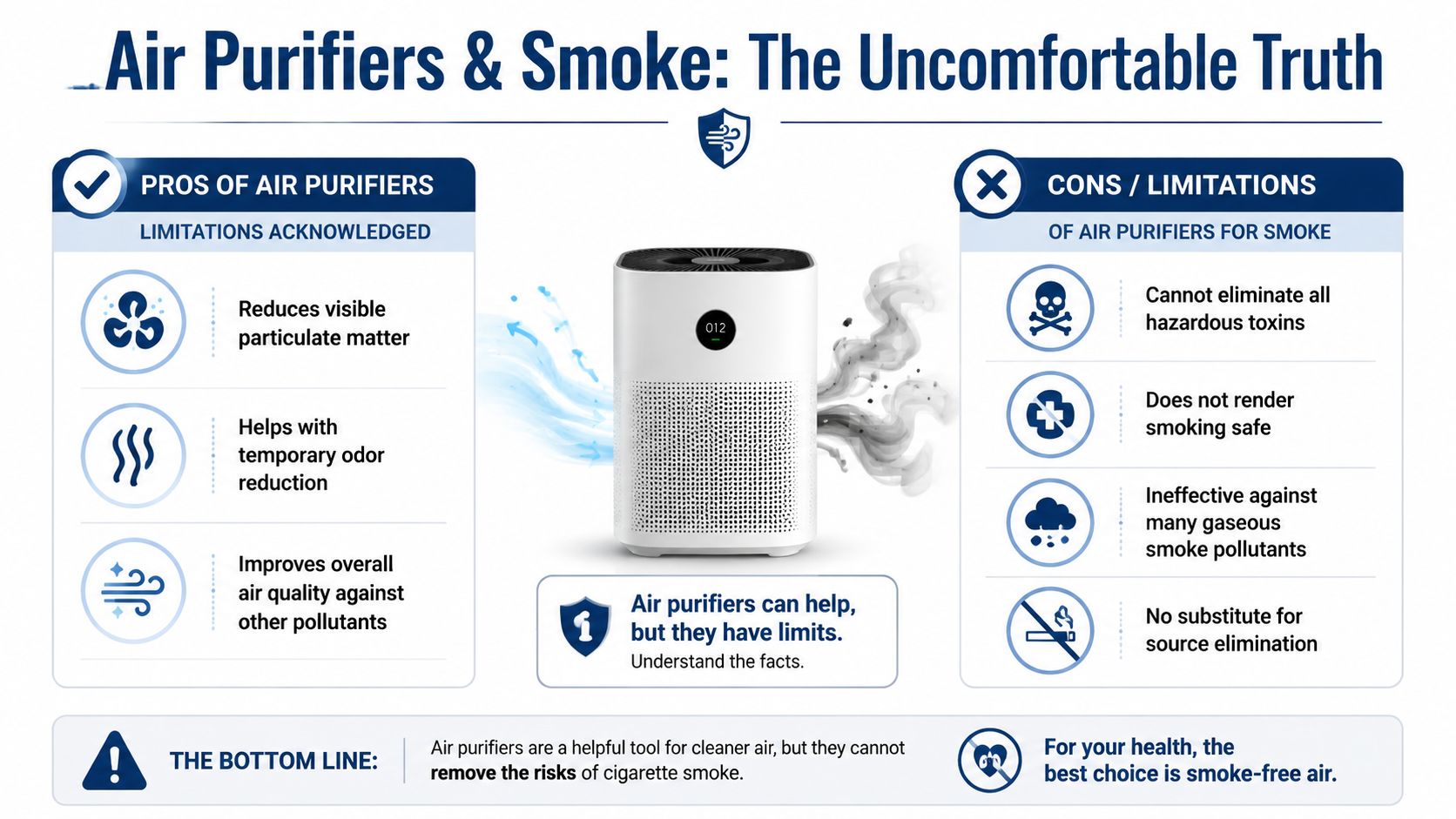
A good air purifier can help. It can reduce particles. It can improve how a room smells. It can lower the amount of smoke contamination hanging in the air.
What it can't do is make indoor smoking safe.
The strongest statement on that point came from the 2006 U.S. Surgeon General's Report, which concluded that separating smokers, using air cleaning technologies, and ventilating buildings cannot eliminate secondhand smoke exposure, as summarized by Americans for Nonsmokers' Rights.
Why that matters in a real home
This isn't about being dramatic. It's about setting the right expectation before you spend money.
If someone smokes indoors, smoke is being produced at the source continuously. The purifier is trying to catch up after the fact. Even a strong unit can only clean the air that passes through it. It cannot stop smoke from traveling into adjacent rooms, settling into materials, or exposing people nearby before filtration happens.
What purifiers are good for
Used correctly, a purifier is still a valuable tool.
- Reducing visible airborne particulate
- Lowering some odor intensity
- Improving air quality from other pollutants in the room
- Supporting a broader smoke-reduction plan
That makes it a harm-reduction device, not a safety shield.
The honest takeaway
Homeowners deserve the truth here. Marketing often implies that enough filtration solves everything. It doesn't.
If smoking continues indoors, use purification as part of a layered response. Don't mistake cleaner-smelling air for fully protected air. Those aren't the same thing.
How to Choose and Use a Portable Air Purifier Effectively
If you're going to use a portable purifier for smoke, size and airflow matter more than the label on the box. A small stylish unit in the corner won't keep up with active smoking in a large family room.
Start with CADR, not marketing language
The most useful performance clue for smoke is airflow, usually discussed as CADR or CFM. A larger volume of processed air allows the machine to reduce airborne contamination more rapidly, similar to using a high-capacity hose to clear a pool.
One cited test showed that a high-CFM unit brought PM1 down to zero in 15 minutes, while other tested units needed 24 to 28 minutes, which is why higher CADR matters for active smoking rooms.
That doesn't mean every home needs the largest machine available. It does mean undersized units often disappoint.
What to look for when shopping
A practical checklist works better than comparing brand slogans.
- True HEPA filtration. You want real particle capture, not vague wording like "HEPA-type."
- Substantial activated carbon. Smoke odor requires more than a token carbon layer.
- High smoke CADR or strong fan delivery. Bigger open spaces need stronger airflow.
- Filter availability. If replacement filters are hard to find, the unit becomes useless fast.
- Noise you can tolerate. A purifier only helps when people keep it running.
If you're comparing room units for broader sensitivity issues, this article on air purifiers for allergies can help you think through practical trade-offs in everyday use.
Placement changes performance
Portable purifiers don't clean through walls. If the smoker is in the den and the purifier is two rooms away, you won't get the result you want.
Use these placement rules:
- Keep it close to the source. The sooner smoke reaches the filter, the better.
- Don't bury it in a corner. The intake and discharge need open space.
- Run it before, during, and after smoking events. Real-time capture works better than cleanup later.
- Keep doors closed when possible. That helps the purifier control one defined zone.
Maintenance is not optional
Smoke loads filters faster than ordinary household dust. If the pre-filter is matted with residue or the carbon is spent, performance drops.
Check the filter condition on schedule. Replace components when the manufacturer calls for it, or sooner if smoke use is heavy. A neglected purifier often turns into a noisy fan with a dirty filter inside.
When Portables Arent Enough Whole-Home IAQ Solutions
You run a room purifier all night, then the AC starts in the morning and the smoke smell comes back through the vents. That usually means the problem has moved beyond one room.

Portable units still have a place. I recommend them for localized exposure all the time. But cigarette smoke is small-particle pollution plus sticky residue plus odor gases. Once that mix gets into returns, settles on blower parts, coats nearby surfaces, and recirculates through the duct system, a single room machine cannot control the full air path.
Signs the portable approach has hit its limit
Look for patterns, not just odor in one spot.
- The smell gets stronger when the system runs. That points to contamination being picked up and redistributed by the HVAC system.
- Several rooms are affected, even with doors closed at times. Smoke has likely spread through shared airflow or attached to surfaces beyond the original smoking area.
- Supply grilles, returns, or ceiling areas show yellowing or film. That is a sign residue has been moving through the house for a while.
- You replaced portable filters and still have eye, throat, or breathing irritation. Reduced odor does not always mean the air is clean enough.
What a whole-home strategy does differently
A whole-home plan treats the air where your house already moves it. In Phoenix, that matters because the cooling system runs often and touches a lot of indoor air over the course of a day.
The usual upgrades are practical, not flashy:
- A better media filter cabinet to capture more fine particles without choking airflow
- In-duct air cleaning equipment to treat recirculated air across the house
- Inspection of the blower, coil, return side, and duct interior to see where smoke residue is sitting
- Airflow and leakage corrections if the system is pulling dirty air from wall cavities, attics, or other unwanted spaces
For homes where smoke has become a house-wide problem, whole-home air purifier options are often the next logical step. The key is matching the equipment to the condition of the home and the HVAC system, not just adding a gadget and hoping for a different result.
Why the HVAC system often keeps the problem going
Smoke does not stay airborne forever. Part of it gets trapped by filtration. A lot of it sticks to dust and interior surfaces. Some of it settles inside returns, supply runs, and mechanical components where air passes over it again and again.
That is why homeowners sometimes describe the house as "fine until the air comes on."
If smoking happened indoors for years, filtration alone may not be enough. The system may need cleaning, and the home may need surface cleaning at the same time so residue is not reintroduced. Even a non-HVAC resource like this guide on a reliable house cleaning service in Reno NV can help with the housekeeping side of reducing settled dust and smoke film.
The practical decision point
Use a portable purifier when the issue is current, limited, and confined to one area. Move to a whole-home IAQ plan when smoke odor returns through the vents, multiple rooms are involved, or the house still feels contaminated after the obvious fixes.
At that stage, the job is no longer "pick a better purifier." The job is to inspect the full system, remove residue where possible, and clean the air through the same HVAC path that is spreading the problem.
Your Next Step Toward a Breathable Home
A common Phoenix call goes like this. The homeowner bought a portable purifier, changed the filter, and the air still smells like stale smoke every time the system starts. At that point, the problem is usually bigger than one room and bigger than one machine.
The next step is to treat cigarette smoke as a whole-house contamination issue, not just an airborne one. Start with the source if smoking is still happening indoors. Then clean the residue that settled onto floors, walls, furnishings, and dust. If smoke has been pulled through the HVAC system for months or years, the air path itself may need attention, including filtration changes and, in some homes, a closer look at whether duct cleaning service near me is part of the right fix.
Surface cleaning still matters. Smoke particles cling to dust, and that dust gets stirred up again by normal activity and airflow. If you are building a broader cleanup plan, this guide on a reliable house cleaning service in Reno NV offers useful ideas for reducing settled residue that can keep the smell alive indoors.
Portable purifiers still have a place. They help in bedrooms, offices, or other problem spots. They do not clean ductwork, correct poor return placement, or stop the HVAC system from recirculating odor from contaminated surfaces.
That is the trade-off homeowners need to understand.
If the smell keeps coming back, if multiple rooms are affected, or if the house feels worse when the blower runs, a whole-home IAQ assessment makes more sense than buying another standalone unit. Comfort Experts can inspect the HVAC system, check airflow and filtration, and help determine whether a portable purifier, duct cleaning, a filter upgrade, or an HVAC-integrated air cleaning system fits your Phoenix Valley home. Call 480-207-1239 or schedule service online.