
A lot of Phoenix homeowners start thinking about a surge protector for ac after the lights blink during a monsoon and the outdoor unit suddenly sounds a little too quiet. That concern is reasonable. Your AC is one of the most expensive systems in your home, and electrical events can damage it fast.
Why Your AC Needs More Than a Circuit Breaker
A summer storm rolls through the Valley. Thunder hits, the lights flicker, and your first thought isn't the TV or the microwave. It's the AC. In Phoenix, that makes sense because when cooling goes down, the house becomes uncomfortable in a hurry.
The part many homeowners miss is simple. A circuit breaker and a surge protector do different jobs. A breaker is there to stop too much sustained current. A surge protector is there to react to a sudden voltage spike before that spike reaches sensitive AC electronics.
A breaker is a dam that shuts flow down when the pressure stays too high. A surge protector is the spillway that redirects a violent burst before it tears through the system.
What gets damaged first
Modern air conditioners don't just rely on motors and contactors anymore. They rely on electronics. That means surge damage often hits the parts that are expensive and not always visually obvious.
According to this HVAC surge cost guide, five key vulnerable HVAC components can cost $2,050 to $6,200 to replace after surge damage, while inverter control boards alone can run $800 to $2,500. In the same guide, a dedicated Type 2 HVAC surge protector is listed at $150 to $400.
A lot of homeowners ask whether the breaker should have caught it. Usually, that's the wrong expectation. Breakers aren't built to act like precision bodyguards for circuit boards.
Why this matters in a repair call
When an AC quits after unstable power, the failure isn't always dramatic. Sometimes the unit still runs, but the controls become erratic. Sometimes communication boards fail later. Sometimes a compressor issue shows up after the electrical hit has already weakened the system.
If you're trying to compare prevention versus repair, this breakdown of what goes into the cost to fix AC problems helps show why electrical protection deserves attention before something burns up.
For a homeowner who wants a broader explanation of what causes household surges in everyday life, this piece on Northern Nevada residential electrical surge advice gives useful context beyond just storms.
Whole-home vs Unit-level Surge Protectors Explained
A lot of confusion starts when people hear, "I already have surge protection." Maybe you do. But the key question is where that protection sits and what it's effective at stopping.
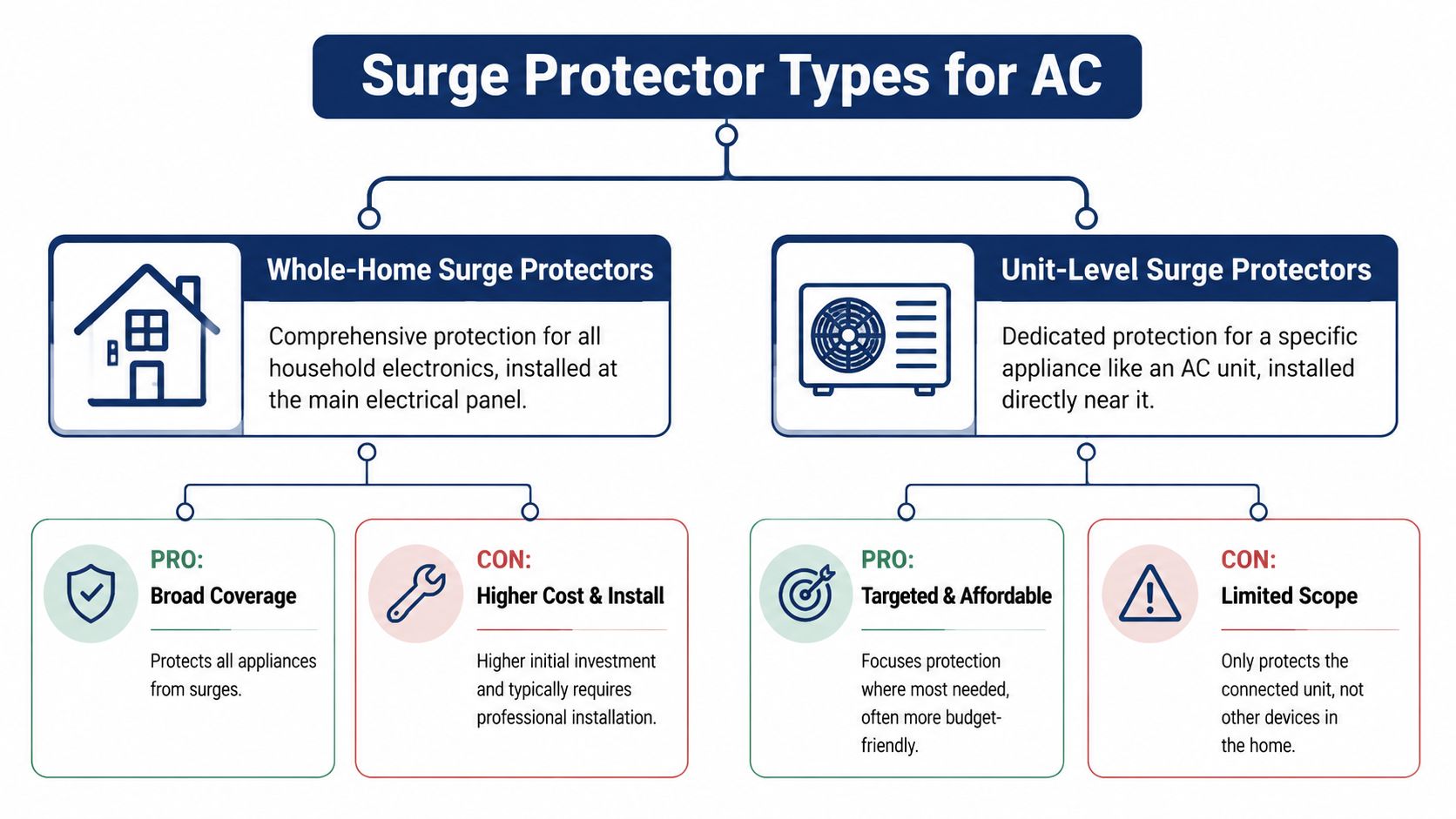
A whole-home protector and a unit-level AC protector are not competing ideas. They work best as layers.
The castle gate and the treasury door
Let me explain. A whole-home protector is like the main gate of a castle. It helps stop large threats coming in from outside, especially the big ugly events that enter through the electrical service.
A dedicated AC protector is more like the guard at the treasury door. It sits close to the equipment you really don't want damaged, and it helps deal with the smaller electrical hits that can still do real harm.
According to Micro-Air's guidance on HVAC surge protection, whole-home surge protection alone provides incomplete defense for HVAC systems. The same guidance says whole-home devices are strong against major external surges, but less effective against smaller, repetitive internal surges, and that a dedicated HVAC protector creates a "layered" defense strategy.
Here is the visual version:
What each type actually does
| Feature | Whole-Home Protector (Type 1/2) | AC Unit Protector (Type 2) |
|---|---|---|
| Primary location | Main electrical panel or service entrance | Outdoor condenser disconnect box or near the AC equipment |
| Main job | Broad protection for the home's electrical system | Focused protection for the air conditioner |
| Best at stopping | Large incoming surges from outside the home | Equipment-level spikes that threaten AC electronics |
| Coverage | Many appliances and devices | One critical system |
| Limit | Doesn't fully protect against all smaller internal disturbances at the unit | Doesn't protect the rest of the home |
| Best use | First layer of defense | Second layer for HVAC-specific protection |
That table is the practical version of what technicians see in the field. If someone installs only one layer, they often assume the job is done. Sometimes it is enough for their risk tolerance. Often it isn't.
What works better in real homes
For a standard split system, the most sensible setup is usually a layered one. The broad device protects the house at the panel. The dedicated device protects the condenser where the AC's vulnerable electronics live.
That matters because the outdoor unit isn't just a noisy box with a fan. It contains components that can be expensive to replace, especially on systems with advanced controls or inverter technology. If you're familiar with the cost of a central air conditioner compressor replacement, you already know why targeted protection at the unit itself matters.
What not to assume
Some homeowners assume a power strip inside the house somehow protects the outdoor condenser. It doesn't. Others think a breaker upgrade equals surge protection. It doesn't.
And one more thing. A soft starter and a surge protector aren't the same tool either. One helps with startup behavior. The other helps with external or system-level voltage spikes. That's a separate conversation, but it's worth keeping clear because mixing the two up leads to bad equipment decisions.
Decoding the Specs What Really Matters on the Box
A surge protector box can look more complicated than it needs to. Phoenix homeowners usually do not need an electrical lesson. They need to know which numbers affect whether the protector gives their AC a fighting chance when the power gets rough in July or during a monsoon storm.
Start with MOV protection and UL listing
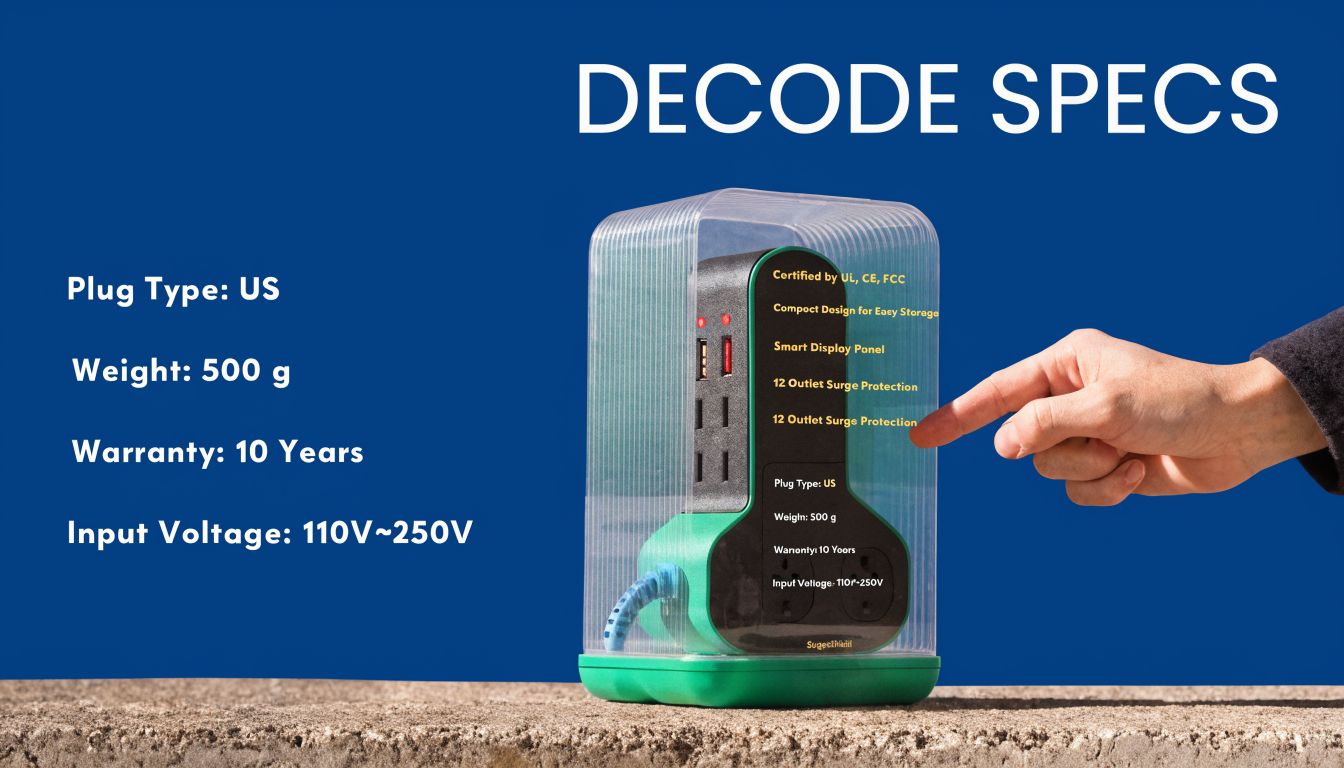
Most HVAC surge protectors use Metal Oxide Varistor, or MOV, technology. Under normal voltage, the MOV stays inactive. When voltage spikes past its threshold, it redirects that excess energy away from the equipment.
According to HVAC School's surge protector guidance, HVAC surge protectors primarily use MOV technology to clamp voltages and shunt excess energy to ground. For a homeowner reviewing options, three items deserve attention first:
- UL 1449 listed: This shows the device meets a recognized safety and surge protection standard.
- Built for HVAC equipment: A protector meant for an outdoor condenser is a better fit than a general plug-in product made for televisions or office gear.
- Visible status indicator: If the unit has sacrificed itself after a surge, a clear indicator makes that easier to catch before the next storm or outage.
Those basics matter more than flashy packaging.
What clamping voltage and response time actually tell you
Clamping voltage is the point where the protector starts doing its job. Lower is not automatically better in every case, but the goal is straightforward. The protector should react early enough to keep a damaging spike from reaching the control board, contactor, or compressor electronics.
Response time is speed. Surges happen fast, and the device has to react fast.
A good protector works like a seatbelt that locks before the passenger slams forward. If it reacts too late, the expensive parts inside the condenser still take the hit.
Pay attention to failure status, not just the headline rating
This is the part many homeowners miss. Surge protectors are sacrificial devices. After enough surge events, the protection element can wear out or fail. The condenser may still run, but the surge protection may already be gone.
That is why I like units with a simple visual indicator. A homeowner can glance at it. A technician can verify it during maintenance. You do not want to assume you are protected in August only to learn the device failed during the first monsoon storm in June.
Numbers only matter if they connect to real cost
Homeowners run into the same problem when comparing efficiency ratings. A spec sheet full of numbers is only useful if you know what changes in actual operation. That is also true when comparing SEER 14 vs 16 AC system efficiency differences. With surge protection, the actual question is simpler. Will this device help protect parts that are expensive to replace?
In Phoenix, that question matters because of the potential for expensive damage. A surge protector usually costs a fraction of what you might spend replacing a control board, an ECM fan motor, or an inverter board on a higher-end system. If the system has communicating controls or inverter-driven components, one electrical event can turn a small preventive purchase into a much larger repair bill.
One practical standard for buying
Do not buy based on the cheapest price on the shelf. Buy based on fit, listing, and whether the installer can explain why that model belongs on your equipment.
The same HVAC School guidance notes that proper protection can help reduce electrical damage and improve equipment reliability over time. That is the outcome that matters in a Phoenix summer. Fewer avoidable repairs, less risk to expensive AC components, and a better chance your system keeps running when the grid is under the most strain.
Installation Options and What to Consider
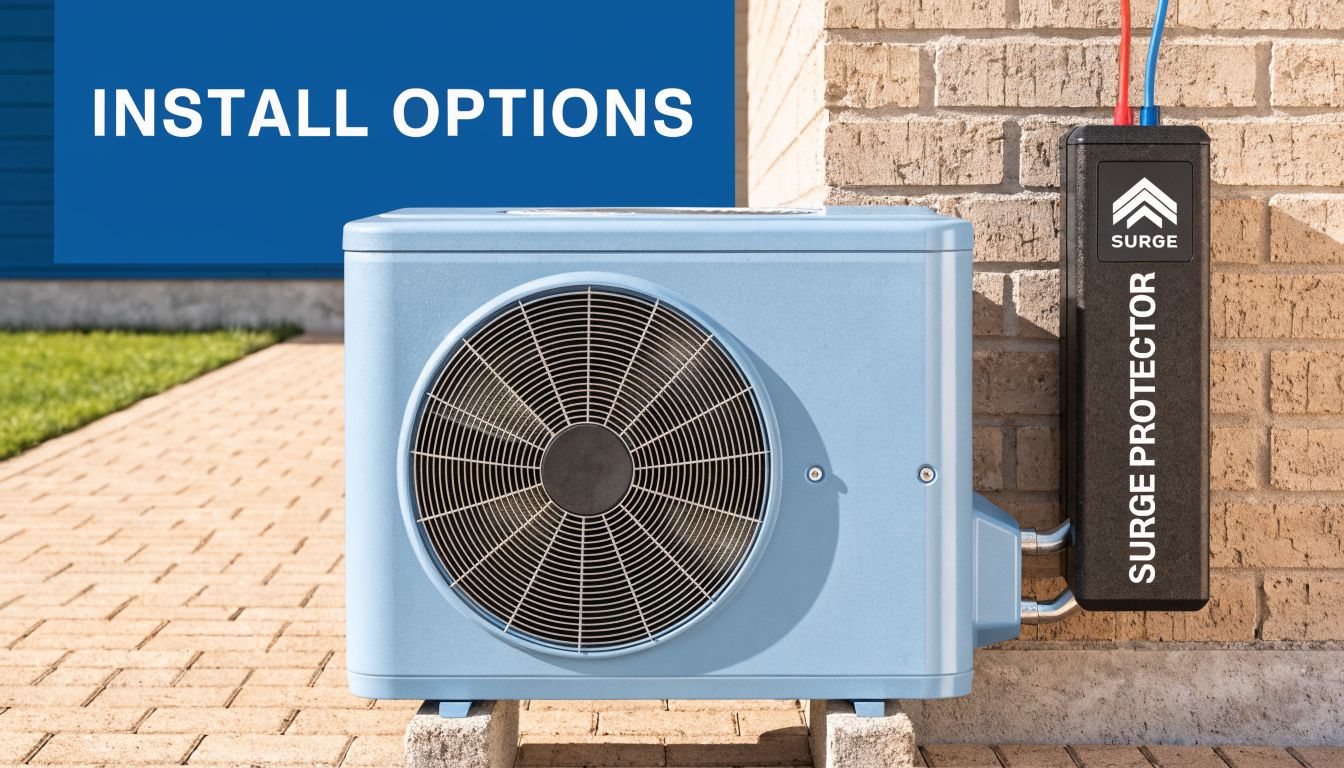
Where the protector gets installed matters almost as much as whether you install one at all. On most residential systems, the dedicated AC surge protector is mounted either inside the condenser's electrical compartment or at the outdoor disconnect box.
Both approaches can work. The better choice depends on the equipment layout, the device being used, and how accessible you want the unit to be for inspection.
Inside the condenser cabinet
Mounting the protector inside the unit keeps it more sheltered from direct sun, dust, and weather. It can be a clean-looking install when the condenser has the space for it.
The downside is visibility. If the protector has a status light, you won't always see it easily without opening the panel. That means many homeowners won't know the device has sacrificed itself until a technician checks it.
At the disconnect box
Installing at the disconnect often makes inspection easier. If the unit has a visual indicator, a tech can usually verify status quickly during maintenance.
There is a trade-off, though. Outside mounting exposes the device more directly to the environment. In Phoenix, that means punishing sun, dust, and temperature extremes. Product selection matters here.
Why this isn't a casual DIY project
The work is happening on a high-voltage AC circuit. That alone should slow the conversation down. A residential condenser typically runs on a 240-volt circuit, and mistakes around that circuit can injure someone, damage equipment, or create code problems that show up later.
Here's the thing. Homeowners are often comfortable replacing thermostats, changing filters, or clearing debris around the unit. Surge protector installation is different because it crosses into equipment wiring and electrical safety.
Consider risks:
- Safety risk: Contact with live high-voltage components can cause serious injury.
- Equipment risk: A wiring error can damage boards, contactors, or the compressor.
- Inspection risk: A badly mounted or mismatched device may not protect anything when the surge arrives.
- Warranty risk: Work that isn't done correctly can create headaches if equipment issues come up later.
For homeowners planning a new system or major upgrade, it's smart to discuss surge protection during the same conversation as the AC installation process in Phoenix. That's often the easiest time to add protection cleanly and intentionally instead of treating it as an afterthought.
The Phoenix Factor Why Your AC Is at Higher Risk Here
Phoenix isn't just hot. It puts electrical and cooling equipment through a very specific kind of stress cycle that homeowners in milder climates don't deal with the same way.
The pattern is familiar. Long heat waves push the grid hard. Afternoon storms roll in during monsoon season. Power flickers, drops, comes back, and your AC is expected to carry the load through all of it.
Monsoon weather is only part of the story
It's commonly believed that surge risk starts and ends with lightning. In Phoenix, lightning absolutely belongs in the conversation. But it isn't the only problem.
Summer grid strain matters too. When the system is under heavy demand and power quality gets unstable, HVAC equipment can be exposed to the kind of electrical irregularities that don't always announce themselves with a dramatic event. Sometimes it looks like a blink. Sometimes it looks like a restart. Sometimes the damage isn't obvious until later.
Your AC runs more, so exposure goes up
In cooler regions, the AC may cycle on and off with long breaks. In the Valley, many systems run hard for extended periods. More runtime means more exposure to whatever the electrical supply is doing.
That doesn't mean every Phoenix home needs the exact same protection plan. It does mean local conditions deserve more respect than a generic national recommendation. The home, the panel, the equipment, and the age of the system all matter.
For homeowners thinking more broadly about reducing strain on the system, these HVAC energy saving tips for Arizona homes are useful because a system that doesn't struggle as hard all day is easier to manage and maintain overall.
Why local judgment matters
You know what? The AC in Phoenix isn't a luxury appliance. It's part of daily safety and livability for a lot of families. That changes how most homeowners should think about risk.
Even advice from outside Arizona can still reinforce the same principle. This piece offering expert advice for london homeowners is a reminder that electrical protection starts with the right infrastructure, even if the climate and equipment demands are very different there.
The local reality is simple:
- Storm season brings sudden electrical events: Monsoons can create the exact kind of unstable conditions electronics hate.
- High heat stresses the power system: When demand is heavy, power quality can become part of the problem.
- AC dependence is constant: The more your system runs, the more chances it has to be present when a bad electrical event happens.
Protect Your Investment and Your Comfort
A surge protector for your air conditioner isn't glamorous. It doesn't make the home quieter, colder, or prettier. What it does is much more valuable. It helps reduce the chance that one ugly electrical event turns into a major repair bill and a house full of heat.
By the time many homeowners start asking about surge protection, they've already had one of those warning moments. Lights flicker. The thermostat resets. The condenser doesn't restart quite right. That's usually the point when preventive protection stops sounding optional.
The trade-off is pretty straightforward
On one side, you have a relatively modest one-time device cost. On the other, you have vulnerable AC components that can be expensive to replace and a cooling system you depend on for daily comfort.
That doesn't mean a surge protector is magic. It won't fix poor wiring, replace maintenance, or solve every electrical problem in a home. It does mean it can add a smart layer of defense to one of the most important appliances you own.
What homeowners usually regret
People rarely regret protecting expensive equipment before trouble starts. They regret waiting until after a surge, outage, or storm when the question changes from "Should I add protection?" to "Why did this board fail now?"
If your system is newer, surge protection helps protect that investment. If your system is older, it may help protect the remaining life you still have in it. In both cases, it supports the same goal. Keep the AC reliable when Phoenix weather is least forgiving.
A good decision is usually a practical one
The smartest home upgrades are often the least exciting. They don't show off. They lower risk.
That is exactly how a dedicated surge protector for AC should be viewed. Not as an accessory. As sensible insurance for comfort, electronics, and repair avoidance.
If you want a professional opinion on the right protection for your system, Comfort Experts can inspect your setup, explain your options clearly, and install the proper device safely. For help protecting your AC before the next storm or outage, call 480-207-1239 or schedule service online.