That damp, sticky feeling inside a Mesa house throws people off because it doesn’t match the desert outside. If you’re searching for how to reduce humidity in house problems without guessing, the fix starts with knowing where the moisture is coming from and which solutions work in Arizona.
That Sticky Feeling Why Humidity Matters in Your Arizona Home
You walk in from a humid August evening in Mesa, the AC is on, the thermostat looks fine, and the house still feels sticky. Sheets feel a little damp. The air feels heavy. Maybe there’s a faint musty smell near a hallway closet. In Arizona, that catches people off guard because we spend most of the year fighting dry air, not excess moisture.

Monsoon season changes the equation. Outdoor humidity climbs fast, and homes that feel comfortable in May or June can start holding moisture in July and August. Then the normal indoor sources pile on. Showers, cooking, laundry, a house sealed up tight for energy savings, or duct leaks that pull damp attic air into the system can all push indoor moisture higher than people expect in the desert.
What high humidity does
High humidity affects comfort first, but it rarely stops there. It can make a home feel warmer than the thermostat setting, drag down AC performance, and create conditions for mildew, odors, and condensation on cooler surfaces.
The target I give homeowners is simple. The U.S. Environmental Protection Agency recommends keeping indoor relative humidity between 30% and 50%, and notes that higher humidity can encourage mold growth, as explained on the EPA's guide to controlling moisture and mold indoors.
That range matters in Arizona because people often assume any uncomfortable indoor air problem must be a cooling problem. Sometimes the thermostat is doing its job and the house still feels off because the moisture level is too high.
Practical rule: If your house feels cool but clammy, temperature probably isn’t the problem. Humidity is.
I see that mistake a lot during monsoon season. Homeowners drop the thermostat lower and lower, the unit runs harder, the electric bill goes up, and the house still doesn’t feel crisp.
Relative humidity in plain English
Relative humidity is just the amount of moisture in the air compared with how much the air can hold at that temperature.
That’s why 74 degrees can feel fine one week and miserable the next. When the air is damp, sweat does not evaporate as well, so your body holds more heat. The house can read “comfortable” on paper and still feel muggy in real life.
How to check your humidity the right way
Don’t rely on guesswork. Use a hygrometer.
They’re inexpensive, and they tell you whether you have a whole-house issue or a room-by-room problem. Start with one in the main living area. If one space feels worse than the rest, add another there and compare readings for a few days, especially in the morning and evening.
Use this quick check:
- Main living room: Shows the overall condition of the house.
- Primary bedroom: Useful because some homes hold more moisture overnight.
- Bathroom outside the shower area: Helps you see whether steam is clearing out.
- Laundry area: Can reveal a venting or airflow problem.
- Closest room to the attic access: Helpful in Arizona homes where hot, humid attic air may be getting pulled in.
Signs the house has a moisture problem
Some clues are obvious. Others get blamed on the AC, the weather, or an old house.
These are the signs I take seriously:
- Musty odor: Moisture has been sitting somewhere long enough to support growth.
- Clammy air: The house feels sticky even when it is cool.
- Condensation: Moisture shows up on windows, supply grilles, or other cool surfaces.
- Uneven comfort: One room feels muggy while another feels normal.
- Stale closets or corners: Low-airflow spaces hold damp air.
- Worsening allergy symptoms: High humidity can make indoor air quality worse. If that is already an issue in your home, this guide on the best air purifiers for allergies is a useful companion read.
The usual culprits in Arizona houses
In Mesa homes, I start with the everyday moisture sources, then I check the mechanical side. A lot of humidity complaints come from a combination of both.
| Trouble spot | Why it raises indoor humidity | What to look for |
|---|---|---|
| Showers and baths | Steam loads the air quickly | Fogged mirrors, damp walls |
| Cooking | Boiling and simmering release moisture | Humid kitchen after meals |
| Dryer vent issues | Moist air stays inside instead of leaving the house | Warm, damp laundry room |
| AC performance problems | The system cools but does not remove enough moisture | Sticky air and weak comfort |
| Duct leaks | Humid attic air can get pulled into the system | Rooms feel muggy, dusty, uneven |
| Monsoon weather | Outdoor moisture rises seasonally | Sudden change in indoor comfort |
A better target than “comfortable enough”
“Feels okay” is not a great humidity standard. Indoor moisture should stay in a controlled range, not bounce around with the weather.
For most homes, 30% to 50% is a practical target. Once readings start climbing above that range, the problem shifts from simple comfort to house conditions, HVAC performance, and indoor air quality.
And in Arizona, one more trade-off matters. Cranking the thermostat down may make the air feel cooler for a while, but it does not always solve the moisture problem. Sometimes it just makes the house colder, the system work harder, and the humidity issue easier to ignore for a few days.
First-Line Defense Simple DIY Humidity Reduction Tactics
Before buying equipment, fix the habits and airflow mistakes that keep adding moisture. A lot of Arizona homes can improve noticeably just by handling steam and damp air better in the rooms that create it.

This is the first line of defense because it’s low cost and immediate. It also tells you whether the issue is mostly behavioral, mostly mechanical, or a mix of both.
Start in the bathroom and kitchen
Bathrooms and kitchens are the two biggest daily moisture factories in most homes. Steam gets released fast, and if it isn’t vented out, it drifts into hallways, bedrooms, closets, and return air pathways.
A primary humidity control method is strategic ventilation. Exhaust fans in kitchens and bathrooms should vent to the exterior, not the attic, and they should operate during moisture-generating activities, according to Trane’s guidance on indoor humidity control.
That “to the exterior” part matters more than many homeowners realize. If a fan dumps damp air into the attic, you haven’t solved anything. You’ve just moved the moisture.
Run the fan while the room is getting humid, not just after you notice the mirror fogging up.
A room-by-room moisture walkthrough
Try this around the house the same day you notice humidity climbing.
- Bathroom: Use the exhaust fan every shower. Keep the door mostly closed during the shower if humidity spreads into the hall. Wipe down wet surfaces if moisture tends to linger.
- Kitchen: Turn on the range hood when boiling water or simmering food. Use lids on pots to keep steam from filling the room.
- Laundry room: Make sure the dryer is venting outdoors and that the vent path isn’t crushed or disconnected.
- Bedrooms: Leave enough space around furniture on exterior walls and in tighter corners so air can move.
- Closets: Keep packed closets from becoming dead-air spaces if they’re already prone to musty smells.
What works fast without buying major equipment
Some DIY steps are simple, but they matter because they reduce the moisture load before your HVAC system has to deal with it.
Here are practical moves worth doing:
- Shorten hot showers: Less steam in the room means less moisture drifting through the house.
- Cover pots and pans: That cuts down steam release during cooking.
- Check the dryer vent termination: If it’s clogged or damaged, moisture can stay indoors.
- Use fans for circulation: Moving air helps prevent damp corners and stagnant pockets.
- Open windows selectively: In Arizona, this only helps when outdoor air is drier. During monsoon periods, open-window advice can backfire.
The trade-off with ventilation in Mesa
The limitations of generic online advice become clear. In many climates, “just open the windows” is harmless advice. In Mesa during monsoon season, that can make things worse.
If outside air is carrying more moisture, ventilation has to be used intelligently. You don’t want to pull in humid outdoor air just because a general home tip said fresh air fixes everything. Let me explain. Ventilation is a tool, not a cure-all. It works best when the air you’re bringing in helps the problem instead of feeding it.
Small checks that often get skipped
Humidity problems love neglected details. A few examples show up all the time:
- Disconnected bath fan ducting: The fan runs, but the moisture never leaves the house.
- Dirty AC filter: Airflow drops, and the system can’t do its job as well. If you’re unsure where yours is, this article on where your air filter is in the house can help.
- Closed interior doors all day: Air gets trapped in certain rooms.
- Furniture pushed tight against walls: That can create low-airflow zones where dampness hangs around longer.
What not to rely on
A few popular “fixes” sound good but don’t solve much when a house has a real humidity issue.
| Common idea | When it helps | Where it falls short |
|---|---|---|
| Opening windows | Helpful when outdoor air is drier | Can add moisture during monsoon weather |
| Ceiling fans only | Good for circulation and comfort | Doesn’t remove moisture from the air |
| Lowering thermostat a lot | May feel cooler temporarily | Doesn’t guarantee proper dehumidification |
| Scent sprays | Masks musty odor | Does nothing to fix moisture |
If the house still feels damp after you clean up these basics, that’s your signal to stop treating it like a habit issue alone. At that point, dedicated dehumidification or HVAC corrections usually need to enter the conversation.
Choosing Your Weapon Portable vs Whole-Home Dehumidifiers
A lot of Mesa and Phoenix homeowners hit the same point in July or August. The AC is running, the house is technically cool, but the bedrooms still feel clammy by evening. That is usually when the portable-versus-whole-home question gets real.
In Arizona, that choice is a little different than it is in Florida or the Gulf Coast. We do not usually battle high humidity every day of the year. We get spikes, often during monsoon season, and those spikes expose weak spots fast. A portable unit can help in one problem room. A whole-home system makes more sense when the damp feeling shows up across the house, or keeps coming back every summer.
Keeping indoor humidity under about 50% to 60% RH helps limit dust mites and other moisture-related comfort problems. Sensitive Choice notes that dust mites survive best once humidity stays high enough for them to hold moisture, which is one reason consistent control matters more than occasional relief from a fan or a colder thermostat setting, according to Sensitive Choice’s guidance on indoor humidity levels.
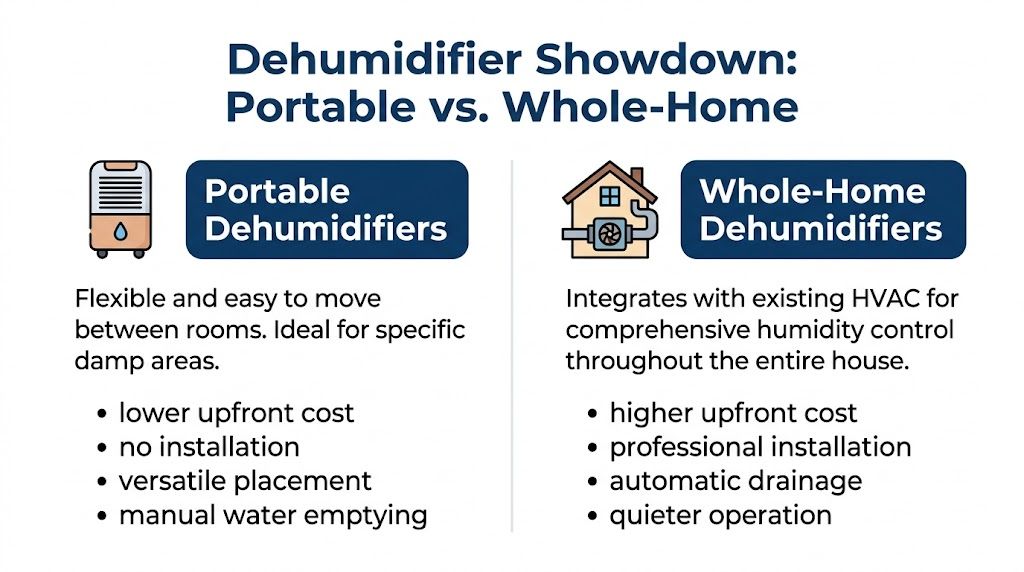
The trade-off is straightforward. Portable dehumidifiers cost less to buy and are easier to test. Whole-home dehumidifiers cost more up front, but they solve a house-wide problem with less daily hassle.
Portable dehumidifiers
Portable units earn their keep in the right situation. I usually recommend them for a single office, bedroom, laundry room, or guest space where the humidity is clearly isolated.
What they do well:
- Lower upfront cost: Good for testing a room without changing the HVAC system.
- Easy placement: You can move the unit to the area that feels worst.
- Fast setup: Plug it in, set the target humidity, and watch what changes.
- Good for spot treatment: Useful when the rest of the house feels normal.
Where they fall short:
- Bucket maintenance: If there is no drain line, somebody has to empty water regularly.
- Noise in the room: Fine for some people, irritating for others, especially at night.
- Added heat: Many portable units dump a little heat back into the space while drying the air.
- Limited coverage: They do not balance humidity across multiple rooms or floors.
That last point matters more than people expect. In a typical Valley home, one damp room can be a room problem. Three or four damp rooms usually means the house is taking in moisture through ducts, outside air leaks, pressure imbalance, or HVAC operation. A portable unit cannot correct those underlying conditions.
Whole-home dehumidifiers
Whole-home dehumidifiers fit houses where the moisture problem is broad, recurring, or tied to how the HVAC system moves air. They connect into the duct system and remove moisture more evenly, instead of asking one machine in one room to carry the load.
As a performance reference, ENERGY STAR notes that whole-home dehumidifiers are designed to remove moisture from the entire home and are typically installed as part of the central system, which is why they perform very differently from portable units in larger spaces. Their whole-home dehumidifier guidance from ENERGY STAR is a solid overview if you want to compare equipment categories.
The downside is cost. Equipment, controls, drainage, and installation add up. The upside is better humidity control without moving machines around, listening to compressor noise in a bedroom, or emptying buckets every day during a storm cycle.
Dehumidifier Showdown Portable vs Whole-Home
| Feature | Portable Dehumidifier | Whole-Home Dehumidifier |
|---|---|---|
| Coverage | One room or localized area | Broad, house-wide coverage |
| Upfront cost | Lower | Higher |
| Installation | Minimal | Professional installation |
| Drainage | Often manual bucket emptying | Usually automatic drainage |
| Noise | More noticeable in the room | Typically quieter in living spaces |
| Convenience | More hands-on | More set-and-forget |
| Best fit | Spot problems | Recurring whole-house humidity |
What I’d recommend based on the problem
The best choice depends on the pattern, not just the humidity reading.
- One room feels damp: Start with a portable unit. Make sure there is not a hidden plumbing leak, bad bath fan exhaust, or low airflow to that room.
- Several rooms feel sticky: Go straight to a whole-home evaluation. House-wide humidity usually points to system-level issues.
- Monsoon season is the only time it gets bad: Whole-home dehumidification often works better than chasing symptoms room by room for six to eight weeks each year.
- You are already comparing room-by-room comfort options: This guide on ductless mini-split vs central air helps explain where isolated control makes sense and where a central solution is the better fit.
A mistake I see all the time
Homeowners buy a portable unit because it is the cheapest first move. Fair enough. Then they expect it to solve return leaks in a hot attic, an oversized AC, or outside air getting pulled into the house during a monsoon.
That is too much to ask from a box in the corner.
Portable units have a place. Whole-home systems have a place too. In Mesa, the right answer usually comes down to one question. Are you treating one damp room, or are you trying to dry out the way the whole house behaves?
Unlocking Your ACs Hidden Dehumidifying Power
Most Arizona homeowners assume the AC should handle humidity automatically. That’s partly true. Air conditioners do remove moisture while they cool. But cooling and dehumidifying aren’t the same thing, and that distinction matters a lot when monsoon air rolls in.
A house can be cool and still feel damp. That usually means the system is satisfying temperature without removing enough moisture, or that humid air is getting into the system faster than it can be managed.
In desert climates like the Phoenix Valley, summer monsoons can raise outdoor humidity enough to push indoor conditions above the recommended 60% RH, which makes targeted HVAC solutions such as duct sealing critical to prevent humid air infiltration, as noted in the EPA moisture control guidance.
Why the AC alone sometimes falls short
When an AC runs, warm indoor air passes over the evaporator coil. Moisture condenses there and drains away. That’s the hidden dehumidifying part of cooling.
But a few things can weaken that process:
- Oversized equipment: It cools the house too fast and doesn’t run long enough to pull enough moisture.
- Dirty components: Reduced airflow or poor coil condition can hurt performance.
- Duct leakage: The system can pull in attic air or lose conditioned air before it reaches the room.
- Fan settings and controls: Improper operation can leave the house cool but not dry enough.
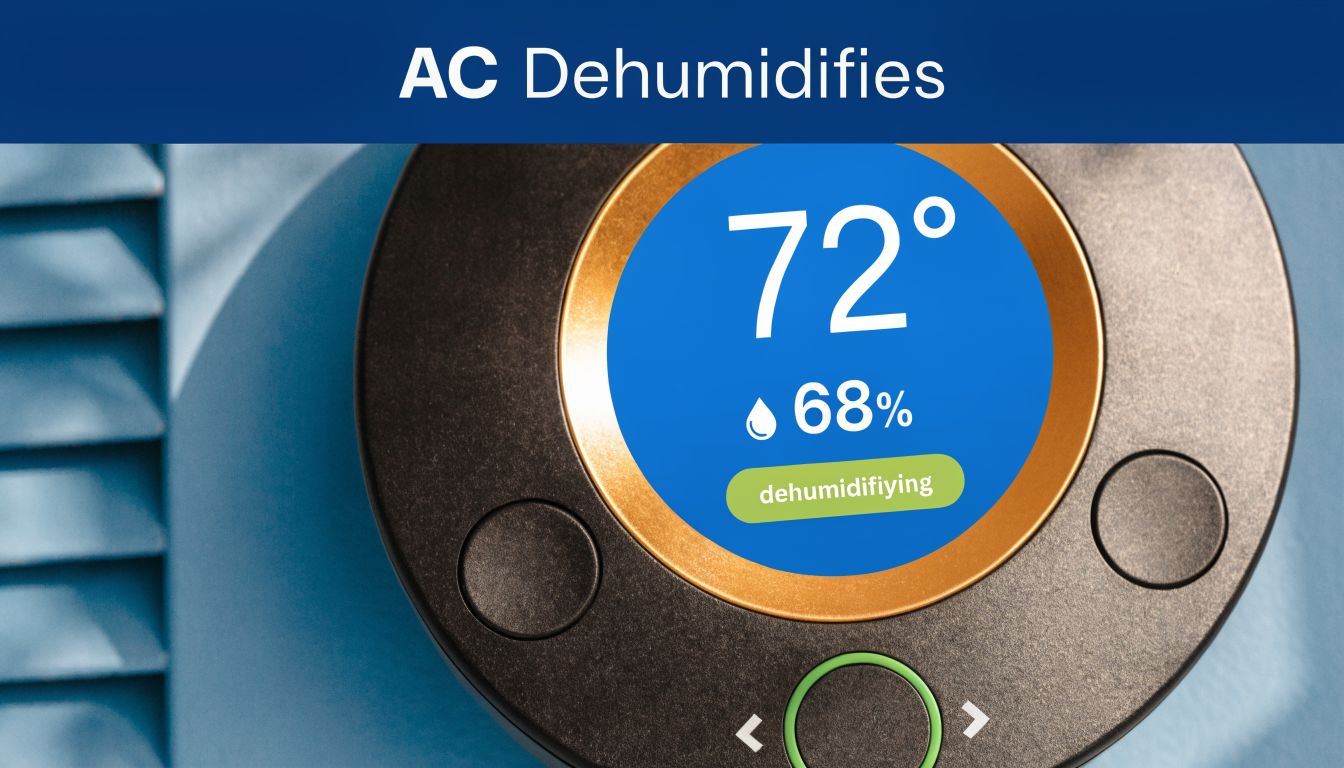
Smart thermostats and humidistats
A better control strategy can make a real difference. Standard thermostats only react to temperature. Smarter controls can account for humidity and adjust operation more intelligently.
That matters in Arizona because a home can read “comfortable” on temperature while still feeling wrong. A thermostat with humidity awareness can help the system respond to that hidden part of comfort.
If the thermostat only watches temperature, it can miss the reason you still feel uncomfortable.
This is one reason homeowners upgrade controls after replacing equipment. The new unit may be efficient, but if the controls don’t support humidity management, comfort can still feel off.
Duct sealing is a humidity fix, not just an energy fix
People usually think of duct sealing as an efficiency upgrade. It is that, but in Mesa it’s also a humidity control move.
If ducts leak in a hot attic, the system can pull in unwanted air or lose conditioned air before it reaches the rooms. During humid weather, that can sabotage comfort fast. This is why targeted sealing methods like Aeroseal come up in serious humidity conversations here. The goal isn’t just better airflow. The goal is keeping humid attic air out of the conditioned side of the system.
When airflow problems mimic humidity problems
Sometimes the issue isn’t moisture creation. It’s air delivery.
A room with weak supply airflow or poor return movement can feel damp because air stagnates there. Homeowners often chase the room with fans or a small dehumidifier when correcting the HVAC side of the equation is the actual solution.
A few examples:
| HVAC issue | What the homeowner feels | What may actually be happening |
|---|---|---|
| Weak bedroom airflow | Room feels stuffy and sticky | Poor supply delivery or balancing |
| Humid hallway near attic access | Damp feel during monsoon weeks | Infiltration from leaks or envelope issues |
| AC runs but comfort is poor | House is cool, not dry | Short cycling or inadequate moisture removal |
| One side of house feels worse | Uneven comfort by zone | Duct leakage, balancing, or control issues |
Don’t ignore the evaporator coil
The evaporator coil is where moisture removal happens, so coil condition matters. If that part of the system is dirty or restricted, humidity control can suffer along with cooling performance.
If you want to understand that component better, this guide on how to clean an evaporator explains what it does and why it affects comfort.
The local Arizona trade-off
In a humid climate, ventilation is often pushed as the default answer. In the Phoenix area, that advice needs context. Sometimes bringing in outside air helps. During monsoon periods, bringing in more outdoor air can be the wrong move if the system isn’t set up to manage it.
That’s why targeted HVAC solutions matter more here than a lot of generic articles admit. The desert climate fools people into thinking humidity control is only a Gulf Coast issue. It isn’t. Arizona homes have their own version of the problem, especially when the building is tight, the ductwork is leaky, or the equipment is only tuned for temperature.
What works better than just turning the AC colder
If your plan is dropping the thermostat lower and lower, you may spend more and still feel uncomfortable. Better options usually include:
- Correcting duct leakage: Stops humid infiltration and improves delivery.
- Improving controls: Lets the system respond to humidity, not just heat.
- Fixing airflow restrictions: Helps the coil do its dehumidifying work.
- Adding dedicated dehumidification when needed: Best when humidity is recurring or house-wide.
That’s the part many homeowners find frustrating. They assume discomfort means the AC needs to be colder. Sometimes the house doesn’t need colder air at all. It needs drier air and a tighter system.
Keeping Humidity at Bay Long-Term Maintenance and When to Call Us
Humidity control isn’t a one-time fix. A house that feels better after one repair can drift right back into sticky conditions if the HVAC system isn’t maintained.
Recent industry data shows that 70% of high-efficiency AC installations can experience humidity spikes of 10% to 15% within six months if they don’t receive annual tune-ups to clean coils and calibrate the system, according to this humidity maintenance discussion. That lines up with what technicians see in the field. Dirty components and neglected settings let moisture problems creep back in.
The maintenance habits that matter most
A few basics go a long way:
- Change filters on schedule: Restricted airflow hurts system performance.
- Keep coils clean: Moisture removal depends on proper heat transfer.
- Check drain function: Water has to leave the system cleanly.
- Review fan and control settings: Good comfort depends on more than temperature.
- Inspect duct condition: Leaks can undermine other improvements.
If you want a practical maintenance reference, this HVAC preventive maintenance checklist is worth keeping handy.
When it’s time to stop troubleshooting alone
Call a pro if any of these are happening:
- Humidity won’t drop below the recommended range
- Musty odors keep coming back
- You see mold or mildew growth
- Certain rooms stay muggy no matter what you do
- The AC cools but the house still feels damp
- You suspect duct leakage, coil issues, or drainage problems
If you’re also dealing with moisture concerns beyond the main living space, this guide on how to avoid mold in your basement gives solid prevention context that pairs well with whole-home humidity control.
Good humidity control should feel steady, not fragile. If comfort only lasts a few days after each DIY attempt, the house is telling you the root cause hasn’t been solved.
If your home still feels sticky, musty, or uncomfortable, Comfort Experts can help you find the actual cause and fix it correctly. Call 480-207-1239 or schedule service to get a professional humidity and HVAC evaluation in Mesa or anywhere in the Phoenix Valley.