Most Phoenix homeowners spend $1,500 to $2,400 for a heat pump compressor replacement, though some jobs land in the $2,500 to $5,000 range when the compressor type, brand compatibility, or system setup makes the work more complex. If you're staring at a dead outdoor unit in Arizona heat, the cost to replace compressor in heat pump matters fast, because this is one of the few repairs that can either save the system or make full replacement the smarter move.
That's why generic national advice usually falls short. In the Phoenix Valley, long cooling seasons, heavy runtime, refrigerant compatibility, and whether your compressor is basic or variable-speed can all swing the final bill in a big way.
What a Heat Pump Compressor Actually Does
A heat pump compressor is the heart of the system. If the thermostat is the brain and the fan is the lungs, the compressor is the part that keeps refrigerant moving so your system can transfer heat where it needs to go.
In plain terms, your heat pump doesn't “create” cold air the way many homeowners picture it. It moves heat. In cooling mode, it pulls heat out of your house and dumps it outside. In heating mode, it does the reverse. The compressor makes that whole process possible by pressurizing the refrigerant and pushing it through the cycle.
If you want a simple overview of that cycle, this explanation of how a heat pump works is a helpful companion.
Why this one part costs so much
A capacitor, contactor, or sensor can fail and still be a fairly contained repair. A compressor is different. It's one of the most complex and expensive components in the outdoor unit, and when it fails, the repair usually involves electrical diagnosis, refrigerant recovery, installation work, evacuation, recharge, and system testing.
Replacing a heat pump compressor is comparable to replacing a car's engine rather than merely swapping a battery. The component itself is significant, but the surrounding labor is equally critical.
A failed compressor isn't just a “bad part.” It can affect refrigerant flow, oil circulation, system pressures, and the condition of nearby components.
What failure usually means for your comfort
When a compressor starts failing, homeowners often notice one of a few things:
- Warm air indoors: The system runs but can't move heat effectively.
- Outdoor unit struggles: It may hum, click, trip breakers, or shut down.
- Long run times: The system seems to work harder with less comfort.
- Intermittent operation: It cools sometimes, then stops keeping up.
Not every no-cooling call is a dead compressor, and that's important. A bad capacitor, control issue, or wiring problem can mimic compressor symptoms. That's one reason honest diagnosis matters so much before anyone quotes a major repair.
Why Phoenix homes feel this repair more sharply
In our climate, your cooling equipment often works hard for long stretches. When the compressor weakens, comfort drops fast. Rooms heat up, indoor humidity control gets uneven, and homeowners end up making a stressful money decision when they're already uncomfortable.
That's also why the cost to replace compressor in heat pump can feel so loaded emotionally. You're not shopping for an upgrade on your own schedule. You're often reacting to a breakdown when the house is already getting hot.
The Real Cost Breakdown for a Compressor Replacement
A compressor quote can look overpriced until you see what the job includes. In Phoenix, this repair is rarely just the price of a metal canister and a few hours on site. It is a sealed-system repair, and sealed-system work is where skill, time, and risk all show up on the invoice.
Estimated Cost Breakdown for Heat Pump Compressor Replacement
| Line Item | Typical Cost Range | What It Covers |
|---|---|---|
| Compressor part | $400 to $1,200 | Replacement compressor based on model and brand |
| Labor | $75 to $150 per hour | Skilled technician time for diagnosis confirmation, recovery, replacement, evacuation, recharge, and testing |
| Total parts and labor | $1,500 to $2,400 | Typical complete replacement job |
| Time on site | 3 to 6 hours | Standard replacement window for professional installation |
For homeowners comparing HVAC estimates in general, HomeProBadge's HVAC guide is also useful for understanding how contractors structure pricing.
Why the quote is more than the compressor price
Homeowners usually lock onto the part cost first. That makes sense. The compressor is the headline item. But on a heat pump, the expensive part of the job is often everything around it.
The replacement has to match the equipment's refrigerant, electrical specs, capacity, and manufacturer requirements. If the match is wrong, the system may cool poorly, draw the wrong amperage, or damage the new compressor early. In Phoenix, where summer run times are long and demand is heavy, a bad install tends to show up fast.
A fair quote usually reflects that risk.
What labor pays for
Labor pays for more than just the physical swap. A trained technician has to confirm the failure, protect the refrigerant circuit, install the new compressor correctly, and make sure the system starts back up under normal pressures.
That work often includes:
- Diagnosis confirmation: Verifying the compressor has failed and that the problem is not a capacitor, contactor, wiring fault, or control issue.
- Refrigerant recovery: Removing and containing refrigerant before opening the system.
- Compressor installation: Cutting out the failed compressor, brazing in the new one, reconnecting wiring, and replacing related materials as needed.
- Evacuation: Pulling the system into a deep vacuum so moisture and non-condensables are removed.
- Recharge and testing: Charging to manufacturer specs, then checking pressures, temperature split, amperage, and overall operation.
Practical rule: If one quote is far lower than the others, ask what was left out. Corners usually show up in cleanup, evacuation, refrigerant charging, or startup testing.
This is the part that surprises people. The line-item table makes the repair look neat, but older systems in the Valley can add cost around the edges. Burned terminals, contaminated refrigerant, a failed capacitor, or a clogged filter drier can all turn a standard job into a longer one.
Heat also changes the stakes. During a Phoenix summer, technicians are often working on equipment that has been running hard for months. That can mean more wear around the compressor failure, not just inside it.
Ask whether the estimate includes refrigerant, filter drier replacement, electrical components if needed, and startup testing. If those items are vague, the final bill can move.
What a solid estimate should show
A good quote does not need to read like a factory manual. It should tell you what equipment is being installed and what procedures are included so you can compare bids accurately.
Use this checklist:
- Correct compressor match: Brand, model compatibility, and refrigerant type
- Clear labor scope: Sealed-system work, not a simple parts swap
- Refrigerant details: Recovery, recharge, and any added materials
- Related protection items: Filter drier or other recommended supporting parts
- Testing after install: Startup verification and performance checks
If you want another point of comparison, this guide on replace AC compressor cost helps show how contractors often frame similar major compressor repairs.
Key Factors That Raise or Lower Your Final Bill
Some compressor jobs are straightforward. Others become expensive fast because of the equipment you own, the refrigerant it uses, and how much extra procedure the system requires.

According to Monkey Wrench Plumbing's heat pump compressor replacement cost guide, total replacement cost typically ranges from $2,500 to $5,000, and variable-speed compressors often carry a 20% to 50% premium over single-stage units. The same source notes labor can rise to 4 to 6 hours and $400 to $1,500, while refrigerant mismatches can increase cost by 30%.
Compressor type changes everything
A standard single-stage compressor is simpler. It turns on, runs at its designed output, and shuts off. A variable-speed compressor is more advanced. It can adjust capacity to match demand more precisely, which helps with comfort and efficiency, but it also raises the stakes on replacement.
Those advanced systems usually cost more to repair because they involve:
- More complex controls
- Brand-specific compatibility concerns
- More careful startup and calibration
- Higher part cost
If you've ever compared efficiency ratings before, this discussion of SEER 14 vs 16 helps explain why higher-efficiency systems often come with more complex components.
Refrigerant compatibility can push a quote up fast
This is one of the least understood cost drivers. Homeowners hear “compressor replacement” and assume the job is about a single part. In reality, refrigerant type and system matching can change the repair from manageable to messy.
If refrigerant types don't line up cleanly with the system design, added work may be needed. That's one reason two homes with “the same problem” can get very different quotes.
If the new compressor doesn't fit the refrigerant and control strategy of the system around it, you're not solving the problem. You're creating the next one.
Brand and model compatibility matter
Not all compressors are interchangeable in the practical, real-world sense homeowners hope for. Even when a replacement is technically available, the right match may be more expensive because of brand-specific design, inventory availability, or the control logic used by the equipment.
This is especially relevant with premium equipment or inverter-driven systems. The part may exist. The question is whether it's the right part for a durable repair.
Phoenix-specific job conditions
Phoenix-area homes add some local realities. Extreme outdoor heat can expose weaknesses in aging systems quickly. Long seasonal runtime means wear tends to show up in the compressor and refrigerant circuit more dramatically than in milder climates.
Then there's access. A ground-level outdoor unit is easier to service than equipment tucked into a tight side yard or placed where setup takes more effort. Even without assigning a number to that difference, it absolutely affects the final bill.
Should You Replace the Compressor or the Entire Heat Pump
This is the hardest decision in the whole conversation. Spending a few thousand dollars to keep a system alive can be smart. It can also be the HVAC version of putting a new engine into a car with a failing transmission, worn tires, and electrical problems.
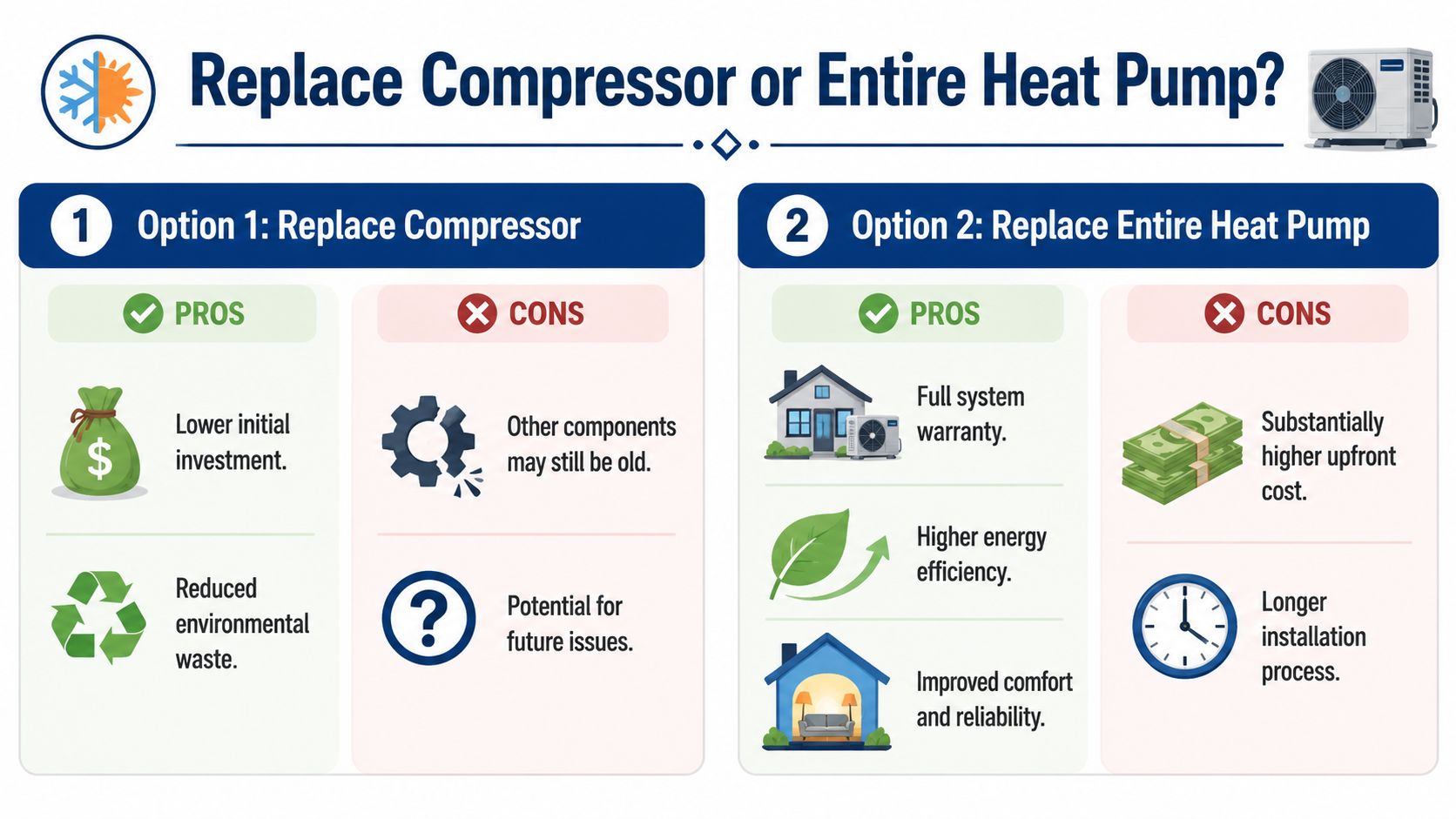
According to Angi's AC compressor cost article, if the compressor is under warranty, replacement can drop to $600 to $1,200, compared with $1,300 to $2,500 when it's out of warranty. The same source says repeated $100 to $300 repair calls on older systems often make less financial sense over time than moving ahead with a larger repair decision.
Start with warranty before anything else
If your compressor is still under manufacturer warranty, that changes the conversation immediately. The labor still matters, but the part cost may be reduced enough that replacement becomes much easier to justify.
That's why one of the first questions a good technician should ask is not “Do you want to repair or replace?” It's “What's still covered?”
A practical version of the 50 percent rule
Homeowners often use a common rule of thumb: if one repair starts eating up a large share of what a new system would cost, full replacement deserves serious consideration. It's not a strict law. It's a financial sanity check.
This matters most when the system is already showing its age in other ways.
Consider full heat pump replacement more seriously if these apply:
- The unit is older and out of warranty: A big repair on aging equipment carries more risk.
- Repair history is stacking up: If the compressor is not the first expensive problem, it may not be the last.
- Comfort has been uneven: Hot rooms, weak airflow, and long run times can point to a broader system issue.
- You're already unhappy with efficiency or noise: A new compressor won't turn an older system into a modern one.
For a deeper look at similar repair-versus-replace thinking, this article on air conditioner compressor replacement is worth reading.
When replacing just the compressor makes sense
A compressor-only repair is often the better move when the rest of the system still has good bones.
That usually looks like this:
- Warranty support is still active
- The system has otherwise been reliable
- The indoor and outdoor equipment are still in decent shape
- You need to avoid the larger upfront cost of total replacement right now
When full heat pump replacement is usually smarter
Some situations point the other way, even if replacing the compressor is technically possible.
An older heat pump with a failed compressor can still be repairable. That doesn't automatically make it a wise investment.
A full system replacement often makes more sense when:
- The unit has a history of repeat repairs
- The compressor failure is one more issue, not the only issue
- You want better comfort, quieter operation, or better efficiency
- Parts compatibility is becoming difficult
- You don't want to keep gambling on an aging system through another Phoenix summer
A neighbor-style decision tree
If you want the shortest honest version, ask these questions in order:
| Question | If yes | If no |
|---|---|---|
| Is the compressor under warranty? | Repair becomes more attractive | Keep evaluating total system value |
| Has the heat pump been reliable otherwise? | Compressor replacement may be reasonable | Full replacement deserves stronger consideration |
| Have repair calls become a pattern? | Lean toward full replacement | Repair may still make sense |
| Do you plan to stay in the home and want better long-term reliability? | New system often fits better | A targeted repair may be enough |
The right answer isn't always the cheapest answer today. Sometimes the smart move is the repair that buys you time. Other times, the smart move is stopping the cycle of one more invoice, one more hot day, and one more temporary fix.
The Replacement Process and Warranty Considerations
In Phoenix, a compressor replacement is usually an all-day disruption for the homeowner, even if the hands-on work only takes part of that window. The technician is opening a sealed refrigerant system, replacing one of the most expensive parts in the unit, then making sure the system can survive real summer load once it starts back up.
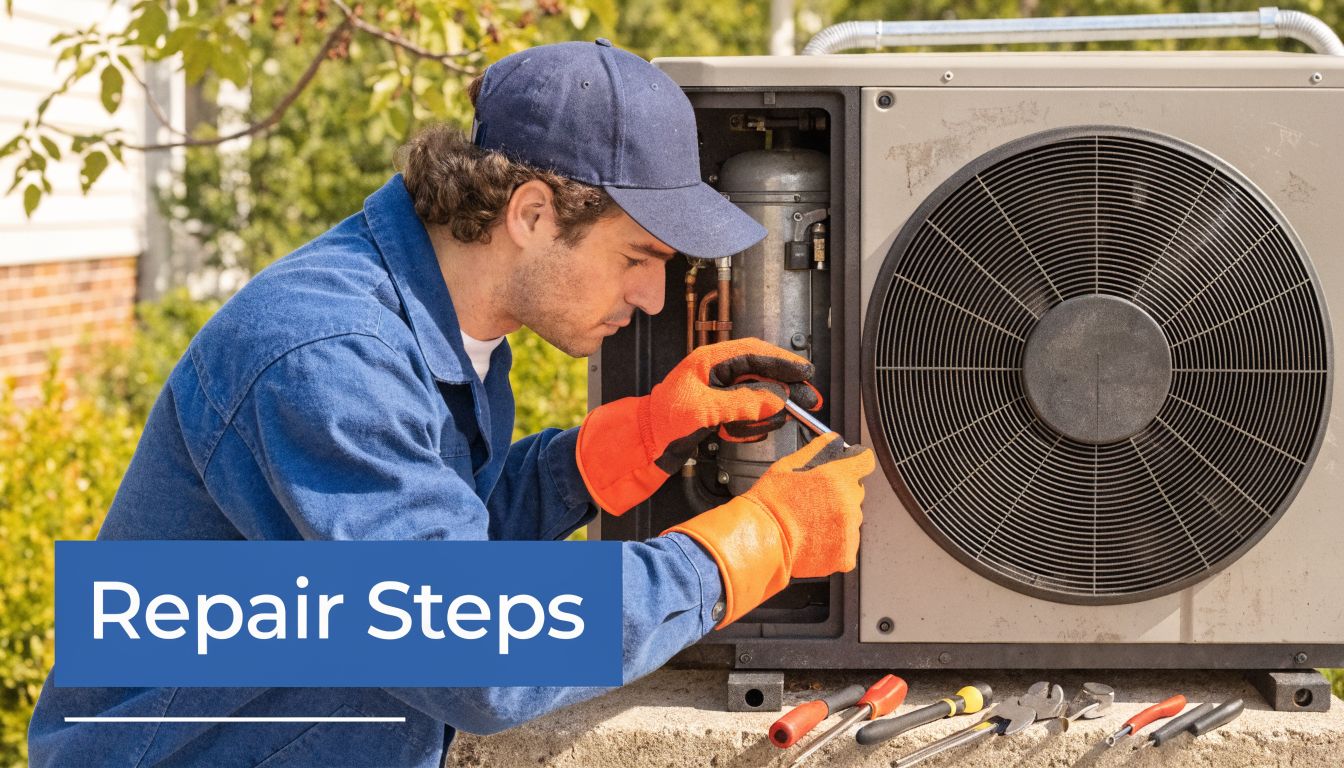
A proper job follows a sequence for a reason. If any step gets rushed, the new compressor can fail early.
What the job should include
A solid compressor replacement usually includes:
- Verifying the diagnosis: A good technician confirms the compressor has failed and that the problem is not a capacitor, contactor, control issue, or airflow problem.
- Recovering refrigerant safely: The refrigerant has to be removed before the sealed system is opened.
- Replacing the compressor and related materials: This often includes filter driers, fittings, oil management steps, and sometimes electrical components tied to the failure.
- Pulling a deep vacuum: Air and moisture have to be removed before the system is recharged.
- Charging and testing under load: The unit should be checked for amperage, pressures, temperature split, and overall operation, especially in high outdoor heat.
Phoenix conditions make this part more important, not less. A system that looks acceptable on a mild morning can show problems fast in afternoon heat. That is one reason I tell homeowners to focus less on the part swap itself and more on whether the company treats the repair like sealed-system work instead of basic AC service.
If you're comparing repair costs with full replacement pricing in other regions, this overview of HVAC replacement costs in Toronto shows how labor, equipment, and local conditions can shift the final number.
Warranty details homeowners often miss
Warranty conversations confuse a lot of people because “the compressor is under warranty” sounds better than it usually is. In many cases, the manufacturer may cover the part but not the labor, refrigerant, diagnostic time, or materials needed to complete the repair correctly.
That can still save real money. It just does not mean the repair is cheap.
Ask these questions before approving the work:
- Is the compressor itself covered by the manufacturer?
- Is labor included, or are you paying that out of pocket?
- Are refrigerant, filter driers, and other materials billed separately?
- Does the replacement compressor come with a new parts warranty?
- Will the contractor handle the warranty claim, or are you expected to sort that out yourself?
Paperwork matters here. Model number, serial number, installation date, and proof of maintenance can all affect what gets approved. On older Phoenix systems, I also recommend asking whether the existing refrigerant type or coil condition could create extra cost during the repair.
If you want to compare quotes or slow the process down before approving a major repair, this guide on finding AC repair service near me is a practical starting point.
Get an Honest Diagnosis from a Comfort Expert
When a heat pump stops cooling in Phoenix, urgency takes over. That's normal. But before you approve a major repair, make sure someone has verified the compressor failure, checked the warranty, and looked at the health of the whole system.
A trustworthy diagnosis should answer a few basic questions clearly:
- Has the compressor failed, or is another component preventing operation?
- What warranty coverage is still available?
- What does compressor replacement cost on this specific system?
- How does that compare with full heat pump replacement?
A second opinion is often worth it when the repair is expensive. If you want one, this page about getting an HVAC second opinion is a practical place to start.
The best HVAC companies don't treat compressor failure like a one-answer sales script. They show you the numbers, explain the risks, and let you choose based on your budget, your timeline, and how long you want this system to keep serving your home.
If you want a straight answer from a local team, Comfort Experts can inspect your system, verify whether the compressor has failed, check warranty status, and lay out repair versus replacement options without pressure. Call 480-207-1239 or schedule service online for a fast diagnostic.