When smoke drifts into a Mesa home, many residents notice the same things first: the smell, the haze, and that uneasy feeling that the air just isn't right. If you're asking **do air purifiers help with smoke, the short answer is yes, but the right setup matters a lot more in Arizona than common articles admit.
The Simple Answer and the Critical Details About Smoke
Yes, air purifiers help with smoke. A good unit with the right filter combination can make a noticeable difference indoors, and the best HEPA models can reduce particle concentrations by as much as 85 percent according to the Consumer Reports summary of EPA guidance on wildfire smoke purifiers.
That's the encouraging part. The part homeowners need to understand is that smoke isn't one thing.

Smoke has two separate problems
One part of smoke is solid particulate matter. This includes the fine debris from wildfire smoke, cigarette smoke, cooking smoke, and other combustion sources. These are the particles that can stay suspended in the air and make a room feel heavy.
The other part is gas. That includes odors and volatile compounds released during burning. This is why a room can still smell smoky even after the visible haze seems better.
Plain-English definition: PM2.5 means very small airborne particles. VOCs are invisible gases and chemical compounds that create odors and can irritate indoor air.
A lot of disappointment with air purifiers comes from buying a machine that only handles one side of the problem. If the purifier captures particles well but has weak odor control, people say, “It's running, but I can still smell smoke.” They're usually right.
What this means in a real Arizona home
In the Phoenix Valley, smoke doesn't always arrive as a dramatic wildfire event. Sometimes it's a neighbor's fire pit, a backyard smoker, cigarette smoke from a nearby patio, or outdoor haze that sneaks in through gaps around doors, duct leaks, and attic bypasses.
That's why the better question isn't just whether air purifiers work. It's whether the purifier you're considering is designed to deal with both the particles and the gases in smoke.
If you're comparing options, this Covenant Aire Solutions air purification guide gives a helpful overview of how purification systems fit into broader indoor air strategies. For homeowners looking at room-by-room fixes versus house-wide improvements, it also helps to understand the broader category of indoor air quality solutions before buying on impulse.
The practical answer
A smoke purifier can absolutely help, especially in a bedroom, office, or nursery. But if your home is dusty, leaky, or relying on one undersized portable unit to clean a large open layout, results will fall short.
Air purification works best when the machine matches the pollutant, the room size, and the way the house actually moves air.
How Air Purifiers Actually Capture Smoke
Most homeowners don't need a deep engineering lesson. They need to know what parts inside the machine do the work and what claims to ignore. Let me explain.
HEPA handles the particle side
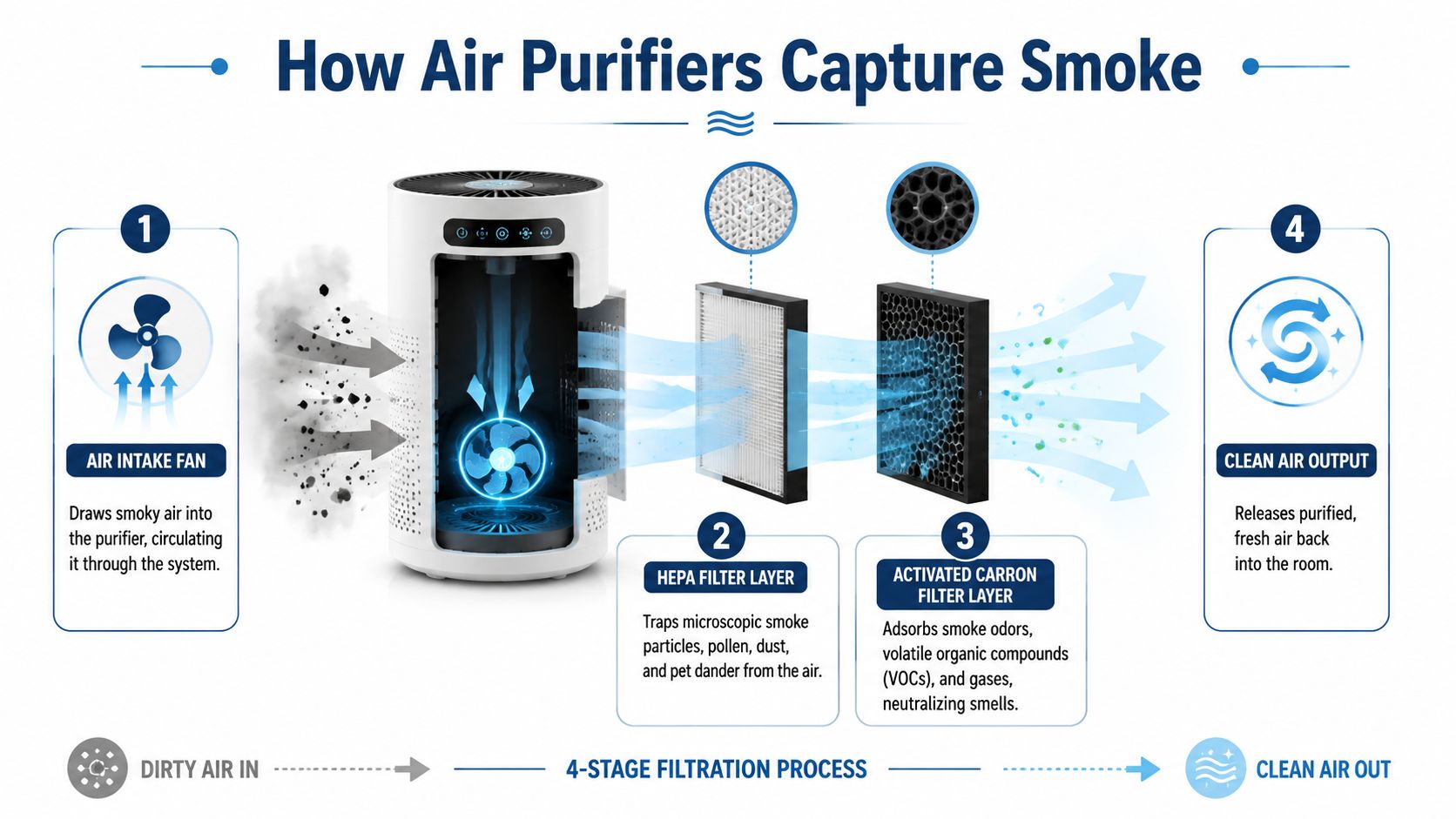
A HEPA filter works like a super-fine net, except it's much more effective than a window screen or a standard thin filter. True HEPA filters capture 99.97% of 0.3-micron particles, and they also capture an even greater percentage of both larger and smaller particles, according to the peer-reviewed wildfire smoke filtration research.
That's why HEPA is so important for smoke. The dangerous part of smoke often lives in the fine particulate range, not in the bits you can easily see floating in sunlight.
Activated carbon handles the odor and gas side
Many buyers get tripped up at this point. HEPA is excellent for particles, but it doesn't absorb gases.
For that, you need activated carbon. Think of carbon as a giant porous sponge with countless tiny pockets where smoke-related gases and odors can cling. It doesn't trap ash the way HEPA does. It adsorbs chemical compounds and helps with the smell that makes people feel like the purifier “isn't working.”
According to Daikin's smoke filtration overview, activated carbon combined with HEPA can capture over 250 harmful chemical compounds in smoke, and this dual approach has been associated with a 3.1% reduction in formaldehyde during smoke events. The same source also notes CDC evidence showing HEPA air cleaner use in residential settings reduced blood cadmium concentrations by 14% and total urinary cadmium by 29%.
Bottom line: If you want help with visible smoke and the lingering smell, you need HEPA plus activated carbon, not HEPA alone.
What doesn't solve smoke well by itself
Some technologies get marketed as if they do everything. They don't.
A UV purifier can serve a purpose in some IAQ strategies, but it's not a smoke solution by itself because smoke is primarily a particle-and-gas problem. Ionizing and ozone-style products also raise separate concerns, and they're not my first recommendation for a family trying to make a home safer during a smoke event.
For cleaner comparisons between filter types and system choices, this guide on the best HVAC filters for allergies can help homeowners understand why capture media matters so much more than marketing language.
What to look for on the spec sheet
If you're standing in a store or browsing online, focus on these features:
- True HEPA filtration: Skip vague phrases like “HEPA-type” or “HEPA-like.”
- Substantial activated carbon: A thin carbon sheet may help a little with smell, but stronger carbon filtration generally performs better for smoke odors.
- A strong fan: Filters only work if the unit moves enough air through them.
- Clear room-size guidance: If the unit is undersized, even good filters won't deliver enough clean air.
You know what? A weak fan paired with a fancy filter is still a weak smoke solution.
Decoding CADR and Choosing the Right Size Purifier
A common mistake in Mesa homes is buying a purifier that looks impressive on the box, then expecting it to clean a large bedroom, loft, and open living area all at once. Smoke does not care about the marketing. The unit has to move enough clean air for the space you are asking it to handle.
That is what CADR measures.
CADR stands for Clean Air Delivery Rate. It is the amount of filtered air a purifier delivers, and most units list separate numbers for smoke, dust, and pollen. For wildfire smoke, the smoke CADR matters most because it gives you the clearest picture of how quickly the machine can reduce fine airborne particles in a room.
Why CADR matters more than extra features
A purifier can have a true HEPA filter and still underperform if the fan is undersized for the room. I see that a lot in Arizona houses with high ceilings, open kitchens, and split layouts. Homeowners buy one portable unit for convenience, but the air volume they need to clean is much bigger than the floor plan suggests.
A practical sizing rule is the two-thirds rule. Aim for a smoke CADR that is about two-thirds of the room's square footage.
That is a starting point, not magic.
If the room opens into a hallway, has tall ceilings, or gets frequent door traffic, sizing up is usually the smarter call. That matters in Arizona because many homes are not chopped into small, easy-to-control rooms. Air moves. Smoke moves with it.
Quick examples using the two-thirds rule
- Small bedroom: A 12 x 12 room is 144 square feet, so look for a smoke CADR of about 96 or more.
- Primary bedroom: A 15 x 20 room is 300 square feet, so a smoke CADR around 200 is a solid target.
- Large open living area: A 500 square foot space needs about 330 smoke CADR, and in many open-concept homes I would rather see homeowners go higher than lower.
Health effects are part of the sizing conversation too. A study in Environmental Health found that each 10 μg/m³ increase in PM2.5 was associated with about a 4% increase in the odds of asthma symptoms in children, which is one reason smoke control needs to be more than a guess during wildfire season (Environmental Health study on PM2.5 and asthma symptoms).
Practical rule: Match the smoke CADR to the room first. App controls, looks, and low-noise claims do not make up for an undersized unit.
Recommended smoke CADR by room size
| Room Size (Square Feet) | Example Room Type | Minimum Smoke CADR |
|---|---|---|
| 144 | 12 x 12 bedroom | 96 |
| 300 | 15 x 20 primary bedroom | 200 |
| 500 | Large living room or open-concept space | 330 |
Portable units can work well in the room they are sized for. They usually fall short when homeowners expect one machine to protect an entire Arizona home. If you are also comparing options for dust, pollen, and pets, this guide to the best air purifiers for allergies can help you sort through the overlap without losing sight of smoke performance.
Getting the Most From Your Purifier in Arizona
Just buying a good purifier isn't enough.
I've seen homeowners put a solid unit in the worst possible spot, run it only occasionally, leave doors open, and then assume air purification doesn't work. In Arizona, setup and maintenance make a bigger difference than people expect.
Placement changes performance
A purifier needs space to breathe. If it's wedged behind a chair, shoved in a corner, or blocked by drapes, airflow drops and the machine can't circulate the room properly.
A better setup usually looks like this:
- Keep it off the wall: Give the intake and discharge room to move air.
- Put it where you spend time: Bedrooms, family rooms, and home offices usually matter most.
- Close up the room during smoke events: Open windows and frequent door traffic work against the purifier.
Run it before the room smells bad
Smoke control is easier when the purifier runs continuously during a smoke event instead of after the smell becomes obvious. If your unit has an auto mode, that can help, but during heavy smoke days many homeowners get better results by manually running a stronger setting for longer stretches.
The “set it and forget it” mindset is where a lot of frustration starts. Filters load up. Rooms change. Outdoor conditions change. The machine still needs attention.
This is the part national buying guides usually miss. In dry desert environments like the Phoenix Valley, smoke odors and particles can linger longer, and standalone purifier performance can drop by 20 to 30% as dust storms clog filters, according to this desert-climate smoke purifier discussion.
That means the same unit that worked well in a mild climate may struggle here if the home also deals with dusty returns, leaky ductwork, or frequent filter loading.
If the prefilter is dirty and the main filter is loaded with desert dust, the purifier spends more energy fighting Arizona than fighting smoke.
Maintenance is part of performance
A smoke purifier is not a one-time purchase. It's a maintenance item.
Watch for these signs that performance is fading:
- Lower airflow: The machine sounds normal, but less air is moving.
- Persistent odor: Smoke smell lingers longer than it used to.
- Visible filter loading: Dust buildup comes fast in many Valley homes.
- More HVAC runtime discomfort: Poor house airflow can make one-room fixes feel less effective.
For the house as a whole, regular HVAC upkeep also matters because smoke and dust problems get worse when filtration and airflow are neglected. This guide on how often HVAC should be serviced is worth reviewing if your system hasn't been looked at in a while.
When Portable Purifiers Arent Enough The Whole-Home Solution
Portable purifiers have a place. I recommend them often for bedrooms, nurseries, home offices, and isolated problem rooms. But there's a point where adding another box in another corner stops being the smart move.
That point usually comes when the house itself is the problem.

Why one-room solutions hit a wall
Portable units clean the air in the room they serve. They do not fix:
- Leaky ductwork pulling in dirty air
- Poor filtration at the central HVAC system
- Pressure imbalances between rooms
- Smoke migrating through hallways and returns
- Open-concept layouts that overwhelm a single machine
In a Mesa or Phoenix-area home with high ceilings, a large great room, multiple return paths, and regular dust intrusion, one portable purifier can feel like bailing out a boat with a coffee mug.
What whole-home smoke control looks like
A stronger strategy starts with the central system because that's what already moves air through the entire house. Depending on the home, that can include:
Better central filtration
A properly selected media filter or high-efficiency filter cabinet can improve whole-home particle capture without relying on multiple portable units. This matters when smoke is affecting the entire living space, not just one bedroom.
Duct sealing
If ducts leak in the attic or crawl spaces, the system can pull dirty air into the house while you're trying to clean it. Sealing those leaks often makes every filtration upgrade work better because the system stops dragging in contaminants from unwanted places.
For homeowners trying to understand maintenance expectations in desert conditions, this resource on find desert-specific furnace filter schedules gives useful context on why filter loading behaves differently here than in milder climates.
Whole-home air purifiers and air cleaners
Professional IAQ add-ons can be integrated directly into the HVAC system so every cycle helps clean distributed air, not just the air near one portable unit. That's a major advantage in larger homes or homes with occupants who are sensitive to smoke, dust, or respiratory triggers.
Recent data referenced by HouseFresh's smoke purifier coverage indicates standalone purifiers can lose up to 40% effectiveness in high-heat conditions above 100°F, while integrated whole-home setups maintain up to 96% air quality improvement. Arizona homeowners don't need to guess whether heat matters. We live with it.
In a hot, dusty Valley home, smoke control works best when the purifier and the HVAC system act like a team instead of competing with each other.
When this upgrade makes sense
A whole-home approach is worth serious consideration if any of these sound familiar:
- You smell smoke in multiple rooms, not just one
- Your home has a large open layout
- You're already running several portable units
- Filters clog fast because of dust
- Someone in the home has asthma or strong smoke sensitivity
- The house never seems fully clean even after adding a room purifier
If you're weighing integrated options, this page on whole-home air purifiers shows the kind of house-wide solutions that go beyond a single portable machine.
Frequently Asked Questions About Smoke and Air Purifiers
Can an air purifier completely remove cigarette smoke smell
Not always. It can reduce airborne particles and odors, especially if it uses both HEPA and activated carbon, but cigarette smoke is stubborn because residue can cling to walls, carpets, upholstery, and HVAC surfaces.
If the smell has been in the home for a long time, air cleaning alone usually won't solve everything. Surface cleaning and source removal matter too.
Are ozone air purifiers a good idea for smoke
I don't recommend them for occupied homes. If a homeowner wants safer, practical smoke reduction, mechanical filtration and activated carbon are the better path.
Smoke is already an air quality problem. Adding another irritant to the indoor environment is not a smart trade.
How long should I run the purifier after a smoke event
Run it until indoor air feels normal again, and longer if outdoor smoke is still drifting in. In many homes, it makes sense to keep the purifier operating continuously during the event and for a while afterward, especially in bedrooms.
If the smell keeps returning, the issue may not be runtime. It may be infiltration, dirty filters, or smoke residue on surfaces.
Will UV light help with smoke
Not as a primary smoke fix. UV can play a role in some indoor air quality systems, but smoke removal is mainly about capturing fine particles and reducing gases and odors. That calls for filtration media, not just light treatment.
Is a portable purifier enough for wildfire season
Sometimes yes, for a single room used as a clean-air space. For a whole house, especially in Arizona, often no.
A standalone unit can help you create one better room. It usually won't solve smoke infiltration throughout a leaky or dusty home.
Breathe Easier with Expert Help
Smoke problems in Mesa usually show up the same way. One bedroom feels tolerable, the living room still smells smoky, and the HVAC keeps pulling in dust and fine particles every time the system runs.
A portable purifier can be the right tool for one room. It is rarely the full answer for an entire Arizona home, especially with open layouts, attic duct leakage, dusty return air, and long cooling seasons that keep the system cycling.
The practical question I tell homeowners to ask is simple: are you trying to protect a chair, a bedroom, or the whole house?
If the goal is one sleeping area during a smoke event, a well-sized portable unit often does the job. If smoke odor, irritation, or haze keeps showing up from room to room, stop treating it like a single-room problem. At that point, the better fix is usually a house-wide plan that matches the way the home moves air, with filtration, duct improvements, and indoor air quality equipment that works with the HVAC system instead of competing with it.
If you want help sorting out whether a portable unit is enough or it's time for a whole-home air quality upgrade, contact Comfort Experts by calling 480-207-1239 or use their schedule service form to have a local pro assess your home.
![Read more about the article Commercial HVAC Maintenance Contracts Explained [Updated 2026]](https://azcomfortexperts.com/wp-content/uploads/2026/04/commercial-hvac-maintenance-contracts-hvac-contracts-300x169.jpg "Commercial HVAC Maintenance Contracts Explained [Updated 2026] 6")