A Mesa homeowner replacing an aging air conditioner usually faces two serious choices: two-stage and variable-speed. The right answer in Arizona isn't automatically the system with the highest efficiency rating. It depends on how often the home operates at part load, whether the ducts deliver the air properly, and whether the property sits in APS or SRP territory.
The Mesa Cooling Decision You're Actually Making
The core choice in variable speed vs two stage AC in Arizona is about runtime behavior. Phoenix has 4,154 annual cooling degree days on a 65°F base, with monthly peaks of 864 in July and 819 in August, according to NOAA's Phoenix climate memorandum. Long compressor runtimes are normal in the Valley, but the system still won't face the same load at midnight, during a mild spring evening, and on a brutally sunny afternoon.
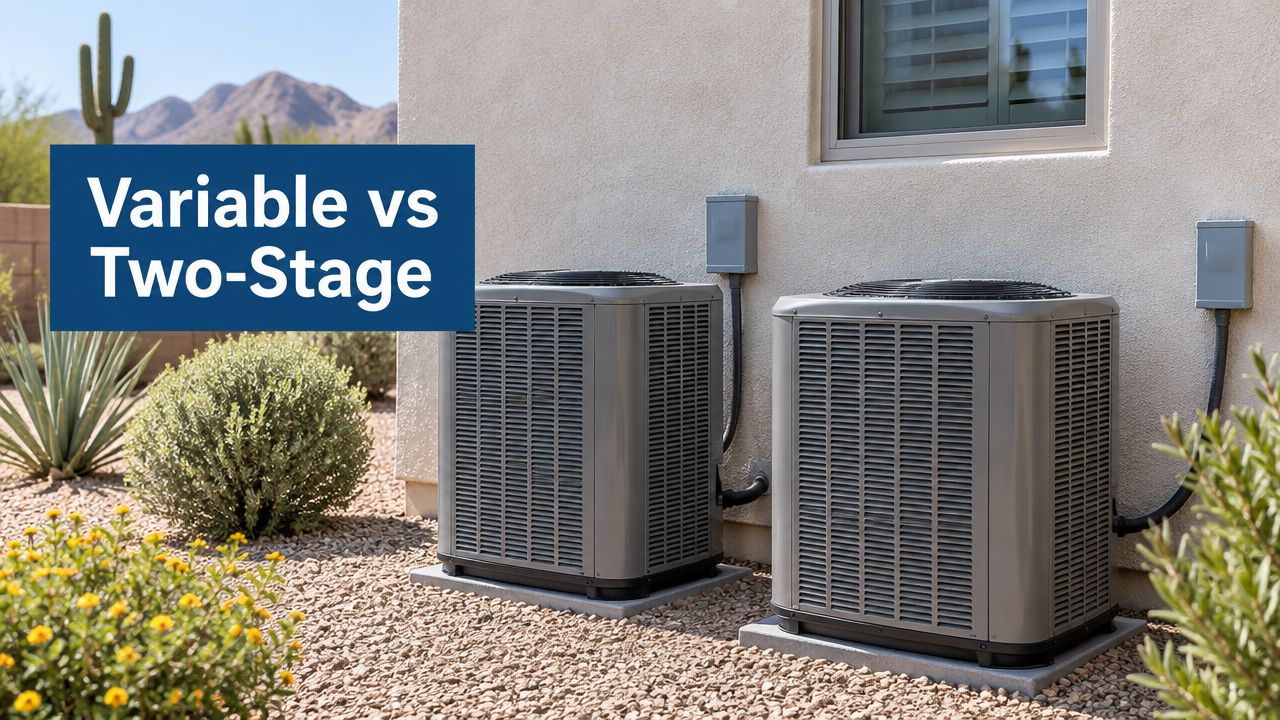
Both systems are a meaningful step above single-stage equipment. Two-stage cooling gives the compressor a low and high output. Variable-speed equipment can adjust output across a much wider range, which lets it follow changing demand more closely.
That advantage matters most when the home has sound ducts, good airflow, multiple zones, or noticeable comfort swings. It matters less when leaky attic ducts waste cooled air or the system runs near full capacity through much of the hottest afternoon.
| Decision factor | Two-stage AC | Variable-speed AC |
|---|---|---|
| Operating behavior | Two fixed compressor levels | Continuously adjusts output |
| Typical efficiency range | About 15.2 to 18 SEER2 | Often 20 to 26 SEER2 |
| Best fit | Practical upgrade with controlled installation cost | Maximum part-load comfort and efficiency |
| Main limitation | Less precise adjustment | Higher equipment and control complexity |
| Arizona question | Is low stage enough for most normal demand? | Will the home provide enough part-load hours to justify the premium? |
The decision should start with a load calculation and duct inspection, not a sales brochure. A Phoenix-area summer design temperature is 110°F, while Arizona's winter design temperature is 28°F, according to Arizona HVAC load calculation guidance. That makes cooling capacity the dominant concern in Mesa and the East Valley.
How Two-Stage and Variable-Speed Systems Actually Work
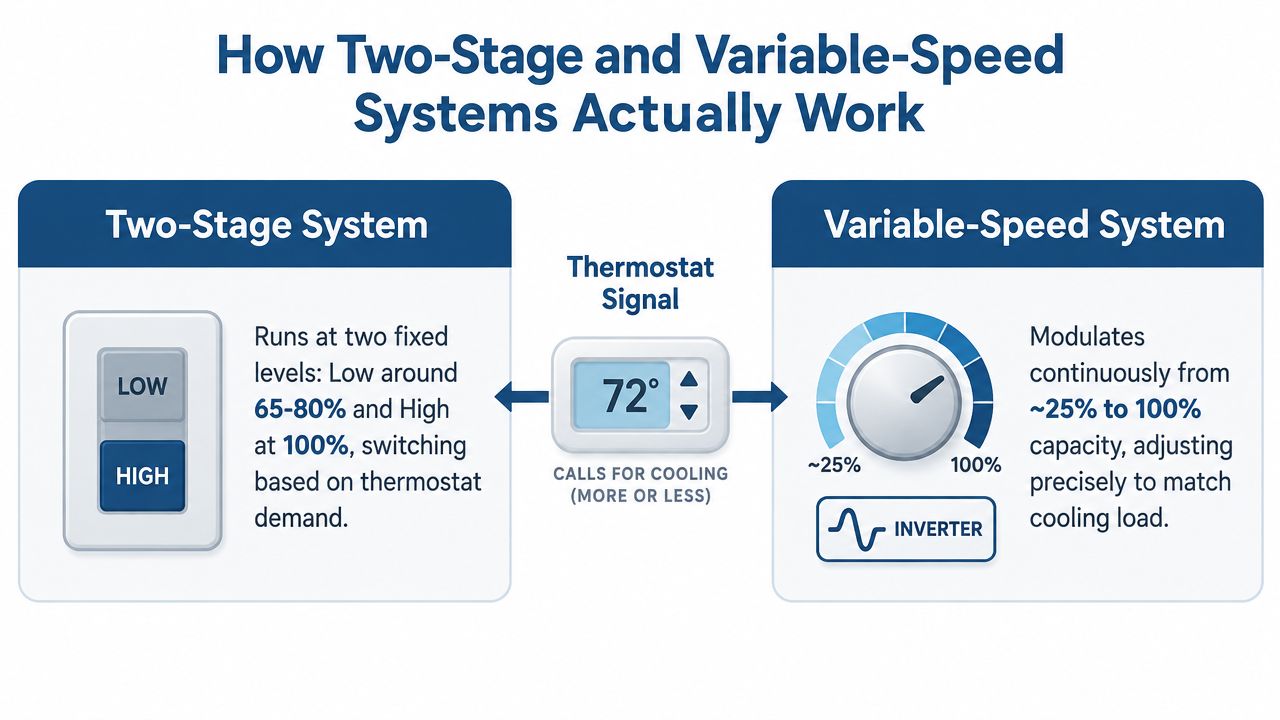
A two-stage compressor has two fixed operating levels. In many systems, low stage is commonly described as roughly 67% capacity, while high stage delivers 100%, as explained by George Brazil's Phoenix comparison. The thermostat calls for cooling, the system starts in low stage when the demand is moderate, and it moves to high stage when the home needs more capacity.
That extra stage reduces the hard blast of a single-stage system. Low stage can run longer, move air more steadily, and give the indoor coil more time to remove moisture. The compressor still has to choose between two fixed outputs, though. It can't settle at a precise level between them.
A variable-speed compressor works more like a dimmer switch. Instead of choosing only low or high, it ramps output up or down across a broad range. This allows the equipment to use less capacity overnight, increase output as west-facing rooms heat up, and respond more gradually when monsoon conditions add moisture to the air.
The indoor blower matters too
The compressor isn't the only component that changes. Two-stage equipment typically pairs compressor staging with blower staging, while variable-speed systems can modulate indoor airflow more gradually. That affects sound, supply-air temperature, filtration time, and moisture removal.
Variable-speed equipment often needs a communicating control system to use its full range. The refrigerant line set also has to match the equipment manufacturer's requirements. A line set that's too small, improperly configured, or reused without proper evaluation can undermine the system's performance before the first summer begins.
Homeowners comparing modern HVAC technology for Mesa homes should also think about protecting the entire system, not just the compressor. A maintenance plan that includes asset protection with HVAC maintenance illustrates the broader principle. Filters, coils, motors, controls, and airflow all affect whether advanced equipment performs as designed.
Side-by-Side Comparison Across the Criteria That Matter
The rating on the equipment label is only one part of the comparison. A variable-speed system usually has the higher published efficiency, but a poorly installed high-efficiency system can perform worse than a properly commissioned two-stage replacement.
Independent HVAC comparisons commonly place two-stage systems around 17 to 18 SEER2, while variable-speed models commonly reach 20 or more SEER2, with some extending into the 22 to 24 SEER2 range, according to Diamondback Air Conditioning and Heating's comparison. Another comparison places typical two-stage equipment around 15.2 to 18 SEER2 and variable-speed systems around 20 to 26 SEER2, with hot-climate use cases reporting energy use about 25% to 35% lower for variable-speed systems than two-stage equipment (HVAC Database).
| Criterion | Two-Stage | Variable-Speed |
|---|---|---|
| Seasonal efficiency | Commonly around 15.2 to 18 SEER2 | Often around 20 to 26 SEER2 |
| Part-load operation | Two fixed outputs | Broad continuous modulation |
| Monsoon moisture control | Better than single-stage when low stage runs long | Strongest when correctly sized and allowed to run at low output |
| Indoor sound | Quieter in low stage, louder at high stage | Usually smoother and quieter at low output |
| Temperature consistency | Steady, with some output changes | Most gradual adjustment across changing loads |
| Repair complexity | Simpler controls in many configurations | More electronic controls and inverter components |
| Installation sensitivity | Still requires correct sizing and airflow | Especially sensitive to ducts, static pressure, controls, and line-set setup |
Comfort depends on airflow
Two-stage equipment already removes much of the on-off cycling problem associated with single-stage systems. Variable speed is an incremental improvement, not a completely different category of cooling.
The gap widens in homes where the load changes constantly. A two-story home with a hot upstairs room, zoning dampers, and strong afternoon solar gain can benefit from the variable-speed blower's ability to adjust airflow. A compact, well-sealed single-zone home may get most of the practical comfort benefit from a properly sized two-stage system.
For homeowners researching air conditioner SEER 16 benefits, the useful question isn't whether a higher rating looks better. The question is whether the ducts, thermostat, airflow, and operating schedule allow the equipment to achieve that rating in the home.
Arizona Costs, Payback, and Utility Territory
The financial calculation deserves more care than a generic “variable speed saves more” claim. Arizona's extreme cooling demand can make the efficiency gap valuable, but sustained peak conditions also narrow the gap because both systems may need to operate near full output.
Utility territory changes the decision. The Arizona efficiency overview notes that APS ended residential efficiency rebates effective January 1, 2026, while SRP continues to offer per-ton incentives, with higher incentives for variable-capacity systems (Phoenix HVAC Authority). Those policies can change, so homeowners should verify current eligibility directly with the utility before counting any incentive in the budget.
SRP and APS also use different rate structures and program approaches. A variable-speed system may gain more value where long, lower-output operation works well with the homeowner's usage pattern. In APS territory, the financial case may depend more heavily on the home's actual part-load hours, duct condition, and comfort goals.
The verified Arizona comparison data supports a broad efficiency advantage for variable speed, but it doesn't provide defensible installed-price ranges, annual bills, or payback periods. Those figures shouldn't be guessed. A contractor needs the home's load, current equipment, duct layout, thermostat setup, and utility territory before calculating ownership cost.
| Ownership question | Two-stage | Variable-speed |
|---|---|---|
| Upfront cost | Often the more restrained premium option | Usually higher because of inverter controls and system integration |
| Energy potential | Strong improvement over single-stage | Higher published efficiency and better part-load potential |
| Payback certainty | Easier to justify in homes with limited duct upgrades | Depends heavily on part-load operation, utility policy, and installation quality |
| Rebate impact | May qualify under some programs, depending on current rules | May receive stronger support in programs favoring variable capacity |
| Best financial test | Compare total installed cost with expected runtime | Compare the premium against verified operating conditions and incentives |
Homeowners considering SRP territory should review how Comfort Experts handles SRP rebates as part of the planning conversation. The rebate should be treated as a possible adjustment, not a guaranteed part of the project price.
Matching the System to Your Home and Usage
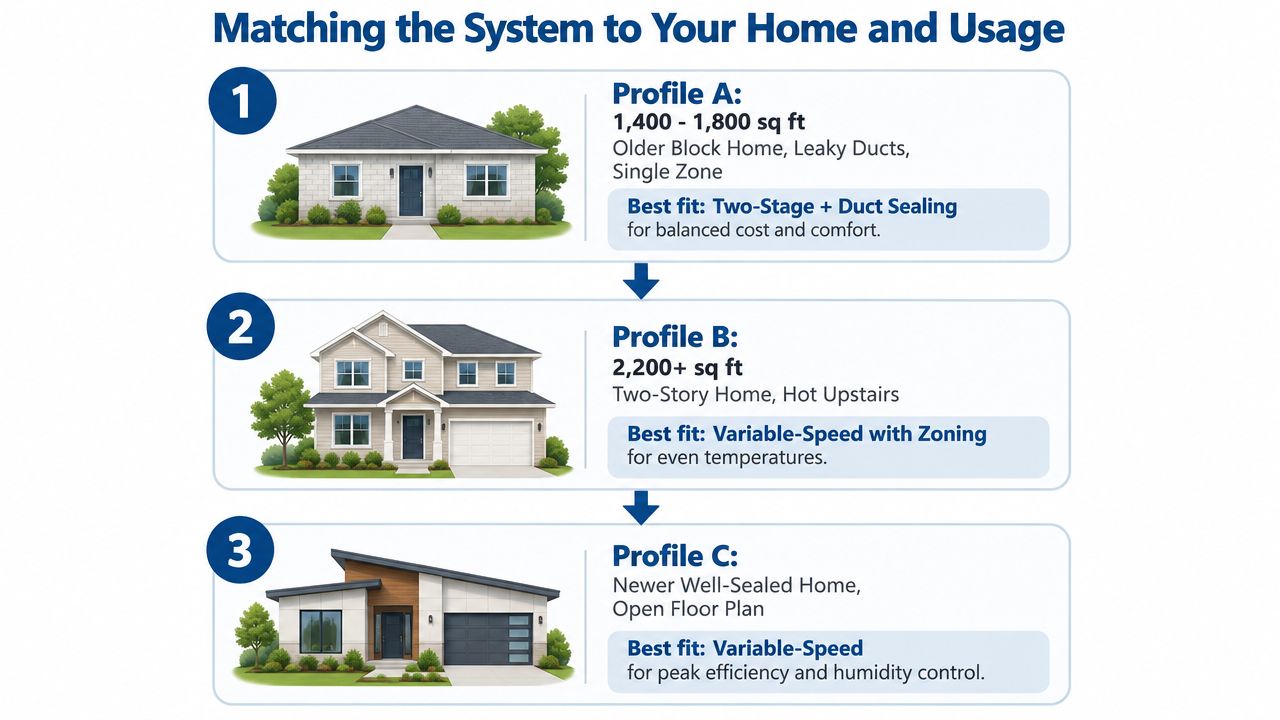
Three Mesa homes can receive three different recommendations even when their owners ask the same question.
Older block home with leaky ducts
A 1,400 to 1,800 square foot older block home with one zone and attic duct leakage usually makes a strong case for two-stage equipment paired with duct sealing. A quality system in the 16 to 17 SEER2 band can provide smoother cooling without asking the homeowner to pay for modulation that escaping air will undermine.
The trade-off is straightforward. The homeowner accepts less precise output control in exchange for putting money into the ducts, return-air capacity, and commissioning. Window performance also matters, so homeowners comparing older single-pane and newer insulated windows can use this window guide from Breaking Glass Co. as a separate envelope reference.
Two-story home with zoning
A larger two-story East Valley home with a bonus room and existing zoning dampers is a different problem. Variable speed can work well when the equipment, dampers, bypass strategy, and thermostat communicate correctly. Long low-output runtimes can help the system respond to upstairs heat without repeatedly overshooting the downstairs zone.
The homeowner should accept a more involved installation and the need for proper static-pressure testing. The system size and efficiency rating must come from a load calculation, not from square footage alone.
Casita or ADU addition
A casita or ADU sharing one system with the main house presents another trade-off. If the duct extension is long, undersized, or difficult to balance, a two-stage system may be the more sensible choice. Variable-speed operation can't repair poor duct design.
A ductless mini-split for the addition may deserve comparison with either central option. The homeowner accepts that the most efficient compressor technology isn't always the best answer if the distribution system is being stretched beyond its design.
Ductwork, Thermostats, and Maintenance Considerations
Premium equipment only performs when the supporting system is ready. Duct leakage, undersized returns, restrictive filters, poor supply balance, and high static pressure can erase much of the benefit of either staging strategy.
Variable-speed systems are particularly dependent on airflow control. They may require a communicating thermostat or manufacturer-specific controls to modulate correctly. Two-stage systems can often work with a conventional two-stage thermostat and may be more forgiving when the existing duct system can't be fully redesigned, though the blower and static pressure still need professional testing.
What a proper installation should include
- Load verification: The contractor should size the equipment for the home rather than match the old unit's capacity.
- Airflow testing: Static pressure and supply-return balance should be checked before the homeowner accepts the installation.
- Control matching: The thermostat must support the equipment's actual staging or communicating requirements.
- Line-set review: Variable-speed equipment needs refrigerant piping that meets the manufacturer's specifications.
- Desert maintenance: Filters, coils, outdoor clearances, and electrical components need attention because Mesa dust can collect quickly.
A quarterly filter check is a practical starting point, but the correct interval depends on filter type, pets, construction dust, and indoor air conditions. Homeowners who need additional filtration can shop EcoQuest Purifiers for purifier, but filtration equipment won't compensate for a blocked filter or inadequate return air.
Warning signs of poor commissioning include repeated high-stage operation, uneven room temperatures, unusual airflow noise, frequent thermostat alerts, and a system that struggles despite clean filters. A dedicated thermostat installation can help when control compatibility is part of the problem.
Common Assumptions Worth Questioning
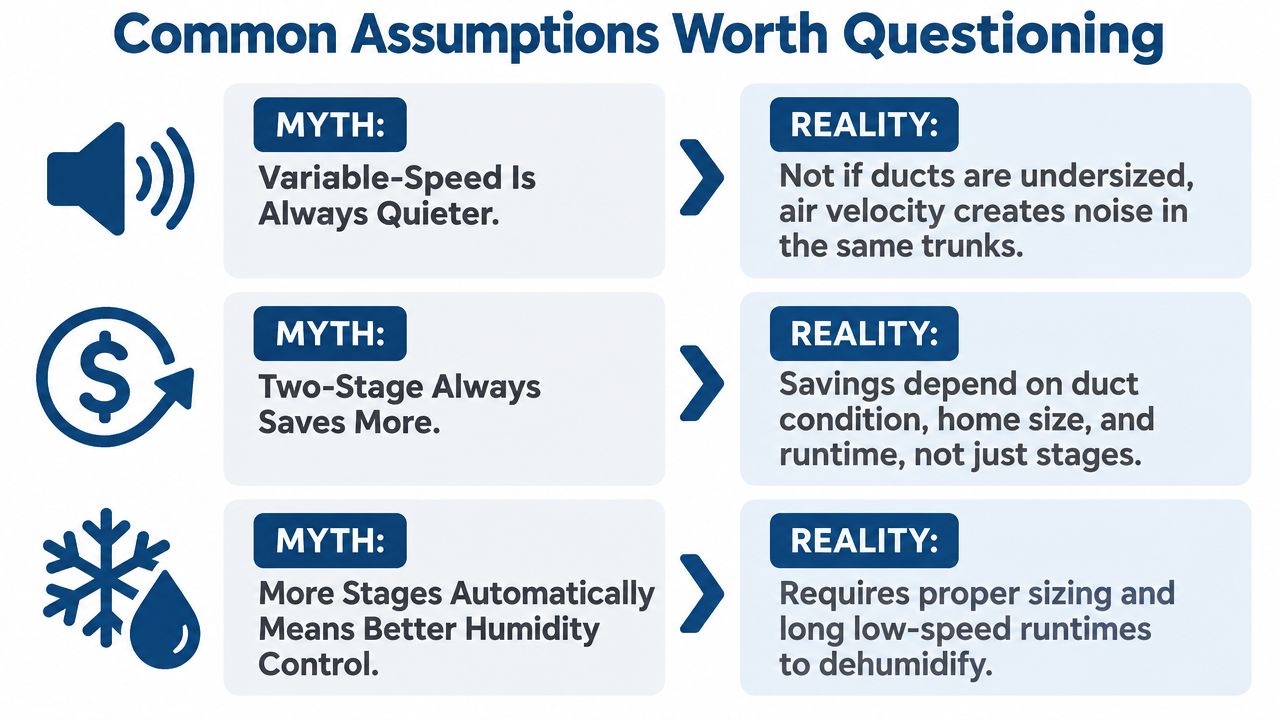
Variable speed isn't automatically quieter. If the ducts are undersized, the blower can still push air through restrictive trunks at an uncomfortable velocity. The outdoor unit may run softly at low output, while the homeowner still hears supply registers rushing.
Two-stage isn't automatically a comfort downgrade. In a tight, well-insulated Mesa home, low stage may handle much of the normal load. If the system is sized correctly and the thermostat is configured properly, many occupants won't notice the change to high stage during the hottest periods.
The expensive mistake isn't choosing two-stage. It's paying for advanced modulation while leaving the airflow problem untouched.
A higher efficiency label also doesn't guarantee lower utility bills. Duct losses, attic heat, restrictive filters, oversized equipment, and poor thermostat placement can overwhelm the expected benefit. The same caution applies to humidity. More stages can help only when the system runs long enough, the indoor coil is properly controlled, and the equipment isn't oversized.
Repair complexity deserves a clear-eyed comparison. Two-stage equipment isn't always inexpensive to repair, and variable-speed equipment isn't automatically unreliable. ECM blowers, inverter boards, communicating controls, and modulating components can all affect future service decisions, regardless of the compressor label.
The contractor pitch that every Arizona home needs variable speed to survive monsoon weather also deserves scrutiny. Variable speed can improve part-load control, but return-air design, duct static pressure, system sizing, and thermostat setup often determine whether the homeowner feels that advantage.
Which System Fits Your Home and Next Steps
A two-stage system is the honest recommendation for a smaller, single-zone home with recently sealed ducts and a controlled replacement budget. For a home under 1,800 square feet, a properly sized 16 to 17 SEER2 two-stage unit can deliver dependable comfort without treating variable speed as a requirement.
Variable speed earns stronger consideration when the home has two stories, existing zoning, a hot bonus room, or a difficult attic duct layout that benefits from precise airflow control. SRP customers should also examine current utility programs, while homeowners focused on indoor comfort may value longer low-output operation more than a simple payback calculation.
Homes with old, inefficient equipment can benefit from any well-designed two-stage replacement. Chasing the final efficiency points isn't always the best use of the budget if duct sealing, return-air improvements, insulation, or thermostat correction are still needed.
The practical next step is a Manual J load calculation and duct inspection before equipment selection. For homeowners comparing AC installation in Mesa, the assessment should identify the required capacity, duct restrictions, thermostat needs, and whether the home has enough part-load operation to justify variable speed.
Comfort Experts can evaluate the home's load, ducts, controls, and replacement options for a Mesa or East Valley property instead of recommending equipment from a rating alone. Homeowners can visit Comfort Experts, call 480-207-1239, or schedule service for a practical system comparison before signing an installation proposal.