
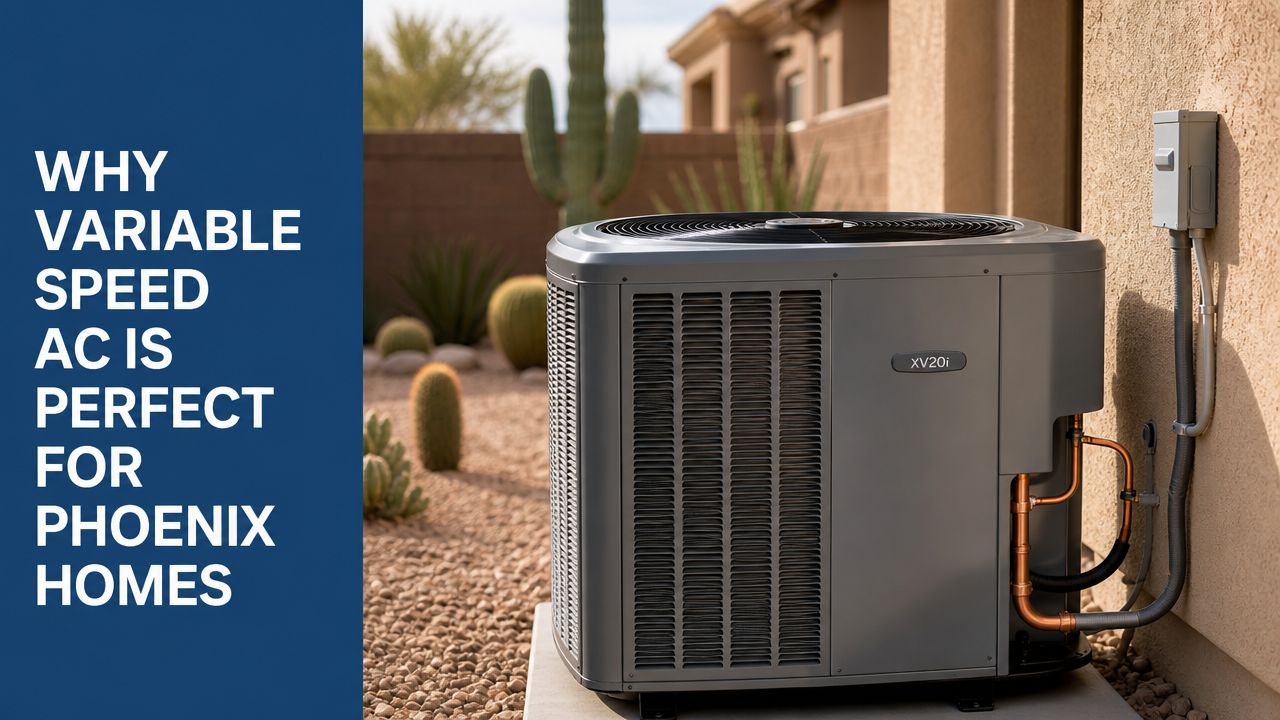
If your AC sounds like it's either sleeping or screaming, you're probably dealing with old on-off cooling. In Phoenix, that usually means uneven rooms, big summer electric bills, and a system that never seems to feel quite right. Variable speed compressor technology changes that by letting your air conditioner adjust output to match what your house needs.
Introduction
Phoenix homeowners know the pattern. The house heats up fast in late afternoon, one bedroom never cools like the others, and the outdoor unit kicks on with that familiar full-blast roar. Then monsoon season hits, and the air feels sticky even when the thermostat says the temperature is fine.
That's where a variable speed compressor earns attention. Instead of cooling your home like a basic machine with only “all on” or “all off,” it can ramp up and down to track real demand. For a climate with long cooling seasons, long partial-load hours, and frequent comfort complaints, that difference matters in a very practical way.
A lot of homeowners hear the term and assume it's just marketing. It isn't. It's a different way of running the heart of the AC system, and when it's applied correctly, it can improve comfort, cut waste, and reduce the wear that comes from constant hard starts.
How a Variable Speed Compressor Really Works
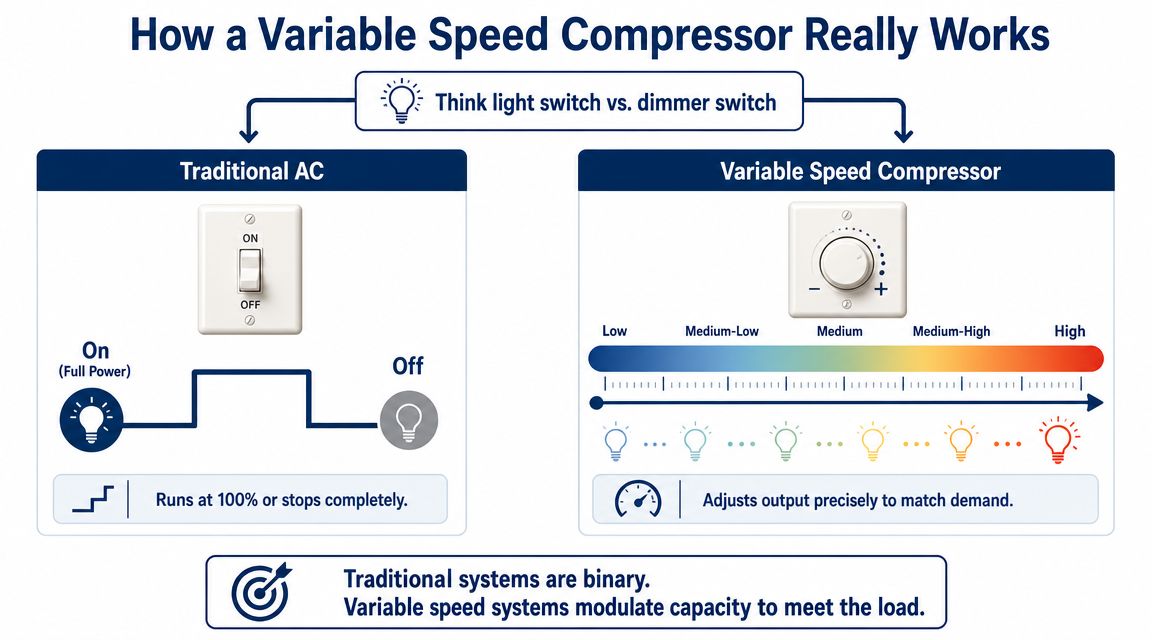
The easiest way to understand it is this. A traditional AC behaves like a light switch. It's either on at full power or off. A variable speed system behaves more like a car's gas pedal or a dimmer switch. It doesn't just slam to one setting. It adjusts.
What changes inside the system
A variable speed compressor reduces power draw by matching motor speed to load in real time. The controller measures system pressure and adjusts RPM with an inverter, making it ideal for applications with fluctuating demand because it only runs as much as needed. That's why the practical result is lower kWh use, fewer start-stop stress events, and steadier comfort instead of fixed-output operation, as described by Atlas Copco's explanation of VSD compressor control.
In plain English, the inverter is the traffic cop. It tells the compressor motor when to speed up, slow down, or hold a low steady pace. Instead of waiting for the house to get warm enough to trigger a hard restart, the system can keep cooling gently and consistently.
That matters because homes don't have a flat, unchanging cooling load. Sun exposure shifts. People cook. Exterior doors open. Rooms on the west side gain heat differently than rooms on the east side. A variable speed system can react to those smaller changes without turning the whole system into a noisy stop-start machine.
How it compares with other AC types
Most homeowners run into three common compressor styles:
- Single-stage: Full output or nothing.
- Two-stage: Usually a lower stage and a higher stage, plus off.
- Variable speed: Many operating levels across a wide range.
A single-stage unit cools aggressively, then shuts off. That creates the temperature swings people feel as “too warm, too cold, too warm again.” A two-stage system is a step better because it can spend more time on a lower output. But it still moves in steps.
A variable speed compressor is much more precise. It can trim output up or down in small increments, which is why the house usually feels more stable.
If you've ever wondered why some modern heat pump systems feel smoother than older equipment, the compressor control is a big reason. If you want the heating and cooling side of that explained in broader terms, this guide on how a heat pump works is a useful companion.
Tangible Benefits in the Phoenix Climate
Phoenix is where this technology stops sounding abstract and starts sounding practical. Long summers, long shoulder seasons, strong afternoon sun, and monsoon humidity all reward a system that can adapt instead of cycling hard.
Lower energy waste during long part-load hours
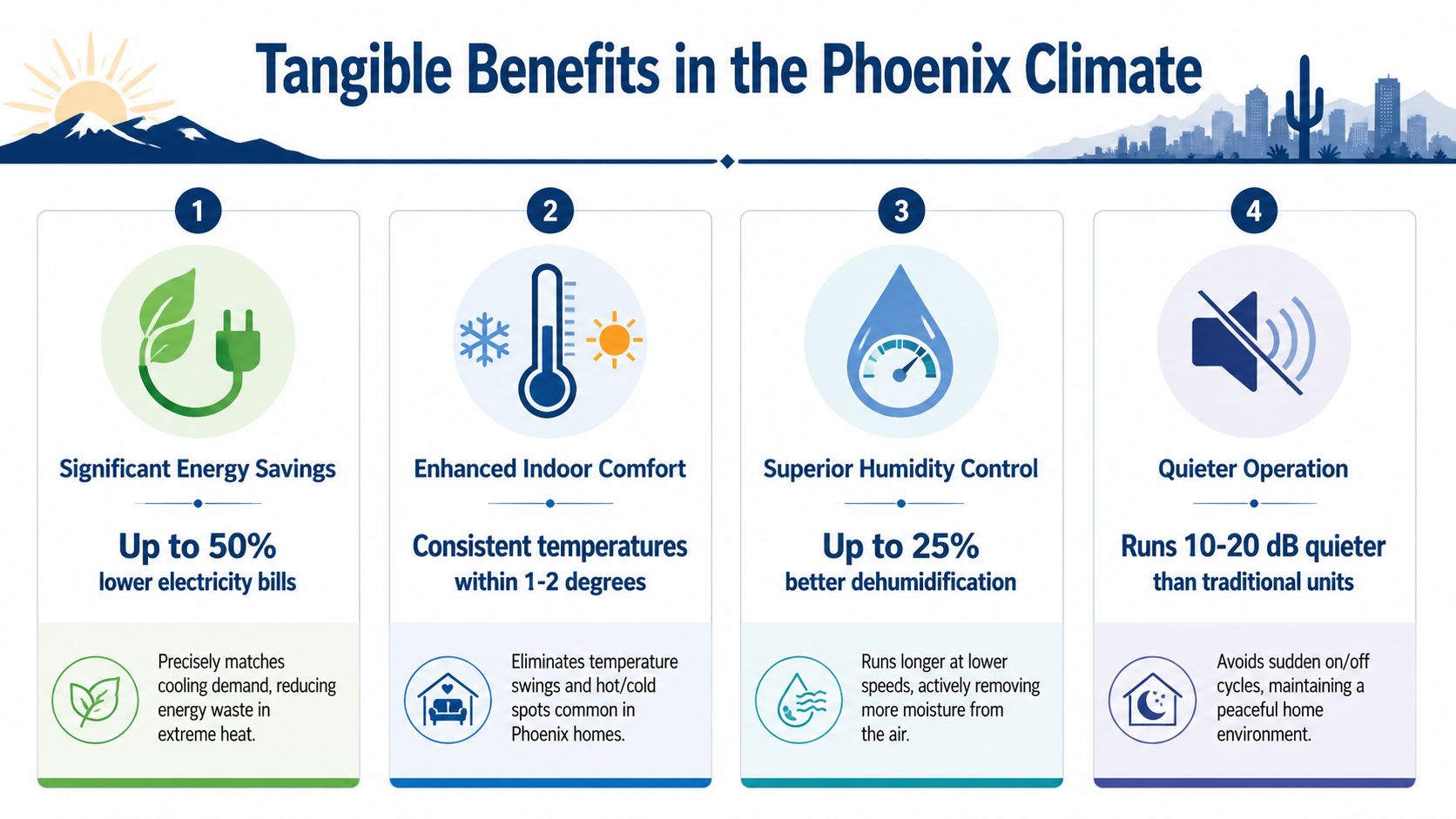
Because variable speed compressors reduce motor speed instead of repeatedly starting and stopping at full output, many models consume roughly 20% to 50% less energy than fixed-speed equivalents when operating below full load, according to this technical overview of variable-speed compressor performance.
That phrase below full load is the key. Phoenix homes spend a lot of time needing cooling, but not always maximum cooling. Early morning, late evening, milder days, shaded interiors, and homes with zoning or better insulation all create periods where the house needs some cooling, not a full-force blast.
That's where fixed-speed equipment wastes energy. It overshoots, shuts off, and repeats. A variable speed compressor can stay engaged at a lower level instead of constantly restarting.
Better comfort in real rooms, not just on paper
Homeowners usually don't complain in technical language. They say things like:
- “The back bedrooms are warmer.”
- “The thermostat says we're fine, but it doesn't feel fine.”
- “The AC is running, but the house still doesn't feel settled.”
Variable speed systems help because they hold temperature more steadily. The system doesn't have to wait for a bigger temperature swing before reacting. Air movement is more consistent, and that usually means fewer hot and cold pockets across the home.
For many households, that comfort improvement matters as much as the utility savings. If you already use connected controls, pairing this type of equipment with a smart thermostat can make the system even more responsive. This article on the benefits of a smart thermostat explains where that pairing makes sense.
Monsoon season is where people notice humidity control
Phoenix is dry most of the year, but monsoon season changes the comfort equation. A house can feel clammy even when the thermostat reading looks acceptable.
Longer, lower-speed operation helps because the system gets more steady coil contact time rather than short, abrupt cooling cycles. In the field, that often translates to a home that feels less muggy and more comfortable during sticky weather.
You know what? That's one of the biggest surprises for homeowners moving from an older single-stage unit. They expected lower noise. They expected smoother cooling. They didn't expect the house to feel less damp during monsoon afternoons.
Quieter operation changes how the house feels
Older systems announce themselves. They start loudly, move a rush of air, then stop. That rhythm gets old fast, especially at night or when the outdoor unit sits near a patio.
Variable speed operation is usually much less intrusive because the system spends more time running gently instead of crashing on and off. The house sounds calmer. Air delivery feels less abrupt. Sleep, conversation, and work-from-home days get fewer interruptions.
That benefit is hard to quantify in a sales sheet, but homeowners notice it quickly.
Comparing Compressor Types Side by Side
If you're trying to decide between basic, better, and premium equipment, a side-by-side comparison helps more than a sales pitch. The biggest difference isn't just efficiency. It's how each system behaves hour by hour inside your home.
Compressor technology comparison
| Feature | Single-Stage | Two-Stage | Variable Speed |
|---|---|---|---|
| Output style | Full power or off | Low, high, or off | Many speeds across a modulation range |
| Comfort feel | Bigger temperature swings | More stable than single-stage | Most consistent indoor temperature |
| Humidity handling | Basic | Better during longer cycles | Usually strongest in long low-load operation |
| Operating noise | More noticeable starts and stops | Quieter than single-stage | Typically the quietest overall experience |
| Upfront cost | Lowest | Mid-range | Highest |
| Best fit | Tight budgets, simple replacements | Homeowners wanting a middle option | Long-term comfort and efficiency focus |
| Typical complaint | Short cycling feel | Still limited in load matching | Higher initial cost and more complex repairs |
What the table means in real life
Single-stage equipment is straightforward. It works, it's familiar, and it's often the cheapest way to replace a failed unit. But you feel the compromise every day. The system cools hard, shuts off, then waits for the house to warm up again.
Two-stage systems improve that pattern. They can spend more time at a lower output, so they usually smooth out some of the swings. For some homes, that middle ground is enough.
Variable speed is the premium end because it tracks demand much more closely. That usually gives the best comfort and the most refined operation. It also asks more from the installer and the service technician.
Why comparison shopping can mislead homeowners
A lot of people compare only price tags. That's understandable, but it misses how the system will feel for the next several years. The better question is this: How do you want the house to behave in July and August?
If you want basic cooling, single-stage may be enough. If you want the house to hold more even temperatures with fewer noticeable swings, a higher-end compressor design starts making more sense.
For equipment efficiency context, this breakdown of SEER 14 vs 16 helps explain why published ratings don't always tell the whole comfort story.
Understanding the Cost and Long-Term Value
The biggest objection is simple. Variable speed systems cost more. That's true, and any honest conversation should start there.
The other part is also true. Purchase price alone is a weak way to evaluate this kind of equipment, especially in Phoenix where the cooling season is long and the system may spend many hours running at partial load.
Why payback matters more than sticker price
Independent HVAC guidance notes that the biggest efficiency gains for variable-speed compressors occur when demand fluctuates. The same guidance also points out that the main downside is cost, including potentially higher repair and labor expenses, which is why payback period is a better lens than purchase price alone. That framing comes from JHFoster's discussion of variable-speed compressor efficiency and cost trade-offs.
That's the right way to think about it. Don't ask only, “What does it cost today?” Ask:
- How long will I stay in the home
- How often does my current AC run
- How uncomfortable am I with the system I have now
- How important are lower noise and steadier temperatures
- What will higher-end repairs mean to me if they come later
A homeowner who barely uses cooling won't value this technology the same way a homeowner who runs AC through a long desert season and feels every comfort issue.
Where variable speed pays off best
A variable speed compressor tends to make the strongest case when:
- Cooling demand rises and falls through the day: That gives the system room to modulate rather than cycle.
- The home has comfort trouble spots: Upstairs rooms, west-facing rooms, and uneven floor plans benefit more from finer output control.
- Humidity bothers the household: Monsoon discomfort often pushes homeowners toward longer-run, lower-speed cooling.
- The owner plans to stay put: Long-term ownership gives the system more time to return value.
It can make less sense when the home has very steady demand, the budget is tight, or the homeowner wants the lowest-cost replacement that restores cooling.
Don't ignore the service side
Advanced control boards, inverters, sensors, and communication features can improve performance. They can also make repair work more specialized. That doesn't mean the equipment is a bad choice. It means you should budget and decide with clear eyes.
If your existing system already has a major refrigerant or compressor issue, reading about air conditioner compressor replacement can help clarify when repair still makes sense and when stepping into a full upgrade is smarter.
Choosing and Installing the Right Unit
A premium system only performs like a premium system when the design and installation are right. In such cases, a lot of homeowners get burned. They buy good equipment and get average results because the setup was rushed, oversized, or poorly commissioned.
Sizing is not optional
The first step is a proper load calculation. Not a guess based on square footage. Not “same size as the old one.” Not “this should be close.”
A variable speed system can adapt, but it isn't magic. If the unit is badly oversized, it may still struggle to deliver the long, stable runtime that makes this technology valuable. If it's undersized, it may run too hard too often and never give you the comfort you expected.
That's why a system-sizing review matter. The contractor should account for insulation, windows, orientation, duct conditions, occupancy patterns, and solar gain. In Phoenix, west-facing glass and attic heat aren't details. They affect the result.
Compatibility matters more than homeowners realize
Some variable-speed scroll compressors can operate across a wide modulation range, with some designs specified from 12 Hz to 160 Hz, and field application depends on verifying inverter limits and control compatibility so the unit can maintain stable low-load operation, as outlined in LG's variable-speed scroll compressor specifications.
That technical point matters because the system is only as good as the matched components around it. The indoor air handler, communicating controls, zoning setup, and thermostat logic all affect how well the compressor can modulate.
Here's what a careful installer checks:
- Control compatibility: The thermostat and equipment have to speak the same language.
- Airflow setup: Blower performance has to support the cooling profile.
- Duct condition: Leaky or undersized ducts can sabotage comfort.
- Refrigerant charge: Variable systems are less forgiving of sloppy setup.
- Commissioning data: The installer should verify operation at startup, not just power the unit on and leave.
Brand matters less than execution
Reliable manufacturers matter, and Trane has a strong reputation in this category. But installation quality still decides whether the system feels excellent or disappointing.
A variable speed compressor is not the place to hire based only on the lowest bid. This is precision equipment. It needs precise design, setup, and follow-up.
Maintenance and Troubleshooting for Modern ACs
A variable speed system doesn't demand constant attention, but it does reward good maintenance. Homeowners can handle the basics. Diagnosis is another story.
What homeowners should do routinely
Start with the simple work that protects airflow and heat transfer.
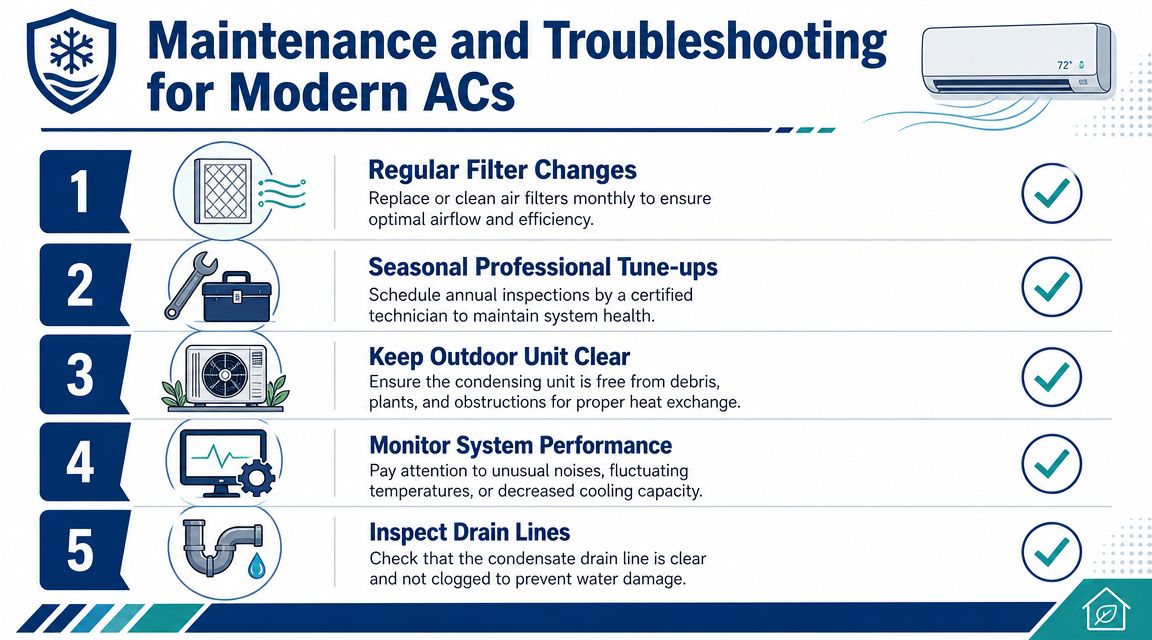
- Change filters regularly: A dirty filter chokes airflow and makes the whole system work harder than it should.
- Keep the outdoor unit clear: Remove leaves, dirt, and plant growth that block heat rejection.
- Watch the drain line: A backed-up condensate line can create water issues and system interruptions.
- Notice changes early: Longer runtimes are normal for variable speed equipment, but poor cooling, odd sounds, or unstable room temperatures are worth attention.
For a broader maintenance schedule, this guide on how often HVAC should be serviced is worth reviewing.
What makes troubleshooting different
Poor cooling from a variable-speed unit may stem from controller signaling, compressor command response, or the control valve, not just the compressor itself. That complexity means troubleshooting requires specialized diagnostics, and advanced components can raise repair costs compared to simpler systems, according to Weather Master's overview of variable-speed AC troubleshooting factors.
That's the part many homeowners don't hear up front. With older equipment, diagnosis was often more straightforward. With communicating systems and inverter-driven compressors, the symptom you notice may not point directly to the failed part.
A house that won't cool properly might have a compressor issue. It might also have a sensor problem, a board communication issue, a wiring fault, or a control valve problem affecting system behavior.
Signs that deserve a trained technician
Call for advanced diagnostics if you notice any of these patterns:
- The system won't ramp up when the house is clearly warm
- The unit seems to run but comfort keeps drifting
- The thermostat or control interface shows error messages
- You hear unusual humming or electrical sounds near startup
- Cooling is inconsistent room to room after the system used to perform well
One useful way to vet service quality is by reading actual homeowner experiences with related indoor air and HVAC work. If you want a third-party snapshot of customer comments, See all AC duct cleaning feedback can give you a feel for the kinds of service details people mention after technicians leave the home.
Maintenance is still cheaper than neglect
Variable speed equipment is advanced, but it isn't fragile when installed and maintained properly. The bigger risk is neglect. Dirty coils, restricted airflow, ignored drain issues, and delayed repairs can drag down performance and push the system into avoidable stress.
The right approach is simple. Stay on top of basic upkeep. Pay attention to changes. When performance feels off, use a technician who can diagnose inverter and control issues rather than swapping parts and hoping.
Your Next Steps to Smarter Home Comfort
A variable speed compressor fits homeowners who care about long-term comfort, quieter operation, and lower energy waste during Phoenix's extended cooling season. It's not the cheapest option, and it's not the right fit for every budget. But for many homes in the Valley, it's the system type that best matches the way real cooling demand behaves.
If you're also thinking about emergency preparedness and fast response expectations, resources like HVAC emergency call answering can help you understand what responsive support looks like when an AC problem shows up at the worst time.
If you want help figuring out whether a variable speed system makes sense for your home, reach out to Comfort Experts for a no-pressure conversation. You can call 480-207-1239 or schedule service online to talk through comfort issues, replacement options, and what kind of payoff you can realistically expect in a Phoenix home.