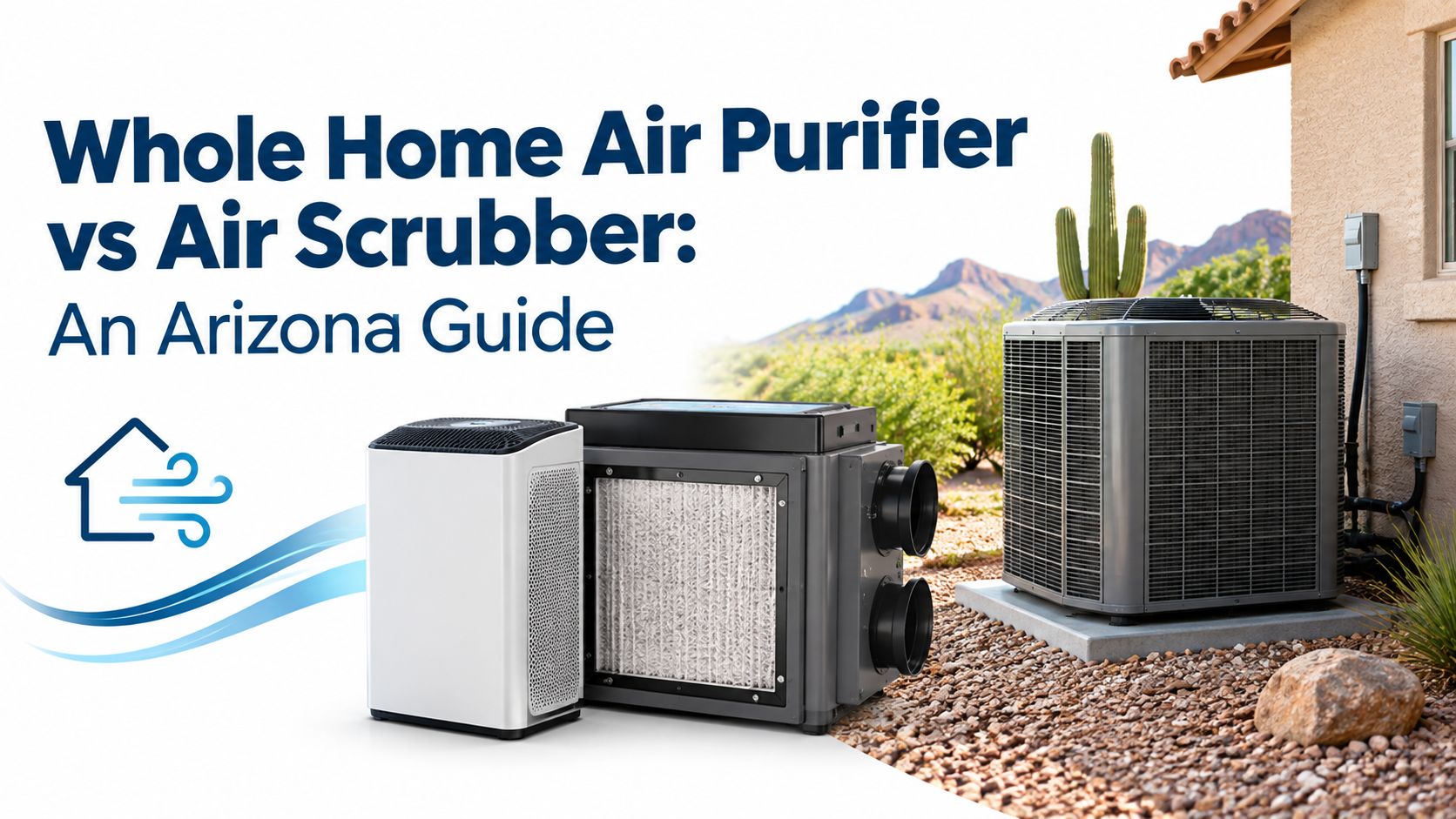
A homeowner in Mesa can run the HVAC fan through a dusty afternoon, open the door during monsoon season, and still wonder why fine dust, smoke, or musty odors keep returning. The choice between a whole home air purifier vs air scrubber depends less on the product name and more on the contaminant, the existing duct system, and whether the blower can handle added resistance.
What Whole Home Air Purifiers and Air Scrubbers Actually Do
A whole-home air purifier works as part of the forced-air HVAC system. Return air moves through a filter cabinet, media filter, or higher-efficiency filtration section before the blower sends conditioned air back through the supply ducts. The device's main job is mechanical capture. Dust, pollen, pet dander, and many smoke particles stay in the filter instead of continuing through the duct loop.
HEPA filtration has roots in World War II, when U.S. military scientists developed HEPA media to prevent radioactive particulate leakage during the Manhattan Project. Modern HEPA filters are commonly defined by 99.97% removal efficiency for 0.3-micron particles, while the MERV scale standardizes HVAC filter performance from 1 to 16 for particles roughly 0.3 to 10 microns, as documented in this history of air-filter development and technical standards.
An HVAC-integrated air scrubber also connects to the duct system, but the cleaning process may include multiple stages. Depending on the equipment, those stages can involve particulate filtration, UV light, photocatalytic oxidation, activated carbon, or ionization. The purpose is to treat contaminants in the airstream, including certain odors, gases, and biological contaminants, rather than relying only on a passive filter.
Mesa dust and construction debris usually point toward strong mechanical filtration. Summer pollen enters through doors, windows, and duct leakage. Wildfire smoke brings much finer particles, so the quality of the filter and the amount of air moving through it matter more than the label on the cabinet.
Practical rule: Filtering removes contaminants from the air by capturing them. Active treatment changes or neutralizes some contaminants. Neither approach fixes a leaking return duct or removes the source of indoor pollution.
Homeowners looking for broader source-control ideas can also review this indoor-air-quality improvement guide from J.G. Carpet Cleaning LLC. For a local HVAC-centered overview, Comfort Experts provides information about whole-home air quality, including filtration and duct-related concerns.
Whole Home Air Purifier vs Air Scrubber at a Glance
The phrase “air scrubber” can describe different equipment, so the specification sheet matters. Some systems are primarily high-throughput filtration devices. Others add UV, carbon, ionization, or photocatalytic stages. A whole-home purifier can also include more than one technology, which means the names alone don't establish performance.
| Criteria | Whole Home Air Purifier | Air Scrubber |
|---|---|---|
| Technology type | Primarily mechanical filtration, sometimes with additional stages | Multi-stage treatment may combine filtration with UV, carbon, PCO, or ionization |
| Filtration method | Media, high-efficiency, or HEPA-grade filtration depending on the model | Prefilter and high-efficiency stages, with optional active treatment |
| Installation | Usually at the return plenum, filter cabinet, or air handler | Commonly installed in-line with the HVAC duct system |
| Typical MERV range | Often selected around residential MERV levels, including MERV 8 or MERV 13 options | Depends on the replaceable filter stages and equipment design |
| Main focus | Dust, pollen, pet particles, and smoke particulate | Particles plus odors, gases, VOCs, and biological contaminants, depending on stages |
| Maintenance | Replace or clean media according to loading and manufacturer guidance | Replace filters and service lamps, cells, or other treatment components |
| Cost band | Varies by filter size, cabinet design, and installation requirements | Varies by airflow capacity, treatment stages, controls, and installation |
| Compatibility | Requires adequate return-air space and acceptable static pressure | Requires duct access, electrical provisions, and blower capacity |
| Best fit | Continuous residential filtration | A broader contamination concern or a home needing additional treatment |
MERV 8 is often described as a residential baseline, while MERV 13 is commonly considered a stronger choice for finer dust and smaller airborne particles. Higher-efficiency filtration can also increase airflow resistance, so the blower and duct system must be checked before installation.
A homeowner comparing terminology may find this practical explanation of home air scrubber vs purifier useful. For duct-connected filtration options, Comfort Experts discusses air purification as part of an HVAC-based indoor-air-quality plan.
Filtration Performance and What the Numbers Really Mean
Ratings answer different questions. MERV describes filter performance within the HVAC filter standard. HEPA identifies a much higher-efficiency filtration category under its commonly used definition. CADR describes the amount of clean air delivered over time, combining airflow with particle-removal efficiency.
ASHRAE describes single-pass efficiency as the fraction of pollutants removed from air passing through a device once. CADR adds airflow to that idea, which is why a filter with excellent capture can still deliver limited whole-home results if the blower moves too little air. A manufacturer comparison cited by ASHRAE showed CADR values around 240 for a whole-house 5-inch media filter, 660 for a whole-house electronic air cleaner, and 1,200 for a high-end whole-house cleaner. The same comparison showed 150 for a room HEPA appliance and 10 to 12 for basic room or standard HVAC filters. Those figures appear in this ASHRAE technical comparison of air-cleaning performance.
A CADR number doesn't replace an HVAC assessment. It doesn't tell a homeowner whether the return duct leaks, whether the filter cabinet bypasses air, or whether the fan runs often enough to circulate the entire home. In a sprawling East Valley floor plan, those details can matter as much as the filter media.
What active stages add
- UV treatment can address certain biological contaminants in the airstream, provided the equipment gives the air adequate exposure.
- Carbon media can help with selected odors and gases, but its usefulness depends on the amount and type of carbon.
- PCO or ionization may add another treatment mechanism, but the homeowner should verify safety documentation and whether the product produces ozone.
Filter condition matters just as much as the original rating. A homeowner comparing when to replace air purifier filters should follow the equipment manufacturer's instructions and inspect the filter sooner when desert dust loads it quickly. Families seeking cleaner air with allergy filters should also confirm that the selected filter fits the system's airflow limits.
How Mesa and East Valley Conditions Shape the Choice
Mesa homes don't all face the same indoor-air problem. A house near active construction may collect heavy mineral dust, while a tightly closed home may struggle more with cooking odors, pet odors, or chemical smells after renovation. The right equipment follows the dominant contaminant.
| Condition | Whole Home Air Purifier Fit | Air Scrubber Fit |
|---|---|---|
| Desert dust and construction particulate | Strong fit when the filter cabinet and blower can handle the selected media | Useful when dust loads are heavy and the system has adequate airflow |
| Monsoon humidity swings and musty odors | Helps capture particles but doesn't control moisture | UV or carbon stages may add value for odors and selected biological concerns |
| Wildfire smoke | Strong fit when the system provides genuine high-efficiency or HEPA-grade filtration | Helpful only when its particulate stage is appropriately rated |
| Salt River corridor pollen | Often the straightforward choice for ongoing particle capture | May add treatment features, but filtration remains essential |
| Older home with leaky ducts | Limited until duct leakage is addressed | Limited until return and supply leakage are corrected |
| Renovation odors and off-gassing | Carbon-equipped filtration may help | A multi-stage system may be more suitable for odors and gases |
Wildfire smoke deserves careful attention. Not every whole-home purifier delivers true HEPA filtration, and not every air scrubber is designed for fine smoke particulate. A product that excels at odor treatment may still leave a homeowner disappointed if the main complaint is visible haze or fine ash.
Monsoon weather creates another distinction. An air-cleaning device won't dry the air or correct a moisture source. A bathroom fan, duct repair, condensate inspection, or dedicated humidity strategy may matter more than adding another treatment stage.
Before choosing: A static-pressure check should come before a high-efficiency filter retrofit, especially on an older rooftop or package unit.
Homes in Gilbert, Queen Creek, and Mesa with older ductwork may pull dusty attic air through leaks. Sealing that return path can prevent contamination before the purifier or scrubber has to process it. The Comfort Experts air quality guide offers additional local context for evaluating filtration, ducts, and airflow together.
Installation, Compatibility, and Operating Costs
The installation decision starts with the air handler, furnace, or rooftop package unit, not the product box. A return-side purifier needs enough cabinet space for the media and enough access for future replacement. An in-line scrubber may need duct modifications, control wiring, and a suitable electrical connection.
The exact requirements vary by equipment. A technician should verify filter dimensions, blower speed, temperature rise where relevant, duct transitions, and total external static pressure before committing to a high-resistance filter or additional treatment module.
| Factor | Whole Home Air Purifier | Air Scrubber |
|---|---|---|
| Primary location | Return plenum, filter cabinet, or air handler | Duct-connected treatment section |
| Main compatibility concern | Filter resistance and cabinet fit | Airflow, electrical access, controls, and duct fit |
| Maintenance task | Media inspection and replacement | Filter, lamp, cell, or treatment-stage service |
| Fan impact | A restrictive filter can reduce delivered airflow | Added stages can increase resistance or operating load |
| Arizona planning issue | Dust may load media quickly | Treatment components may require scheduled service |
| Best installation check | Static pressure and filter bypass | Static pressure, blower capacity, and electrical requirements |
Operating expense depends on filter size, fan runtime, equipment design, and the homeowner's maintenance habits. A larger media filter may last longer than a small restrictive filter, but it still needs inspection. A scrubber with lamps or cells adds components that can lose effectiveness when neglected.
Whole-home systems rely heavily on existing fan runtime. If the thermostat rarely calls for heating or cooling and the fan stays off, air cleaning is intermittent. A technician can discuss fan settings, but continuous fan operation also affects comfort and utility use in a hot Mesa summer.
Duct sealing can be a better investment than either device when leakage is substantial. The same applies when an older blower is already struggling to meet cooling demand. The Comfort Experts discussion of indoor air quality explains why filtration should be considered alongside airflow and duct condition rather than as an isolated upgrade.
Pros and Cons for Desert Homes
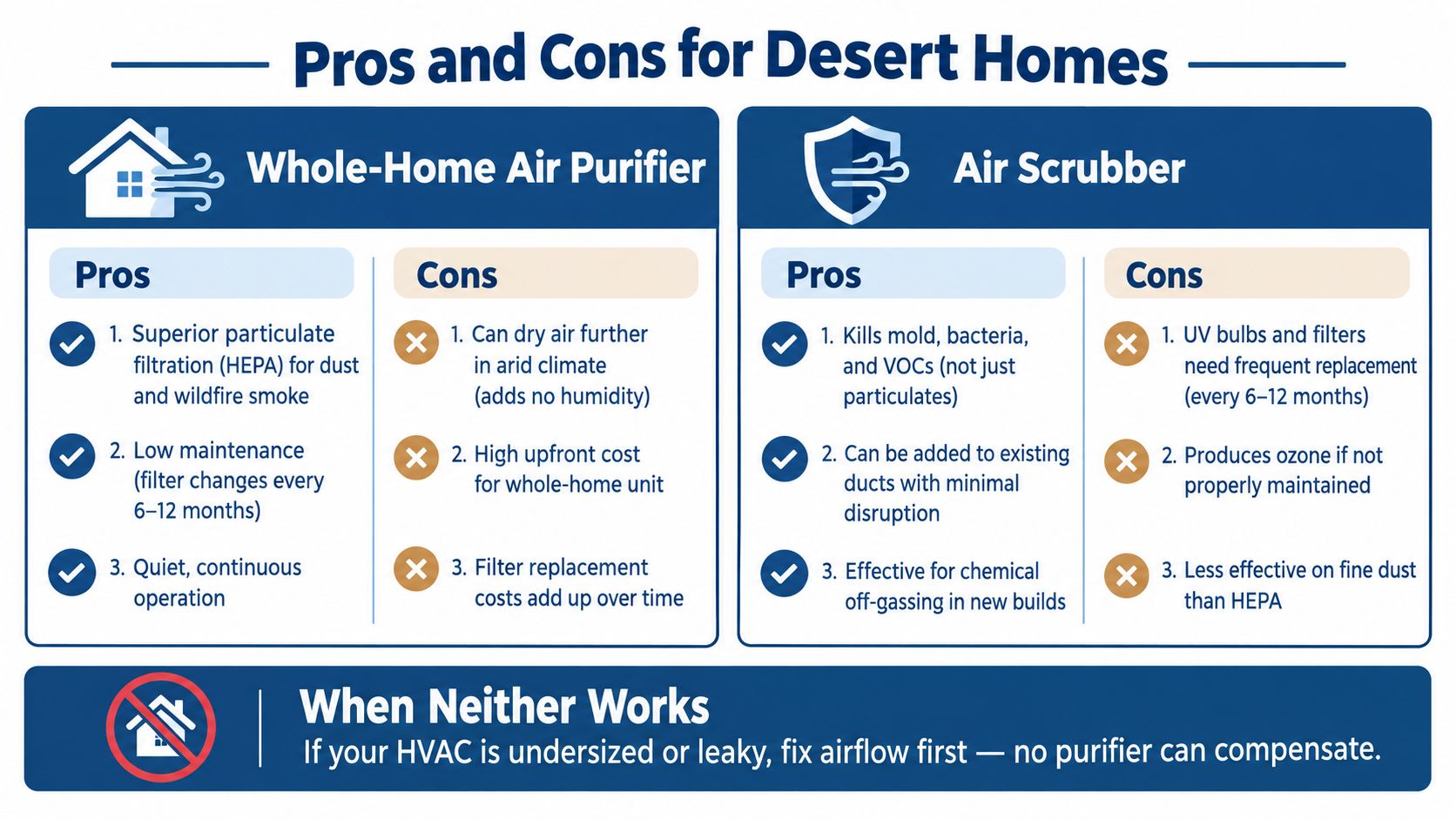
A whole-home purifier usually makes the stronger starting point for a dust- and pollen-heavy house. Mechanical filtration provides a clear maintenance path, and the collected material remains in a replaceable filter. The trade-off is airflow. A high-MERV or HEPA-grade filter can challenge an aging blower, especially when the cabinet is undersized or the return duct is already restrictive.
An air scrubber makes more sense when odors, selected gases, renovation emissions, or biological concerns sit alongside ordinary dust. Its extra stages can broaden the treatment approach, but the homeowner still needs an effective particulate filter. A scrubber shouldn't be treated as a substitute for HEPA-grade capture during serious smoke events.
Where neither option solves the root problem
- Leaky return ducts: Dust entering through attic or wall cavities will continue to load any filter.
- Poor ventilation strategy: A home may need controlled outdoor-air management rather than recirculating indoor air.
- Moisture problems: Neither device repairs a condensate issue, roof leak, plumbing leak, or inadequate bathroom exhaust.
- Undersized HVAC equipment: Added resistance can worsen airflow and cooling performance instead of improving comfort.
Desert homes also need realistic expectations. An air purifier doesn't add humidity, and an air scrubber doesn't replace source control. Noise, filter access, cabinet space, and any effect on the air-handler warranty should be discussed before work begins. A measurement-based installation is more reliable than choosing by square-foot marketing alone.
Which Option Fits Your Situation
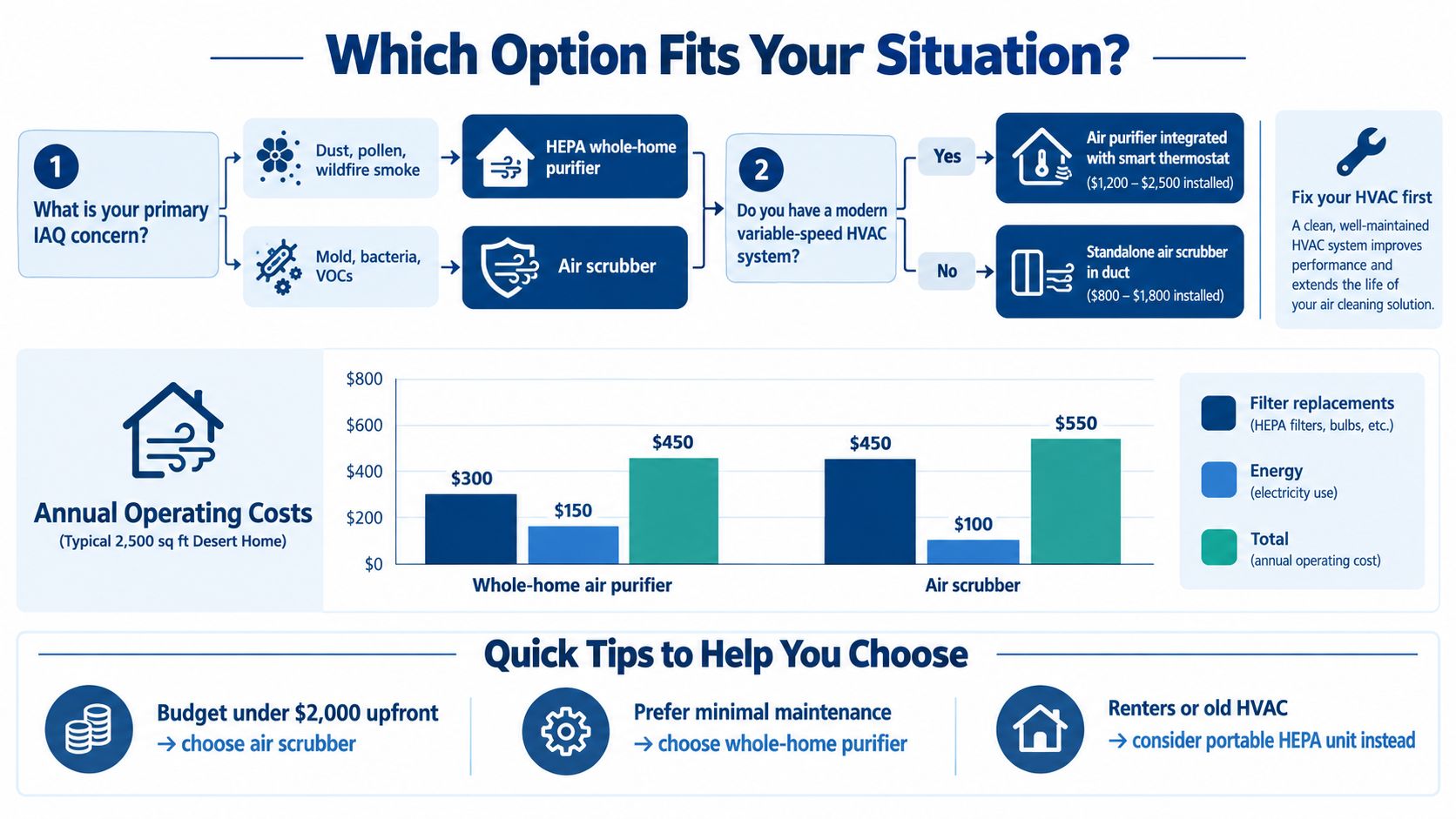
The decision can be narrowed by identifying the main complaint first.
- Dust, pollen, or wildfire smoke: Favor a whole-home purifier with appropriately rated mechanical filtration, subject to static-pressure limits.
- Odors, renovation emissions, or selected biological concerns: Consider an air scrubber with verified treatment stages and adequate particulate filtration.
- Older single-stage equipment: Start with airflow testing and a filter upgrade that the blower can tolerate.
- Variable-speed equipment: The system may offer more flexibility, but it still needs a pressure and airflow check.
- Leaky ducts or uneven rooms: Address duct sealing, return capacity, or zoning before adding treatment equipment.
The existing HVAC system determines what will work. A restrictive filter can reduce airflow across an older blower, while an additional scrubber stage can create similar problems if the duct system lacks room. A contractor should measure static pressure, verify the filter cabinet, inspect duct leakage, and confirm that the equipment can deliver the required airflow.
Comfort Experts can evaluate those conditions and size an indoor-air-quality option around the home's actual HVAC setup. That approach avoids selecting a device because its brochure uses a familiar term.
Common Questions and Next Steps for Arizona Homeowners
Can either system be added to an older Goodman or Trane unit? Often, yes, but the answer depends on cabinet clearance, duct dimensions, blower capacity, electrical access, and static pressure. The model name alone isn't enough to approve an installation.
How often should filters or UV lamps be changed? Desert dust can shorten service intervals, so homeowners should follow the manufacturer's schedule and inspect components regularly. A loaded filter can reduce airflow before it looks completely blocked.
Can these systems eliminate Valley fever spores? No air-cleaning device should be presented as a complete health safeguard. Mechanical filtration may capture airborne particles when the system operates, but source control, cleaning practices, and medical guidance remain important.
Will a duct modification affect the warranty? It can, depending on the equipment manufacturer and installation quality. The contractor should document the modification, preserve service access, and avoid changes that push the air handler outside its operating limits.
Neither option eliminates the need to seal leaky ducts, control dust at the source, or run bathroom exhaust during and after showers when monsoon humidity rises. For most Mesa homes, the central trade-off is straightforward: choose filtration when fine particles dominate, and consider active treatment when odors or broader contamination concerns justify the added complexity.
Comfort Experts evaluates HVAC airflow, filter cabinets, duct conditions, and indoor-air-quality concerns across Mesa and the East Valley. Homeowners can visit Comfort Experts, call 480-207-1239, or schedule service for a practical assessment before selecting a whole-home purifier or air scrubber.