
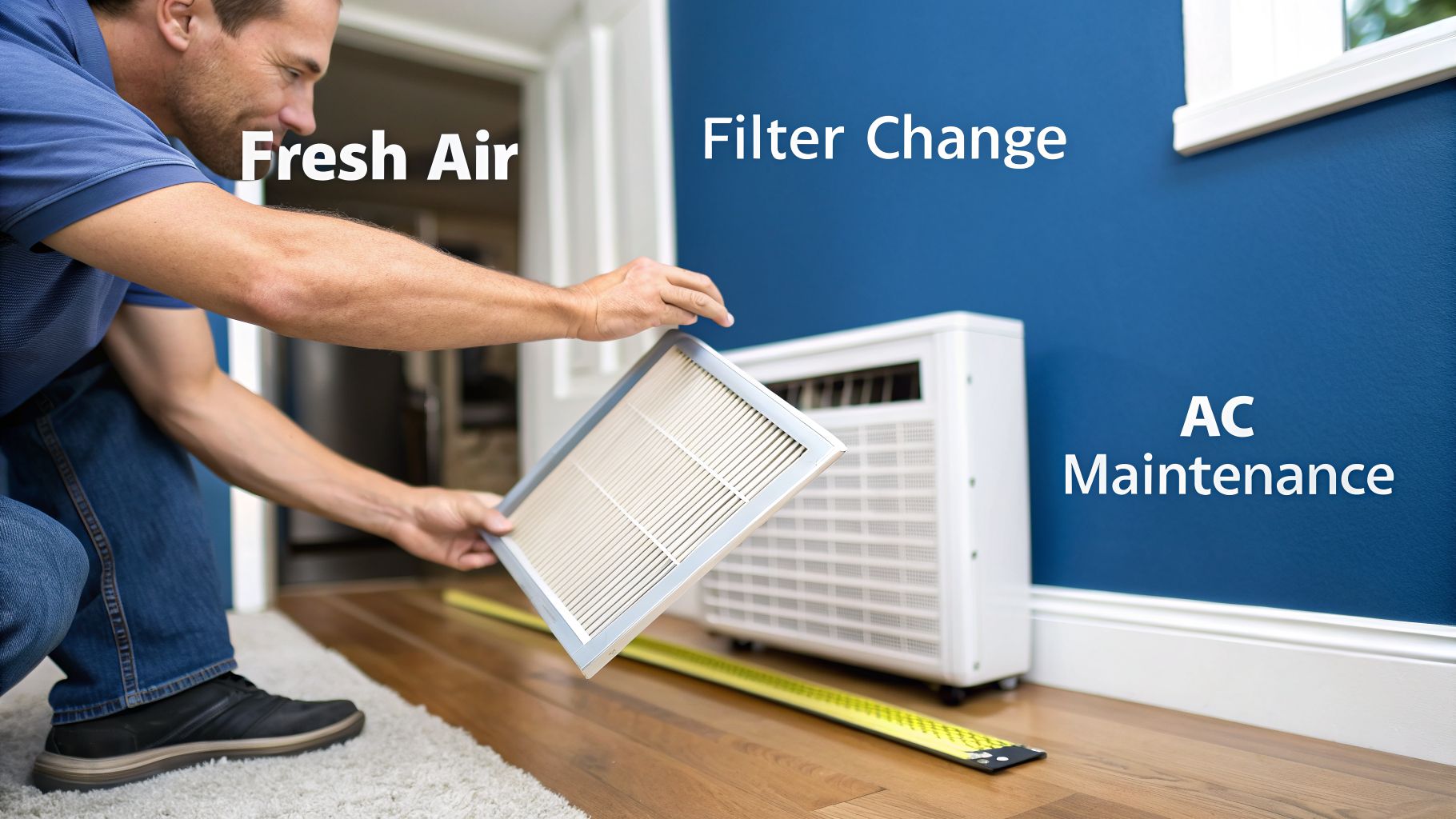
Feeling that familiar Arizona heat creeping in? Before your AC unit starts its summer marathon, learning how to install an ac air filter is more than just a DIY task; it's a crucial step in protecting your system, improving your air, and saving money. This simple component is your home's first line of defense against the relentless dust and soaring energy bills that define our climate.
Why A Clean AC Filter Is Your Best Friend in Phoenix
Honestly, that little rectangle of pleated paper is the unsung hero of your entire home comfort system. Here in the dusty Phoenix climate, its job is monumental. It stands guard, trapping dust, pollen, and all sorts of other airborne gunk before it can get inside and wreak havoc on the sensitive parts of your HVAC unit.
Once a filter gets clogged, your AC is basically trying to breathe through a stuffy nose. The system has to work way harder just to pull in enough air, and that leads to some immediate and expensive problems. You know what? It's a bit like trying to run a race while only breathing through a straw—eventually, you're going to get exhausted and give up. That's what your AC does, too.
A dirty filter can slash your air conditioner’s efficiency by as much as 15%. For a Phoenix homeowner, that’s a direct hit to your wallet on summer electricity bills.
That extra strain doesn’t just hurt your bank account. It also puts a ton of wear and tear on critical parts like the blower motor, which dramatically increases the odds of a frustrating and costly breakdown right in the middle of July. From our decades of experience at Comfort Experts, we've seen countless mid-summer emergencies that could have been prevented by this one simple maintenance task.
Healthier Home Environment
A clean filter does more than just protect your AC unit; it protects your family. It's a huge player in keeping your indoor air quality healthy, which is a big deal for anyone in the house with allergies or asthma. A fresh filter is your best tool for trapping:
- The fine dust and dirt that’s everywhere in the Valley.
- Pet dander from your furry family members.
- Pollen and other allergens that always seem to find their way inside.
And while you're focused on the AC, don't forget that other things in your home affect air quality, too. Think of your carpets and rugs—they’re basically your home’s biggest air filter and can hold onto just as much dust.
By sticking to a regular filter-changing schedule, you're doing more than just basic home maintenance. You’re making a smart investment in your home’s efficiency, your family’s health, and the long-term survival of your HVAC system. It's a small action with a massive impact.
Picking the Right AC Filter for Your Arizona Home
Walking into the filter aisle at a hardware store can be surprisingly overwhelming. You're faced with a wall of options, numbers, and promises, making it tough to know which one is actually right for your system. But grabbing the correct filter is the most critical first step, long before you even think about installation.
Let me explain. It all boils down to two things: size and MERV rating. Get either of these wrong, and you could be hurting your AC's performance and your home's air quality.
Finding Your Filter's Dimensions
First things first: you absolutely have to know what size you need. This is non-negotiable. An ill-fitting filter is almost as bad as a clogged one because it lets dusty, unfiltered air sneak around the edges and get pulled straight into your HVAC system. That unfiltered air bypasses the protection and goes right to the sensitive, expensive components of your unit.
Luckily, finding the size is usually simple. The dimensions are almost always printed right on the side of your existing filter's cardboard frame. Look for a series of three numbers, like 16x25x1 or 20x25x4.
- 16×25: This is the length and width of the filter.
- x1 or x4: This is the thickness, or depth. It's a common mistake to grab a 1-inch filter when you need a 4-inch media filter, so pay close attention to this number.
Snap a picture with your phone before you head to the store. If the numbers are missing or have worn off, just pull out a tape measure and get the length, width, and depth yourself.
Demystifying MERV Ratings in a Dusty Climate
Here’s the thing: the right MERV rating for a Phoenix home is a delicate balancing act. MERV stands for Minimum Efficiency Reporting Value, and it’s a standard scale (usually 1-16 for homes) that tells you how well a filter captures airborne junk.
A higher MERV number means the filter traps smaller particles. Sounds great, right? But it's not that simple. A higher MERV rating also means the filter material is denser, which can restrict airflow. Forcing your AC to work harder to pull air through a super-dense filter can strain the system, drive up your power bill, and even lead to expensive damage over time.
For our dusty Arizona environment, you have to find the sweet spot between capturing particles and letting your system breathe. Pushing the MERV rating too high without a system designed for it can do more harm than good.
As HVAC professionals serving the Valley for years, we see the consequences of this mismatch all the time. A homeowner with good intentions buys the "best" filter with the highest MERV rating, only to cause their system to freeze up from lack of airflow. Let's break down the common options to find the best fit for your home.
MERV Rating Comparison for Phoenix Homes
This table should help you choose the right filter by balancing how much it cleans the air with how it impacts your AC's airflow, especially given how much dust we deal with here.
| MERV Rating | What It Traps | Best For | Phoenix Replacement Frequency |
|---|---|---|---|
| MERV 8 | Pollen, dust mites, basic dust, lint | Standard residential homes without specific air quality concerns. | Every 60-90 days (Check at 45 days) |
| MERV 11 | Pet dander, smoke, smog, some bacteria | Homes with pets, mild allergies, or near moderate traffic. | Every 45-60 days (Check at 30 days) |
| MERV 13 | Bacteria, virus carriers, all smoke particles | Homes with significant allergy/asthma concerns or near heavy dust zones (like construction). | Every 30-45 days (Check monthly) |
For most homes in the Phoenix area, a MERV 8 filter provides a fantastic balance of filtration and airflow. It’s the workhorse we recommend most often.
However, if you have pets that shed or family members with allergies, stepping up to a MERV 11 can make a real, noticeable difference in your indoor air quality. If you want to dive deeper into this topic, we have a complete guide to the best HVAC filters for allergies that goes into even more detail.
We generally tell homeowners to be very cautious with MERV 13 or higher filters. Unless your HVAC system was specifically designed or modified to handle that level of airflow resistance, it's best to stick with a lower rating. Choosing the right filter makes the whole job worthwhile and ensures your system runs smoothly all summer long.
A Practical Guide to Installing Your New AC Air Filter
Alright, you've got the right filter and you're ready to swap out the old one. This is one of the easiest, most important jobs you can do for your AC, and we’re going to walk through how it’s done in the most common setups we see in homes across Mesa and the Valley.
Just as a quick recap, picking the right filter is half the battle. This graphic lays out the three key things to get right before you even open the filter slot.
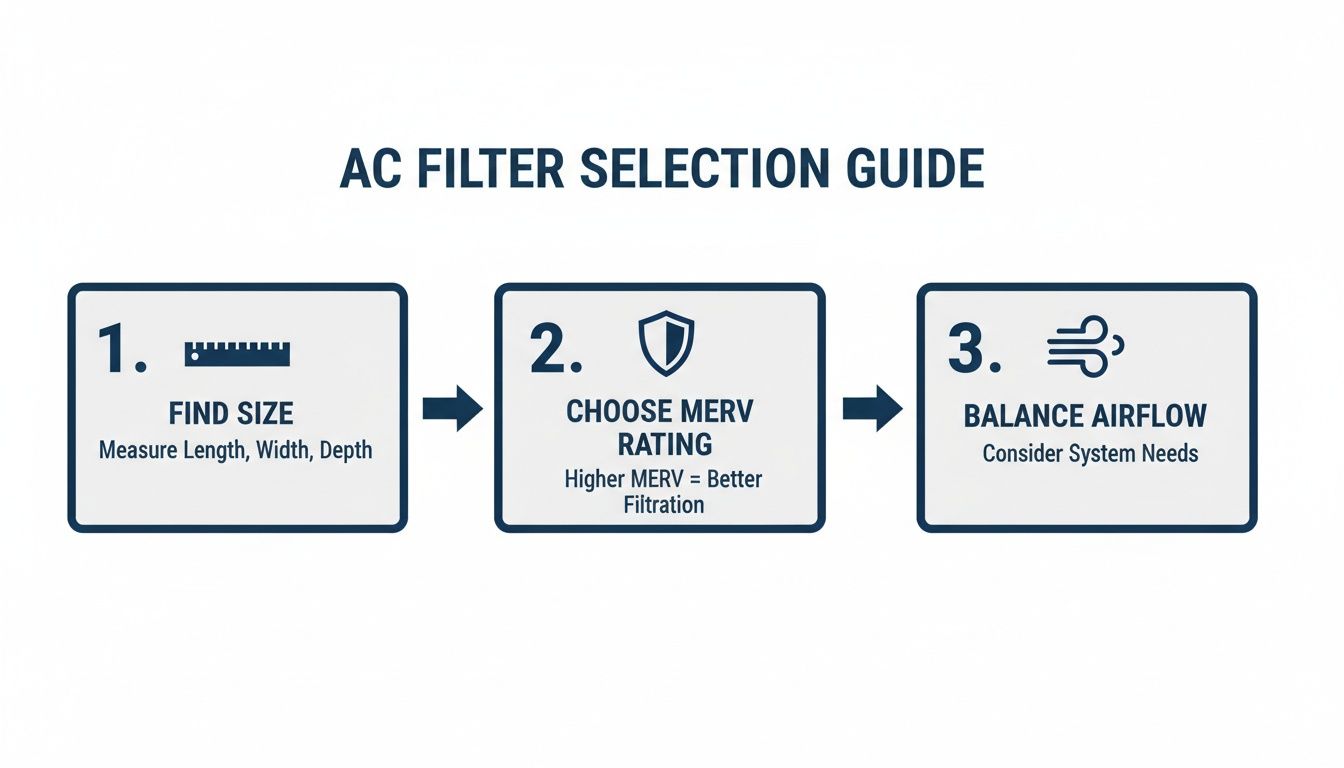
Starting with the correct size, the right MERV rating for our dusty air, and a filter that doesn't choke your system’s airflow is the foundation for a successful swap.
Before you touch anything, find your thermostat and switch the system to "Off." Don't just set the temperature higher; turn it completely off. It’s a simple safety measure that ensures the blower fan doesn’t suddenly kick on while your hands are in there.
Finding and Accessing Your Filter
First, you need to find the filter. Every house is a little different. If you're standing in your hallway scratching your head, our guide on where to find the air filter in your house will help you track it down. Most homes in our area use one of these two setups.
Hallway or Ceiling Return Vents
This is what we see in the vast majority of Phoenix-area homes. You’ll have a large metal grille on a wall (usually in a central hallway) or on the ceiling.
- Look for small tabs or latches along the edge of the grille. A quick slide is usually all it takes to unlatch the cover, which will then swing open on a hinge.
- The old filter is sitting right inside. Just grab an edge and pull it straight out.
Attic or Garage Air Handlers
If your main HVAC unit (the air handler) lives in the attic or garage, the filter is probably in a slot right on the machine itself.
- Find the large, wide duct that pulls air into the unit. The filter slot will be right there, usually covered by a thin metal door.
- This cover might have a thumbscrew holding it shut or it might simply slide off. Once it's off, the filter slides out just like a letter from an envelope.
No matter where you find it, you’re going to see a lot of dust. This is totally normal, but it’s also a great opportunity for a little preventative maintenance.
Before you slide that clean filter in, take a moment. Use a vacuum with a brush attachment or a damp cloth to wipe down the inside of the housing and the grille itself. Getting rid of that layer of dust prevents it from immediately clogging up your brand-new filter.
It’s a simple trick our techs at Comfort Experts use on every service call. It adds maybe two minutes to the job but helps your new filter work better from day one.
The Most Important Detail: The Airflow Arrow
You’ve got the grimy old filter out. Now, pick up your new one and look at the cardboard frame. You’ll see one or more arrows printed on the side.
This isn’t a suggestion. This is the single most critical detail of the entire process.
That arrow shows the correct direction of airflow. It must always point toward the furnace or air handler—the machine that does the work—and away from the space where air is being pulled from your home.
- For a ceiling/wall vent: The arrow needs to point up into the ceiling or into the wall—toward the ductwork.
- For an attic/garage unit: The arrow needs to point directly into the air handler itself.
Putting it in backward is a serious mistake. A filter installed backward can’t trap dust properly and, worse, it creates a major airflow blockage. The filter media is designed to catch dirt from one direction; reversing it can cause the filter to bend or even collapse, potentially getting sucked into the blower motor and causing expensive damage.
Once you’ve confirmed the arrow is pointing the right way, slide the new filter into the slot. It should feel snug, but you shouldn't have to force it. If it’s a struggle, double-check that you have the right size.
Close the grille or replace the slot cover, then head back to the thermostat and turn your system back on. That's it, you're done.
This small task has a huge impact. The U.S. Department of Energy states that a clean filter can improve your AC’s efficiency by up to 15%. For a Phoenix homeowner, that can easily translate to $150-$200 in electricity savings over a year. With our ACs running an average of 2,000 hours annually and dealing with constant dust, a monthly filter check is one of the smartest things you can do for your home.
How Often to Change Your Filter in the Valley
That “90-day filter” you just bought? Does it really last 90 days in a Phoenix home? Not a chance. Generic advice on filter changes is meant for milder climates, but here in the Valley, our environment puts AC systems through a completely different kind of stress.
You’d be surprised how often we see brand-new, 90-day filters clogged solid after just 30-45 days during a typical summer. Between monsoon dust, nearby construction, and simply running the system nonstop, forgetting to check your filter is one of the fastest ways to cause an expensive breakdown right when you need your AC the most.
Factors That Shorten Filter Lifespan
Think of the filter's stated lifespan as a "best-case scenario." Several common Arizona-specific factors can dramatically shorten that time.
- Monsoon Season: Those impressive dust storms, or haboobs, dump a massive amount of fine dirt and debris into the air. Your AC filter works overtime to keep all that grit out of your home and your HVAC system.
- Pets in the Home: Pet dander is a huge contributor to clogged filters. The more furry friends you have, the more frequently you'll need to check your filter—no exceptions.
- Allergies or Asthma: If anyone in your home suffers from respiratory issues, more frequent changes with a quality filter are non-negotiable for maintaining healthy indoor air.
- Nearby Construction: Living near a new build or a road project means your filter is battling a constant supply of extra dust that most homes don't have to deal with.
A filter's job is to get dirty—that's how you know it's working. But in our environment, it gets dirty much, much faster. Ignoring this reality is a recipe for system strain and higher energy bills.
In dusty areas like greater Phoenix, outdoor air pollution can spike by 50% during monsoon season. For the 40% of Arizona households with pets, swapping filters every 45 days is a wise move, while those with allergies should aim for monthly changes to achieve up to 60% cleaner air.
A Simple Framework for Remembering
Sticking to a schedule is everything. The "set it and forget it" approach simply doesn't work here. You need an active reminder system to stay on top of it.
We have a whole post that digs deep into how often you should really change air filters in Phoenix, but here is a simple framework to get you started.
- During peak summer (May-September): Check your filter every 30 days. If it looks dirty, change it. Don't wait.
- During shoulder seasons (October-April): Check it every 45-60 days.
The easiest way to remember is to use your phone. Set a recurring calendar event with an alert. If you have a smart thermostat, take five minutes to set up its filter reminder function. This simple habit is one of the best things you can do to keep your system healthy and efficient all year long.
When a Simple Filter Change Is Not Enough

A fresh air filter is one of the most powerful things you can do for your AC. It can fix weak airflow, improve air quality, and even trim your energy bills. But sometimes, you do everything right—you find the right size, slide in a brand-new filter—and the problem just… stays.
When that happens, your AC is trying to tell you something important. The issue isn't the filter; it’s a symptom of something deeper inside the system.
Knowing how to spot these warning signs is key. It’s the difference between catching a small problem early and facing a total system breakdown during a brutal Phoenix heatwave. Trust us, you don't want to be making that emergency call in July.
Symptoms a New Filter Won't Fix
So you’ve swapped the filter, but your AC is still acting up. It's time to put on your detective hat. If you notice any of these issues, it’s a strong sign you need a professional to take a look.
Weak Airflow: With a clean filter, the air from your vents should feel strong and steady. If it’s still wheezing out, the culprit could be a failing blower motor or—more often in our dusty climate—leaky or blocked-up ductwork hiding in the attic.
Persistent Musty Odors: A new filter should make your home smell cleaner. If you’re still getting a damp, funky, or "dirty sock" smell, that’s a classic sign of moisture and potential microbial growth on the evaporator coils or somewhere else a filter can't reach.
Strange Noises: Your air conditioner should be a predictable background hum. Any grinding, high-pitched squealing, or metallic clanking is a serious red flag. Those noises often mean failing motors, worn bearings, or loose parts that need immediate attention.
Frequent Cycling: Is your AC kicking on and off every few minutes? That’s called “short cycling,” and it points to bigger trouble like refrigerant leaks, electrical issues, or even a system that was improperly sized for your home from the start.
Deeper Issues Behind the Symptoms
These symptoms are usually just the tip of the iceberg. They're outward signs of hidden problems that require professional diagnostic tools and years of experience to pinpoint and fix correctly. As our team often explains in our guide on how to diagnose common AC problems, a clean filter is step one, but it’s not the whole story for a truly healthy system.
It's a shocking statistic, but a survey from The Zebra found that 82% of Americans don't change their AC filters monthly. In a high-use climate like Phoenix, that simple neglect can cause or worsen these deeper issues. The Department of Energy reports this can slash your system’s efficiency by 5-15%.
If you've done your part with regular filter changes but still worry about lingering odors or allergens, it’s natural to wonder how often air quality testing should be done to find what a standard filter might be missing. When you've checked all the DIY boxes and the problem persists, that's your cue to call in the pros.
Common Questions About Installing AC Air Filters
Even with a step-by-step guide, questions are bound to pop up. That’s perfectly normal—especially with something as critical as your AC in the middle of a Phoenix summer. To wrap things up, we’ve put together the most common questions our technicians at Comfort Experts hear from homeowners about installing air filters.
What Happens If I Install My AC Filter Backwards?
This is probably the most common mistake we see, and it can cause real headaches. That little arrow printed on the filter’s cardboard frame isn’t just a suggestion—it must point in the direction the air is flowing, which is always toward your furnace or air handler.
When you put it in backward, the filter can't trap dirt the way it was designed to. Worse, it basically chokes your system, forcing the blower motor to work way harder than it should. This drives up your energy bill, puts a ton of strain on the motor, and in a worst-case scenario, the filter can actually collapse and get sucked into your ductwork, causing some serious damage.
Can I Use a Washable Filter Instead of Disposable Ones?
Washable filters sound great on paper—buy it once and you're done, right? The reality is a bit more complicated. Most washable filters have lower MERV ratings, meaning they just aren't as good at catching the small stuff like pet dander, bacteria, and the fine dust that blows in during a haboob.
Expert Insight: The biggest risk with washable filters is moisture. If you don't let it dry 100% before putting it back in, that damp filter becomes a perfect breeding ground for mold and mildew. Your AC will then happily circulate those spores all through your home.
For most homes, especially if anyone has allergies, a high-quality disposable filter is the safer, more trustworthy bet for better air quality.
My Filter Size Is Unusual and I Cannot Find It. What Should I Do?
This happens more often than you'd think, especially with older systems or in custom-built homes. First thing's first: grab a tape measure and double-check your measurements. It’s easy to be off by a quarter-inch, and that makes all the difference.
If you’ve confirmed the odd size and still can't find it at the hardware store, whatever you do, don't try to cram in a filter that's "close enough." Any gaps around the edges will let unfiltered air zip right past the filter, defeating the whole purpose and letting dust and debris get into your sensitive equipment. For more quick answers, you can always check our general FAQ page.
If you're still stuck trying to track down a weird filter size or you have any other concerns about your HVAC system's performance, it might be time to let a professional take a look. The team at Comfort Experts has seen it all and can track down the right filter or diagnose any underlying issues to keep your home comfortable. Just give us a call at 480-207-1239 or schedule service online today.