If you're standing in the hallway right now wondering why the heat still sounds like it's running, take a breath. A furnace won't turn off problem can be simple, but it can also point to a safety issue, so the right order matters more than guessing.
First Things First Shut It Down Safely
When a furnace keeps running, the first job isn't diagnosis. It's control. If the system won't respond normally, shut it down before you start poking at the thermostat or opening any access panel.
Data from the NFPA indicates that malfunctioning furnaces, especially those not shutting off due to failed safety components, were implicated in 14,500 residential structure fires annually between 2017-2021, accounting for 8% of all home heating fires, according to NFPA home fire data.
Use the furnace switch first
Most furnaces have a nearby power switch that looks a lot like a standard light switch. It's often mounted on the side of the furnace, on a wall close to the unit, or near the entrance to the mechanical closet or garage location.
Follow this order:
- Lower the thermostat setting so the system is no longer calling for heat.
- Set the thermostat fan to AUTO if it isn't already there.
- Turn off the furnace service switch.
- Wait and listen. The burner and blower should stop.
If the unit doesn't stop, don't keep cycling switches on and off. Move to the breaker panel.
Practical rule: If you smell gas, hear unusual buzzing, or the cabinet feels excessively hot, skip troubleshooting and cut power immediately.
If the switch doesn't work, use the breaker
At the electrical panel, find the breaker labeled furnace, air handler, or HVAC. Turn it fully to OFF. If the labels are sloppy or unclear, don't guess by flipping random breakers one by one while the system is live. That's how homeowners lose lights, refrigerators, or part of the HVAC circuit without solving the underlying problem.
A few things matter here:
- Use one hand if possible when operating the breaker. It reduces risk if there's a fault.
- Stand on a dry surface. Garage slabs in winter mornings can hold moisture.
- Don't remove furnace doors yet if you're frustrated or rushed.
What not to do
People under stress tend to jump straight to the thermostat wiring or furnace panel. That's exactly when mistakes happen.
Avoid these:
- Don't keep resetting the system repeatedly. A temporary restart can hide a failing control.
- Don't tape down a switch or bypass a safety. That turns a repair issue into a hazard.
- Don't run the unit “just until morning.” If it isn't shutting down properly, that extra runtime can worsen damage.
If you want a good baseline for routine care after this is resolved, keep a furnace maintenance checklist handy. It won't solve a stuck-running furnace in the moment, but it does help catch the conditions that often lead to these calls.
The Usual Suspects Thermostat and Fan Settings
A lot of homeowners think the furnace itself is stuck when the problem is the blower fan. That distinction matters. The burners may be off while the fan keeps moving air, which feels like the heat never ended.
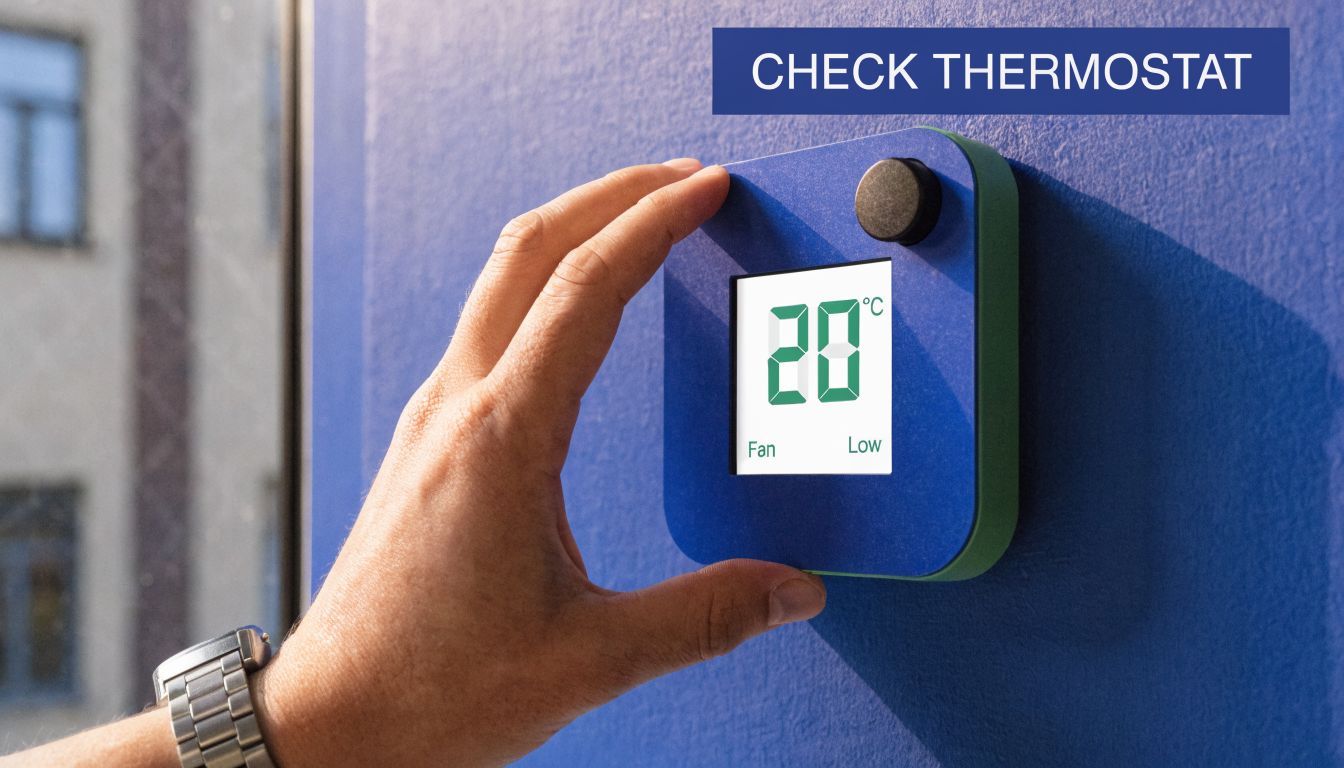
A 2023 report from ACCA found that 62% of “won't turn off” incidents stem from thermostat misconfigurations, especially the fan switch being left on ON instead of AUTO, according to ACCA.
Check the fan setting before anything else
This is the first screen or switch I want a homeowner to look at. If the fan is set to ON, the blower is told to run continuously. That can feel exactly like a furnace fault, especially if the air coming out is still warm from the last heat cycle.
Here's the plain-English difference:
| Setting | What it does | What you notice |
|---|---|---|
| AUTO | Fan runs only when the furnace calls for heat, then stops after the cycle | Normal operation |
| ON | Fan runs continuously | Feels like the furnace won't stop |
If you switch from ON to AUTO and the airflow stops after a short delay, that's good news. You likely don't have a furnace failure at all.
Sometimes the fix is one small switch that got bumped during cleaning, battery replacement, or a settings change.
Lower the setpoint and watch the response
If the thermostat already says AUTO, lower the temperature several degrees below the room temperature. Then wait a few minutes.
You're looking for one of three reactions:
- The system shuts down normally. The thermostat is responding.
- The display behaves oddly or goes blank. The thermostat may need fresh batteries or a reset.
- The furnace keeps running anyway. The call for heat may be stuck in the thermostat or somewhere downstream.
Digital thermostats can also send bad signals when batteries get weak. That's not dramatic. It just creates strange behavior that wastes time if no one checks the simple stuff first.
Smart thermostat issues are real too
Newer thermostats add convenience, but they also add another failure point. If your issue began right after a software update, app change, or equipment setting adjustment, don't ignore that timing.
Try this sequence:
- Replace batteries if your model uses them.
- Restart the thermostat through the menu or app.
- Review schedule settings for hold modes, vacation overrides, or fan circulation modes.
- Remove the thermostat faceplate only if you're comfortable doing so and only after the power is off.
If removing the faceplate causes the furnace to stop, that's a strong clue the thermostat itself is the problem. If you need help with the reset side of the process, this guide on how to reset an AC thermostat covers the basic logic clearly, even though the symptom here is heat-related.
What works and what doesn't
What works is controlled testing. One setting at a time. One change at a time.
What doesn't work is changing five thermostat settings in a rush and then trying to remember what happened. That creates more confusion than the original fault.
Digging Deeper When Your Furnace's Own Controls Fail
If the thermostat checks out and the furnace still ignores the stop command, attention shifts from the wall control to the components inside the unit, where the problem often becomes less visible and more technical.
In arid regions like the Phoenix Valley, furnaces run longer to compensate for rapid moisture loss from heated air. Data from Energy Star shows furnaces in low-humidity zones cycle 15-20% longer than humid climates, which can make operation seem nonstop, according to Energy Star.
The limit switch is small but critical
The limit switch is one of the furnace's main safety controls. Its job is to monitor temperature inside the unit and react if the furnace gets too hot. When it fails, sticks, or reads incorrectly, the system can behave in ways that don't make sense from the thermostat alone.
You might notice:
- The blower runs long after the burners should be off
- The furnace shuts off and restarts oddly
- The unit seems hot and noisy, even when the house already feels warm
A failed limit switch isn't just an inconvenience. It can point to overheating, restricted airflow, or a control problem that the furnace is trying to manage badly.
Control boards and relays can get stuck
The control board is the traffic manager inside the furnace. It receives signals, sequences operation, and tells the blower and ignition components when to act. When a relay on that board sticks, the furnace may keep the blower running or continue acting like there's still a demand.
Such situations often cause casual DIY to go sideways. The symptom looks simple. The diagnosis isn't.
A furnace that won't obey the thermostat often has a control problem, not a temperature problem.
A stuck relay can mimic a thermostat issue almost perfectly. So can a fan relay that stays closed. On older systems, those parts may be separate. On newer ones, they may be built into the board.
Arizona dryness changes the feel of the problem
Mesa homeowners run into one confusing pattern every winter. The furnace technically works, but it seems to run far longer than expected, and everyone in the house starts asking whether something is broken.
Low humidity changes comfort. Dry air can make indoor heat feel less satisfying, even when the thermostat is reading correctly. That's why some homes in the Valley feel chilly and overworked at the same time.
A whole-home humidity strategy can help in homes that always feel dry and drafty during heating season. But if the unit will not stop when the thermostat says it should, that's not a humidity issue alone.
Where homeowners should stop
There is a difference between observing and repairing. Looking for visible soot, a dirty filter, or a blinking board code is reasonable. Pulling wires, testing energized components, or bypassing safeties is not.
For homeowners who like to understand fault-finding logic before calling, these Brisbane electrical troubleshooting tips are a useful general read because they explain how technicians narrow faults methodically instead of guessing. And if your heating issue is paired with cooling trouble or a broader system failure, this guide on heater and AC not working can help you separate single-component faults from whole-system issues.
Serious Signs Wiring Shorts and Stuck Gas Valves
Some symptoms change the situation from frustrating to urgent. A furnace that keeps running because of a fan setting is annoying. A furnace that ignores control signals because of a wiring short or gas valve problem is different.
A 2023 ACCA survey of 5,000 technicians found that 35% of non-stop furnaces traced back to wiring shorts between the thermostat and control board, a problem that shows up more often in older Phoenix homes built pre-2000.
Signs of a wiring short
A short between low-voltage thermostat wiring and the control circuit usually doesn't look dramatic. You probably won't see sparks. What you see is a furnace that doesn't listen.
Watch for patterns like these:
- Changing thermostat settings does nothing
- The furnace starts or continues without a clear call for heat
- The problem comes and goes when doors, panels, or wire bundles are moved
- The issue appears in an older home after years of “working fine”
This is common in houses where insulation on small control wires has gotten brittle, where previous repairs left messy splices, or where multiple thermostat upgrades happened over the years.
Signs that need immediate professional attention
Gas valve issues are less common, but they deserve respect. If a gas valve sticks open or doesn't close correctly, you're not dealing with a settings problem anymore.
Stop and call for help if you notice:
- A gas smell anywhere near the furnace
- Burners that continue acting abnormally
- Clicking, delayed ignition, or flames that don't look stable
- The unit keeps trying to fire even after power cycling attempts
If you suspect a gas control fault, don't try to “confirm it” by repeatedly restarting the furnace.
The practical line between DIY and professional diagnosis
You know what? This is the line. Homeowners can safely verify settings, replace thermostat batteries, check a filter, and shut the system down. They should not troubleshoot energized wiring, gas valves, or board-level electrical faults.
In Mesa, this matters even more in older houses where a “simple furnace issue” sometimes turns out to be mixed with aging wiring, prior remodel shortcuts, or a mismatched thermostat installation. Once the symptom points past normal thermostat behavior, hands-off is the smart move.
Common Problems Repair Costs and Prevention
When a furnace won't stop, most homeowners want two answers. What's probably wrong, and what is this likely to cost me? Fair question.
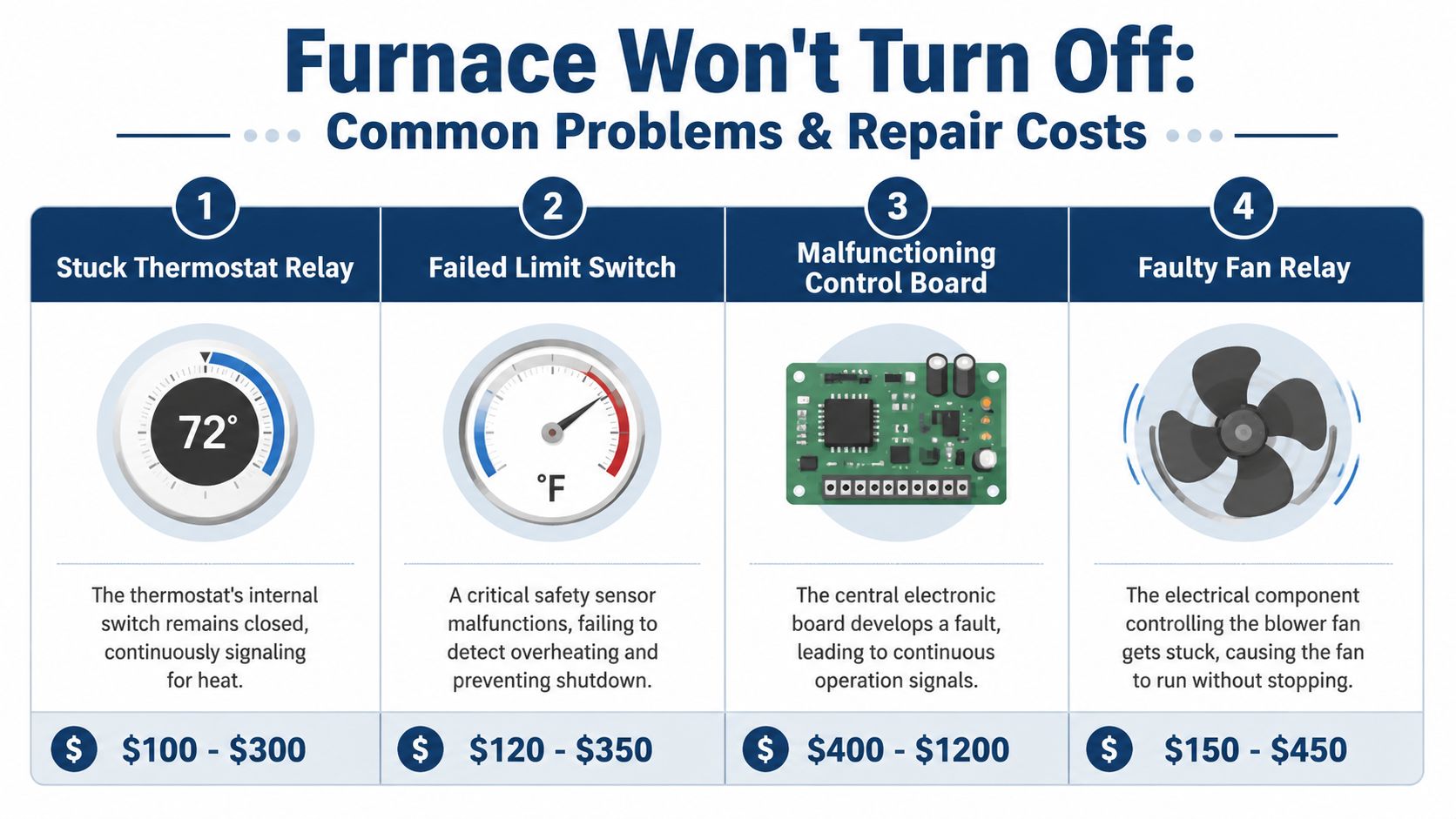
For Arizona homeowners, average winter gas bills hit $150 per month in 2023, and a stuck furnace can inflate costs by 50% due to unrestricted runtime. That same issue can also signal deeper problems such as faulty limit switches, which account for 18% of cases, according to EIA data.
Furnace Problem Diagnostic Chart
| Symptom | Likely Cause | Estimated Repair Cost | DIY or Pro? |
|---|---|---|---|
| Blower runs constantly but heat output seems normal | Fan set to ON instead of AUTO, or thermostat relay issue | $100 – $300 | DIY first, then pro |
| Furnace overheats or blower won't shut down correctly | Failed limit switch | $120 – $350 | Pro |
| System ignores thermostat commands and runs unpredictably | Malfunctioning control board | $400 – $1200 | Pro |
| Fan runs nonstop even when heating cycle ends | Faulty fan relay | $150 – $450 | Pro |
Those repair ranges reflect common field scenarios shown in the infographic above. The final bill still depends on equipment design, access, part availability, and whether the problem damaged anything else.
Cost isn't the only factor
The cheapest repair isn't always the smartest one. If an older furnace has repeated control issues, brittle wiring, a neglected filter history, and an aging thermostat, replacing one part may restore operation without restoring reliability.
That doesn't mean every old furnace should be replaced. It means diagnosis should look at the whole chain:
- Command issue from the thermostat
- Safety issue from the limit switch
- Electrical issue from a relay or board
- Airflow issue from filter restriction or blower problems
This is why homeowners often benefit from reading up on the cost of a furnace inspection before authorizing work. A good inspection should explain not only the failed part, but whether that part failed by itself or because another condition stressed it first.
Prevention that actually helps
The prevention list is shorter than expected.
- Replace filters on time. A restricted filter changes temperature and airflow behavior inside the furnace.
- Check thermostat settings after any battery swap or app update. Small changes create big confusion.
- Pay attention to new sounds. Buzzing relays, delayed starts, and unusually long fan run-on should be checked early.
- Schedule routine heating maintenance. A technician can spot weak controls, heat stress, and wiring wear before the unit gets stuck running on the coldest night.
Maintenance doesn't prevent every failure. It does reduce the number of surprises and catches the risky ones earlier.
When to Call Comfort Experts Your Local HVAC Lifeline
If you've shut the system down, checked the thermostat, and the furnace still won't respond normally, that's enough home troubleshooting. Past that point, the risk climbs faster than the benefit.
A professional diagnosis matters because nonstop operation can come from several places that look identical from the hallway. The thermostat might be fine while the board relay is welded shut. The blower might be obeying a failed limit control. The wire fault might only show up under load. Those are not problems you want solved by trial and error.
Mesa homeowners also deal with a mix of dry winter conditions, aging housing stock, remodel-era wiring, and a lot of equipment that doesn't get much heating use until the one week it suddenly has to. That combination hides problems until the unit refuses to shut down. When you need service, responsiveness matters too. If you're curious how some HVAC companies improve communication during urgent calls, discover professional HVAC call answering for a behind-the-scenes look at why fast intake and accurate dispatch make such a difference.
If you're comparing local repair options, review this page on furnace repair in Mesa so you know what a proper heating service visit should include, from diagnosis to safe repair recommendations.
If your furnace won't stop running and you want an honest diagnosis from a local team, contact Comfort Experts. You can call 480-207-1239 or schedule service online.