In 110°F+ Mesa weather, a heat pump can run for hours without shutting off because Arizona's extreme cooling load keeps demanding heat removal. That steady operation is often normal, but it becomes a service issue when the home can't reach the thermostat setting, airflow drops, ice appears, or the system starts cycling rapidly.
A homeowner may hear the outdoor unit humming through a July afternoon and assume the compressor is stuck. At 3 p.m., the fan may still be spinning, the supply air may feel only mildly cool, and the thermostat may hold within one or two degrees of its setting for hours. Those clues can describe a heat pump doing exactly what it was designed to do in Mesa, not necessarily a failed system.
The important distinction is whether the system is running steadily while maintaining comfort or running continuously while losing the fight. The causes range from Arizona's design temperatures and inverter controls to dirty coils, restricted airflow, refrigerant problems, duct losses, thermostat errors, and poor sizing.
What It Looks Like When a Heat Pump Just Won't Quit
A normal summer afternoon in Mesa can make a heat pump look broken. The outdoor fan keeps turning, the compressor hums without a noticeable pause, and the air from the registers feels cool rather than cold. Meanwhile, the thermostat may show a setting near the actual room temperature and hold there for much of the afternoon.
That pattern matters. A heat pump doesn't need to blast the home with icy air to work correctly. It removes heat gradually, and variable-speed equipment may lower its output after the indoor temperature gets close to the setting. The result is a long, quiet cycle instead of the obvious on-and-off pattern associated with older single-stage equipment.
Arizona homes also keep adding heat while the system is removing it. Sunlight enters through west-facing windows, roof heat moves through the attic, doors open, and hot air enters through duct leaks or gaps in the building envelope. At the hottest part of the day, the heat pump may have little spare capacity left for a fast temperature drop.
Practical rule: Steady operation with a stable indoor temperature is usually less concerning than repeated starts, weak airflow, or a thermostat that keeps climbing.
Homeowners comparing symptoms with heat pump problems in Mesa should watch the indoor result, not the runtime alone. A system that runs for a long stretch but maintains the setpoint is behaving differently from one that runs endlessly while rooms become warmer.
The rest of the diagnosis comes down to three checks: Can the heat pump reach the setting? Does air move properly? Does the equipment sound and behave normally? If the answer is yes, long runtime may reflect the day's heat. If the answer is no, the runtime is a symptom that deserves attention.
How Arizona's Climate Keeps the System Running
Arizona gives heat pumps a demanding cooling assignment. Four local conditions explain most long runtimes in Mesa and the East Valley.
Extreme design temperatures reduce available capacity
Phoenix and Mesa are commonly cited at a 110°F dry-bulb and 71°F wet-bulb outdoor design condition, according to Southwest heat-pump sizing guidance. A heat pump has to reject indoor heat into outdoor air that is already extremely hot. That reduces the system's effective capacity and keeps the compressor working longer.
Equipment selected around a generic 95°F assumption can fall short during the hottest afternoon hours. The unit may be operating normally while lacking enough capacity to pull the indoor temperature down quickly.
The load is dominated by cooling
Arizona equipment selection is driven primarily by the cooling load, not the heating load. Outdoor temperatures often exceed 100°F, and the Southwest cooling-efficiency standard is set at 15 SEER2 with an EER2 minimum of 11.7 to account for peak performance in hot conditions, as explained in hot-dry climate SEER2 guidance.
That means the system is built to manage long periods of sensible heat from windows, walls, attics, ducts, and air leakage. A unit that runs for a long time during peak cooling may be carrying the expected load.
Inverter equipment intentionally stretches runtime
Variable-speed and inverter-driven heat pumps can modulate from roughly 25% to 100% of rated capacity, according to Arizona heat-pump viability guidance. Rather than shutting off as soon as the thermostat approaches its setting, the compressor ramps down and continues moving a smaller amount of heat.
That behavior improves temperature stability and reduces short-cycling. It also makes the system sound like it “won't quit,” even when it's operating at a low output.
Monsoon humidity adds extra work
Desert air is usually dry, so latent moisture removal is limited for much of the year. Monsoon events change that quickly. Humidity rises, and the heat pump must remove both sensible heat and moisture, which can lengthen the cycle even when the thermostat reading looks acceptable.
Dust makes the situation worse by coating outdoor coils and reducing heat transfer. Homeowners can review the role of damage to coils from desert dust before deciding that continuous operation automatically means compressor failure.
Balance Point and Heating Behavior in the Desert
A heat pump's balance point is the outdoor temperature at which its heating output matches the home's heat loss. Below that point, the system may run continuously and call for auxiliary electric resistance heat to hold the thermostat setting, as described by Penn State's heat-pump thermodynamics case study.
Mesa rarely has the prolonged cold conditions seen in northern climates, but winter behavior can still confuse homeowners. Overnight temperatures can drop into the 30s, and a large morning setback can force the system to recover quickly. The thermostat may bring on auxiliary heat, especially if its lockout setting prevents the heat pump from handling colder conditions on its own.
Standard heat pumps are commonly associated with a 30°F to 40°F balance point, while cold-climate inverter systems may operate to a balance point around 0°F to 15°F, according to auxiliary-heat control guidance. Those figures aren't a reason to change settings blindly. They show why thermostat programming and equipment type matter.
Thermostat settings that change runtime
- Auxiliary heat helps the heat pump meet a heating demand when the outdoor unit can't keep up alone.
- Emergency heat bypasses normal heat-pump operation and should not be selected as a routine setting.
- Auxiliary-heat lockout determines when backup heat is allowed or prevented.
- Large temperature setbacks can create a long recovery cycle, even when the equipment is healthy.
Homeowners wanting a plain-language explanation can find heat pump info from Comfort Experts. The heating question is separate from a summer cooling failure, so the thermostat display and operating mode should be checked before anyone assumes the equipment has a mechanical defect.
Normal Long Runtime vs a Real Problem
The simplest test is whether the house is comfortable. Long operation during a brutal afternoon isn't automatically bad. A heat pump that steadily maintains the setpoint, ramps down, and avoids repeated starts is usually responding to a sustained load.
The warning signs are different. A system that runs while the temperature keeps rising, blows weak or warm air, trips a breaker, develops ice on the copper line set, or starts and stops every few minutes needs professional attention.
| Situation | What's Normal | What's a Problem |
|---|---|---|
| Hot afternoon | Extended operation while the thermostat stays near the setpoint | Continuous operation with the indoor temperature still climbing |
| Supply air | Air feels consistently cool with steady airflow | Air feels warm, weak, or noticeably different from one register to another |
| Variable-speed unit | Quiet ramp-down after recovering from a setback | The compressor stays at high output and comfort never improves |
| Outdoor coil | Fan runs steadily and the cabinet remains free of heavy blockage | Coil is packed with dust, airflow is restricted, or the fan doesn't respond normally |
| Refrigerant circuit | No frost or ice on the lines | Ice appears on the copper line set or indoor coil |
| Electrical operation | Normal startup without repeated interruption | Breaker trips, burning odor appears, or the unit clicks on and off every few minutes |
| Winter heating | A mild defrost cycle or temporary auxiliary heat call | Auxiliary heat stays active unexpectedly or the heat pump can't hold the setting |
Warm supply air combined with a frozen coil can point to low refrigerant or a metering-device problem. Short-cycling combined with breaker trips suggests an electrical or compressor-start issue, not normal Arizona modulation.
A heat pump doesn't need to shut off often to be healthy. It does need to produce the expected indoor result.
Common Mechanical and Controls Causes in East Valley Homes
When long runtime comes with poor comfort, the cause usually falls into one of four groups: controls, airflow, refrigerant, or sizing. Mesa, Gilbert, Chandler, and Queen Creek homes each have different construction details, but desert heat and dust expose the same weak points.
Controls can create a false cooling demand
A thermostat mounted in a hallway near afternoon sunlight, above a warm return grille, or close to a heat-producing appliance may read higher than the occupied rooms. Honeywell and Ecobee thermostats can both misread conditions when location and airflow distort the sensor.
The homeowner can compare the thermostat with a separate thermometer placed near the return grille. A persistent gap of several degrees suggests a sensor, placement, or airflow issue rather than a compressor that needs to run longer. A professional can evaluate thermostat installation when relocation, replacement, zoning, or calibration is appropriate.
Airflow restrictions make the system work harder
Dusty monsoon conditions load filters quickly. A dirty evaporator coil, blocked return grille, closed registers, or furniture pushed against a return can reduce the air crossing the coil. The heat pump then has less opportunity to move heat out of the home.
Attic ductwork adds another problem. Crushed flex duct, disconnected sections, and leakage send conditioned air into hot attic spaces instead of occupied rooms. Homeowners can inspect visible duct sections and registers, but static pressure testing and duct-leakage diagnosis require proper instruments.
Refrigerant problems reduce cooling capacity
A heat pump operates in a closed refrigerant circuit. A low charge usually means a leak, possibly at a Schrader valve, connection, or corroded condenser coil. Pool chemicals and desert exposure can contribute to component deterioration around outdoor equipment.
Topping off refrigerant without locating the leak is a poor repair decision. It may provide temporary improvement while allowing the underlying problem to continue and placing the compressor under unnecessary strain. Refrigerant work also involves regulated materials and specialized recovery and charging equipment.
Sizing problems show up at the extremes
An undersized unit may perform acceptably during moderate weather but run continuously at Arizona's actual peak design temperature. Recent high-ambient guidance emphasizes checking equipment performance at 110°F to 125°F, rather than assuming a standard rating tells the whole story, as discussed by Arizona heat-pump equipment guidance.
Oversizing causes the opposite trouble. A large unit may satisfy the thermostat quickly, then shut off before it has managed humidity and airflow properly. The result is short-cycling, uneven rooms, and poor comfort despite a powerful-looking system.
A homeowner can change a filter and clear a register. The homeowner should not open a refrigerant circuit, evacuate or recharge R-410A or R-454B, or handle a capacitor. Capacitors can retain dangerous electrical energy, and HVAC equipment can involve 240V circuits even when the thermostat appears inactive.
Safe Troubleshooting Steps Homeowners Can Try
A short inspection can separate an airflow or setting issue from a problem that needs a technician. The safest checks happen at the thermostat, registers, filter, and visible outdoor cabinet.
Compare temperature readings. Place a separate thermometer near the return grille for about ten minutes and compare it with the thermostat. A noticeable difference may indicate thermostat placement or sensor trouble, while matching readings point toward the actual system and home load.
Replace the filter. Install the correct size filter, especially after a dusty storm or a long cooling stretch. A loaded filter restricts airflow and can contribute to coil icing.
Open and clear registers. Confirm supply registers and return grilles are open and free from furniture, rugs, curtains, and stored items. The system needs a clear path for air to leave and return.
Rinse the outdoor coil carefully. Turn the system off before cleaning. A gentle garden-hose rinse from the inside out can remove loose surface dust, but forceful spray can bend fins and make heat transfer worse.
Check the operating controls. Confirm the thermostat is set to Cool, not Heat or Auto, and that the fan is set to Auto. Check the electrical panel for a tripped double-pole breaker and look at the outdoor disconnect without opening electrical compartments.
Several actions should stay off the homeowner's list. Don't poke at capacitors, remove a service-valve cap, or keep restarting equipment that smells like burnt insulation. Don't climb onto a wet tile roof to reach a rooftop package unit.
Safety boundary: A filter, register, and thermostat check are reasonable homeowner tasks. Refrigerant, capacitor, wiring, and internal coil work belong with a qualified HVAC technician.
Once those safe checks are complete, the next question is whether routine care can reduce strain before the next peak-heat cycle.
Energy-Saving Tips and Maintenance for Mesa Heat Pumps
Maintenance should reduce avoidable strain, not promise a fixed utility-bill result. Actual performance depends on equipment age, duct condition, insulation, windows, thermostat settings, and solar exposure.
A practical Mesa routine includes:
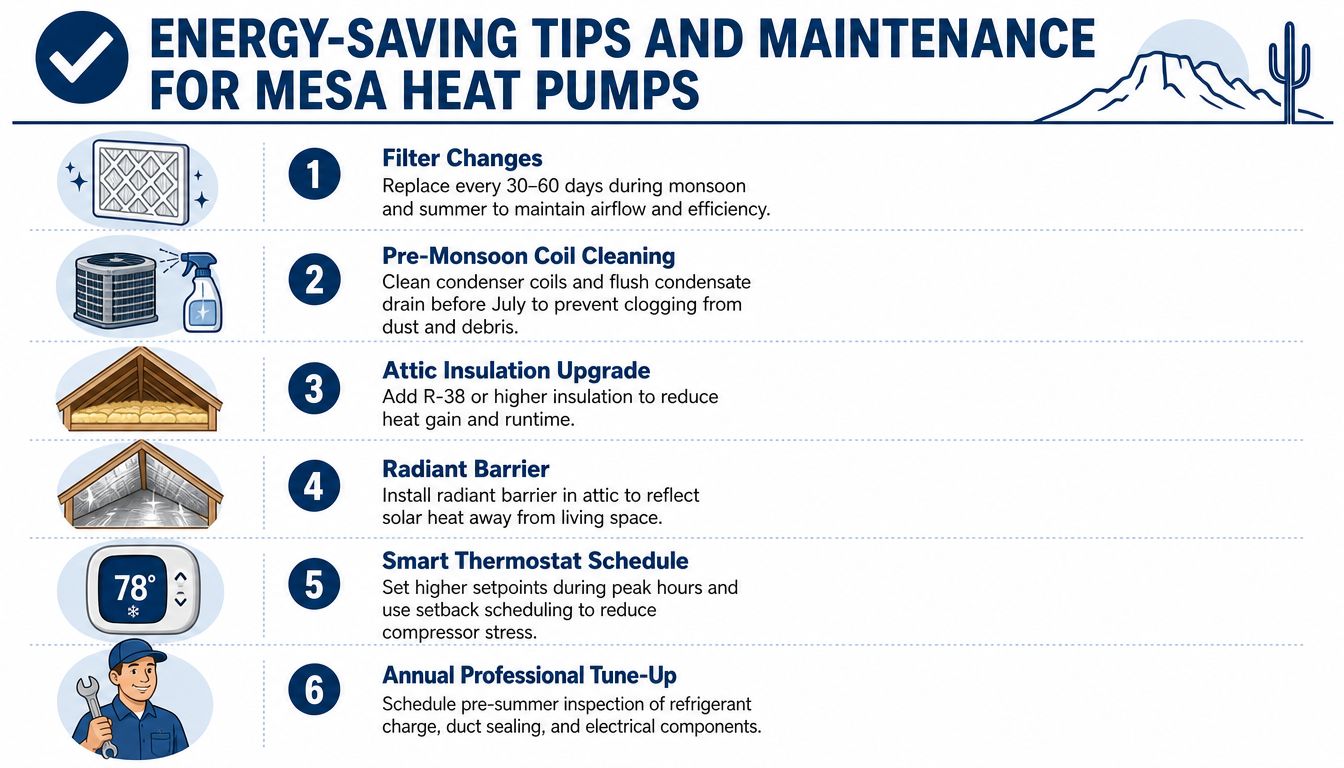
- Filter changes: Inspect filters often and replace them at 30- to 60-day intervals during summer and monsoon conditions, as shown in the provided Mesa maintenance guidance.
- Pre-monsoon cleaning: Clean the outdoor coil and flush the condensate drain before the heavy cooling period.
- Attic improvements: Review insulation and radiant-barrier options when attic heat keeps rooms uncomfortable.
- Thermostat scheduling: Raise the cooling setting while the home is vacant, then avoid an aggressive recovery that forces the system to run at full output for a long stretch.
- Air movement: Ceiling fans can help occupants feel comfortable at a slightly higher thermostat setting, though fans don't lower the room temperature.
- Outdoor clearance: Keep leaves, debris, and stored items away from the condenser so the fan can move air freely. Shade can help only when it doesn't restrict the required clearance or airflow.
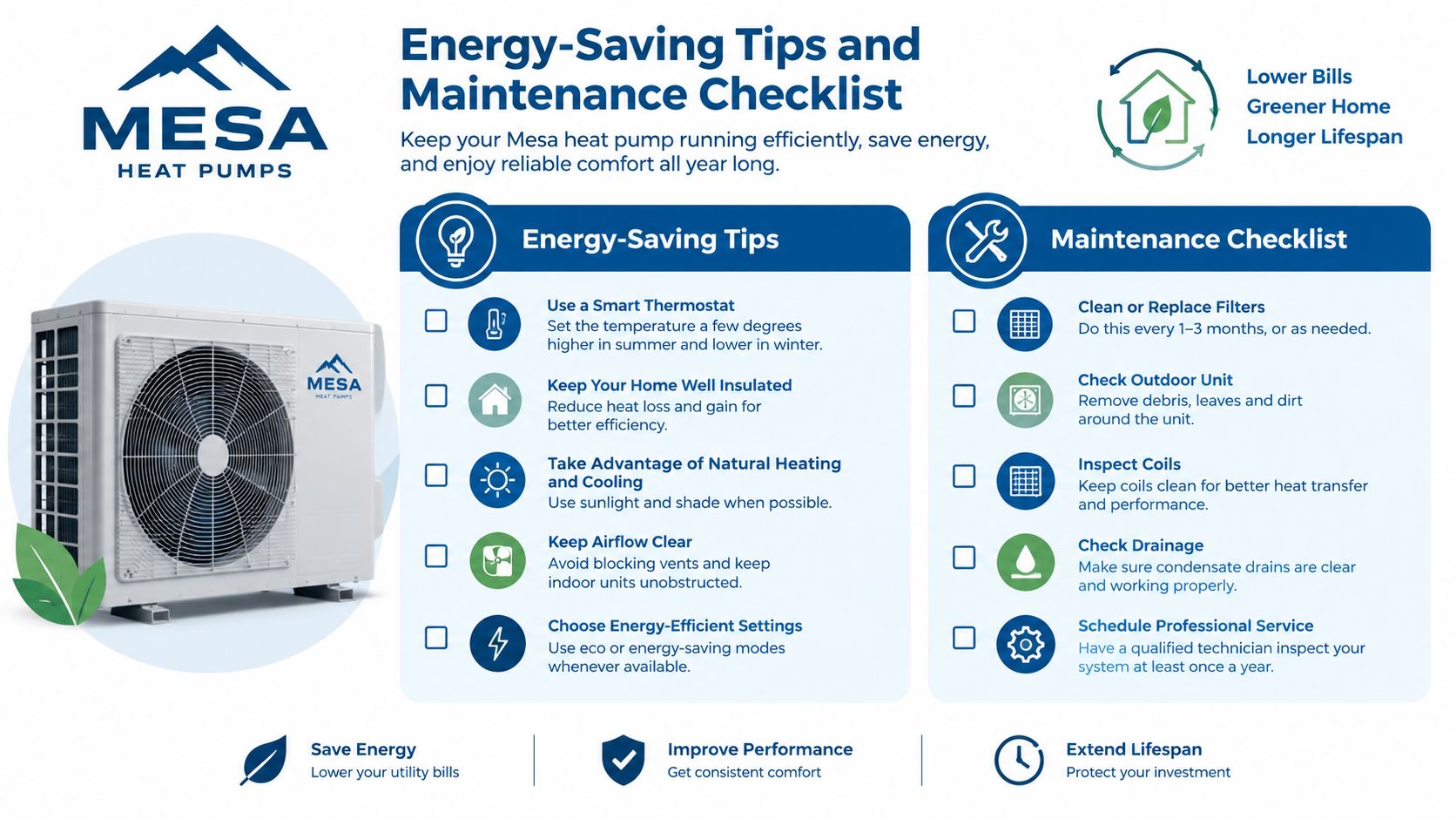
Professional service should include more than a quick visual glance. A technician can measure airflow, inspect the coil, verify refrigerant conditions, check duct performance, and confirm that the controls call for the correct mode. Homeowners looking for scheduled heat pump maintenance can use those checks to address a long-runtime complaint before it becomes a no-cooling call.
When to Call Comfort Experts and What to Expect Next
A service visit makes sense when the thermostat shows the correct setting but the home never reaches it, the unit runs for hours on milder days, ice forms on the refrigerant lines, the breaker trips, or the utility bill rises without a weather-related reason. Short-cycling also deserves prompt attention because repeated starts place more stress on electrical and compressor components than a steady cycle.
A proper diagnostic should identify the cause instead of treating runtime as the problem. The technician should evaluate:
- Airflow and static pressure, to find restricted filters, dirty coils, blocked returns, or duct problems.
- Refrigerant operation, including superheat and subcooling measurements where applicable.
- Duct leakage, especially in attic runs and older East Valley homes.
- Thermostat location and calibration, including whether sunlight or return-air heat affects the reading.
- Equipment sizing and high-ambient performance, matched to the home's actual cooling demand and Arizona design conditions above 110°F, as explained in hot-dry heat-pump performance guidance.
The homeowner should receive a plain explanation of what failed, what can be repaired, and when replacement makes more sense. A long-running inverter unit that maintains temperature may need monitoring and maintenance. An older single-stage system that can't reach the setting may need airflow correction, leak repair, controls work, or a properly sized replacement.
Property managers and office operators can also use an HVAC lead capture service to keep service requests organized when occupants report after-hours comfort problems. For a Mesa or East Valley homeowner, the immediate decision is simpler: monitor stable comfort, complete safe checks, and call for diagnosis when comfort or equipment behavior deteriorates.
Comfort Experts handles heat pump diagnostics, repair, maintenance, airflow concerns, thermostat issues, and replacement decisions for Mesa and East Valley homes. Call 480-207-1239 or schedule service when the system runs constantly without holding temperature, develops ice, trips a breaker, or behaves differently after dust or monsoon weather. Visit Comfort Experts for local HVAC support grounded in the conditions Arizona equipment faces.