
When a Phoenix summer is already pushing your old system to the edge, replacing the AC stops feeling optional and starts feeling urgent. A proper trane ac unit installation isn't just about getting cold air again. It's about making sure your home can handle the kind of heat that doesn't let up.
Your Complete Guide to a Perfect Trane AC Installation
If your current air conditioner is limping through another Arizona summer, you’re probably asking a few practical questions all at once. How much is this going to cost, how long will the job take, and how do you know the install is being done right?
That last question matters more than most homeowners realize. A premium system can still disappoint if the installer cuts corners, and that’s true whether you’re replacing a ground unit, a rooftop package unit, or coordinating HVAC work alongside a larger home project. If your installation is part of a broader renovation, it also helps to review these critical questions to ask a general contractor so the HVAC scope, permits, and scheduling don’t get lost in the shuffle.
Why Your Installation Quality Matters More in Arizona
Phoenix doesn’t treat air conditioning gently. It punishes weak workmanship fast.
A Trane system is built for durability, and Trane units are engineered to perform efficiently for 15 to 20 years with regular maintenance, with SEER2 ratings up to 21.5 across the lineup according to this Trane systems overview. But in the Valley, that performance depends heavily on how the system is installed for local conditions.

Arizona heat exposes every shortcut
In milder climates, an installation mistake may hide for a while. In Phoenix, the system runs hard and long, so those mistakes show up sooner as poor cooling, more noise, comfort complaints, or repeated service calls.
Think about what your air conditioner is dealing with here:
- Extreme summer heat: The system has to reject heat outdoors when the outdoor environment is already brutal.
- Dust and debris: Fine desert dust affects coils, drain areas, electrical compartments, and airflow if the install and sealing work aren’t clean.
- Long cooling seasons: Equipment doesn’t get much downtime, so weak craftsmanship gets tested constantly.
- High homeowner expectations: And rightly so. When it’s scorching outside, “mostly working” doesn’t count.
That’s why installation quality often matters as much as the equipment choice itself. A well-installed mid-tier system can outperform a badly installed premium one in real-world comfort.
What works and what doesn’t
Here’s what usually works in Arizona homes. The contractor sizes the equipment carefully, checks duct performance, verifies airflow, and commissions the system instead of turning it on and leaving.
What doesn’t work? Swapping boxes. That means removing the old unit, dropping in a new condenser and coil, and assuming the rest of the house will somehow cooperate. It won’t.
A lot of homeowners focus first on efficiency numbers, and that’s understandable. If you’re comparing options, this breakdown of SEER 14 vs 16 helps clarify where higher efficiency makes sense and where proper installation may have a bigger impact on daily comfort.
The foundation analogy fits
You know what? A rushed AC install in Arizona is a lot like building a house on weak footings in unstable ground. The home may look fine at first, but the underlying mistakes keep showing up.
The same thing happens with HVAC. If the refrigerant charge is off, if the airflow is wrong, if the ductwork leaks badly, or if the outdoor unit sits in a poor location, the system spends its life fighting uphill. Homeowners feel that struggle as uneven cooling, louder operation, and more frustration during the hottest stretches of the year.
Why local conditions change the conversation
National advice can be useful, but Phoenix homes have their own patterns. Some have long line-set runs. Some have aging attic ductwork that leaks conditioned air into brutally hot spaces. Some sit in sun-heavy orientations that drive up afternoon demand. Some rooftop setups take a beating from heat exposure and dust.
That’s why a local installer should never approach trane ac unit installation as a generic replacement. Arizona isn’t generic, and your cooling load isn’t either.
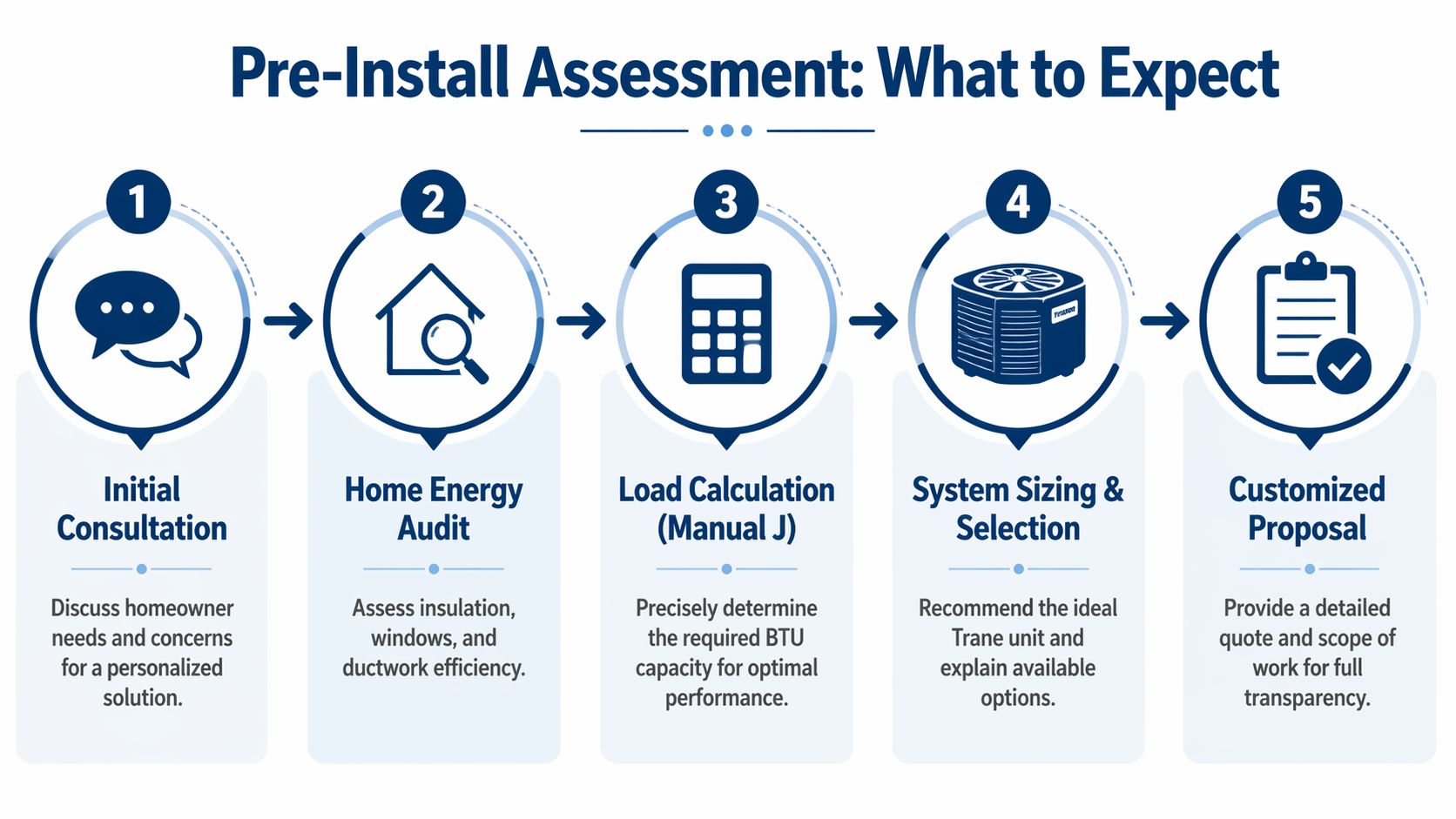
The Professional Pre-Install Assessment What to Expect
A real estimate should feel less like a sales pitch and more like a diagnosis. If somebody walks in, glances at the old condenser, and hands you a quote in a few minutes, that’s a warning sign.
A proper pre-install visit should answer one core question. What does this specific home need to stay comfortable in Phoenix without overspending or underperforming?
Sizing starts with the house, not the old unit
One of the most important parts of the visit is load calculation. Many homeowners hear “system sizing” and assume it’s some technical formality. It’s not. It’s the process used to estimate how much cooling your house needs.
That calculation considers the home itself, not just square footage. Things like insulation, sun exposure, window quality, ceiling height, and air leakage all affect the result. In Phoenix, those factors matter a lot because afternoon heat gain can be punishing.
If a contractor matches the tonnage of the old system, they may be repeating an old mistake. Bigger isn’t automatically better, either. Oversized systems can short cycle, cool unevenly, and miss the comfort target homeowners expect.
Ductwork often decides how the new system will feel
Many replacement jobs get judged by the equipment brand, but the duct system often determines whether rooms feel balanced. During assessment, the installer should inspect the condition and layout of the ductwork, especially in attics where heat exposure is severe.
Common trouble spots include:
- Leaky connections: Conditioned air escapes before it reaches the rooms that need it.
- Poor return airflow: The system struggles to pull enough air back to the unit.
- Crushed or deteriorated duct sections: Air delivery drops, sometimes room by room.
- Undersized ducts: A high-quality system can still perform badly if airflow is restricted.
Homeowners are often surprised when the root cause of “my back bedroom never cools right” isn’t the outdoor unit at all.
The electrical side has to be checked too
A professional should also verify the electrical setup before installation day. That includes disconnects, breakers, wiring condition, and whether the system pairing you’re considering fits the home safely and correctly.
This isn’t glamorous, but it matters. HVAC equipment relies on clean, correct electrical installation to start, run, and protect itself properly. Ignoring that side of the job can create nuisance shutdowns, parts stress, and code issues.
What a homeowner should expect to see
A strong pre-install process usually includes a mix of observation, questions, and measurement. It should feel deliberate.
Here’s what that often looks like in practice:
Comfort discussion
The contractor asks where your hot spots are, how the current system behaves in late afternoon, whether humidity or air quality feels off, and what matters most to your family.Home inspection
They examine the equipment location, attic or rooftop conditions, duct routing, insulation realities, and access challenges that can affect labor and system design.System matching review
They consider whether you’re replacing only the condenser and coil or looking at a communicating system, furnace, air handler, or thermostat upgrade.Proposal clarity
The quote should explain what’s included, not just throw out a price.
A complete Trane installation can range from $5,000 to $26,000, including equipment, professional labor, old system removal, and accessories, with permits adding $100 to $250 for a standard replacement according to this Trane installation cost guide. That range is wide for a reason. The final number changes with efficiency level, system complexity, and what the house needs to support the equipment properly.
Questions worth asking during the estimate
A homeowner doesn’t need to speak like a technician to spot quality. A few direct questions can tell you a lot.
How are you sizing the system?
Listen for mention of load calculation, not just square footage or matching the old unit.Are you evaluating the ducts?
If the answer is vague, comfort problems may follow the new install.What’s included in the proposal?
Removal, accessories, permits, thermostat, code items, and startup details should be clear.Will the system be commissioned after install?
That means tested, adjusted, and verified, not just powered on.
If you’re trying to understand how sizing decisions affect comfort, this guide on what size air conditioner do I need is a useful companion to the in-home assessment.
Choosing Your Trane System Sizing and Efficiency Explained
Once the home has been evaluated properly, the conversation shifts from “Which unit is cheapest?” to “Which system fits the way this house lives in Phoenix?”
That’s a much better question.
Trane tiers in plain English
Most homeowners don’t need a deep dive into every model number. They need a practical way to think about the lineup. Broadly, Trane systems are often discussed in tiers such as XR, XL, and higher-end communicating or variable-capacity options.
Here’s a simple way to compare them.
| Trane AC Model Tiers at a Glance | Compressor Type | Typical SEER2 Range | Best For |
|---|---|---|---|
| XR tier | Single-stage or basic staged options | Lower to mid range within Trane lineup | Homeowners who want dependable cooling with fewer advanced features |
| XL tier | Two-stage in many configurations | Mid to high range within lineup | Families who want better comfort control and quieter operation |
| Top premium tier | Variable-speed or communicating options | Upper end of lineup | Homes where comfort precision, efficiency, and long run performance matter most |
The exact available match depends on the indoor equipment, controls, and approved system pairing. That’s why selection should never happen from the condenser brochure alone.
Compressor style changes how the home feels
A single-stage system is simple. It’s largely on or off. When cooling is needed, it ramps to its main operating level and runs.
A two-stage system adds flexibility. On milder cooling calls, it can operate at a lower stage and avoid the abrupt blast-and-stop pattern some homeowners notice with older equipment.
Variable-speed equipment is smoother still. It operates much like a vehicle that can adjust speed gradually instead of jumping from parked to full throttle. In Arizona, that can translate into steadier indoor temperatures and less noticeable cycling.
Efficiency matters, but matching matters too
Trane’s lineup includes SEER ratings from 14 to 22, with newer SEER2 ratings from 14.8 to 21.5 as noted earlier in the article. Higher efficiency generally means the system can cool using less electricity over time, which matters in a place where AC demand can dominate summer utility bills.
But efficiency ratings only mean something when the system is installed and matched correctly. That means the outdoor unit, indoor coil or air handler, controls, and refrigerant setup all need to work as an approved combination. If they don’t, the homeowner may not get the comfort or operating efficiency they expected.
That’s why professionals talk about “matched systems.” It’s not contractor jargon for the sake of it. It’s the difference between a designed system and a parts swap.
How to think about the real trade-offs
Some homeowners prioritize initial budget. Others care most about noise, smoother room temperatures, or long-term utility control. All of those are valid.
A practical decision framework looks like this:
- If budget leads the decision: An entry-level or standard staged Trane system may make sense if the home’s ductwork and installation quality are strong.
- If comfort complaints are the main issue: Two-stage or variable-capacity options often deserve a closer look.
- If the home has hot and cold room swings: Equipment alone may not solve it. Duct and airflow improvements may matter just as much.
- If you plan to stay in the house long term: Efficiency, controls, and install quality tend to matter more.
Some homeowners also want smart control features. Trane’s Nexia Home Intelligence platform supports remote HVAC management, which can help homeowners manage settings through a smartphone or tablet, as noted in the earlier verified overview. For people who travel, manage second homes, or want easier control over indoor comfort, that can be a meaningful upgrade.
Why Phoenix homes need careful sizing conversations
In Arizona, cooling equipment has to handle real load, not guesswork. A unit that’s too small may struggle during severe heat. A unit that’s too large may cool quickly without running in the balanced way needed for overall comfort. The right answer usually comes from measured design, not assumptions.
Here’s where homeowners often get stuck:
- They compare only tonnage.
- They compare only sticker price.
- They assume “higher SEER2” automatically fixes comfort.
- They underestimate the effect of ducts, insulation, and controls.
A better buying conversation puts the home first. Then it chooses the Trane system that supports that home best.
Installation Day The Step-by-Step Professional Workflow
When installation day arrives, the work should look organized from the first few minutes. Good crews don’t just bring equipment. They bring a process.
A standard on-site installation commonly takes 2 to 8 hours, though more complex situations can push longer, according to the earlier referenced Trane pricing and installation overview. The difference comes down to access, system complexity, code work, duct modifications, and what the technicians discover once the old equipment is opened up.

Before the first tool comes out
The first phase should protect your home and set the job up for clean execution. Technicians should confirm the scope, protect flooring and work areas, and plan the removal path for the old equipment.
That sounds basic, but it tells you a lot. Crews that start carefully usually work carefully.
A professional workflow typically includes:
- Property protection: Drop cloths, corner awareness, and clean pathways.
- Scope confirmation: Matching equipment, thermostat, accessories, and install notes against the work order.
- Safe shutdown: Electrical isolation before any removal starts.
- Refrigerant recovery: The old refrigerant must be recovered properly, not vented.
Removal and prep work matter more than homeowners realize
The old system has to come out cleanly, but the real craftsmanship starts in prep. The line set, coil location, drain configuration, electrical connections, and mounting conditions all affect how well the new system will live.
For the outdoor section, one detail is non-negotiable. The support pad must be level and isolated from the building foundation. Trane’s installation guidance notes that the outdoor unit’s support pad must be perfectly level and separate from the structure to reduce vibration and protect compressor oil return, which directly affects long-term reliability and noise level, as shown in this Trane condensing unit installation literature.
If that pad is off, the unit may still run. But “running” and “running correctly for years” are not the same thing.
The hidden technical steps that separate pros from shortcuts
Homeowners usually notice the new thermostat and the shiny condenser. They don’t always see the technical steps that protect the system from early trouble.
Those steps include clean refrigerant piping practices, careful brazing, proper evacuation, and thorough system commissioning. When technicians braze copper lines with nitrogen flowing through the tubing, they help prevent internal scale and contamination. When they pull a deep vacuum and verify it with the right instruments, they remove moisture and non-condensables that can hurt performance and component life.
These aren’t luxury extras. They’re part of doing the job right.
Start-up and commissioning
This is the point where too many installers rush. A proper start-up means the crew doesn’t stop at powering the system on and leaving once cold air comes out.
They should check operation methodically. That includes verifying airflow, checking temperature behavior, confirming controls, and making sure the system is performing as intended. If the installation includes furnace or air handler integration, thermostat programming, or communicating controls, all of that needs to be verified too.
Many homeowners don’t realize how much difference commissioning makes. It’s one of the biggest separators between a replacement that feels “fine” and one that feels dialed in.
Common installation day mistakes that create future problems
Here are some problems that often start on day one:
Skipping level verification on the condenser pad
The unit may transmit more vibration, run louder, or face long-term mechanical stress.Reusing questionable materials
Old drain components, worn disconnects, or poor line-set conditions can haunt a new install.Weak sealing at penetrations and connections
Arizona dust finds gaps, and so does hot attic air.Minimal startup testing
If the system isn’t properly checked, the homeowner may become the first person to discover the problem.
If you want to see what a full replacement process generally includes from a contractor perspective, this page on AC replacement and installation in Mesa gives a helpful overview.
What the homeowner should notice by the end of the day
A professional installation should leave behind more than a running AC. The work area should be cleaned up. The equipment should look deliberate and secure. The thermostat should be configured. The system should sound normal, not strained or rattly.
And the crew should be able to explain what was done in plain English.
That matters. Homeowners shouldn’t feel like they got handed a mystery box attached to the side of the house. They should understand the system they just invested in.
Understanding Phoenix Valley Permits Costs and Timelines
Most homeowners ask the same two questions first. What’s this going to cost, and how long is this going to take?
Fair questions. The honest answer is that both depend on the house, the equipment choice, and how clean or complicated the installation is.
Why one Trane install costs more than another
The earlier cited cost range is broad because replacement jobs vary widely. A straightforward system changeout is one thing. A project involving duct updates, controls, permit coordination, or harder access is something else.
Factors that commonly affect price include:
- System efficiency choice: Higher-end equipment usually carries a higher upfront investment.
- System configuration: Replacing only cooling equipment is different from replacing a full communicating setup.
- Access difficulty: Tight attics, rooftop work, and older homes can add labor complexity.
- Code and support items: Drain updates, disconnects, pad work, and electrical corrections all matter.
- Permit scope: Standard replacements tend to be simpler than jobs involving larger modifications.
Permits may not feel exciting, but they protect the homeowner. They help confirm the work meets local code, and they create a layer of accountability that fly-by-night installs tend to avoid.
Permits are part of a clean job
In cities around the Phoenix Valley, permit requirements can vary by municipality and by the type of work being performed. A standard AC replacement often falls into a predictable process. Once the project includes more significant duct or related modifications, the path can become more involved.
That’s one reason “cheap” quotes sometimes look attractive at first. They may leave things out. Permits, code corrections, cleanup, commissioning, or accessories can disappear from the estimate until they suddenly reappear as a problem.
Timelines need to account for real-world variables
Some installations are smooth and direct. Others uncover issues once the old equipment is removed. Drain problems, failing transitions, weak platforms, damaged line insulation, or electrical concerns can all change the pace of the day.
One technical point deserves special attention in Arizona homes. Trane outdoor units are factory-charged for 15 feet of line set, and longer runs require a certified installer to weigh in additional refrigerant carefully to hit target subcooling and avoid premature compressor damage, according to this Trane residential installation literature. In Valley homes with longer runs, that’s not a detail to gloss over.
That single issue is a good example of why timelines and labor can vary. When the crew has to measure, adjust, verify, and document correctly, the job takes skill and attention.
What a realistic homeowner mindset looks like
It helps to think in terms of total project quality, not just installation speed. Fast is good when the work is still precise. Fast is bad when it means skipping verification.
A useful way to evaluate the proposal is to ask whether it clearly addresses these areas:
| What to Review | Why It Matters |
|---|---|
| Equipment scope | Confirms exactly what is being replaced and matched |
| Permit handling | Helps ensure code compliance and cleaner project oversight |
| Included labor items | Prevents surprises around removal, accessories, and startup |
| Commissioning details | Indicates whether performance verification is part of the job |
| Potential add-ons | Helps you prepare for electrical, duct, or access-related needs |
If you want a broader look at replacement budget factors, this guide on cost to replace an AC unit provides helpful context.
The Final Handoff Warranty Registration and Maintenance
The installation isn’t really finished when the house gets cool. The handoff matters.
A good final walkthrough should include thermostat operation, filter access, basic homeowner care, and a clear explanation of what paperwork you should keep. If the installer rushes out the door without covering those items, the job feels incomplete because it is incomplete.

Warranty registration is not a minor detail
This is one of the most overlooked parts of a trane ac unit installation. Homeowners assume it happens automatically. Sometimes it doesn’t.
According to HVAC consumer reports, 20-30% of new AC installations face warranty disputes due to incomplete or incorrect registration, a problem highlighted in this Trane HVAC installation resource. That’s a big reason the installer should help complete and verify the registration process rather than leaving the homeowner to figure it out later.
In practical terms, that means confirming model and serial details, installation information, and any related documentation while the job is still fresh and accessible.
Documentation protects the investment
Home systems work a lot like roofs in one important respect. The equipment matters, but the documentation behind it matters too. That broader principle is similar to how contractors talk about comprehensive warranty protection in other parts of the home. Good coverage only helps when the paperwork and workmanship line up.
A homeowner should leave the job with confidence on a few points:
- What equipment was installed
- How to operate the thermostat
- Where to find warranty information
- Who handled registration and what was submitted
- When to schedule the first maintenance visit
Maintenance matters more in the Valley
Arizona’s heat, dust, and long cooling season aren’t friendly to neglected systems. Trane equipment is built for long service life, but regular maintenance is part of protecting that lifespan and keeping the system operating efficiently over time.
That doesn’t mean homeowners need to obsess over every sound. It means they should stay ahead of filter changes, keep the outdoor area clear, and schedule professional service on a consistent basis. If you’re wondering what “consistent” should look like, this guide on how often HVAC should be serviced is worth reviewing.
Ready for a Cooler Summer in Phoenix
A well-executed Trane installation gives you more than new equipment. It gives you confidence that the system was sized properly, installed cleanly, charged correctly, and set up to survive real Arizona heat.
If your current system is struggling, replacement doesn’t have to feel confusing. The right process makes the decision clearer, the installation smoother, and the long-term results much better.
If you’re ready to talk through your options with Comfort Experts, call 480-207-1239 or schedule service to get started.