You know that sinking feeling when your AC is running, but your Phoenix home just keeps getting hotter? It’s a classic sign something is wrong, and more often than not, the culprit is an evaporator coil replacement. Getting a handle on this single component is the first step toward figuring out what’s wrong and making a smart decision for your AC's health—especially with how hard our systems work in the Arizona climate.
The Unsung Hero of Your Phoenix AC System

Think of the evaporator coil as the part of your AC system where the actual cooling magic happens. It’s tucked away inside your indoor air handler, and this A-shaped grid of copper or aluminum tubing has one critical job: to absorb heat and humidity from your home’s air. Without a working evaporator coil, your air conditioner is just an expensive fan; the entire cooling process depends on it doing its job right.
How It Makes Cold Air
Let me explain. Imagine holding an ice-cold can of soda on a blistering hot day. You’ll notice two things right away: the can is cold, and moisture starts beading up on the outside. Your evaporator coil does the exact same thing, but for all the air in your house.
Here’s a simple breakdown of its role in the cooling cycle:
- Air Gets Pulled In: Your system’s blower fan draws in warm, humid air from your living spaces and pushes it directly over the evaporator coil.
- Heat Gets Absorbed: A super-chilled chemical refrigerant flows through the coil's tubing. As that warm air passes over the cold tubes, the refrigerant literally soaks up the heat, just like that cold soda can pulls heat from your hand.
- Humidity Gets Zapped: As the air rapidly cools, it can't hold onto its moisture anymore. That water vapor condenses onto the coil’s surface, drips into a drain pan, and is safely piped away—effectively dehumidifying your home.
- Cold Air Gets Sent Out: The now-cool, dry air is blown back into your home through the vents. Meanwhile, the refrigerant, having absorbed all that heat, heads to the outdoor condenser unit to dump it outside.
The entire comfort level of your home really comes down to this one part’s ability to transfer heat. If it’s dirty, corroded, or leaking refrigerant, the whole system’s performance tanks, leaving you with a warm house and sky-high energy bills.
This whole process is why evaporator coil health has become such a big deal. In fact, the U.S. accounted for a massive 73.7% share of the global evaporator and condenser coil market in 2023. That number is pushed by homeowners everywhere—especially here in the Phoenix area—looking for more energy-efficient systems to fight back against rising utility costs.
Knowing exactly where this critical component is hidden is the first step to spotting trouble. For a more detailed walkthrough, you can learn more about finding the evaporator coils in your HVAC system in our helpful article. When you know what it does and where to find it, you’re in a much better position to know when something’s gone wrong.
Telltale Signs Your Evaporator Coil Is Failing

Does your AC seem to be running all day without actually cooling your house down? It's not just in your head. A failing evaporator coil almost always sends out warning signs before it gives up completely, and catching them early can save you from a sweltering Phoenix summer day with zero relief.
Think of these symptoms as your air conditioner's cry for help. Ignoring them often leads to bigger problems and much higher repair bills down the road. Learning what to look for is the first step in figuring out if you need an evaporator coil replacement.
Warm or Weak Airflow From Vents
This is usually the first thing homeowners notice. If the air drifting out of your vents feels more lukewarm than cold, or if the airflow itself feels weak, your evaporator coil is a likely suspect.
When the coil is caked with dust or leaking refrigerant, it simply can’t pull enough heat out of the air passing over it. The result is air that’s barely cooler than when it went in, leaving your home sticky and uncomfortable no matter how low you crank the thermostat.
Your AC System is Constantly Running
An air conditioner that never shuts off is a classic sign of an inefficient system, and a faulty evaporator coil is one of the most common culprits we see. Your thermostat is supposed to tell the AC to take a break once it hits your target temperature.
But if the coil isn’t doing its job, your home may never get cool enough to satisfy the thermostat. Your AC will just keep running and running, trying to do a job it's no longer capable of. This not only puts a ton of stress on other expensive parts but also makes your electric bill skyrocket.
When your system runs non-stop, it's a major red flag. It’s working overtime to compensate for a weak link—and that weak link is very often a compromised evaporator coil that has lost its ability to transfer heat efficiently.
A Frozen Evaporator Coil
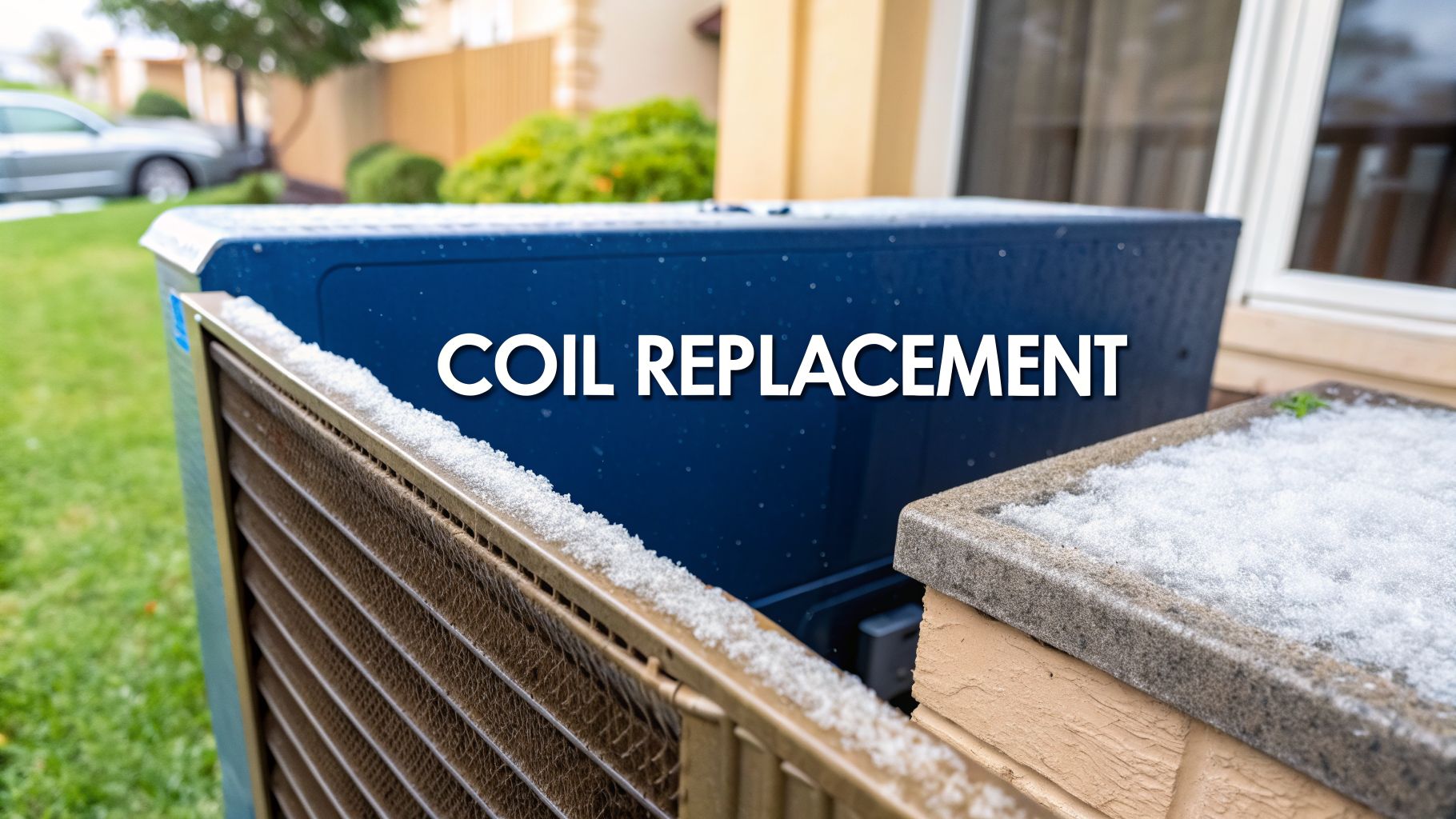
It sounds completely backward, doesn't it? But seeing ice on your indoor AC unit is a clear sign of trouble, not top-notch performance. A layer of frost or even a solid block of ice on the evaporator coil usually points to one of two main issues: restricted airflow or low refrigerant.
- Restricted Airflow: A filthy air filter or a dirty coil itself can choke off the flow of warm household air. Without that warm air to keep its temperature in check, the coil’s surface plummets below freezing, and any humidity in the air instantly turns to ice on contact.
- Low Refrigerant: A refrigerant leak causes the pressure inside the system to drop, which in turn makes the refrigerant get much colder than it's designed to. This super-chills the coil, causing it to freeze over fast.
A frozen coil completely blocks air from passing through, shutting down your cooling. You'll have to turn the system off and let it thaw out before a tech can even begin to find the real problem. This is one of the most obvious signs that an evaporator coil replacement could be in your near future. If you're dealing with this or other strange symptoms, our guide on how to diagnose common AC problems can help you dig deeper.
Puddles of Water or Refrigerant Leaks
The evaporator coil is also your home’s dehumidifier, pulling moisture from the air that condenses into water and flows out a drain line. If you find puddles of water near your indoor air handler, it might mean the coil has frozen and is now thawing, or the drain line is clogged. Even more alarming, especially if your air handler is in the attic, could be a water leak from a ceiling light. This often points back to a severe overflow issue with the AC's drain system.
Worse yet is a refrigerant leak. You might hear a distinct hissing or bubbling noise from the indoor unit, or even spot an oily film on the coil itself. A refrigerant leak doesn't just kill your AC's cooling ability—it's a sure sign the coil is physically damaged and will almost certainly need to be replaced.
An evaporator coil isn't something most homeowners think about until it breaks, usually on the hottest day of the year. While these parts don’t last forever anywhere, the unforgiving Arizona climate puts them under a unique and relentless kind of stress.
It’s more than just the triple-digit heat. Our environment creates a perfect storm of challenges that pushes your entire HVAC system to its breaking point. Understanding these local culprits—from dust storms to near-constant runtime—is the first step to figuring out why you might be facing an evaporator coil replacement sooner than someone in a milder state.
Here's a breakdown of the most common reasons we see coils fail in the Phoenix and Mesa area.
Common Causes of Evaporator Coil Failure
Before diving into the nitty-gritty details, this table gives you a quick overview of what goes wrong, what you'll notice, and what you can do about it. Think of it as a field guide to protecting your coil.
| Cause of Failure | What to Look For | How to Prevent It |
|---|---|---|
| Formicary Corrosion | Gradual loss of cooling, hissing sounds, oily residue near the indoor unit. Often a slow leak that gets worse over time. | Use household cleaners and air fresheners sparingly. Improve home ventilation. Consider an all-aluminum coil on your next replacement. |
| Dust & Debris Buildup | AC struggles to keep up, runs constantly, and may freeze into a block of ice. You might also notice a musty smell. | Change your air filter religiously (every 30-60 days). Schedule annual professional AC tune-ups to have the coil cleaned. |
| Vibrations & Stress | A sudden, major refrigerant leak. The system might stop cooling completely in a short period. | Ensure the indoor air handler is installed on a level, stable surface. Annual maintenance can spot weakened joints before they fail. |
Each of these issues puts your system on a path to failure, but knowing what you’re up against can make a huge difference.
The Attack From Within: Formicary Corrosion
One of the most destructive problems we see out here is formicary corrosion. That’s a technical name for a simple, frustrating process: a chemical reaction that literally eats tiny, pinhole leaks into your coil's copper tubing from the inside out.
The best analogy is to think of it like termites for your AC. It happens when three things come together:
- Copper: The metal used in most traditional evaporator coils.
- Moisture: A constant byproduct of your AC removing humidity from the air.
- Volatile Organic Compounds (VOCs): Invisible chemicals floating around your house from things like cleaning supplies, air fresheners, new furniture, and even paint.
When these elements mix on the wet surface of the coil, they create formic acid, which slowly eats away at the copper. The result is a refrigerant leak that’s nearly impossible to find and patch, leaving a full replacement as the only real fix.
For Phoenix homeowners, formicary corrosion is a major adversary. Our long AC run times mean the coil is constantly damp, giving it maximum exposure to any VOCs in your home. This process silently accelerates until the system just can't keep up anymore.
The Insulating Blanket of Arizona Dust
If you've lived in the Valley through a single monsoon, you know our dust gets everywhere. That fine, powdery grit gets pulled into your HVAC system every time it kicks on. If you aren't diligent about changing your filter, that dust and debris builds up directly on the fins of your evaporator coil.
This grimy layer acts like a thick, insulating blanket. The coil’s entire job is to pull heat out of your air, and it can't do that when it's smothered. This forces your whole system to work harder and run longer, causing two major headaches:
- Increased Wear and Tear: The compressor gets pushed to its limits, dramatically shortening the life of your system's most expensive component.
- Freezing: With airflow blocked, the coil’s temperature can plummet below freezing. It quickly turns into a solid block of ice, bringing all cooling to a screeching halt.
Newer regulations are addressing this. Today, about 28% of new coils come with special coatings to resist buildup and corrosion—a critical feature in dusty places like ours. One Texas case study, which mirrors the needs of Phoenix residents, showed that switching to coated microchannel coils cut energy use by 18% and doubled the time between cleanings. You can learn more about these HVAC fan and coil market trends and how they’re improving system durability.
Constant Vibration and Mechanical Stress
Finally, never underestimate the simple physics of wear and tear. Your HVAC system is a machine with a powerful fan motor that creates vibrations every single time it runs.
Over thousands of hours, these tiny, constant vibrations can weaken the brazed joints and connections holding the copper tubing together. In a climate where the AC runs for most of the year, that cumulative stress adds up. Eventually, a weak point can crack, creating another leak and forcing a replacement to get your cool air back.
Evaporator Coil Replacement Cost in Phoenix
When your AC dies in the middle of a Phoenix summer, the first question is always about the cost. So, what’s an evaporator coil replacement going to set you back? Honestly, it depends. There isn't a simple, flat-rate price because every home and HVAC system is a little different.
Based on what we see every day in the Phoenix and Mesa area, a typical evaporator coil replacement cost will likely fall somewhere between $2,500 and $6,500. That figure isn't just the part; it’s an all-in price that covers the new coil, the skilled labor to install it, and the refrigerant needed to get your home cool again.
So what makes the price swing from one end of that range to the other? Let's unpack the main factors.
Key Factors Influencing Your Final Cost
Not all replacement jobs are created equal. The specifics of your air conditioner and where it's located can dramatically change the final invoice.
Here’s what moves the needle on your quote:
- The Coil Itself: The size, brand, and type of coil all play a role. Bigger systems need bigger, more expensive coils.
- Labor and Complexity: This is an involved, technical job, not a simple part swap. The time it takes a technician to do it right is a major part of the cost.
- Refrigerant Type and Amount: The refrigerant your system uses can be one of the biggest cost variables, especially if you have an older unit.
Let's dig into each of these to see why they make such a big difference.
The Parts: The Coil and Refrigerant
The type of refrigerant in your system is one of the biggest wild cards. Many older AC units (typically those installed before 2010) use R-22 refrigerant, a substance that's been phased out due to its environmental impact. What’s left of it is incredibly expensive.
If your system runs on R-22, the high cost of just the refrigerant can sometimes push the total repair bill uncomfortably close to the cost of a brand-new system. It’s a critical point to discuss with your technician.
Newer systems use R-410A, which is much more affordable and easy to get. The cost difference between refilling an old R-22 system and a modern R-410A unit can be hundreds, if not thousands, of dollars. While this article is about the coil, it's important to see the whole financial picture. For a deeper look at system-wide costs, you might find our guide on AC replacement cost helpful.
The Labor Involved
Replacing an evaporator coil is not a quick fix. It's a labor-intensive job that takes a skilled technician 3 to 5 hours or more to complete properly. It’s a delicate, multi-step process.
Here’s a look at what the work actually involves:
- Safely recovering any refrigerant left in the system (a required environmental step).
- Disconnecting the high- and low-pressure refrigerant lines and electrical connections.
- Physically removing the old, faulty coil from your indoor air handler.
- Installing the new coil, which sometimes requires modifications to the existing cabinet for a perfect fit.
- Brazing (a form of welding) the copper refrigerant lines to the new coil to create a leak-proof seal.
- Pressure testing and vacuuming the entire system to remove every trace of air and moisture, which is critical for performance.
- Recharging the system with the exact, factory-specified amount of fresh refrigerant.
Where your indoor unit is located also matters. A coil tucked into a scorching, cramped attic or a tight closet will take much longer to access and work on than one in an open garage, which will be reflected in the labor cost.
Warranty Status
Finally, your system’s warranty can have a huge effect on your out-of-pocket cost. If your AC is still under the manufacturer's parts warranty (usually 5-10 years), the new coil itself may be covered.
But here’s the fine print: manufacturer warranties almost never cover the labor needed to install the part or the refrigerant to recharge the system. So even with a valid warranty, you should still expect to pay for the service call and the recharge. If the system is out of warranty, you'll be covering the full cost of the part, labor, and refrigerant.
Deciding Between Repair and Full Replacement
When a technician tells you your evaporator coil is on its last legs, you're suddenly facing a big decision. Should you go for a repair, or is it time for a full evaporator coil replacement? A quick patch on a minor leak might seem like the cheapest route, but it’s often just a temporary fix—especially if your AC unit is older or the coil is covered in that tell-tale frosty corrosion.
Here’s the thing: making the right choice isn't just about getting cold air blowing again. It's about making a smart financial investment in your home's long-term comfort. Sometimes, pouring more money into an aging system is like putting a new patch on an old, worn-out tire. It might get you a little further down the road, but you know what’s coming.
This decision tree helps map out the key factors—like the coil's condition, labor costs, and refrigerant type—that swing the needle toward either repair or replacement.

As you can see, major factors like the age of your system and the type of refrigerant it uses are huge turning points. More often than not, they point toward replacement as the more logical, long-term solution.
When Replacement Is the Smarter Move
In many of the homes we see across Phoenix and Mesa, a full replacement isn't just the best option; it's the only one that truly makes financial sense. If your AC system ticks any of these boxes, you should be thinking about replacing more than just the coil.
- Your System is Old: Air conditioners in Arizona have a tough job, and a typical lifespan is around 8-10 years. Throwing hundreds of dollars at a system that's already approaching the end of its service life is a poor investment. A brand-new coil will be forced to work with an old, tired condenser, which can strain the new part and kill your efficiency.
- Your System Uses R-22 Refrigerant: If your AC was installed before 2010, there's a good chance it runs on R-22. That refrigerant has been completely phased out, and the remaining supply is incredibly expensive. The cost to recharge your system after a repair could be astronomical, making a new, efficient R-410A system a much wiser financial move.
- The Coil is Out of Warranty: If your parts warranty has expired, you're on the hook for the full price of a new coil. When you add in the high cost of labor and a potential refrigerant top-off, the total bill can quickly climb to a major fraction of what a brand-new, more efficient system would cost.
The "50% Rule" for HVAC Decisions
There’s a trusted guideline in the HVAC world that we use to help homeowners weigh their options. It’s called the 50% Rule, and it’s a simple but incredibly effective way to make a tough call.
The rule states: If the cost of a repair is more than 50% of the cost of a completely new system, you should replace the entire unit.
A full system replacement gets you a perfectly matched, highly efficient setup with a fresh warranty, better performance, and lower energy bills for years to come. The global market for HVAC fans and coils is currently valued at $11.8 billion and growing fast, partly because new efficiency standards are pushing homeowners to upgrade. Industry retrofit statistics show 29% of commercial chains are already upgrading their systems, highlighting a broader trend toward more reliable technology.
For a Phoenix homeowner, putting off the replacement of an aging, inefficient system often just means gambling on more breakdowns and higher costs right around the corner. You can read the full research about these market trends to see how the whole world is shifting.
How to Extend Your New Coil's Lifespan

Alright, the new evaporator coil is in. You've just made a significant investment in your home's comfort, and the last thing you want is to be in the same boat a few years down the road. Making sure that new coil lasts isn't just about dodging another repair bill; it’s about protecting the efficiency and health of your entire AC system.
The good news is, you don’t need to be an HVAC technician to do it. It all boils down to a few simple, consistent habits that any Phoenix homeowner can manage. Being proactive turns that new coil from a short-term fix into a long-term solution.
Commit to Regular Professional Maintenance
If you only do one thing on this list, make it this. Scheduling an annual professional AC tune-up is simply non-negotiable for any air conditioner trying to survive the Arizona heat. When a certified Comfort Experts technician visits, they’re doing a lot more than just a quick look-see.
They perform a detailed inspection and cleaning that directly protects your new coil. This involves checking refrigerant levels, cleaning away the sneaky dust buildup that chokes airflow, and making sure all the electrical connections are tight. This is the preventative care that catches small issues before they can grow into coil-killing problems.
A professional tune-up is like a yearly physical for your air conditioner. It ensures every component is working in harmony, which reduces the strain on your new evaporator coil and helps it perform at peak efficiency.
Diligently Change Your Air Filters
You know what? This is the easiest win for any homeowner. Think of your system’s air filter as the first line of defense against our relentless Arizona dust. When that filter gets clogged, all that dust, dirt, and debris has to go somewhere—and its favorite destination is the delicate fins of your brand-new evaporator coil.
A dirty coil can’t absorb heat the way it's supposed to, forcing the whole system to work overtime and eventually leading to it freezing up. The fix is simple: check your air filter every 30 days and swap it out when it looks dirty. This small, cheap task is one of the most powerful ways to protect your investment. A clean filter means clean air is flowing over your coil, letting it do its job perfectly. You can learn more about how to clean your evaporator coil and see just how vital those filters are.
Keep the Area Around Your Units Clear
Your AC system is a team with two main players: the indoor unit (housing the evaporator coil) and the outdoor unit (the condenser). For the system to work right, both need room to breathe.
- Outdoor Condenser Unit: Make sure there’s at least two feet of clear space all the way around your outdoor unit. Trim back bushes, sweep away leaves, and don't store garden tools or bins right up against it. The condenser’s job is to dump all the heat your evaporator coil just absorbed from inside, and it can't do that if it's suffocating.
- Indoor Air Handler: Keep the closet or area around your indoor unit free of clutter. This not only ensures it can pull in air easily but also gives technicians safe and clear access when it's time for maintenance.
By sticking to these straightforward strategies, you create an environment where your new coil can thrive, delivering the reliable, efficient cooling you paid for for years to come.
Frequently Asked Questions About Evaporator Coils
When you learn there’s a problem with your AC’s evaporator coil, it’s natural to have a lot of questions. This isn't a part most homeowners think about until it fails. Since it’s absolutely essential for cooling your home in the Phoenix heat, we wanted to give you some straight answers to the questions we hear most often about a potential evaporator coil replacement.
How Long Should an Evaporator Coil Last in Arizona?
Here in Arizona, you can generally expect an evaporator coil to last between 10 to 15 years. That number isn't set in stone, though. A few local factors can really change the outcome, like our fine desert dust, your indoor air quality, and—most importantly—how consistently your system gets professional maintenance.
Regular professional maintenance is the single best way to get the most life out of your coil. It directly fights back against the dust and grime buildup that leads to corrosion and early failure in our climate.
Consistent care is what helps a coil reach that 15-year mark, and sometimes even push past it. Without it, you could be facing a replacement much sooner.
Can I Replace Just the Evaporator Coil and Not the Condenser?
Yes, in many cases, you can replace only the indoor evaporator coil without swapping out the entire AC system. But this comes with a huge warning: the new coil must be a manufacturer-approved match for your existing outdoor condenser unit.
Think of it like putting a new transmission in your car—it has to be designed to work with that specific engine. A mismatched coil and condenser will cause all sorts of headaches:
- Poor Efficiency: The system will never hit its rated SEER efficiency, which means you’ll pay more on your electricity bill every month.
- Premature Failure: The mismatch creates extra strain on both the new coil and the old condenser, drastically shortening their lifespan.
- Voided Warranty: Installing an unapproved coil will almost certainly void the manufacturer's warranty on the part, and it could even jeopardize the warranty on your whole system.
Is a Refrigerant Leak from My Coil Dangerous?
While modern refrigerants like R-410A aren’t considered toxic in the way you might think, a major leak does carry some risk. The main concern isn't poisoning but oxygen displacement. If a large amount of refrigerant were to leak into a small, sealed room with no ventilation, it could lower the level of breathable oxygen.
For most homeowners, the more immediate issues are your AC’s health and the environmental impact. If you notice any hissing sounds or find an oily residue near your indoor unit, that's a red flag. It needs an immediate inspection from a professional to make sure it's safe, stop the leak, and prevent bigger, more expensive damage to your AC.
Will a New Evaporator Coil Make My AC More Efficient?
Absolutely. A new, clean evaporator coil will almost always bring your AC's efficiency right back to where it should be. Over the years, the old coil gets caked in a layer of dust, pet dander, and grime, which acts like an insulator. This layer forces your system to run longer and work much harder to pull heat out of your home’s air.
Installing a new coil is like clearing a major roadblock. Your air conditioner can finally transfer heat the way it was designed to, letting it cool your home faster and shut off sooner. That translates directly into lower power bills and comfort you can actually feel—something every Phoenix homeowner can appreciate.
If you’re still weighing your options and want to understand the repair process better, our guide on finding professional AC repair service near you is a great next step. It’s all about helping you make a smart call for your home, not a panicked one. The honest truth is you just want your AC to work. Our team at Comfort Experts gets it. We’re here to give you a straight diagnosis and a clear path to getting your home cool and comfortable again. When that strange noise from the attic or the warm air blowing from your vents isn't going to fix itself, give us a call at 480-207-1239 or schedule service, and we’ll send a qualified tech out to take a look.