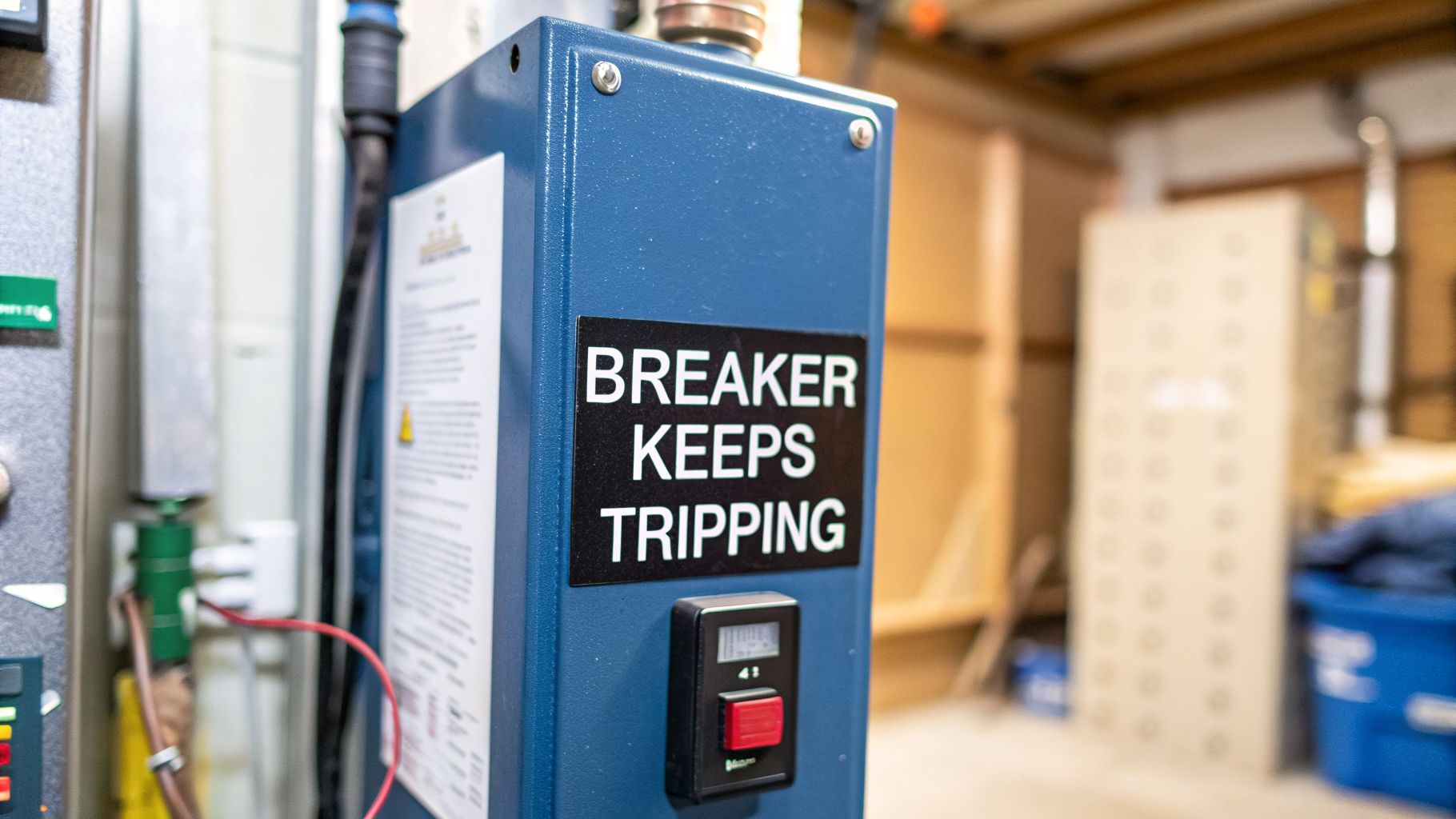
It’s a classic winter night frustration. You’re finally settling in, and poof—the heat cuts out, leaving you in the cold. A quick trip to the electrical panel confirms it: the furnace breaker keeps tripping. While your first instinct might be to just flip it back on, it's crucial to understand that a circuit breaker is a vital safety device warning you that something is wrong.
What To Do First When Your Furnace Breaker Trips
That sinking feeling when the house goes quiet and cold is never fun, but approaching this with a calm, safety-first mindset is your best move. Your furnace’s breaker is there to protect your home’s wiring and the furnace itself from a power surge or electrical fault. When it trips, it’s telling you that the circuit is drawing more power than it can safely handle.
First things first, you need to find your home’s main electrical panel. It’s usually tucked away in the garage, a basement, or a utility closet. Look for the breaker labeled "Furnace," "HVAC," or "Air Handler."
A tripped breaker will be sitting in the middle, not quite "ON" but not fully "OFF" either. To reset it properly:
- Push the switch firmly all the way to the "OFF" position. You need to do this to re-engage the internal spring.
- Then, flip it back to the "ON" position.
Now, here’s the most important part: only do this once. What happens next is your first real clue.
Interpreting the Breaker's Response
If the breaker stays on and your furnace kicks back to life, you might have just had a momentary overload. This can happen from a random power surge or a one-off hiccup as the system started up. Keep an eye on it, but you might be in the clear.
But what if that breaker trips again—either right away or within a few minutes? Then you’ve got a persistent problem that needs to be taken seriously.
Critical Safety Note: Never, ever repeatedly reset a breaker that trips immediately. An instant trip signals a direct electrical fault, like a short circuit. This is a potential fire hazard and requires a professional to diagnose safely.
This flowchart breaks down those first few moments and what they mean.

As you can see, an immediate re-trip is a hard stop. It's time to put on your detective hat, not force the system to run. If your heater and AC are not working and the breaker refuses to cooperate, it’s time to figure out why.
While furnace-specific issues are common, it's also helpful to understand what to do when a safety switch trips in general. The core principle is always the same: treat it as a warning, not an inconvenience. An immediate trip is your home’s electrical system protecting itself—and you.
Checking The Most Common Culprit: A Dirty Air Filter
Honestly, if your furnace breaker keeps tripping, the cause is often much simpler and less scary than you might imagine. Before you start worrying about complex electrical faults or a failing motor, let’s look at the number one reason we see this happen in homes across the Phoenix Valley: a dirty air filter.

Think of your furnace like an athlete. For it to perform, it needs to breathe freely. The air filter’s job is to keep dust and debris out of the sensitive internal components, but when it gets clogged, it’s like trying to run a marathon while breathing through a straw.
Your furnace's blower motor has to work much harder to pull air through a packed-full filter. This extra effort demands more electricity. The motor draws more and more amperage until it exceeds the circuit breaker's safety limit, and click—the breaker trips to prevent the motor from overheating and the wires from becoming a fire hazard.
How A Clogged Filter Triggers Your Breaker
The connection between a dirty filter and a tripped breaker is direct. Studies show that a severely dirty filter can reduce airflow by as much as 50%. This forces the blower motor to draw 25-30% more amperage than normal—more than enough to overload a standard 15-20 amp circuit.
This strain doesn't just trip breakers. It can shorten the motor’s life by up to 20%, leading to far more expensive repairs down the road.
In Arizona, where desert dust is a constant battle, a standard 90-day filter replacement schedule is often not enough. As experienced HVAC professionals serving the Valley for years, we’ve seen filters in Mesa and surrounding areas become completely clogged in as little as 30 days, especially during dusty seasons or if you have pets. This first-hand experience underscores why we always start our diagnostics here.
How To Inspect And Replace Your Furnace Filter
Checking your filter is a quick task that can save you a headache and a service call. If you aren't sure where it's located, you can check out our guide on where to find the air filter in your house.
Once you find it, slide the old filter out and hold it up to a light. Can't see the light? It’s long overdue for a change. Replacing it is simple:
- Note the Size: The filter’s dimensions (e.g., 20x25x1) are printed right on its cardboard frame.
- Buy the Right Replacement: Make sure the new filter is the exact same size. Using the wrong size lets dirty air sneak past the edges.
- Check the Airflow Arrow: The new filter will have an arrow on its frame. This arrow must point toward the furnace and away from the return air duct.
- Slide It In: Insert the new filter, ensuring a snug fit, and replace the cover panel.
After replacing the filter, head back to your electrical panel and reset the breaker one last time. If it holds and the furnace runs normally, you’ve likely found your culprit. This simple maintenance step is the single most effective thing you can do to prevent your furnace breaker from tripping and keep your system running efficiently.
Investigating Deeper Electrical System Issues
Alright, so you’ve swapped the filter and flipped the breaker, but it just tripped again. When that happens, it’s a sign that we need to look past simple maintenance and into the electrical system itself.
When your furnace breaker keeps tripping, it's often shouting about a bigger problem. We’re talking about things like a circuit overload, a short circuit, or a ground fault—all of which are more serious than a dirty filter. Let me explain.
Let’s start with the most common electrical issue we find in the field: an overloaded circuit. Your furnace should always have its own dedicated circuit. That means no other appliances share its breaker. In older homes, though, we see shared circuits all the time. If your furnace pulls 10-15 amps and you fire up a power saw in the garage that pulls another 12 amps on the same 20-amp circuit, that breaker is going to trip. Every time.
Differentiating Circuit Overloads from Short Circuits
An overload is a capacity problem—too much electrical draw on one line. A short circuit is a different beast entirely, and it's far more dangerous. This is what happens when a "hot" wire makes contact with a "neutral" one, creating a path of least resistance that causes a huge, immediate surge of current. That’s what makes the breaker snap off instantly.
You can usually tell the difference by paying attention to when and how it trips:
| Fault Type | How It Trips | Common Warning Signs |
|---|---|---|
| Overload | Trips after running a few minutes. | Lights may dim; may coincide with other appliance use. |
| Short Circuit | Trips instantly when power is called for. | Popping sounds, burning smell, scorch marks. |
| Ground Fault | Trips instantly when power is called for. | Similar to a short circuit, but involves a live wire touching a ground. |
If you suspect a short, this is no longer a DIY situation. It's a genuine safety hazard that needs a licensed professional, period. A related issue is a ground fault, where a hot wire touches the furnace's metal casing, which is just as dangerous.
The Electrical Safety Foundation International (ESFI) reports that arc-faults, often caused by damaged wiring leading to shorts, are a factor in thousands of home electrical fires annually. This is a powerful reminder from a trusted authority to figure out the root cause instead of just resetting a stubborn breaker.
We see this constantly in homes built before modern electrical codes became the norm. Shared circuits affect an estimated 25-30% of houses built before 1980, and they're behind nearly 20% of our service calls for tripping breakers.
Not sure if your home has one? A quick real-world test can tell you a lot. Does the breaker trip when you're using a power tool in the garage workshop that happens to share a circuit with the furnace? That's the classic sign of an overloaded, shared circuit that needs an electrician to fix.
Sometimes, even thermostat wiring can be the hidden culprit. As a first step, you can learn how to reset your AC thermostat to rule out a simple glitch. While a thermostat is less likely to trip a breaker on its own, its wiring can cause electrical faults if it's damaged.
When The Furnace Itself Is The Problem
So you’ve already checked the filter and ruled out the simple electrical issues, but your furnace breaker keeps on tripping. What now? Often, the root cause isn't the circuit but a problem hiding inside the furnace cabinet itself.
When a major component starts to fail, it has to work much harder, pulling way more electricity than it should. Your breaker trips because it’s doing its job—shutting things down before that overcurrent becomes a serious hazard.

You don’t need to grab any tools, but learning to spot the signs of a mechanical failure will help you know exactly what’s happening and when to call a pro.
The Struggling Blower Motor
The most frequent mechanical offender we find is a failing blower motor. This is the powerful fan that pushes all that cozy, warm air through your home’s ductwork. As the motor wears out, it struggles to spin, drawing more and more current until it finally trips the circuit.
The good news is that a dying motor usually gives you some audible clues before it completely quits. The next time the furnace tries to start, listen carefully.
- A loud humming or buzzing: This often means the motor is having a tough time getting started or is seizing up.
- Screeching or grinding sounds: These are the classic death rattles of worn-out motor bearings.
- A faint burning smell: This is a major red flag. It points to an overheating motor, which is a significant fire risk and needs immediate attention.
If you hear or smell any of these things, kill the power to the furnace at the breaker panel right away and call for professional help. A motor problem won’t get better on its own; it will only lead to more damage.
Other Internal Culprits
While the blower motor is suspect number one, it’s not the only part that can go bad and cause an electrical overload. Here's the thing: a few other internal components can be the source of your tripping breaker.
Expert Insight: In the field, we see faulty capacitors all the time. This little cylinder-shaped part gives the blower motor the powerful jolt it needs to start spinning. When the capacitor dies, the motor can't get going, causing it to draw a massive spike of power that trips the breaker almost instantly. Our technicians can test and replace these quickly, often restoring function in a single visit.
Other potential issues include:
- Faulty Limit Switch: This is a safety device that shuts the furnace down if it gets too hot. If the switch itself malfunctions, it can trigger shutdowns or create its own electrical fault.
- Damaged Internal Wiring: Over the years, vibrations inside the furnace can cause wires to fray, chafe, or work themselves loose. This can easily lead to a short circuit.
If you suspect an internal failure is behind your issue, it’s a good idea to review these 8 clear signs your furnace needs repair to see if your system is sending out other distress signals. These aren’t DIY jobs—they require the diagnostic tools and hands-on expertise of a certified HVAC technician to fix safely and correctly.
How Professional Maintenance Prevents Future Breaker Trips
We’ve spent this whole time talking about what to do when your furnace breaker trips. That’s the reactive side—the emergency fix.
But the single best way to deal with a tripping breaker is to make sure it never happens in the first place. That’s where proactive, professional maintenance comes in. It’s the difference between patching a problem and preventing it entirely.
An annual furnace tune-up isn't just a quick filter swap. It’s a comprehensive health check for your entire heating system, specifically targeting the little stressors that build up and cause electrical faults. Think of it as preventative medicine for your furnace.
What a Professional Tune-Up Really Involves
When a certified technician from an authoritative company like Comfort Experts performs a maintenance visit, they're systematically hunting for all the potential failure points we've talked about. It's a process designed to catch small issues before they snowball into a no-heat emergency.
A thorough tune-up directly addresses the root causes of a tripping breaker by:
- Checking Amperage Draw: A pro will use a multimeter to measure the exact electrical current your blower motor and other parts are pulling. If the amperage is creeping up, that’s a clear signal a part is straining and headed for failure. We can spot it long before it’s bad enough to overload your circuit.
- Tightening Electrical Connections: Your furnace vibrates. Over hundreds of heating cycles, those tiny vibrations can work electrical connections loose. A loose wire creates resistance, which generates heat—a classic fire hazard and a common cause of electrical faults. A tech inspects and tightens every terminal.
- Cleaning Key Components: We go way beyond the filter. A technician will clean the blower wheel, where caked-on dust throws the motor off balance and makes it work harder. They'll also clean burners and other parts to ensure the whole system runs efficiently and without strain.
Expert Insight: According to the U.S. Department of Energy, a properly maintained heating system can be up to 25% more energy-efficient. That efficiency boost means less electrical strain on your system, which drastically reduces the odds of a tripped breaker while also saving you money every month.
This is the kind of detailed work that makes a real difference. If you’re curious what that looks like step-by-step, you can see our entire process in our detailed furnace maintenance checklist.
Ultimately, investing in an annual tune-up is the most reliable way to avoid the frustration of a furnace that just won't stay on.
Clear Signs It’s Time To Call An HVAC Professional
You know what? It's okay to admit when a problem is beyond a DIY fix. You’ve checked the filter and made sure the vents are clear. But there’s a critical line between a simple task and a problem that demands a professional’s touch. When it comes to your furnace, knowing when to put the tools down is the most important skill you can have.
Some symptoms aren't just warnings; they're giant red flags telling you that messing around could be dangerous for your home and family. If your furnace is doing any of the following, it’s time to stop troubleshooting and pick up the phone.
The Breaker Trips Instantly
This is the big one. If you reset the breaker and it clicks off the instant the furnace tries to power on, you have a serious electrical problem.
This isn’t a case of a motor struggling to start. It’s a direct short circuit. That means raw electrical current is surging somewhere it absolutely shouldn’t, and that’s a major fire hazard. Don't try to flip it back on "just one more time." There is no homeowner fix for this—it’s a job for a technician with the right tools to trace the fault safely.
You Smell Something Burning
A burning smell is never something to ignore. Your nose is often the first line of defense, and different odors can point to different dangers.
- A metallic or electrical burning smell: This is a classic sign of an overheating motor, melting wire insulation, or a fried control board. It's an urgent problem.
- A dusty, sharp smell: You might get this when you first turn on the heat for the season as dust burns off the components. If that smell doesn't go away after the first cycle or gets worse, it’s a red flag.
Any smell of burning plastic or wires is your cue to shut off the power at the breaker panel immediately and call for emergency help. The risk of a fire is just too high to gamble.
You Hear Loud, Unusual Noises
Your furnace should be a background hum, not the main event. Sudden, loud, or grinding noises are mechanical parts crying for help.
- Screeching or grinding almost always points to dying motor bearings. That motor is on its last legs.
- A loud bang or pop when the furnace kicks on could be an issue with your ductwork expanding. In a gas furnace, it could also signal delayed ignition—a very dangerous situation.
- A high-pitched squeal often means a worn-out blower belt or a motor that's under serious strain.
Ignoring these sounds is asking for a bigger, more expensive failure. That grinding motor will eventually seize completely, which can cause a cascade of other electrical problems.
When your furnace's issues are more than skin deep, it's time to bring in experts who offer professional HVAC services to get a real diagnosis. If you’re seeing any of these serious signs, stop guessing and let a certified pro take over. It’s always the right call.
Don't risk your family's safety or comfort by guessing what's wrong with your furnace. The licensed and insured team at Comfort Experts is ready to safely diagnose and resolve the problem, day or night. For fast, reliable service, call us at 480-207-1239 or schedule service online to get your heat back on safely.