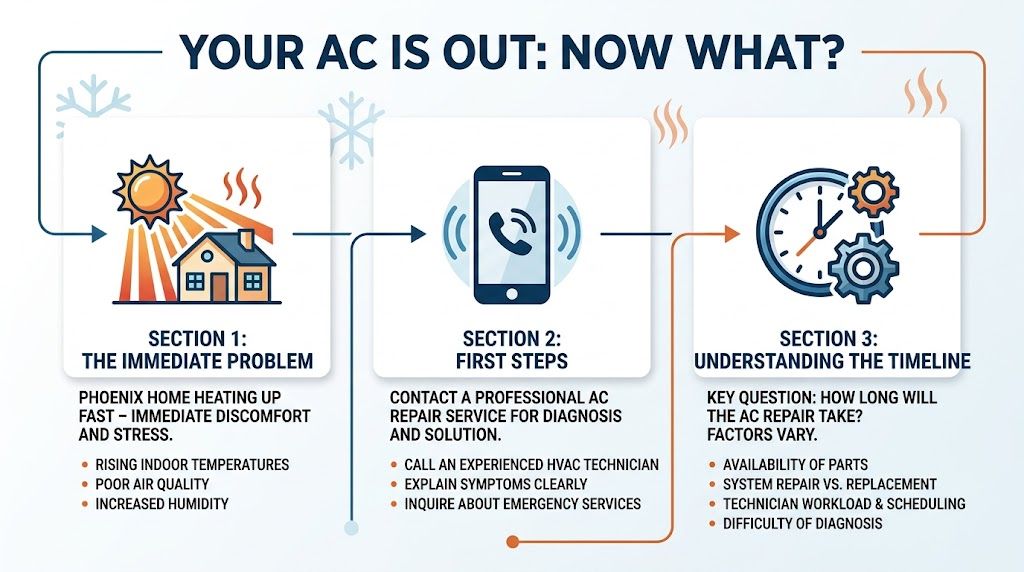
When your AC quits in Mesa, the house can heat up fast and the stress hits even faster. If you’re asking how long does ac repair take, the honest answer is anywhere from about 30 minutes to several days, depending on the failure, the system, and whether parts are available.
Your AC Is Out Now What
A broken AC in the Phoenix Valley doesn’t feel like a minor inconvenience. It feels urgent, because it is.
When the air stops moving and the indoor temperature starts climbing, most homeowners want one answer first. How long is this going to take? In the field, the timeline usually depends on whether you’re dealing with a quick-access part, a drainage issue, a refrigerant problem, or a major component failure.
The good news is that many calls are not worst-case scenarios. According to industry estimates, thermostat replacement typically takes 30 minutes to 1 hour, air filter replacement takes about 30 minutes, clogged drain line repairs average 1 to 2 hours, and compressor failure often takes 4 to 6 hours or more. The same source also notes that minor repairs make up about 60 to 70% of service calls in hot climates (DND DFW AC repair timelines).
AC repair timelines at a glance
| AC Repair Type | Estimated Time |
|---|---|
| Air filter replacement | About 30 minutes |
| Thermostat replacement | 30 minutes to 1 hour |
| Clogged drain line | 1 to 2 hours |
| Refrigerant recharge | 1 to 3 hours |
| Compressor repair or replacement work | 4 to 6 hours or more |
| Major repair on an older or severely damaged unit | 8 hours or more, sometimes longer if parts must be ordered |
That table gives you the fast answer, but it doesn’t tell the whole story. A job can look simple from the thermostat and turn out to be a control issue, airflow issue, or a refrigerant-related problem once testing starts.
What to do first
Before a technician arrives, keep the situation safe and manageable.
- Turn the system off if it’s making harsh noises, short cycling, or not moving air correctly.
- Check the thermostat settings so you don’t lose time on a simple control issue.
- Look at the filter if it’s easy to access. A heavily loaded filter can create symptoms that mimic larger problems.
- Keep blinds closed and reduce heat gain inside the house.
- Call quickly rather than waiting to “see if it comes back.”
Practical rule: The sooner a technician can inspect the system, the better the chance the repair stays smaller, simpler, and faster.
If you want a basic homeowner-level troubleshooting guide before the truck arrives, this article on how to diagnose AC problems is a useful starting point.
And if you’ve ever wondered why some companies answer immediately while others don’t during a heat wave, a strong HVAC answering service setup can make a real difference in getting homeowners scheduled quickly when call volume spikes.
Decoding the AC Service Call A Step-By-Step Timeline
A professional AC repair visit should feel organized, not chaotic. Homeowners are already hot, frustrated, and worried about what this is going to cost. The service process should lower that stress, not add to it.

The first call and dispatch
When you call for service, the first goal is simple. Get the right technician to the right problem.
A useful dispatcher will ask what the system is doing, whether it’s completely down, whether there’s water, ice, smell, or noise, and whether anyone in the home has urgent cooling needs. That information matters because no one wants a technician arriving without the tools or likely replacement parts for the job.
If you’re trying to understand what a local service process should look like, this guide on AC repair service near me gives a solid homeowner perspective.
The diagnostic phase
At this point, a rushed company gets into trouble.
A good technician doesn’t guess. They verify power, controls, airflow, coil condition, drain condition, electrical readings, and refrigerant behavior if needed. Sometimes the problem shows itself quickly. Sometimes a symptom points one direction while the root cause is somewhere else entirely.
For example, a warm house can be caused by a failed thermostat, a restricted drain shutting off cooling, a failed outdoor component, or a low-charge condition. Same complaint, very different repair paths.
The diagnostic visit isn’t wasted time. It’s what keeps you from paying for the wrong repair.
Quote approval and actual repair
Once the fault is confirmed, the next step should be clear communication. You should know what failed, what needs to happen, and whether the work can be completed immediately.
On straightforward calls, the technician can move from diagnosis into repair right away. On larger repairs, the timeline changes if a specialty part, warranty coordination, or additional system inspection is required.
Final testing matters
The repair isn’t done just because the unit starts.
A proper finish includes system testing under operation, confirming the thermostat is responding, checking temperature performance, verifying drainage where applicable, and making sure the system cycles normally. Homeowners remember the companies that leave cool air behind, not the ones that just swap a part and rush off.
A Deeper Look at Common AC Repair Timelines
Not all AC repairs take long for the same reason. Some are quick because the failed part is easy to access and easy to confirm. Others take time because the technician has to diagnose carefully, follow code and EPA rules, and test the system after the repair.
Minor repairs that are often fast
The quickest calls are usually simple component failures or maintenance-related issues.
Thermostat replacement, filter replacement, and drain line clearing often move fast because the work area is accessible and the fix is direct. You identify the failed or blocked item, correct it, and test system operation.
These jobs still need to be done correctly. A miswired thermostat or an incompletely cleared drain can create a callback. But in terms of labor, they’re typically the least disruptive.
Moderate repairs that require process, not guessing
Refrigerant-related work is where homeowners often underestimate the time involved. A lot of people think refrigerant is like air in a tire. It isn’t.
If the system is low because of a leak, the technician has to find the leak, repair it, evacuate the system properly, and recharge by weight. According to this breakdown of the repair process, refrigerant leak repairs typically take 2 to 6 hours and involve leak detection, brazing the line, evacuating the system to a 500-micron vacuum, and recharging by weight under EPA Clean Air Act requirements (refrigerant leak repair process and timing).
That timeline makes sense in the field. Leak search takes time. Brazing takes care. Pulling a proper vacuum takes patience. Then the system has to be charged accurately and run-tested.
Why leak repairs can’t be rushed
A rushed leak repair usually creates one of two bad outcomes. The leak never gets fully corrected, or moisture remains in the system.
Both problems come back to haunt the homeowner.
- Leak detection matters because topping off without finding the leak doesn’t solve the underlying problem.
- Proper evacuation matters because moisture and non-condensables damage performance and reliability.
- Weighed-in charge matters because too much or too little refrigerant affects pressures, temperatures, and compressor health.
If a technician says a leak repair is “just a quick top-off,” that should make you cautious.
Major repairs take longer because the system has to come apart
When the compressor fails, the job becomes a lot more labor-intensive. This isn’t a surface-level repair.
The refrigerant has to be handled correctly. Components may need to be cut out and replaced. New connections may need brazing. Then the system has to be evacuated, recharged, and tested under load.
That’s why compressor work is often described by homeowners as an all-day event. It can be. And on an older system, it may also raise a different question. Is this repair still worth doing, or is replacement the smarter move?
If you want to understand that decision point better, this page on air conditioner compressor replacement explains what homeowners should weigh before approving major work.
The Biggest Factors That Can Change Your Repair Timeline
The same repair can take very different amounts of time from one house to the next. That’s not a dodge. That is the nature of HVAC work.
Parts availability can change everything
If the truck carries the part and the diagnosis is clear, a repair can move fast.
If the system needs a specialty board, an older compressor-related component, or a less common OEM part, the timeline changes immediately. According to HVAC service data, major AC repairs on older units can average 8 hours or more and can extend to several days if parts must be ordered. The same source states that parts delays affect 25 to 35% of major repairs, adding 1 to 3 days, especially on systems over 10 years old, and that those systems represent 40% of U.S. residential AC stock (major AC repair timing and parts delays).
That’s one reason older equipment becomes harder to keep alive in the middle of summer. The repair itself may be possible. Sometimes, obtaining the correct part quickly poses the biggest obstacle.
Accessibility changes labor time
A condenser in an open side yard is one thing. An air handler packed into a tight attic is another.
A technician working in a cramped attic has less room to test, remove panels, braze, or replace components. Even basic tasks slow down when the work area is tight, dusty, poorly lit, or brutally hot.
Age and condition of the system matter
Old units rarely fail in clean, isolated ways.
A homeowner may call because the AC stopped cooling yesterday, but the technician may find a dirty coil, stressed electrical components, airflow restrictions, and signs of previous patch repairs. At that point, the repair timeline gets longer because the system is telling a bigger story than the symptom on the thermostat.
One problem can reveal another
Frustration often arises from this. A homeowner hears “it may be simple,” then the final answer is more involved.
That isn’t always because anyone missed something. Sometimes one failed part prevented the system from running long enough to expose a second issue. Once the first problem is corrected and the equipment runs under normal conditions, the technician can see the full picture.
A careful repair visit may take longer up front, but it usually saves time, money, and repeat breakdowns later.
If your system is completely down during a heat event, this is also when priority dispatch matters. Homeowners dealing with urgent cooling loss often look first at emergency AC repair options because getting the technician there quickly is the first half of the battle.
Why Phoenix Heat Changes the AC Repair Game
A generic AC article written for mild weather doesn’t tell the full truth for Mesa or the rest of the Valley. Arizona heat changes the repair timeline before the technician even opens the service panel.
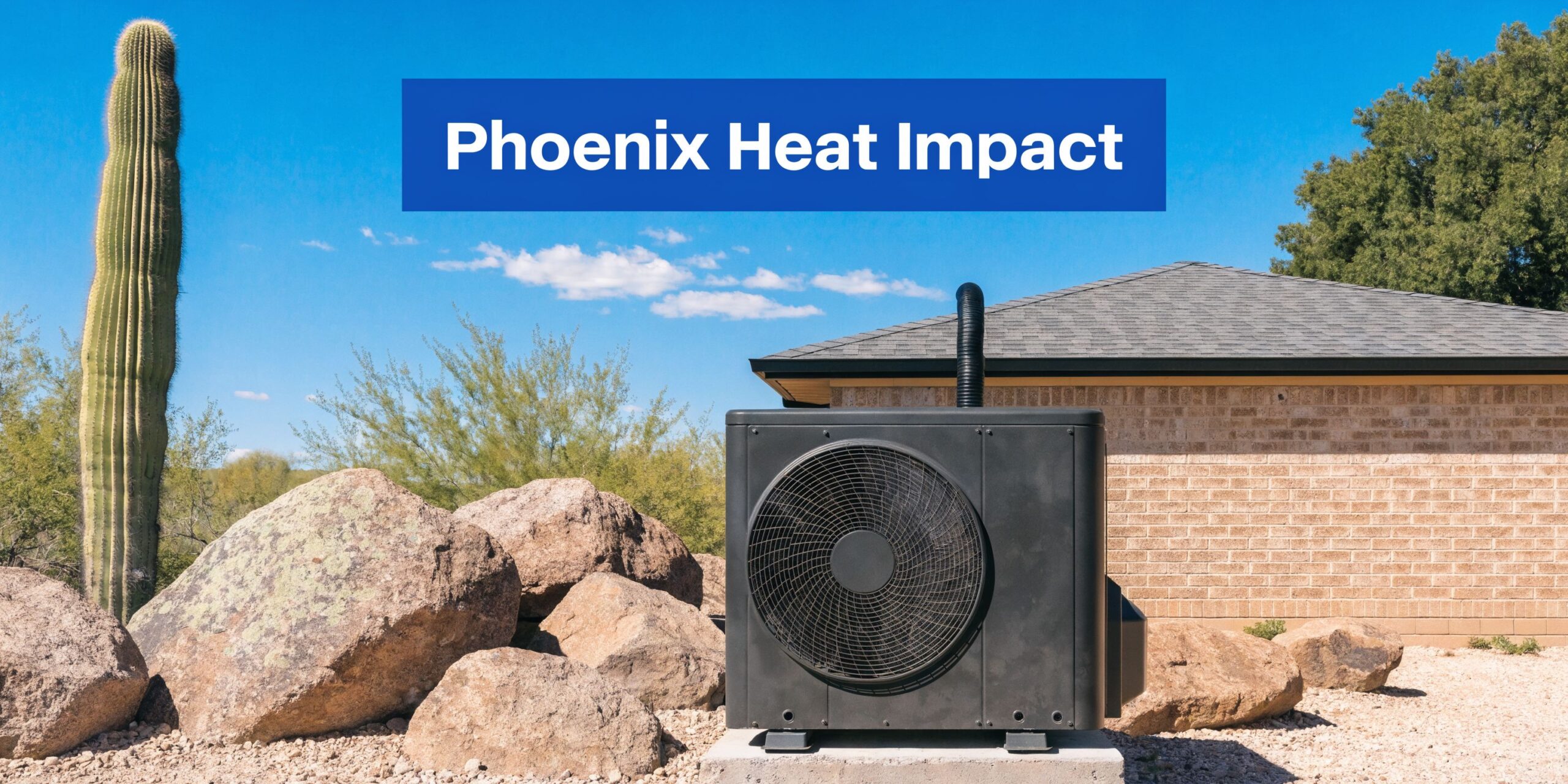
Extreme heat affects technicians and equipment
In desert climates like the Phoenix Valley, summer temperatures exceeding 110°F can increase AC repair duration by 30 to 50% due to safety protocols and heat-related technician fatigue. The same source reports 40% longer on-site times during peak demand surges, and that Phoenix sees 25% more compressor issues than national averages due to thermal stress (Phoenix heat impact on AC repair timelines).
Those numbers track with what homeowners feel every summer. Systems run harder, longer, and under more stress here. Compressors, capacitors, contactors, and wiring all live a tougher life in this climate.
Safety protocols are real, not optional
People sometimes assume the only reason a repair takes longer in summer is scheduling. That’s only part of it.
A technician working on a roof, beside a heat-soaked condenser, or inside a superheated attic has to pace the work safely. That may mean shorter bursts of labor, more hydration, and extra time for careful testing rather than rushing through the hottest part of the day.
You know what? That slower pace is often the right pace. A rushed repair in extreme heat is how mistakes happen.
Peak-season demand changes the entire service environment
The Valley doesn’t experience a small bump in demand during major heat waves. It gets slammed.
That means more calls, more stressed equipment, and more competition for common parts at local supply houses. Even when the diagnosis is straightforward, the market around the repair is more strained.
For Mesa homeowners, this is the local reality. The climate doesn’t just increase the chance of failure. It also affects dispatch, on-site labor speed, and parts flow across the region.
How You Can Help Speed Up Your AC Repair
Homeowners can’t and shouldn’t do the technician’s job. But you can remove the little delays that slow a service call down.
A short prep checklist
- Clear access around equipment so the technician can reach the thermostat, indoor unit, and outdoor condenser without moving storage bins, patio furniture, or boxes.
- Write down the symptoms before the appointment. Was the system blowing warm air, making a buzzing noise, tripping the breaker, leaking water, or freezing up?
- Have the model information ready if it’s visible and easy to read. That can help with parts identification.
- Secure pets before arrival so doors can stay open and the technician can move safely between indoor and outdoor components.
Why this helps
AC diagnosis often involves moving back and forth between the thermostat, the air handler or furnace section, and the condenser outside. Every obstacle adds time.
One clear description from the homeowner can also point the technician in the right direction faster than you’d think. “It hummed but the fan didn’t start” is more useful than “it just stopped working.”
If you want to reduce the chances of emergency breakdowns in the first place, a seasonal HVAC preventive maintenance checklist is worth keeping on hand.
The fastest repair is the one that never turns into a major failure.
Frequently Asked Questions About AC Repair Times
When is it faster to replace my AC than repair it
Sometimes replacement is the faster path to reliable cooling, especially when the system has repeated failures, major component damage, or poor overall condition.
There isn’t one magic formula that fits every house. But in practice, replacement becomes the better conversation when a major repair won’t address the rest of the unit’s age-related wear. If the compressor is failing, the coil is in rough shape, and the system has a history of breakdowns, repairing one piece may only buy short-term time.
A good technician should show you the condition of the system, not pressure you. The key question isn’t just “Can it be repaired?” It’s “Will this repair put you back in a dependable position?”
Does an emergency call mean the actual repair is faster
Emergency service usually means dispatch happens sooner, not that the on-site labor magically becomes shorter.
If the problem is a simple electrical part and the truck has it, yes, the whole experience may feel fast. But if the system needs deep diagnostics, refrigerant work, or a major component, the physical repair still takes the time it takes. Priority scheduling gets the process started sooner. It doesn’t eliminate the work itself.
That distinction matters for expectations. Fast arrival is one thing. Proper repair is another.
Are there any AC repairs I can do myself to save time
A few homeowner checks are reasonable.
You can replace an accessible filter, confirm thermostat settings, and check whether a breaker has tripped. Those steps are safe and sometimes solve the issue.
Anything involving electrical components, refrigerant, capacitors, compressors, or brazing should be left to a licensed technician. Those repairs carry safety risks, can damage the equipment if done incorrectly, and may create bigger problems than the original failure.
Why do two companies sometimes quote different timeframes
Because one may be estimating the visible problem, while the other is estimating the full job including testing, cleanup, and possible complications.
Shorter isn’t always better. A realistic timeline usually means the technician is accounting for diagnosis, proper repair procedure, and system verification at the end.
Get Your Cool Back Fast with Comfort Experts
When AC fails in Mesa, every hour feels longer. Local homeowners need AC repair in Mesa, AZ from a team that understands desert heat, responds quickly, and fixes the issue correctly instead of guessing.
Comfort Experts serves the Phoenix Valley with licensed, neighbor-first HVAC service backed by local experience. Reliable scheduling also depends on strong communication systems, and resources like 24/7 phone answering for home services show why fast response starts the moment a customer reaches out.
If your AC is down and you need help now, contact Comfort Experts. Call 480-207-1239 or schedule service online to get your cooling restored fast.