

If you’ve got a bedroom that turns into an oven every afternoon, or a home office that never seems to match the thermostat setting, you’re not alone in Mesa. What is a ductless mini split system is a question a lot of homeowners ask right after they get tired of fighting one stubborn room in Arizona heat.
Introduction
A ductless mini-split is a heating and cooling system that moves heat without using house-wide ductwork. It provides one room, or a few rooms, with their own dedicated comfort system, rather than asking one central unit to guess what every part of the house needs.
That matters here. In the Phoenix area, one sunny west-facing room can feel completely different from the rest of the house.
So What Exactly Is a Ductless Mini-Split System
A lot of the confusion is in the name.
Ductless means it doesn’t rely on big metal ducts running through the attic or walls. Split means the system has two main sides. One part sits outside, and one part sits inside. They’re connected by a small bundle of lines and wiring.

The simple version
If central air is like one big speaker trying to fill the whole house with the same music, a mini-split is more like putting a smart speaker in the rooms that need it.
You control comfort where people are. Not where ducts happen to run.
That’s why mini-splits are common in:
- Hot master bedrooms that never cool right
- Garage conversions where no ductwork exists
- Home additions added after the original HVAC system
- Older homes with limited space for ducts
- Guest rooms that don’t need constant cooling
- Detached offices or casitas where separate control makes sense
The three pieces homeowners should know
Most homeowners don’t need a refrigeration textbook. You just need to know the working parts.
| Component | What it does | Why it matters |
|---|---|---|
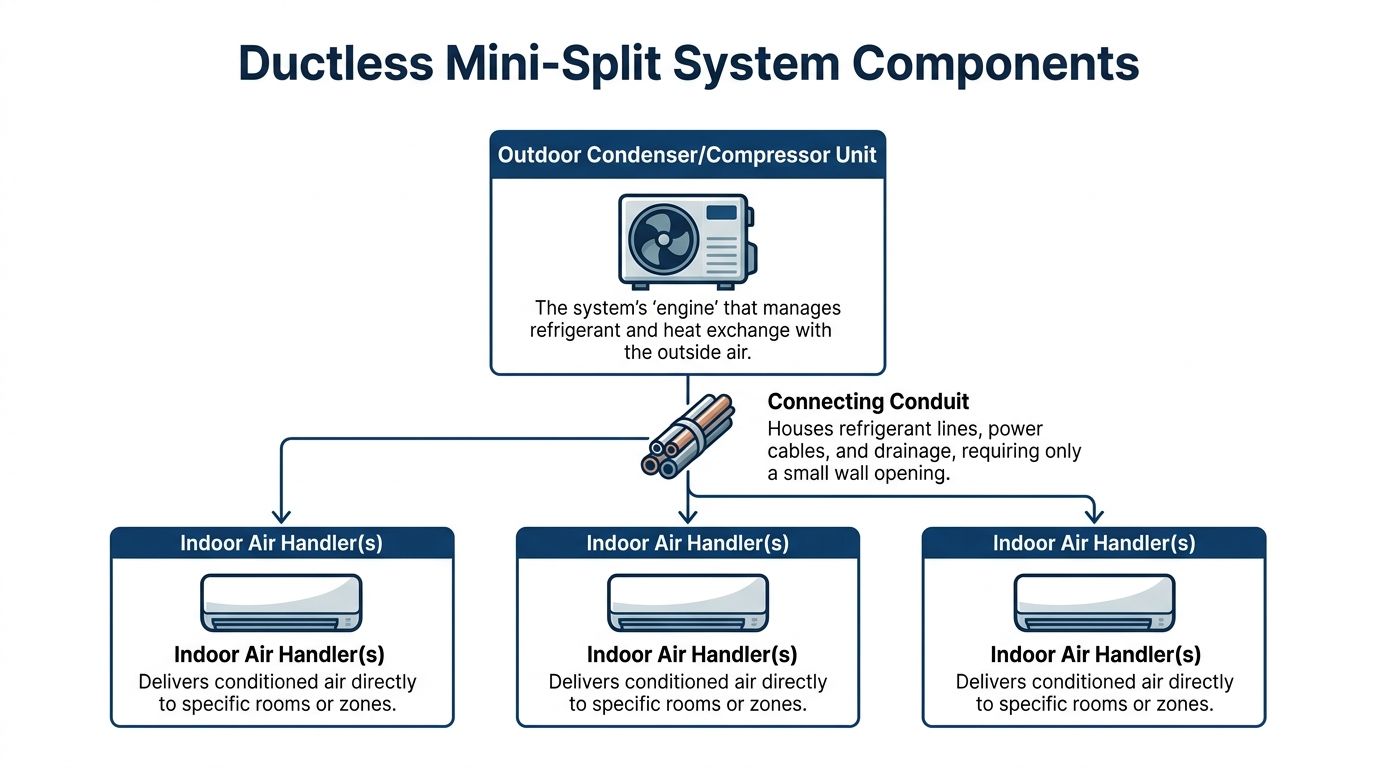
| Outdoor unit | Handles the heat exchange and compressor work | This is the engine of the system |
| Indoor unit | Blows conditioned air into the room | This is what you see mounted inside |
| Conduit line set | Connects the two with refrigerant, power, and drain lines | This avoids major remodeling |
The conduit is the part many people like once they understand it. Instead of tearing open the house for new duct runs, the installer usually routes a compact connection between indoor and outdoor equipment.
A mini-split isn’t a glorified window unit. It’s a real HVAC system, just built for room-by-room control.
Why people mix them up with window units
That happens because both can cool one area. But they are not the same thing.
A window unit is a self-contained appliance stuffed into an opening. A ductless mini-split is a permanent system with an outdoor unit doing the heavy work and an indoor head delivering comfort with minimal noise inside.
That split design is what makes it feel more like built-in comfort and less like a temporary fix.
Why the concept clicks in Arizona
In Mesa, houses don’t heat up evenly. A shaded room on the north side behaves one way. A room with afternoon sun behaves another way. Add high ceilings, older insulation, or a remodel, and central air can start feeling blunt.
Mini-splits solve a very Arizona problem. They let you cool the room that’s hot.
How These Systems Deliver Targeted Cooling and Heating
The easiest way to understand a mini-split is to think of refrigerant like a heat sponge. It absorbs heat from inside your room, carries it outside, and releases it there. In heating mode, it reverses direction and brings heat indoors.
What each part is doing
The outdoor unit compresses and circulates refrigerant. The indoor air handler pulls room air across a coil, and that refrigerant absorbs or releases heat depending on the mode. The conduit links everything together.
That sounds technical, but the result is simple. The system reacts to the room it serves instead of relying on a thermostat somewhere else in the house.
Why inverter technology matters
Mini-splits distinguish themselves from older equipment.
Many ductless systems use variable-speed DC inverter compressors. Instead of turning all the way on, then all the way off, the compressor ramps up and down to match real demand. A Pioneer ductless inverter model description notes efficiency as high as 20.8 SEER2 for cooling in a 12,000 BTU/h unit, and states this inverter approach can reduce energy consumption by up to 30 to 40% over traditional systems by cutting wasteful on-off cycling.
A good analogy is cruise control in your truck or SUV. Flooring it, then slamming the brake, is rough and wasteful. Holding a steady pace is smoother and usually cheaper to run.
Why that matters in the Phoenix area
In Arizona, comfort problems usually show up in three ways:
- A room gets hot fast in late afternoon
- The main system short-cycles or overworks
- People fight over the thermostat
Mini-splits deal with those problems directly. The indoor unit targets the exact room. The inverter adjusts output instead of overshooting. And because the system can modulate, it often holds a steadier temperature instead of making the room swing from chilly to warm.
Cooling is only half the story
Most mini-splits sold today are heat pumps. That means they can cool in summer and heat in winter.
That surprises a lot of homeowners. They hear “mini-split AC” and assume it’s cooling only. In reality, many systems are built for year-round use.
If you want the basics on heat pump operation, this quick guide on how a heat pump works helps connect the dots.
Practical rule: The equipment can be high-end, but if the room is sized wrong or the installation is sloppy, performance drops fast.
Single-zone vs multi-zone
You can install one indoor unit with one outdoor unit for a problem room. Or you can use one outdoor unit to serve multiple indoor heads in different parts of the home.
Single-zone setups are often the cleanest answer for one stubborn space. Multi-zone setups make sense when several rooms need independent control.
What works best depends on layout, load, electrical capacity, sun exposure, and how your family uses the house. A guest room that sits empty most days should not be treated the same as a west-facing primary bedroom occupied every night.
The Big Three The Main Advantages of Going Ductless
In Mesa and Phoenix, the best argument for a mini-split usually shows up in one room, not on a spec sheet. It is the garage gym that never cools down, the casita with no ductwork, or the back bedroom that gets hammered by afternoon sun while the hallway thermostat says everything is fine.
That is where ductless earns its keep. It solves specific comfort problems with less waste, better control, and less construction than adding or reworking ductwork.
Lower energy waste
A ductless system skips the long duct runs that often pass through a superheated attic. In Arizona, that matters. Any cooling you send through hot, leaky, poorly insulated ducts has to survive that trip before it ever reaches the room you care about.
The U.S. Department of Energy notes that homes can lose a significant share of heating and cooling energy through ducts, especially when ducts run through unconditioned spaces such as attics. A ductless setup avoids that part of the problem because the indoor unit delivers conditioned air right into the room instead of pushing it across the house through sheet metal and flex duct.
That does not automatically mean every mini-split beats every central system on operating cost. A well-designed central system with tight ducts can still perform well. But if the house has attic duct losses, one stubborn hot zone, or a room that only gets used part of the day, ductless often gives you a cleaner path to lower waste.
Zoned comfort that fits how people actually live
This is the advantage homeowners notice on day one.
A mini-split lets each served room run based on that room's load, occupancy, and sun exposure. The guest room can stay warmer when nobody is in it. The home office can stay comfortable all afternoon. The west-facing bedroom does not have to beg the hallway thermostat for relief.
That matters even more in Phoenix-area homes where solar gain changes room to room. One side of the house may be manageable. Another can feel like it has a different climate by 5 p.m.
Zoning helps with more than comfort. It also helps you avoid cooling empty space. If you want to cut waste across the house, these HVAC energy saving tips for Arizona homes work well alongside a room-by-room strategy.
Installation flexibility
Mini-splits make sense where ducts do not.
That includes sunrooms, workshops, enclosed patios, older additions, garages, detached offices, and casitas. In those spaces, adding new ductwork can mean opening walls or ceilings, finding a path through the attic, upsizing equipment, and hoping the airflow works out at the end. A mini-split usually needs a small wall penetration, proper electrical, a drain plan, and a good location for the indoor and outdoor units.
That simpler path is one reason these systems are common in retrofit work.
They also work well as a support system. If the main central unit still serves most of the home reasonably well, a mini-split can fix the trouble spot instead of forcing a full system replacement before the rest of the equipment is worn out.
If one room is the problem, treat that room directly.
The trade-offs Arizona homeowners should know
Mini-splits have real strengths. They also have limits, and installers should be honest about them.
- Upfront cost is usually higher than a window unit and can surprise homeowners expecting a cheap single-room fix
- Indoor unit placement matters because the head is visible and has to be located for airflow, service access, and condensate drainage
- Sizing matters a lot in Arizona heat, especially in rooms with west glass, poor insulation, or high ceilings
- Dust and filter maintenance are part of the deal in Mesa, where fine dust can build up fast and choke airflow if nobody stays on top of cleaning
- Monsoon humidity adds condensate load, so drain routing and pitch need to be done right or you can end up with water problems
- Multi-zone systems require good design, because one outdoor unit serving several rooms is convenient, but performance depends on how those rooms are used at the same time
I also caution homeowners about the low-ambient and high-heat question. Not every mini-split handles 110°F-plus afternoons equally well. Equipment selection matters, and so does installation quality. A strong brand with the wrong sizing or poor line-set and drain work will still disappoint.
Ductless Mini-Splits vs Central Air and Window Units
Homeowners usually aren’t deciding in a vacuum. They’re comparing a mini-split to what they already know.
Here’s the quick version first.
Quick Comparison Mini-Split vs Central AC vs Window Unit
| Feature | Ductless Mini-Split | Central Air System | Window AC Unit |
|---|---|---|---|
| Best use case | Targeted room-by-room comfort or homes without ducts | Whole-home cooling when ductwork is already well designed | Temporary or budget single-room cooling |
| Efficiency profile | High efficiency, especially with inverter operation | Can work well, but duct losses can hurt performance | Usually the least refined approach |
| Comfort control | Strong zoning and independent room control | One thermostat often controls large areas | Only cools the room it sits in |
| Installation impact | Light to moderate, minimal wall penetration | Heavier if new ducts or major retrofit are needed | Simple physically, but awkward in use |
| Noise indoors | Typically very quiet | Usually quiet at supply registers | Often louder and more noticeable |
| Appearance | Visible indoor unit on wall, ceiling, or floor style depending on model | Hidden distribution, visible vents only | Visible appliance in the window |
| Long-term fit | Excellent for additions, hot spots, garages, casitas | Excellent for whole homes designed around ducts | Best as a stopgap |
Mini-splits compared with central air
Central air still makes sense in the right house.
If a home has well-designed ductwork, good attic insulation, proper return air, and a system that’s correctly sized, central AC can deliver solid whole-home comfort. In a new build designed around ducts from the start, central may be the cleanest answer.
But that’s not every house in Mesa.
A lot of homes have one or more of these problems:
- Poor airflow to certain rooms
- Long duct runs through brutal attic heat
- Additions tacked onto the original layout
- One thermostat in a location that doesn’t represent the hot rooms
- Comfort complaints that never go away even after repairs
That’s where mini-splits often win. They don’t ask the central system to do a job it was never set up to do.
If you’re weighing both options directly, this comparison of ductless mini-split vs central air can help narrow it down.
When central air is still the better answer
Mini-splits are not automatically the better system.
Central air is often the better answer when:
- The entire house needs replacement anyway
- The duct system is in good shape
- You want a fully hidden look with standard registers
- The home layout works well with one integrated system
- You don’t need separate room control
If the whole-home equipment is worn out and every room is affected, patching one area with ductless may not solve the bigger issue.
Mini-splits compared with window units
This one is easier.
Window units are usually chosen because they’re cheap upfront and fast to plug in. For a rental, a temporary setup, or a short-term need, that can be fine.
But they come with real drawbacks:
- They block part of the window
- They tend to be noisier
- They’re less polished in operation
- They can be poor fit-and-finish for the home
- They usually don’t deliver the same level of comfort control
A mini-split feels like part of the home. A window unit feels like an appliance you’re putting up with.
Window units can cool a room. Mini-splits are built to condition a room properly.
The practical decision
If you’re trying to cool one office, one garage conversion, one bonus room, or one bedroom that never gets comfortable, a mini-split usually makes much more sense than reworking a whole central system or living with a noisy window box.
If you’re building new or replacing a complete whole-house setup with strong duct design already in place, central air may still be the cleaner path.
The right answer depends less on brand loyalty and more on the actual problem you’re trying to solve.
Why Mini-Splits Thrive in the Phoenix and Mesa Climate
Arizona is where generic HVAC advice falls apart.
A system can look great on paper and still disappoint if nobody accounts for direct sun, stucco construction, room orientation, dust, and long cooling seasons. That’s why mini-splits need to be discussed in local terms, not just brochure terms.

They fit the way desert homes actually behave
In hot-dry climates like the Phoenix Valley, mini-splits can achieve 25 to 30% better runtime efficiency than central systems when applied properly, according to Mitsubishi Comfort’s article on mini-splits in hot-dry climates.
That lines up with what contractors see in homes with isolated hot rooms, converted garages, and additions with difficult airflow.
The keyword there is properly.
Arizona heat punishes bad sizing
A small room in another state might be easy. A small room in Mesa with west exposure, big windows, and poor insulation is a different animal.
That’s why sizing matters so much. On paper square footage is a starting point, not the answer.
A good installer looks at:
- Window area and direction
- Insulation and ceiling height
- Stucco and wall construction
- How many people use the room
- Appliances or electronics adding heat
- Whether the room sits over a garage
- Sun load in late afternoon
A mini-split that’s too small will run hard and leave you disappointed. Too large, and it can cycle poorly and control comfort less smoothly.
Direct sun on the outdoor unit is a real issue
This gets ignored all the time.
The same Mitsubishi source notes that improper shading of the outdoor unit in direct Arizona sun can raise its temperature by 10 to 15°F, reducing efficiency and potentially cutting lifespan by up to 20%.
That doesn’t mean you box the unit in. It means placement matters.
Put the outdoor unit where it can breathe. Shade helps, but trapped hot air hurts.
Dust and monsoon season change the maintenance picture
Mesa dust is hard on filters and coils. Monsoon season adds another wrinkle because humidity changes the way systems behave and exposes neglected maintenance quickly.
What works in our climate:
- Regular filter cleaning so airflow stays where it should
- Outdoor coil checks because dust buildup hurts heat transfer
- Clear condensate management before humidity spikes expose clogs
- Thoughtful outdoor placement away from the harshest reflected heat and dust concentration
- Professional inspection when performance drops, noise changes, or drain issues show up
What doesn’t work:
- Ignoring airflow reduction
- Treating it like a set-it-and-forget-it appliance
- Installing by square footage alone
- Mounting for convenience instead of serviceability
- Assuming all rooms in the house have the same load
Why mini-splits match common Mesa remodels
A lot of local homes weren’t designed around today’s room usage. Bedrooms became offices. Garages became gyms. Additions got enclosed. Casitas became occupied space more often.
Mini-splits fit those changes because they don’t require tearing the house apart to force ductwork into places it never belonged. They also pair well with efficiency decisions homeowners already compare, like SEER 14 vs 16, when they’re thinking about operating cost and equipment performance.
One more local reality
Arizona homeowners often ask if mini-splits can really handle the brutal part of summer. The answer is yes, when the system is selected and installed for the load you have, not the load someone guesses from a quick online chart.
That’s the difference between “it cools” and “it solves the room.”
Installation Costs Maintenance and Getting Started
A mini-split install is usually a one-day or two-day job, not a whole-house construction project. That matters in Mesa, where people often want relief in a bedroom, office, garage gym, or casita without tearing into walls just to add ductwork.

What installation usually involves
For a single-zone system, professional installation often needs only a three-inch hole through an exterior wall for the conduit, according to the U.S. Department of Energy ductless mini-split guide. The DOE also notes that a 12,000 BTU unit may cover 500 to 600 square feet in many climates. In Mesa and Phoenix, that rule of thumb needs a reality check. West-facing glass, poor insulation, high ceilings, and attic heat can push the load well past what a quick chart suggests.
That wall opening carries the parts that make the system work:
- Refrigerant lines
- Electrical connection
- Condensate drain
- Communication wiring
The physical install is usually straightforward. Getting the design right is the part that separates a room that stays comfortable at 4 p.m. in July from one that runs nonstop and still feels warm.
Real cost ranges
Price swings a lot because mini-split jobs are rarely identical. A basic one-room install on an easy exterior wall costs far less than a multi-zone setup with a long line-set run, electrical upgrades, and finish work to keep everything tidy.
HomeAdvisor reports that ductless mini-split installation typically runs from about $2,000 to $14,500, with a national average around $3,000, depending on the number of zones and the complexity of the job, as outlined in its mini-split installation cost guide. Local pricing in the Phoenix area can land higher when the job needs more labor, more copper, or more electrical work.
In Arizona, I tell homeowners to budget for the room and the conditions, not just the equipment. Cheap pricing on an undersized system is not a bargain if it struggles through a 112 degree week.
What affects price most
These are the items that usually move the number up or down:
| Cost factor | Why it changes the job |
|---|---|
| Number of indoor units | More zones mean more equipment, more line sets, and more labor |
| Line-set distance | Longer runs add material cost and can limit placement options |
| Electrical requirements | Some installs need a new disconnect, breaker space, or a dedicated circuit |
| Wall and mounting conditions | Block walls, second-story access, and tricky mounting spots slow the work |
| Drain routing | The system has to drain reliably during humid weather, not just on dry days |
| Outdoor unit location | Placement affects service access, sun exposure, airflow, and appearance |
| Finish expectations | Concealing line covers and cleaning up exterior details takes extra time |
Maintenance that matters in Arizona
Mini-splits need simple, regular care. In the Phoenix and Mesa dust, skipping that care shows up fast.
Start with the indoor filter. Check it often during heavy cooling season, especially if the room has pets, a lot of foot traffic, or the door opens to a dusty patio or garage. A clogged filter cuts airflow, and low airflow in extreme heat makes the system work harder for less cooling.
Keep an eye on the drain, too. Monsoon humidity can expose a drain problem that stayed hidden during dry weather. If the unit starts smelling musty, drips indoors, or shuts off unexpectedly, get it looked at before a small blockage turns into drywall damage.
The outdoor unit also needs space to breathe. Cottonwood fluff, dust, leaves, and yard debris can build up on the coil and reduce heat transfer right when the system needs every bit of capacity.
A dirty mini-split usually fades before it fails. You notice longer run times, weaker cooling, and a room that never quite settles down.
What to ask before you install
Before approving the job, ask questions that get past the sales sheet:
- How are you calculating the load for this room in Arizona summer conditions
- Will this system still hold temperature during late afternoon heat
- Where will the indoor unit throw air, and will that leave hot spots
- How will the condensate drain be routed and tested
- What electrical work is included
- How easy will this setup be to service next year
- What maintenance should I handle myself, and what should a technician do
If you are comparing local options, this page on ductless AC replacement and installation in Mesa shows what a typical service path includes. Comfort Experts is one licensed local option for that work in the Phoenix Valley.
Your Ductless Mini-Split Questions Answered
Can a ductless mini-split also heat my home in winter
Yes. Most ductless mini-splits sold today are heat pumps, so the same system that cools in July can heat in January.
That fits Arizona well. Our winters are mild, and a mini-split usually has no trouble handling a bedroom, casita, garage conversion, office, or addition without tying into the main duct system. For many Mesa and Phoenix homes, the bigger question is not whether it can heat. It is whether that room needs its own control year-round.
How noisy are they really
Quieter than a window unit and usually quieter than people expect.
Many indoor heads run at sound levels similar to a quiet library on low speed, according to manufacturer specifications published by Mitsubishi Electric and Daikin. Outdoor units still make noise, but a properly installed system should not sound harsh or rattly. Placement matters here in Arizona. Put the condenser too close to a bedroom window or a tight side yard, and even a quiet unit becomes more noticeable at night.
Indoor sound is usually the part homeowners comment on first. They feel the cooling before they hear the equipment.
Can I save money by installing a mini-split myself
Usually not for long.
A mini-split install in Phoenix is not just hanging a box on the wall. The system has to be sized for real desert heat, the line set has to be protected from sun damage, the drain has to flow correctly during humid monsoon stretches, and the refrigerant circuit has to be pulled into a proper vacuum and tested. Miss one of those steps and you can end up with weak cooling, water stains, nuisance shutdowns, or a compressor that wears out early.
DIY kits exist, but I would be careful with them in Arizona. Our conditions punish shortcuts fast.
Are mini-splits good for one room only
They are excellent for one room, and that is still one of their best uses.
They can also serve several rooms through a multi-zone setup. That said, more zones are not automatically better. In some homes, a single-zone unit for the hottest trouble spot is the cleanest fix. In others, a multi-zone system makes sense if you want separate temperature control in bedrooms, a home office, or an addition. The right answer depends on the layout, the sun load, and how those rooms are used.
Do they last
They can last a long time if the install is clean and the maintenance stays consistent.
Consumer guidance from ENERGY STAR notes that many heat pumps and ductless systems can provide years of service with proper care, but lifespan depends heavily on climate, run time, and upkeep. In Mesa, heavy summer demand, airborne dust, and neglected filters shorten that window. A well-installed system that gets cleaned and serviced on schedule usually holds up much better than one that is oversized, dirty, or stuck in a bad location.
If you are dealing with one room that never cools right, or you want a straight answer on whether ductless is the right fix for your home, contact Comfort Experts by calling 480-207-1239 or use the online form to schedule service.