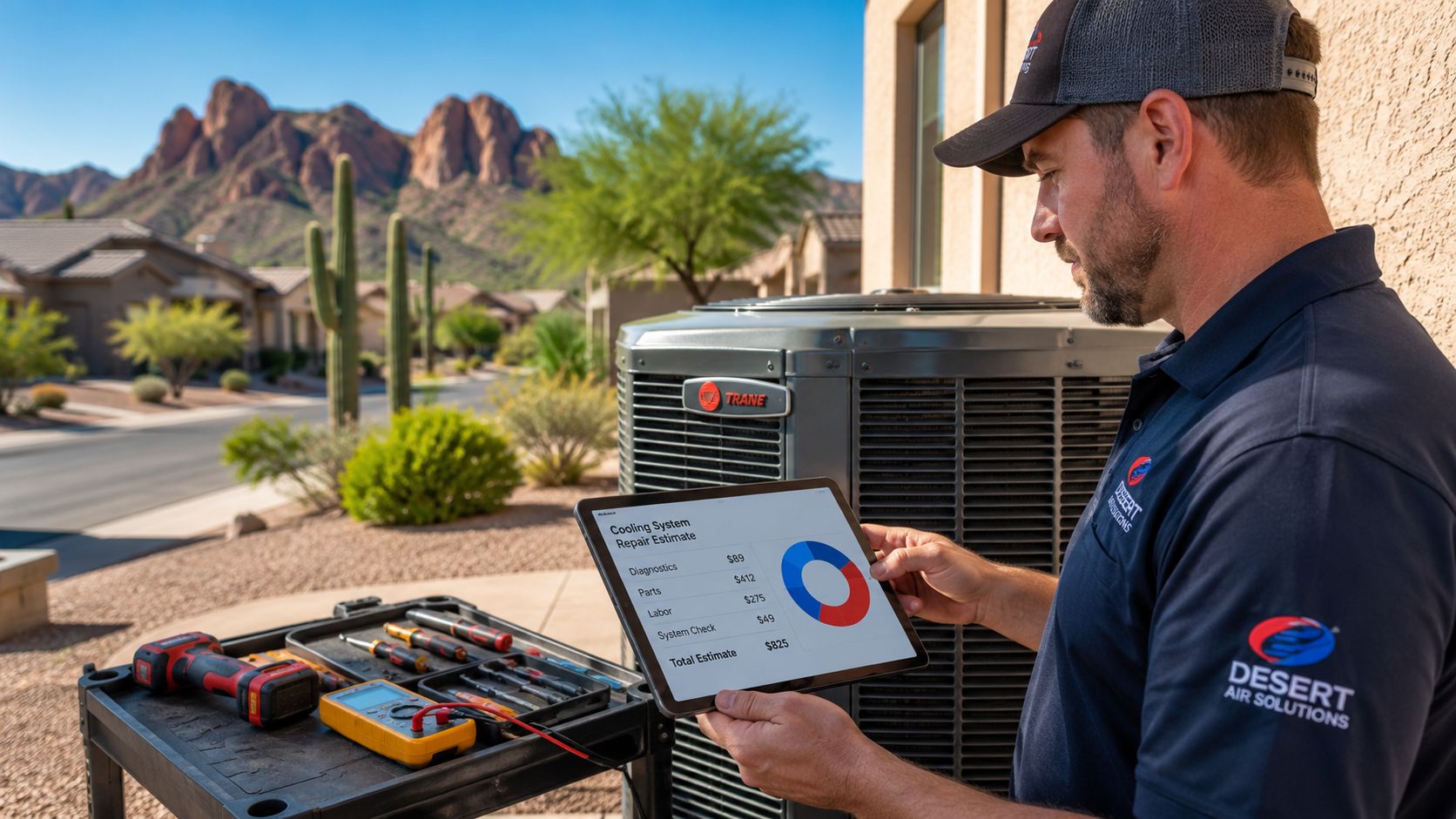
A broken AC in Mesa usually costs $250 to $850 for a typical repair visit, with many minor fixes landing around $150 to $450 and major failures climbing past $2,000. That's a wide spread, but it makes sense in a market where some calls end with a simple capacitor or drain line repair and others uncover a compressor, coil, or refrigerant problem.
When the house won't cool in July, the main question usually isn't just price. It's whether the system needs a fast, reasonable repair or whether the money would be better spent on replacement. Mesa homeowners deal with long cooling seasons, rooftop package units, dusty coils, older split systems, and monsoon storms that can turn a small problem into an urgent one fast.
How Much Does AC Repair Cost in Mesa
Your AC quits at 4 p.m. in June, the house is climbing past comfortable, and the first question is simple. How much is this going to cost me?
In Mesa, most repair calls land somewhere between a fairly small parts-and-labor fix and a much larger repair that makes you reconsider the whole system. A clogged drain line, bad capacitor, or failed contactor usually stays on the lower end. Once the problem involves a fan motor, refrigerant leak, coil, or compressor, the number rises fast, especially on older equipment.
The hard part is that the symptom does not set the price. Warm air, weak airflow, short cycling, breaker trips, and rattling noises can all come from very different failures. I see that a lot on Mesa homes with rooftop package units, where access, sun exposure, and years of dust buildup can turn a routine repair into a longer job.
Homeowners looking for local service options can start with AC repair in Mesa, but the cost decision usually comes down to three things: what failed, how old the system is, and whether this repair still makes financial sense in Arizona heat.
That last part matters.
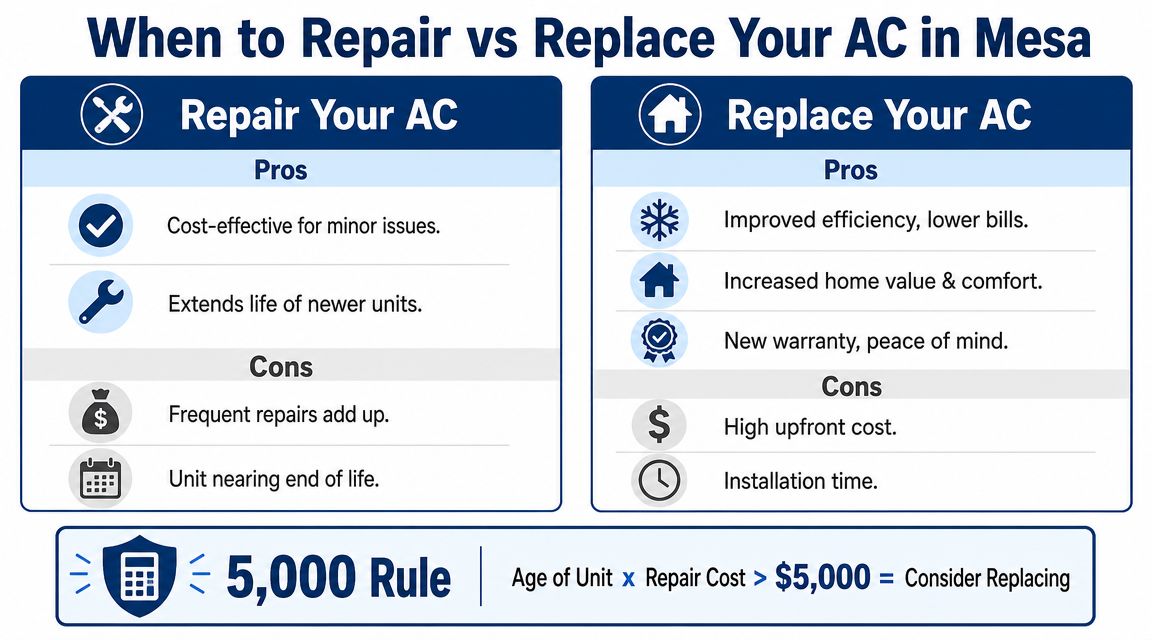
On an older unit, especially one with expensive parts or R-22 refrigerant history, a repair quote is not just a repair quote. It is also a replacement decision. Many Mesa contractors use the $5,000 rule as a quick benchmark. Multiply the unit age by the repair cost. If the result is over $5,000, replacement deserves a serious look. It is not a law, but it is a practical way to keep from sinking too much money into a system near the end of its life.
Two homes can both have an AC that "stopped cooling" and still get very different estimates. A ground-level split system with easy access is usually simpler to diagnose and repair than a rooftop unit on an older Mesa house. Monsoon dust, heat-stressed electrical parts, and harder-to-source components all affect the final bill.
Mesa AC Repair Price Ranges for Common Failures
Mesa repair pricing makes more sense when you tie the number to the failed part, not just the symptom. “AC not cooling” can mean a clogged drain line, a bad capacitor, a fan motor failure, or a compressor problem. On rooftop package units, which are common on older Mesa homes, access and sun exposure can also push the final price higher than homeowners expect.
Estimated AC Repair Costs in Mesa AZ (2026)
| Common AC Repair | Typical Cost Range |
|---|---|
| Clogged drain line | $150 to $450 |
| Capacitor | $150 to $450 |
| Contactor | $150 to $450 |
| Thermostat replacement | $175 to $550 |
| Condenser fan motor | $650 to $1,200 |
| Refrigerant leak repair | $750 to $2,200 |
| Evaporator coil | $1,400 to $3,800 |
| Compressor | $2,000 to $4,500 |
These ranges are best used as working estimates. The actual quote depends on system type, access, part availability, and whether the repair involves refrigerant handling.
Lower-cost repairs that are still common
The repairs that usually stay at the lower end of the scale are drain line clogs, capacitors, and contactors. In Mesa, those failures show up all the time because systems run for long hours in high heat, and rooftop equipment deals with extra dust, vibration, and weather exposure.
A capacitor helps the motors start and stay running. When it weakens, the unit may hum, struggle to start, or shut off after trying. A contactor controls power to major components. When the contacts burn or pit, the system may click but not start, or it may start inconsistently.
A clogged drain line is different. It is often less expensive than a major mechanical repair, but it can still shut the system down if the float switch trips. During monsoon season, I also see drain issues tied to heavy dust and neglected maintenance, especially in attic or closet air handlers.
For a broader look at symptoms and failure points, see this guide to common AC repairs in Arizona.
Mid-range repairs where labor starts to matter more
Once you move into controls and motor repairs, labor and access become a bigger part of the bill.
A thermostat replacement can stay fairly modest if the thermostat itself has failed and the wiring is in good shape. If the actual issue is a low-voltage short, control board problem, or communication fault, the final invoice can climb because diagnosis takes longer.
A condenser fan motor is a good example of a repair that sounds simple but often is not. The motor sits in direct Arizona sun and pulls air through a dusty outdoor coil. When it fails, the system cannot get rid of heat properly, and continuing to run it can put extra strain on the compressor. On a rooftop unit, that repair may also take longer because of access, haul-up, and testing in extreme heat.
Expensive failures that change the decision
The primary financial fork in the road starts with refrigerant and sealed-system repairs.
- Refrigerant leak repair: $750 to $2,200
- Evaporator coil: $1,400 to $3,800
- Compressor: $2,000 to $4,500
A refrigerant leak repair can be a small fix or a bigger project depending on where the leak is and whether the system has lost a significant charge. An evaporator coil repair usually means you are dealing with a major component failure, not a quick service call. A compressor replacement is the point where many Mesa homeowners stop and do the math.
That is where the $5,000 rule becomes useful in real life. If the unit age multiplied by the repair cost puts you over $5,000, replacement deserves a hard look. A 12-year-old system with a $2,500 repair estimate lands at $30,000 on that rule. At that point, even if the repair is possible, it may not be the smartest place to put your money.
I tell homeowners the same thing all summer. A repair can fix the immediate problem and still be a poor long-term investment, especially on an older system with past refrigerant issues, heavy rooftop wear, or multiple recent breakdowns.
Deconstructing Your AC Repair Bill
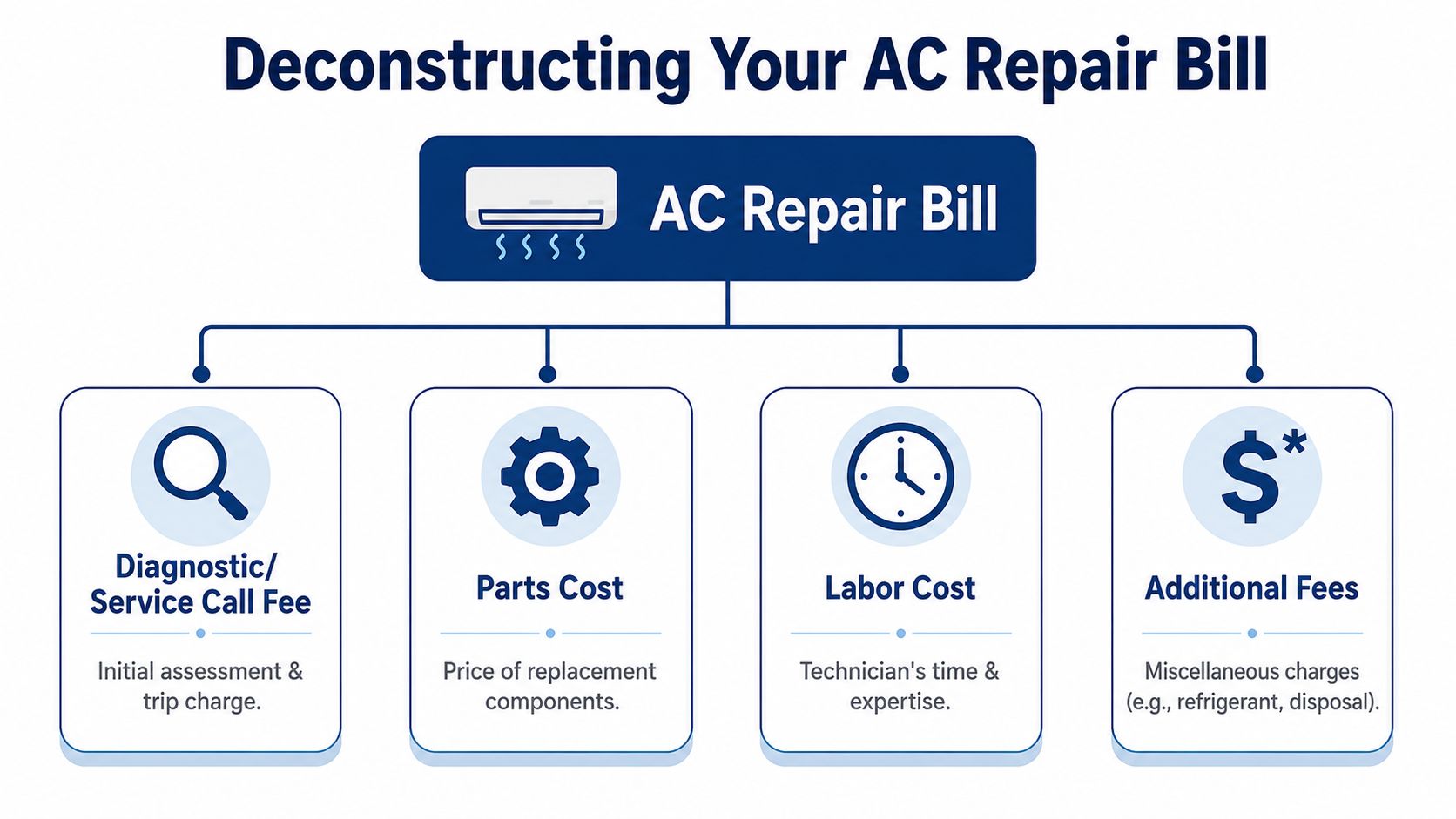
A Mesa AC repair bill usually has four moving pieces: the diagnostic visit, the part, labor, and any job-specific materials. Homeowners often focus on the part because that is the easiest line item to recognize. In practice, the time to find the failure and verify the fix is a big share of the cost, especially on rooftop units and older systems that have seen years of heat, dust, and deferred maintenance.
Diagnostic and service call charges
The first charge is the service call and diagnosis.
That fee covers travel, system inspection, electrical testing, and enough troubleshooting to identify the actual failure. Good diagnosis saves money because it keeps a tech from swapping parts based on a guess. In Mesa, that matters. A system that quits in extreme heat can have more than one problem at the same time, especially if monsoon dust has choked the coil or the unit has been short-cycling for a while.
Parts and labor are separate cost drivers
Once the problem is confirmed, the bill usually breaks into parts and labor.
A capacitor may be a modest part cost, but the job still includes testing the old part, installing the new one correctly, checking voltage and amperage, and confirming the system starts and cools the way it should. A contactor, fan motor, or control board follows the same pattern. The part is only one piece of the invoice.
Labor climbs when the repair takes longer, access is harder, or the system needs extra setup and testing after the part goes in. That is common on Mesa rooftop package units, where getting tools, parts, and gauges up safely takes more time than a simple ground-level split system call.
Extra charges usually come from job complexity
The line items that surprise homeowners are usually tied to complexity.
- Refrigerant and related materials: Leak checks, pressure testing, brazing, filter driers, and refrigerant can add cost fast.
- Access and working conditions: Rooftop units, tight attic air handlers, and older equipment with brittle panels or rusted fasteners take more time.
- Follow-up testing: Some repairs need temperature split checks, static pressure readings, drain verification, or a longer run test before the job is done.
Maintenance also affects what shows up on the invoice. Systems that get regular AC maintenance in Mesa usually give a tech a cleaner, more stable platform to work from. Neglected systems tend to hide secondary problems.
For landlords and investors, controls can affect operating cost too. A smart thermostat will not fix a failing compressor, but it can reduce waste between repairs and help improve NOI with smart thermostats.
The cheapest part on the invoice is rarely the whole repair. You are paying for diagnosis, safe installation, and proof that the system is actually cooling again.
Key Factors That Influence Your Final Repair Cost
One Mesa homeowner can pay far less than another for what sounds like the same repair. The difference usually comes down to the system itself, the house, and what Arizona weather has done to the equipment over time.
System age and equipment type
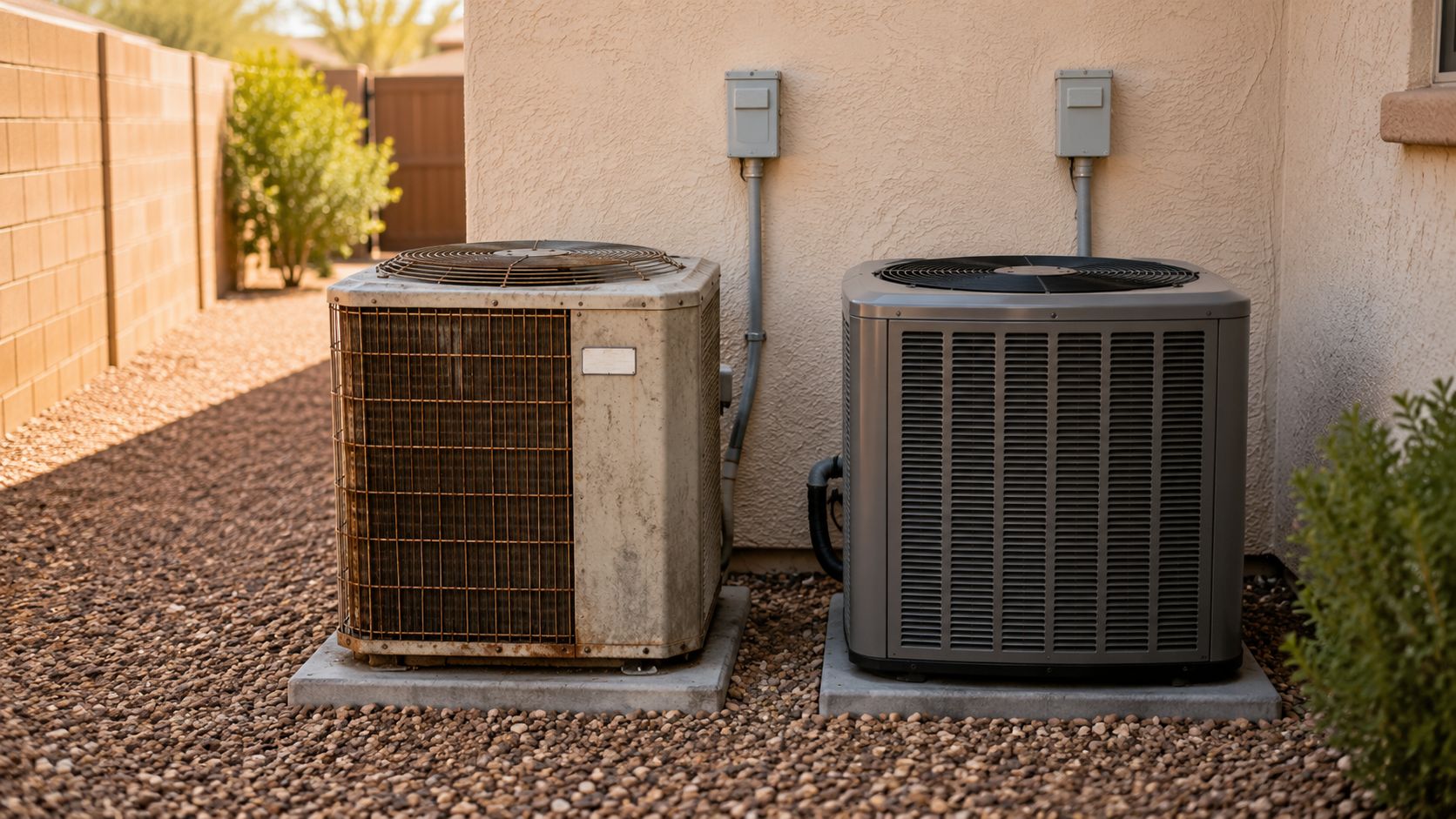
Older systems are harder to repair for a simple reason. Parts may be less available, previous repairs may have changed how the equipment performs, and wear is usually spread across more than one component by the time the current failure shows up.
Equipment type matters too. Mesa has a mix of split systems, heat pumps, and rooftop package units. A rooftop package unit can take more time to access and work on safely than a system with easy ground-level access. That doesn't automatically mean the bill will be high, but it often means the repair isn't as simple as replacing a part and walking away.
Refrigerant type and sealed-system condition
Refrigerant issues often turn a routine call into a bigger decision. If the system has a leak, the repair isn't just “add refrigerant.” A proper fix means finding the leak, evaluating the failed component, and deciding whether the system is worth investing in.
When the leak is in a major component, the homeowner has to look at the whole system, not just the immediate symptom. That's why coil and compressor repairs often become replacement conversations in Arizona.
Arizona dust, monsoons, and maintenance history
Mesa equipment deals with dust nearly year-round, then gets hit with monsoon wind, debris, and sudden electrical stress. Dirty condenser coils make the unit run hotter. Restricted airflow puts pressure on motors and compressors. Drain issues show up fast in humid stretches and shoulder seasons.
Routine AC maintenance in Mesa doesn't eliminate every failure, but it does help catch weak capacitors, dirty coils, loose electrical connections, and drainage problems before they stack together.
A few practical examples:
- Dirty outdoor coil: The system may still cool, but it has to work harder and run longer.
- Rooftop debris after a storm: Airflow can drop or electrical components can be affected.
- Neglected filters in an older house: Reduced airflow can strain the indoor side of the system.
Property goals can affect the repair choice
For landlords and small property managers, the repair decision often includes operating cost, tenant comfort, and control strategy. Smart thermostats can help with scheduling and oversight, and property owners looking to improve NOI with smart thermostats often evaluate repairs in that larger context.
That same thinking applies to owner-occupied homes. If the unit is already expensive to operate, uneven from room to room, and one major part has failed, the repair quote isn't the only cost worth considering.
In Mesa, the final repair number is rarely just about one bad part. It's often a combination of age, access, dust load, refrigerant condition, and how hard the system has been working.
When to Repair vs Replace Your AC in Mesa
It is 6 p.m. in July, the house is still 88 degrees, and the estimate in your hand is big enough to make you hesitate. That is the critical repair-versus-replace moment in Mesa. The question is not just whether the unit can be fixed. It is whether putting more money into this system makes sense for the next few summers.
Mesa market guidance puts many repairs in the $150 to $600 range, while full system replacement is about $5,800 to $12,000+. That same guidance also points to two practical benchmarks homeowners use all the time: replacement deserves a hard look when the repair is around half the cost of a new system, and the age-times-repair-cost test can help sort out gray-area cases, according to Mesa repair versus replace cost guidance.
Use the 5,000 rule as a screening tool
The $5,000 rule is simple. Multiply the unit's age by the repair cost. If that number lands over $5,000, replacement usually deserves serious consideration.
I treat that as a screening tool, not a law. A 12-year-old rooftop package unit with a major motor or refrigerant repair is a very different bet than a newer split system with one isolated electrical failure. In Mesa, rooftop exposure, monsoon dust, long cooling seasons, and older ductwork all affect how much useful life is really left after the repair.
Repair usually makes sense when the system still has good years left
A repair is often the better financial move when the problem is limited and the rest of the equipment is doing its job.
- The failure is isolated: A capacitor, contactor, drain repair, or control issue is different from a compressor or coil problem.
- The unit has been dependable: One service call in a hot climate is normal. Repeated summer breakdowns are a pattern.
- Cooling performance has been acceptable: If the home has been staying comfortable and power bills have not jumped for no clear reason, repairing can be a reasonable way to keep a sound system going.
- The repair does not push you close to replacement cost: That matters more than the part itself.
Replacement deserves a hard look when the quote is only part of the problem
Mesa homeowners usually regret replacement less when they make the call before the unit becomes a string of expensive visits. If a major component fails on an older system, the repair number is only one part of the risk.
Replacement is often the smarter call when:
- A compressor or coil has failed: Those repairs can be expensive enough that the math changes fast.
- The unit is older and exposed: Rooftop systems take a beating in Arizona sun, dust, and storm weather.
- Comfort has been slipping for a while: Hot rooms, weak airflow, long run times, and uneven cooling usually point to bigger system wear, not just one bad part.
- You are planning to stay in the home: Lower repair risk and better efficiency can matter more over several summers than saving money on this one invoice.
For a more detailed breakdown of AC repair vs replacement, that guide walks through the decision in an Arizona-specific context.
Look at the next three summers, not just today's bill
A cheap repair can still be the expensive choice if the unit is near the end and another major part is likely next. A replacement can also be the wrong move if the system is newer, the issue is minor, and the equipment has otherwise been reliable.
Get the diagnosis in writing. Ask what failed, what condition the rest of the system is in, and what the contractor expects over the next few seasons. Before approving a large repair or a full replacement, it also helps to review the basics of confirming contractor credentials.
In Mesa, the cleanest decision is usually the one that balances age, repair size, reliability, and how the system has been performing in real heat. If the unit still cools well and the repair is contained, fix it. If the system is older, expensive to repair, and already warning you with comfort problems, replacement is often the better use of money.
How to Get an Accurate Estimate and Hire a Great Local Company
Your AC quits at 6 p.m. in July, the house is climbing past 85, and the first company says, "You need a major repair." That is when a clear estimate matters most.
A solid estimate starts with an actual diagnosis, not a price range tossed out before anyone has checked the system. In Mesa, that matters because rooftop units, heat-soaked attics, monsoon dust, and older ductwork can all make one symptom look like another. A weak capacitor, dirty condenser coil, airflow restriction, or failing blower motor can all show up as "not cooling well," but the repair cost and the long-term risk are very different.
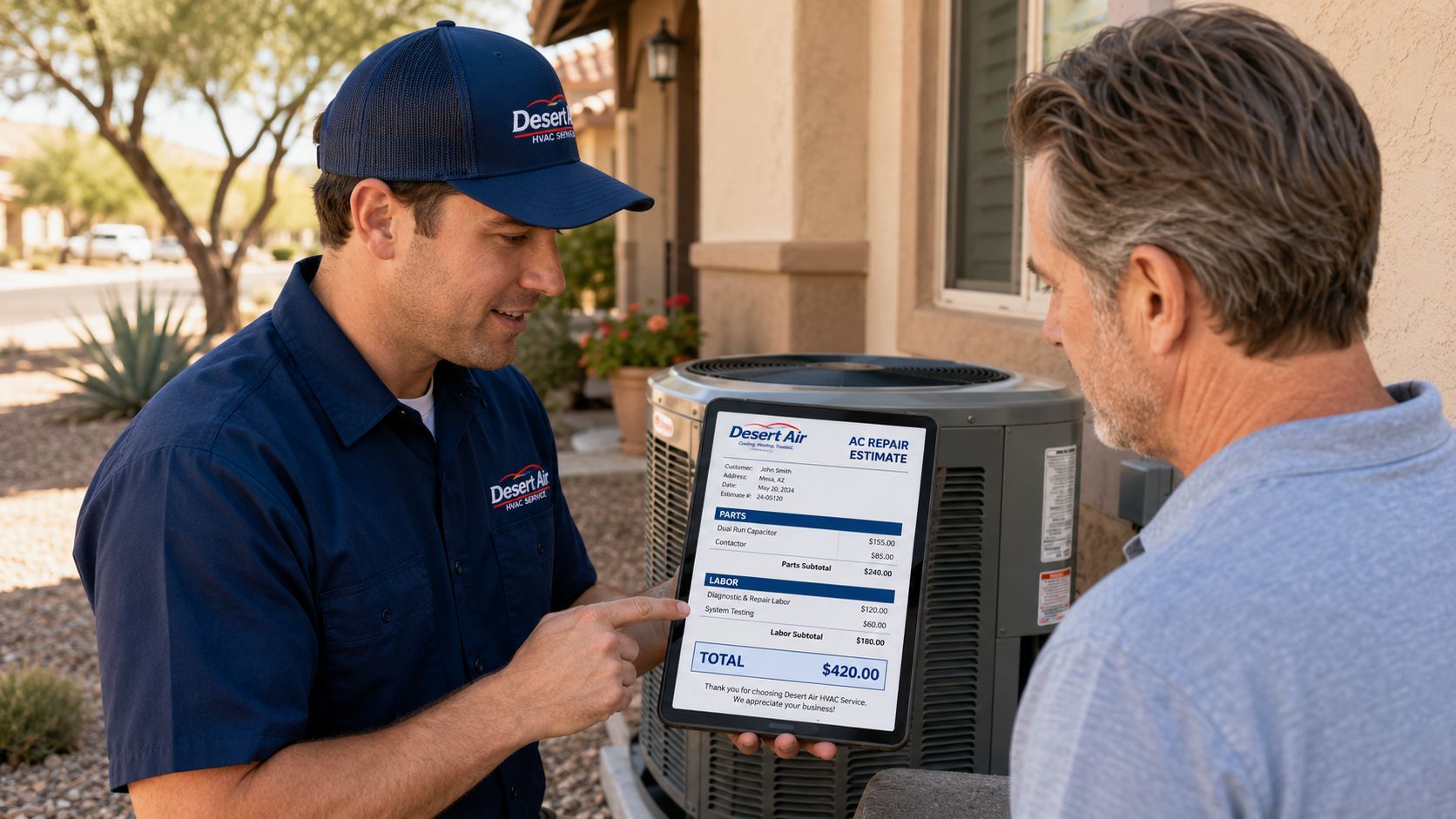
Ask for the diagnosis in writing. The estimate should list the failed part or repair scope, labor, and any recommended follow-up work. If a company says the system needs a major repair, ask one more question: is this a one-problem fix on a system worth keeping, or are you close to the $5,000 rule territory where replacement deserves a serious look?
Here is what to check before you hire:
- Written scope of work: The quote should show what failed, what is being replaced or repaired, and what is included in the price.
- Photos or readings when appropriate: On rooftop package units especially, a good tech should be able to show burn marks, failed capacitors, refrigerant readings, damaged wiring, or coil condition.
- License and insurance verification: Homeowners can review basics around confirming contractor credentials before approving major HVAC work.
- Mesa-specific experience: A company that works in Mesa every day will be more familiar with sun-beaten rooftop systems, dust-loaded coils, and the repair limits of older equipment in East Valley homes.
- A second opinion for expensive repairs: If the quote is high enough that replacement is on the table, compare it against another local company. This guide to the best AC repair companies in Mesa is a practical place to start.
Watch for vague language. "Tune-up and repair as needed" is not the same as "replace dual run capacitor, verify amp draw, test refrigerant charge, and confirm temperature split." Specific language makes it much easier to compare bids and avoid paying twice when the first repair does not solve the underlying problem.
Comfort Experts provides AC diagnostics and repair service in Mesa and the East Valley for homeowners who want a clear diagnosis and an itemized path forward.
If the system is down and you need the problem diagnosed clearly, Comfort Experts can help. Call 480-207-1239 or schedule service to get the issue reviewed in plain language.