An air scrubber pulls indoor air through staged filtration to reduce suspended particles, and a HEPA stage can remove at least 99.97% of particles at 0.3 microns when it meets the true HEPA standard. In a Mesa home, that can mean less dust and smoke moving through the breathing zone, but it won't remove every pollutant or fix an active source by itself.
A monsoon storm can push dust across the East Valley, rattle windows, and leave a fine film on the coffee table by morning while the air conditioner runs. Homeowners often ask what do air scrubbers do after seeing that grit return through the supply registers, noticing persistent odors, or worrying about smoke that has drifted into the area.
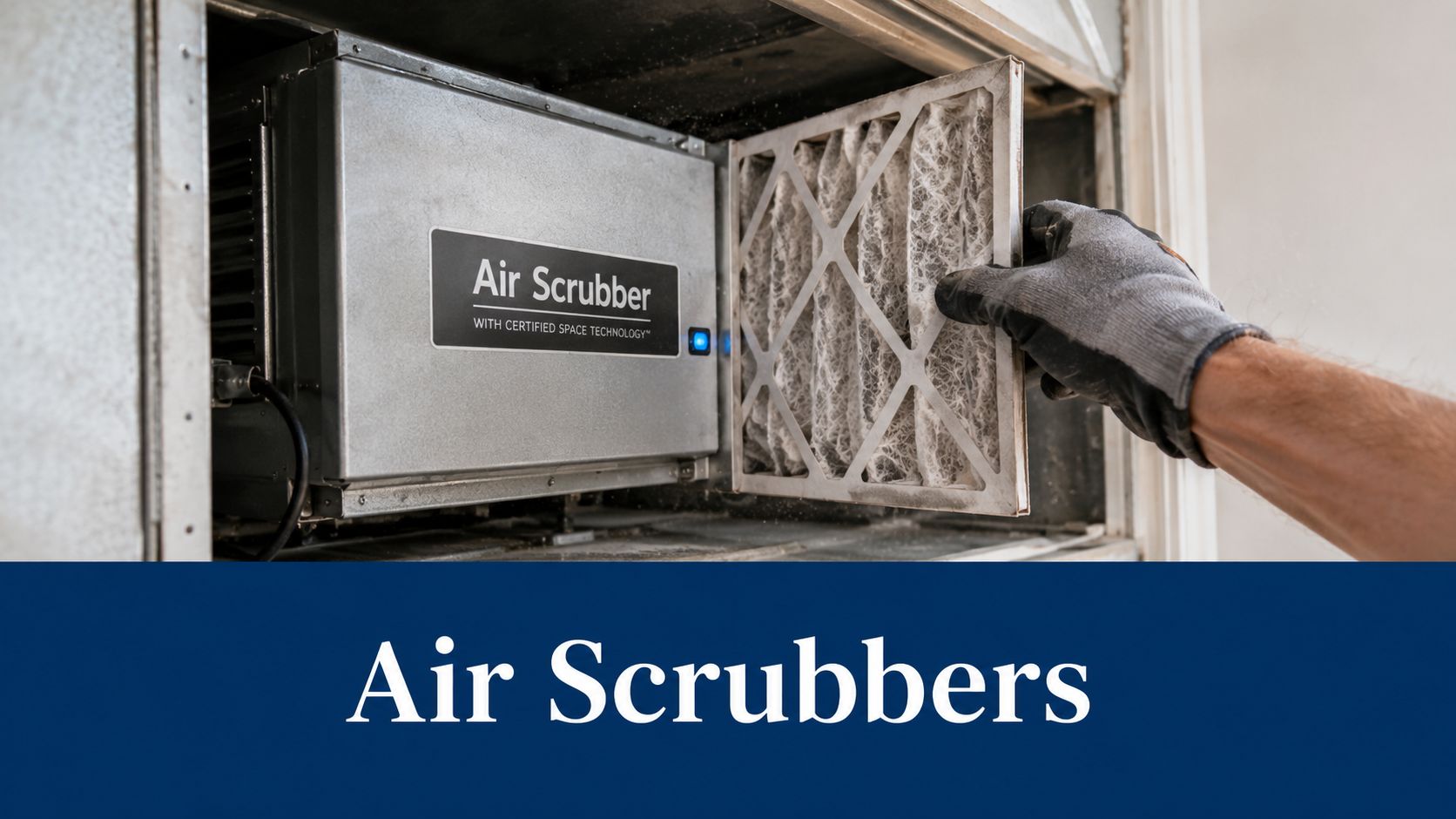
The plain answer is that an air scrubber is an air-cleaning device. A whole-home model is installed in or near the HVAC return, where it pulls air through multiple filtration stages before the blower sends the treated air back through the ductwork. Depending on the equipment, those stages may include a prefilter, high-efficiency particle filtration, activated carbon, UV-C, or electronic technology.
That makes an air scrubber different from turning the thermostat fan on. The device can reduce airborne particle pollution, but source control, adequate ventilation, duct condition, and correct sizing still determine the result. The EPA guide to air cleaners for homes cautions that air cleaners alone can't guarantee adequate indoor air quality when pollutant sources remain active or ventilation is insufficient.
Why Mesa Homeowners Are Asking About Air Scrubbers Right Now
After a haboob, fine desert dust can collect on furniture and return through the registers when the air conditioner runs. Monsoon winds stir dust from construction areas and unpaved surfaces, while wildfire smoke can drift into the Phoenix area and remain indoors after doors and windows are closed. These events make air quality a practical HVAC concern, not just a cleaning issue.
Those conditions explain why homeowners search for Mesa indoor air quality solutions. A standard one-inch return filter protects HVAC equipment and catches some airborne debris. A whole-home air scrubber adds filtration capacity and may include media for certain odors or gaseous pollutants, depending on its design.
The right questions are easier to answer when the cleaning location is clear. For dust or smoke in the breathing zone, a portable unit placed near occupied rooms may clean the air people are inhaling. A duct-connected scrubber cleans air as it passes through the HVAC system. It will not remove dust already settled on shelves, carpets, or ceiling fans. Surface cleaning and source control still matter.
The final question is whether adding one makes sense for the house. The answer depends on the filter cabinet, blower capacity, duct leakage, indoor particle load, pets, smoke exposure, and the homeowner's willingness to replace or maintain the media. A restrictive filter can create airflow problems if the system was not designed to handle it.
Portable filtration can also matter in occupied spaces. In a controlled conference-room case study, the CDC reported that two portable HEPA air cleaners meeting EPA-recommended clean air delivery rates reduced exposure to simulated exhaled SARS-CoV-2 aerosols by up to 65%. Combining the cleaners with universal masking reduced exposure by up to 90%. Those results support filtration as a supplemental measure, not a guarantee that a residential device eliminates infection risk.
For Mesa homeowners, the useful question is specific: will the equipment address the dust, smoke, or odor problem, and can the HVAC system move air through it without creating new airflow problems? During a dust storm, monsoon, or smoke event, that distinction helps determine whether the home needs breathing-zone cleaning, ductwork filtration, or better surface and source control.
How an Air Scrubber Actually Works in Your Home
A whole-home air scrubber normally connects to the return side of the HVAC system or sits within the air handler. When the blower operates, return air passes through the equipment before the system sends it back through the supply ducts.
The process is easiest to understand as a series of filters, with each stage assigned a different job.
The filtration path
A prefilter catches larger debris. Pleated media can capture coarse dust, hair, and other particles before they reach the more expensive downstream filter. This stage helps protect the finer media from loading too quickly.
A high-efficiency particle stage captures smaller particles. This is the stage aimed at fine dust, smoke, pollen, and other suspended particles. The EPA says portable air cleaners and HVAC filters can remove particles, including PM2.5, which is among the smaller particle categories of health concern. The actual result depends on airflow, filter fit, runtime, and room conditions.
Activated carbon addresses some gases and odors. Carbon works differently from a particle filter. It adsorbs certain odor compounds and VOCs, but a device without special media such as activated carbon doesn't remove gaseous pollutants like radon, according to the EPA guidance linked above.
Optional electronic stages require separate scrutiny. Some products include UV-C lamps or ionization. These technologies aren't interchangeable with mechanical filtration, and ozone-producing devices can irritate airways. The EPA warns homeowners to avoid ozone-generating air cleaners in occupied spaces and recommends checking for UL 2998 certification when evaluating electronic equipment marketed as zero ozone emissions. See the EPA discussion of bipolar ionization and ozone concerns.
The clean-air effect is measured through factors such as CADR, air changes per hour, filter efficiency, and actual exposure reduction. A CDC-cited example found that in a typical 2,000 cubic-foot room, a portable cleaner rated at 300 cfm could provide clean-air equivalent to 10 air changes per hour, which helps show why airflow matters as much as the filter label.
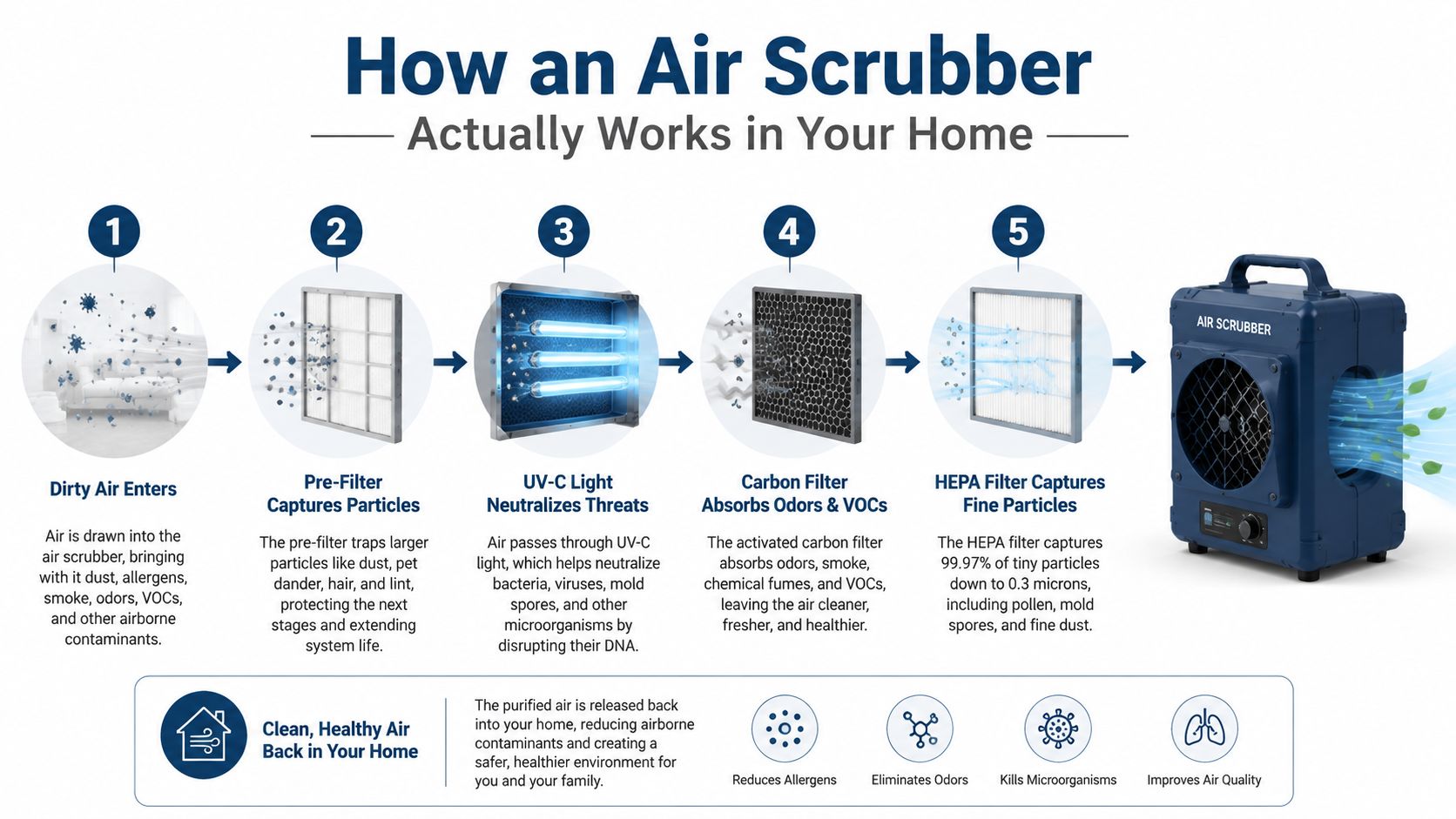
A homeowner may notice less visible dust recirculating and fewer light odors moving from room to room, but the unit doesn't vacuum surfaces or repair leaking ductwork. For broader housekeeping steps that support cleaner indoor spaces, the indoor air quality benefits of regular cleaning are also worth considering.
Whole-Home Air Scrubbers vs Portable Air Purifiers
The term air scrubber is used inconsistently. In residential HVAC conversations, it often means an in-duct air-cleaning add-on. In restoration and industrial work, it can mean a portable unit designed for high-airflow filtration or negative-pressure containment. A portable room air purifier is a separate category, although both devices clean air by moving it through filtration.
| Feature | Whole-Home In-Duct Scrubber | Portable Air Purifier |
|---|---|---|
| Coverage | Treats air moving through connected HVAC ducts | Usually targets one room or defined zone |
| Installation | Requires HVAC assessment and duct or air-handler work | Plugs into a standard outlet |
| Operation | Can run with the HVAC blower and thermostat controls | Uses its own fan and controls |
| Best fit | Multiple rooms, open floor plans, recurring dust or smoke concerns | Bedroom, office, nursery, or rental home |
| Odor treatment | May include activated carbon in the filtration assembly | Depends on the model and amount of carbon media |
| Limitations | Doesn't clean rooms the HVAC system doesn't serve, and may affect static pressure | Won't provide whole-home coverage from one location |
A portable unit can be a sensible choice when only one room needs attention. A renter may also prefer it because no duct modification is required. A homeowner with a central system, several occupied rooms, and recurring desert dust may prefer a whole-home approach because the equipment treats air as it returns to the air handler.
Runtime affects results. In a randomized crossover trial across 60 apartments, constant operation reduced weekly mean PM concentrations by 66%, while auto mode reduced them by 40%. The study's practical lesson is that equipment presence isn't enough. Runtime and control strategy matter, especially during cooking, renovation, or smoke intrusion.
Homeowners comparing options for cleaner indoor air should also consider fan noise, filter access, duct condition, and whether the existing blower can handle the added resistance.
What an Air Scrubber Reduces and What It Does Not
A staged air scrubber is primarily a particle-reduction system. It can reduce suspended dust, pollen, pet dander, and fine particles associated with smoke when the filter, airflow, and operating schedule match the space.
A true HEPA filter is defined by the EPA as removing at least 99.97% of airborne particles at 0.3 microns. In an HVAC system, however, the filter rating is only part of the outcome. Leaky filter tracks, bypass air, undersized cabinets, dirty coils, and short blower cycles can all reduce the amount of air that receives treatment.
| Contaminant | Reduced by Air Scrubber? | Key Rating or Mechanism |
|---|---|---|
| Coarse dust | Generally, yes | Prefilter or pleated filter captures larger particles |
| PM2.5 and smoke particles | Often, with suitable filtration | Mechanical filter efficiency, airflow, CADR, and runtime |
| Pollen and pet dander | Generally, yes | Particle filtration |
| Odors | Sometimes | Activated carbon is needed for many gaseous compounds |
| VOCs | Device-dependent | Carbon capacity and pollutant chemistry matter |
| Radon and other gases | Not through particle filtration alone | Requires appropriate gas-treatment media and source evaluation |
| Mold growth or moisture damage | No | Source control, drying, repair, and remediation are required |
| Settled dust on surfaces | No | Cleaning and source reduction are still necessary |
MERV ratings help compare in-duct filters. The EPA says MERV 11 filters remove roughly 20% of particles in the 0.3 to 1 micron range, while MERV 13 filters typically achieve at least 50% removal efficiency for the smallest tested particles. Separate EPA filtration guidance identifies MERV 13 to 16 filters as capable of reducing indoor particles by as much as 95%, depending on the application and conditions.
An air scrubber won't eliminate a mold colony, solve a roof leak, remove moisture from building materials, or guarantee that a home is free of viruses. Ionization also deserves caution because some devices can produce ozone or other by-products. Homeowners dealing with recurring dust from damaged or contaminated ductwork may need air duct cleaning and duct sealing, not only a new filter cabinet.
Practical rule: Filtration handles airborne particles. It doesn't replace fixing the source that keeps releasing them.
Air Scrubbers Compared to HEPA, UV, and Humidification
An air scrubber can combine multiple technologies, but each component has a different role. Treating the word “scrubber” as proof that every pollutant will be removed leads to poor equipment decisions.
HEPA describes a particle-filtration standard, not a complete air-cleaning system. The EPA's true HEPA benchmark is 99.97% removal at 0.3 microns. Portable cleaners often use HEPA media, while many whole-home systems use high-MERV filters because a true HEPA filter can add significant resistance to a residential duct system.
UV-C uses ultraviolet energy inside the duct or near the coil. It may help address biological material that passes through the treated zone, but it isn't a substitute for particle filtration and it doesn't clean dust from furniture or carpet. Installation quality, exposure time, lamp condition, and placement all affect its usefulness.
Humidification solves a different Arizona problem. Dry winter air can contribute to static, irritated skin, and wood movement, but an air scrubber doesn't add moisture. A whole-home humidifier can address dryness while the filtration system handles airborne particles.
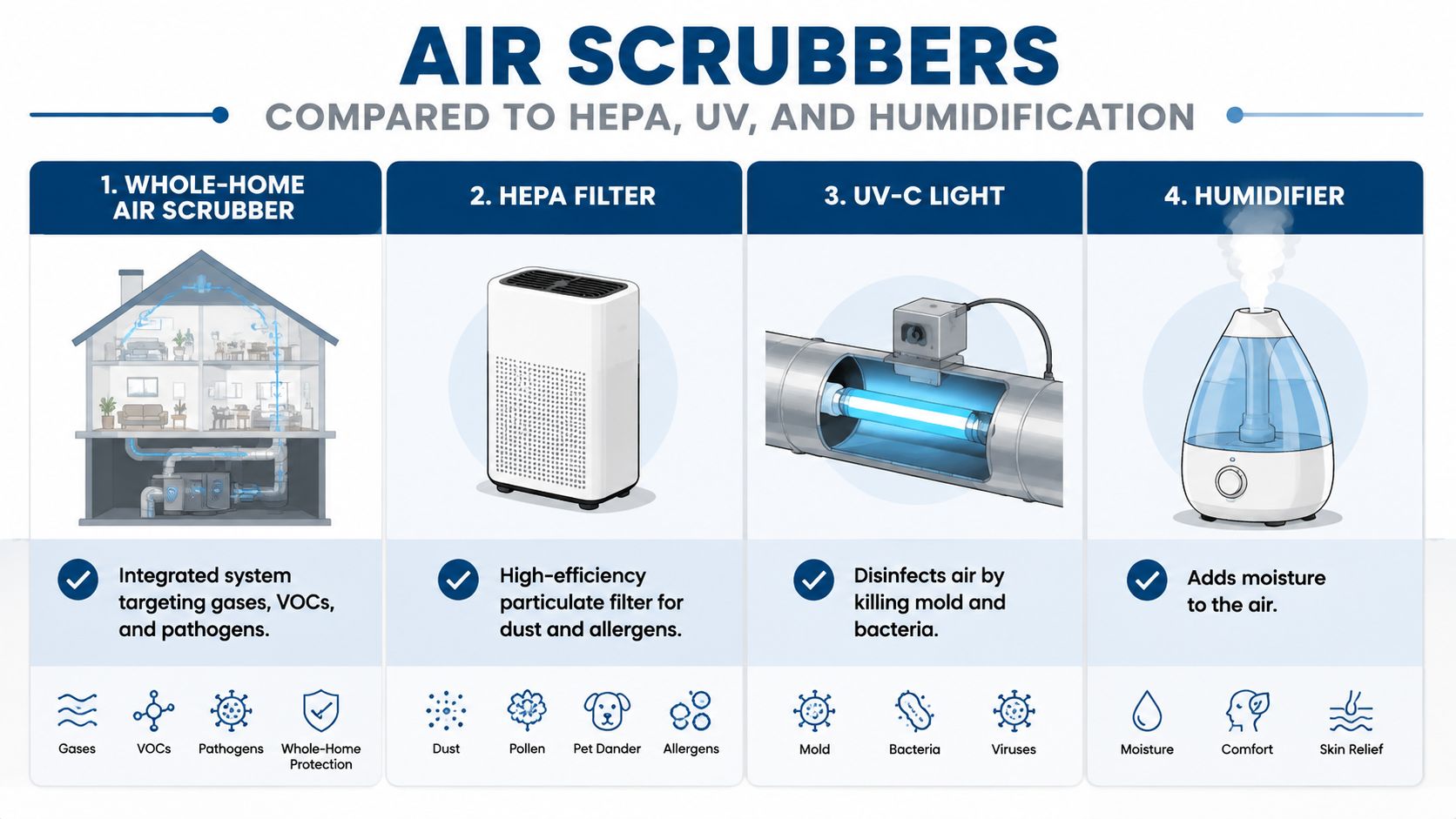
| Technology | Main job | Better fit |
|---|---|---|
| Whole-home air scrubber | Combines filtration and optional media for particles, odors, and selected contaminants | Recurring dust, smoke particles, pets, or whole-house coverage |
| HEPA cleaner | High-efficiency particle removal | A room or zone with concentrated particle concerns |
| UV-C system | Treats air or surfaces exposed to the lamp inside HVAC equipment | A supplemental biological-control measure |
| Humidifier | Adds moisture | Dry winter air and static concerns |
Homeowners researching keeping your home virus-free should treat filtration as one layer of risk reduction rather than a guarantee. Good ventilation, source control, appropriate filtration, and sensible occupancy practices work together.
For help with selecting an air purifier for Arizona homes, the deciding complaint matters more than the product label. Dust and odors point toward filtration and carbon. Dryness points toward humidification. A homeowner focused on airborne biological particles may consider UV as a supplement to a sound mechanical filter.
Installation, Maintenance, and Operating Costs in Arizona
A whole-home retrofit typically starts at the return duct or air-handler cabinet. The installer has to confirm the available space, match the filter assembly to the HVAC system, check the blower's ability to overcome added resistance, and make sure the filter seals properly so air doesn't bypass the media.
Arizona conditions shorten the time between filter checks. Haboob dust, monsoon construction dust, pet hair, and smoke intrusion can load media faster than a clean suburban environment. The manufacturer's maintenance schedule should control replacement, but homeowners should inspect the filter rather than relying only on the calendar.
What owners should monitor
- Filter condition: Check the media every 60 to 90 days during heavy use, then adjust based on loading and manufacturer guidance.
- Media replacement: Many media filters require replacement every 6 to 12 months, but dust exposure and pets can shorten that interval.
- UV components: UV lamps commonly require annual replacement, subject to the product instructions and measured output.
- Airflow: A whistling cabinet, weak supply airflow, or a system that struggles after installation deserves professional evaluation.
- Operating expense: Electricity use and replacement-media expense vary by fan runtime, filter type, and equipment design. A precise local cost can't be stated responsibly without the selected system and operating schedule.
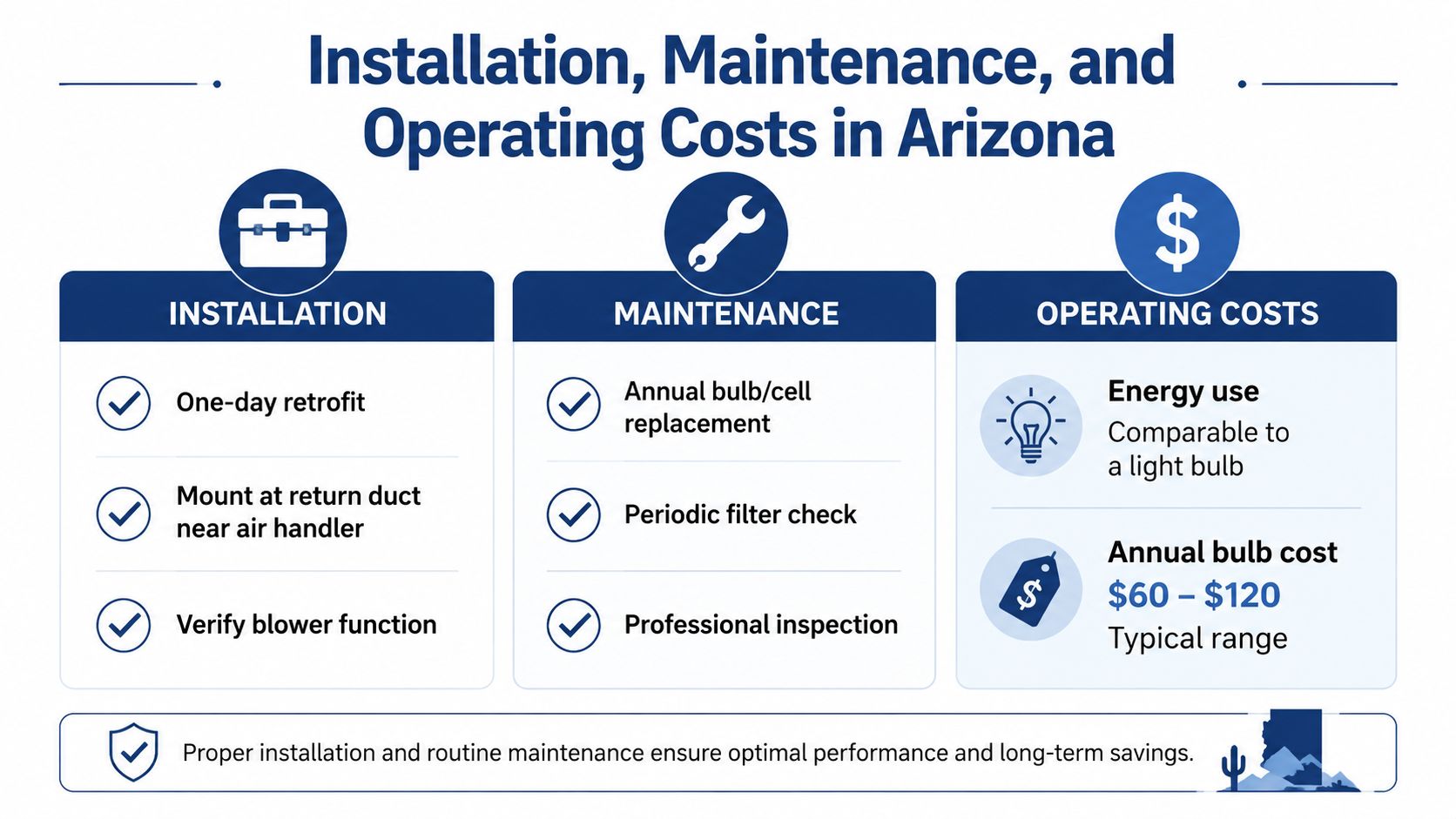
A first-year owner checklist should include recording the installation date, photographing the filter size, checking the media after major dust events, and keeping replacement parts available. During a smoke event, continuous operation may improve particle removal, but it also increases runtime and filter loading.
No reliable installed-price range or annual operating-cost figure is provided for the East Valley in the available data. Homeowners should request an itemized quote that separates equipment, duct modifications, labor, replacement media, optional carbon, UV components, and any required airflow corrections.
Choosing the Right Air Scrubber for Your East Valley Home
The right choice depends less on the word “scrubber” and more on the home's air path. A technician evaluating a Mesa, Gilbert, Chandler, or Queen Creek property should start with three questions.
Start with the house
First, identify the HVAC arrangement. A central split system, rooftop package unit, heat pump, and ductless mini-split don't offer the same installation path. A ductless system may need a room-based solution or a separate indoor-air-quality approach rather than a conventional return-side cabinet.
Second, identify the main complaint. Fine dust after storms points toward particle filtration and better source control. Smoke concerns call for high-efficiency particle filtration, appropriate runtime, and possibly activated carbon for odor compounds. Persistent smells may also indicate contaminated materials, return leaks, cooking sources, or ductwork that needs attention.
Third, consider coverage and maintenance. A single home office may be adequately served by a portable HEPA cleaner. A larger home with pets, several bedrooms, and a central HVAC system may benefit from whole-home treatment if the ductwork and blower can support it.
A staged decision usually makes sense
Many homeowners can begin with a properly fitted filter, an HVAC maintenance visit, and an inspection for return-side leaks. If dust or smoke remains a problem, a whole-home in-duct system can be considered. A portable unit remains useful for a nursery, bedroom, or office where concentrated cleaning is needed.
Property managers overseeing multi-unit rentals should standardize filter sizes, inspection procedures, and replacement records before selecting advanced equipment. Consistent maintenance often matters as much as the device itself. Broader whole-house filtration insights can help clarify why filtration selection should match the home's contaminants and airflow.
Homeowners who aren't sure whether the problem is particles, odors, duct leakage, or moisture can use this guide to healthy indoor air to organize the next inspection questions.
Comfort Experts can assess HVAC airflow, filtration options, duct condition, and whole-home air-cleaning solutions for Mesa and East Valley properties. Call 480-207-1239 or Comfort Experts to discuss whether a filter upgrade, duct service, portable purifier, or in-duct air scrubber fits the home's actual problem.