A Mesa homeowner may be comparing replacement quotes after another summer breakdown, with one proposal advertising a 10-year AC warranty and another using different wording for what looks like the same protection. The number on the brochure matters, but it doesn't tell the whole story. The comparison is between parts, compressor, labor, registration, and what happens if the home changes hands.
The Hidden Gap Between Parts and Labor Coverage
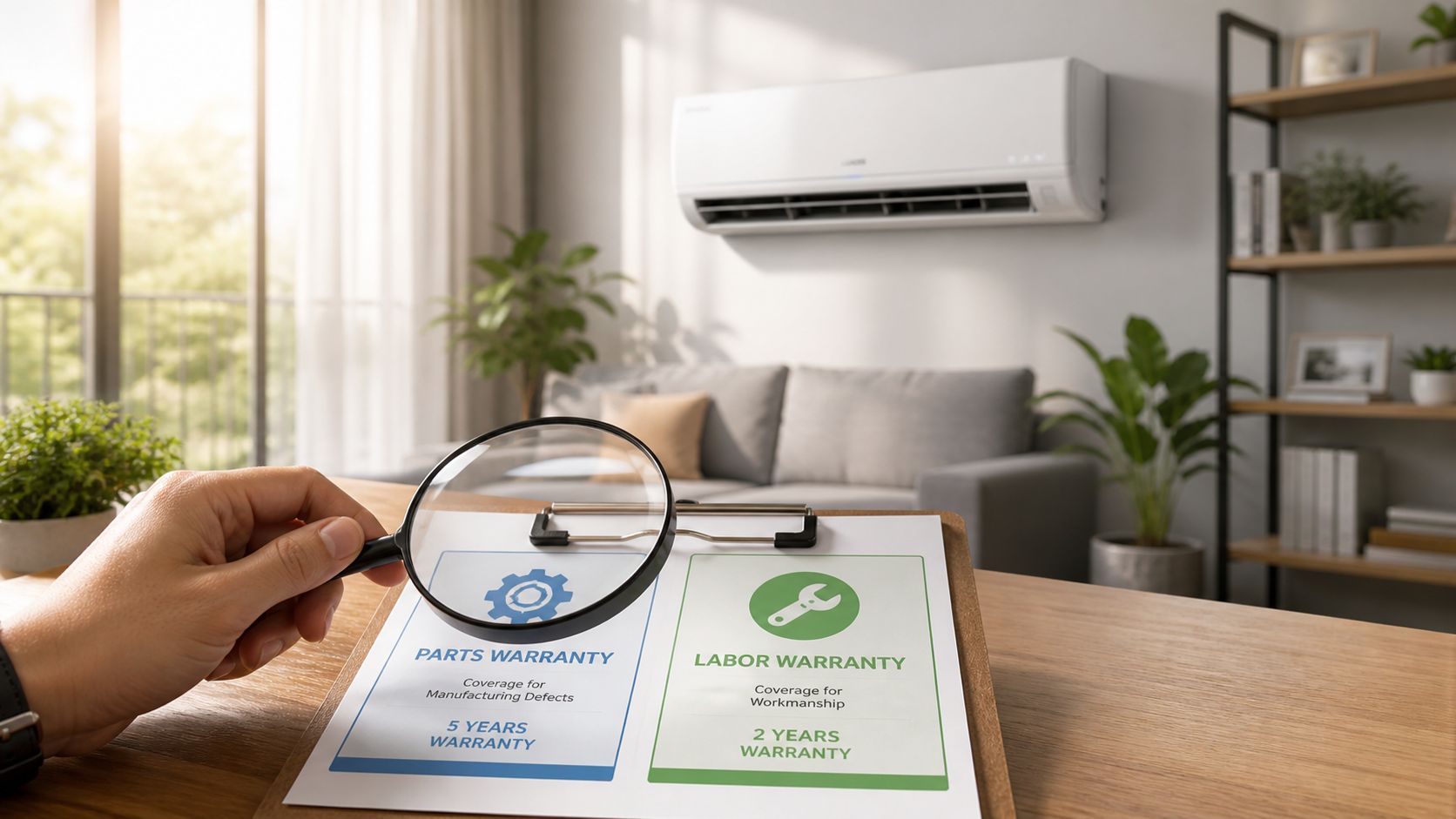
The most common mistake is staring at the large 10-year parts warranty and assuming the repair will be free for ten years. Manufacturer parts coverage and installer labor coverage are separate promises. A covered compressor may cost nothing as a replacement part, while diagnosis, refrigerant, travel, and the technician's time remain billable.
Major brands commonly advertise 10-year parts coverage on registered systems, while labor from the original installer is often limited to 1 to 2 years. That split is why the practical comparison isn't the headline term. It's the relationship between the parts warranty, compressor warranty, and labor warranty. Independent compressor guidance also identifies refrigerant, travel, diagnostics, and installation labor as costs that may remain excluded even when the failed component is covered.
Practical rule: A “10-year warranty” isn't a complete warranty description until the quote states who pays for diagnosis and installation labor.
What each part of the warranty means
| Coverage Area | Typical Manufacturer Term | Typical Labor Term |
|---|---|---|
| General parts | 5 years by default, potentially 10 years when registered | Usually separate from the manufacturer |
| Compressor | May have a different term by model tier | Usually covered only if the installer or labor plan says so |
| Installation labor | Usually excluded | Commonly 1 to 2 years from the original installer |
| Refrigerant, travel, and diagnostics | Often excluded | Plan-dependent, must be stated in writing |
The compressor deserves special attention because it's often the highest-value covered component. If it fails during a Mesa cooling season, the part may be covered while the work required to access, remove, replace, evacuate, recharge, and test the system is not. A quote that lists only “10-year parts” leaves that exposure unclear.
What to request before comparing systems
Ask for the manufacturer warranty document and the contractor's labor warranty as separate paperwork. The replacement proposal should identify the equipment model numbers, the standard and registered parts terms, the compressor term, labor duration, and exclusions.
A properly sized system and careful installation also affect the value of any warranty. Homeowners reviewing AC replacement in Mesa should compare the installation scope alongside the warranty, including duct modifications, system matching, startup procedures, and who handles a warranty claim.
How Registration Deadlines Change Your Warranty Terms
Registration is one of the easiest warranty details to miss because it happens after installation, when the homeowner is focused on cooling the house again. Many manufacturers use a 60- to 90-day registration window, and missing it can reduce parts coverage from 10 years to 5 years, as explained in this HVAC warranty comparison guide.
The longer term is conditional, not automatic. The quote should identify the deadline, who completes registration, and what proof the homeowner receives afterward.
Registered and unregistered terms are not the same
| Registration Status | Parts Term | Important Condition |
|---|---|---|
| Registered within the required window | May extend to 10 years | The exact deadline and model eligibility apply |
| Not registered on time | May revert to 5 years | Labor may still be excluded |
| Registered premium or eligible model | Can include different compressor or replacement terms | Model tier must be verified |
| Labor option selected separately | Depends on the plan | Selection may have its own deadline |
Goodman's product literature says registration must be completed within 60 days for eligible products to receive 10-year parts coverage, a 10-year unit replacement warranty, or lifetime compressor coverage. Those benefits aren't universal across every product, so the model number matters more than the brand name alone. Goodman's product literature should be checked against the exact equipment proposed.
Carrier states that its labor option must be selected within 90 days of installation. If registration is missed after that period, Carrier says coverage falls back to a standard 5-year parts warranty with no labor coverage, according to its residential warranty information.
American Standard states that registered limited warranty coverage can extend to 10 years when registered within 60 days, but its registered warranty still doesn't cover labor. Trane likewise states that its registered limited warranty covers parts that fail because of manufacturer defects, not the labor required to repair them, and that registration within 60 days can lengthen coverage to 10 years in many cases. Those terms can vary by product, so a homeowner comparing a Trane cooling system should request the current warranty for the proposed model.
Registration questions for the quote
Before signing, ask:
- Who registers the equipment? The contractor should explain whether the homeowner must complete the process.
- What is the exact deadline? Don't settle for “register it soon.”
- Which model tier qualifies? Single-phase and premium product lines may have different terms.
- Does compressor coverage differ? A compressor promise may not match the general parts term.
- Is labor available separately? Ask how long it lasts and whether selection is required within a set window.
Why Labor Exclusions Cost More in Arizona Heat
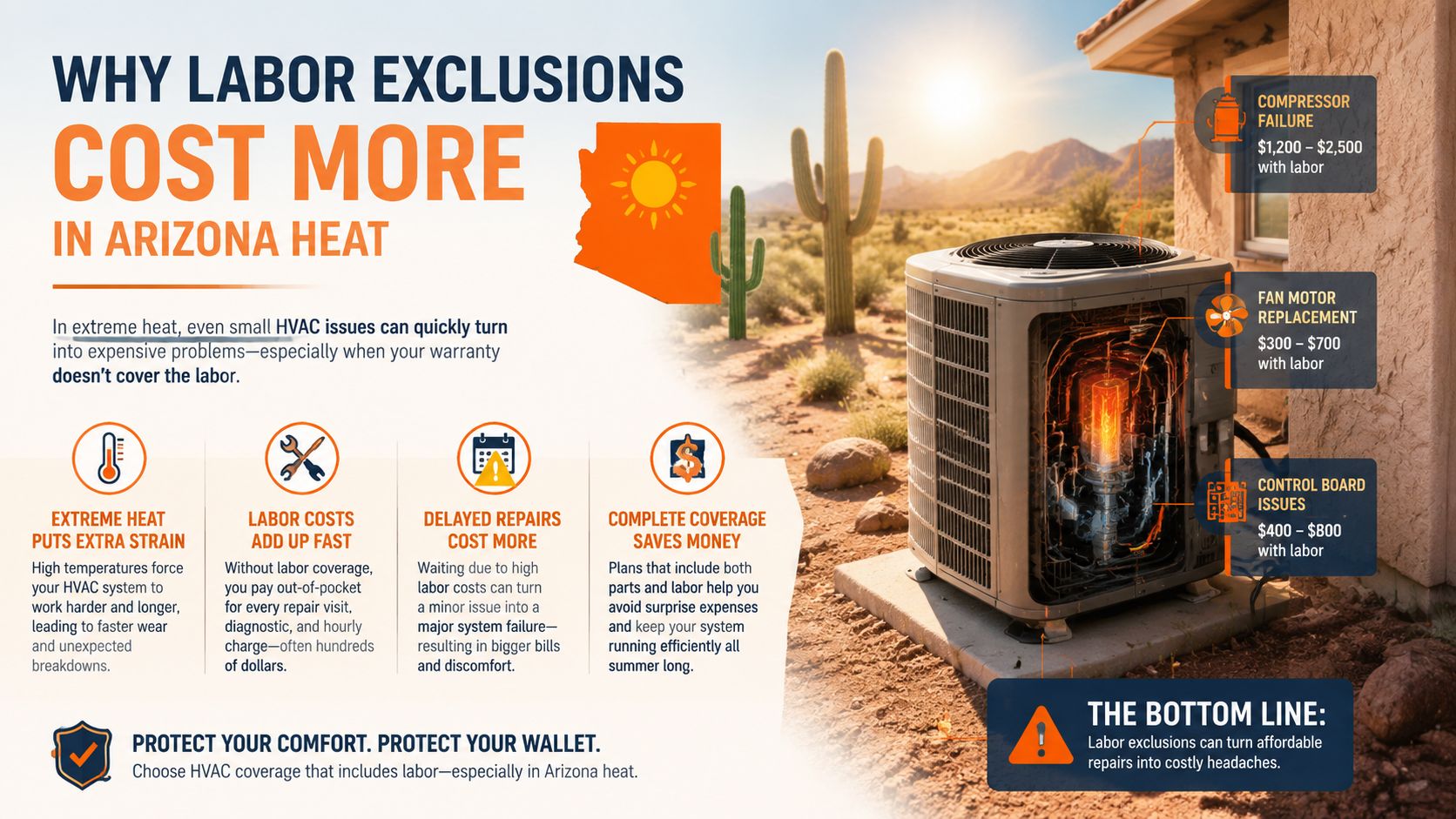
A parts-only warranty becomes more consequential in Mesa because an AC failure during sustained summer heat isn't a minor inconvenience. Dust, heavy cooling demand, monsoon conditions, and repeated long operating cycles can make a breakdown especially disruptive, even when the failed component qualifies for replacement.
Manufacturer parts warranties commonly cover compressors, coils, and control boards for about 5 to 10 years when registered, while labor is often limited to 1 to 2 years or excluded by the manufacturer. The distinction is documented in HVAC warranty coverage guidance, which also reports that U.S.-based HVAC manufacturers paid $823 million in warranty claims in 2025 and set aside $970 million in warranty accruals.
A covered compressor can still create a service bill
A compressor claim typically requires more than exchanging a box. A technician has to confirm the failure, verify the model and serial information, obtain the covered component, remove the failed compressor, install the replacement, and restore the sealed system. Refrigerant, diagnostic time, travel, and labor may remain outside the parts warranty.
That creates two different financial outcomes for systems carrying the same “10-year warranty.” One may include contractor-backed labor protection or a separately purchased labor plan. The other may provide only the component, leaving the homeowner responsible for the service work.
Compare the labor promise in plain language
The quote should answer these questions without requiring the buyer to interpret fine print:
- Is labor covered for the full parts term, only the workmanship period, or not at all?
- Does coverage include diagnosis, travel, refrigerant, and materials?
- Must the original installer perform the work?
- What happens if the installer is no longer available?
- Is the plan included in the proposal or sold separately?
Trane's warranty information states that registered parts coverage doesn't include repair labor. Lennox shows that eligible systems may be configured with extended parts-only coverage or labor coverage options, which makes a side-by-side review essential. When an older system is already failing, the homeowner can also use a separate guide to weigh AC repair vs replacement before choosing a warranty package.
Transferability and Ownership-Horizon Rules
Selling the home can change the practical value of an AC warranty. Manufacturer parts coverage may follow the equipment, while labor protection often stays tied to the original installer or a separate service plan. A transferable parts warranty does not automatically give the next owner transferable labor coverage.
Carrier's terms state that the remaining portion of the first five years transfers without registration. To keep longer coverage in place, the new owner must register the transfer within 90 days of the ownership change and pay the required transfer fee, according to Carrier's warranty documentation.
Use an ownership checklist
Ask for exact answers before assuming the warranty adds resale value:
- Identify what transfers. Parts, the compressor, labor, and service-plan benefits may follow separate rules.
- Confirm the deadline. The buyer may have only the stated window to submit the transfer.
- Check the fee. Preserving extended coverage may require payment.
- Keep the records. Save the invoice, model and serial numbers, registration confirmation, and warranty terms.
- Ask about the second owner. Coverage can change after a sale even though the equipment remains installed.
The price comparison matters too. Consumer sources report that home warranty protection for HVAC commonly costs about $350 to $900 per year, while manufacturer warranties generally cover parts rather than labor. Separately sold extended labor plans can cost roughly $300 to $800 for 5 to 10 years. Compare those options with the likely cost of diagnosis, travel, refrigerant, and repair labor in Mesa, rather than selecting the longest advertised term.

Arizona buyers should read the written manufacturer terms and check applicable state requirements. Florida law, for example, provides that as of July 1, 2024, certain manufacturer HVAC warranties on residential real property conveyed to a new owner transfer automatically and may not depend on product registration. That Florida rule does not establish the terms for an Arizona home.
For a local second opinion before signing, Comfort Experts helps you evaluate the equipment, transfer conditions, and labor exposure instead of relying on the headline warranty term.
Decision Matrix for Mesa Homeowners
The best warranty depends on how the system will be used and how long the homeowner expects to keep it. A rooftop or packaged unit on an older Mesa home may face a different service environment than a newer split system, but the same comparison principle applies: match the coverage structure to the likely ownership horizon and repair scenario.
Industry commentary reports that extended HVAC warranty adoption has nearly doubled since 2019, potentially reflecting growing awareness of labor and transfer gaps rather than confidence in parts-only protection. That trend doesn't prove an extended plan is worthwhile for every home. It does show why the plan's actual inclusions deserve scrutiny.
| Homeowner Situation | Priority Feature | Recommended Action |
|---|---|---|
| Selling within 2 years | Clear transfer rules and useful remaining labor coverage | Verify whether coverage transfers, whether a fee applies, and whether the buyer receives the paperwork |
| Staying 10 or more years | Long registered parts and compressor coverage | Register promptly, confirm model eligibility, and compare the cost and terms of extended labor |
| Keeping the home through repeated peak heat cycles | Labor protection, dependable installation, and service support | Favor clear labor terms and installation quality over a longer parts headline alone |
| Replacing an older rooftop or package unit | Scope of installation and matched equipment | Confirm access, duct connections, drainage, startup testing, and warranty responsibilities in writing |
Homeowners comparing the total replacement decision can review independent planning information on HVAC system prices as one reference point, then request itemized local proposals. A national or general estimate won't resolve the warranty question, but it can help buyers understand why equipment, labor, installation complexity, and accessories should appear separately.
For Arizona-specific planning, the Comfort Experts 2026 AC cost guide can help organize the replacement discussion. The warranty should be evaluated alongside sizing, duct condition, thermostat compatibility, indoor air quality needs, and the contractor's ability to service the system later.
Questions to Ask Your Installer Before Signing
A replacement quote should make the warranty easy to verify. If the salesperson can state only the brand and the headline term, the proposal isn't detailed enough for a major equipment decision.
Ask about the exact coverage
- “What are the standard and registered parts terms for this model?” Request the manufacturer document, not a verbal summary.
- “Does the compressor have a separate term?” Confirm whether it matches the general parts coverage.
- “What labor does the installer cover?” Ask for the duration and whether diagnosis, refrigerant, travel, and materials are included.
- “Is an extended labor plan available?” If so, ask who administers it, what it excludes, and whether it transfers.
- “What could reduce or end coverage?” Registration, maintenance, equipment matching, and unauthorized modifications may have specific requirements.
Verify the installation responsibilities
The proposal should list model numbers, equipment scope, labor, removal, permits, startup procedures, and any duct or electrical modifications. It should also explain who handles a claim, whether the original installer must return, and what happens if another contractor diagnoses the failure.
Registration should be completed promptly after installation, with confirmation saved alongside the invoice and serial numbers. Homeowners should also verify the contractor's current licensing and insurance information, check availability and service policies, and review the manufacturer warranty page for the exact product rather than relying on a generic brand brochure.
The strongest quote combines a long registered parts term, clear compressor language, written labor protection, and specific transfer rules. A longer headline warranty can't make up for vague exclusions or an installation scope that leaves important work unstated.
Comfort Experts provides AC diagnostics, repair, replacement, installation, maintenance, heat pump service, ductless systems, thermostats, zoning, indoor air quality, and commercial HVAC support across Mesa and the East Valley. Homeowners comparing warranty terms or replacement proposals can visit Comfort Experts or call 480-207-1239 to discuss the equipment, labor coverage, and registration details before work begins.