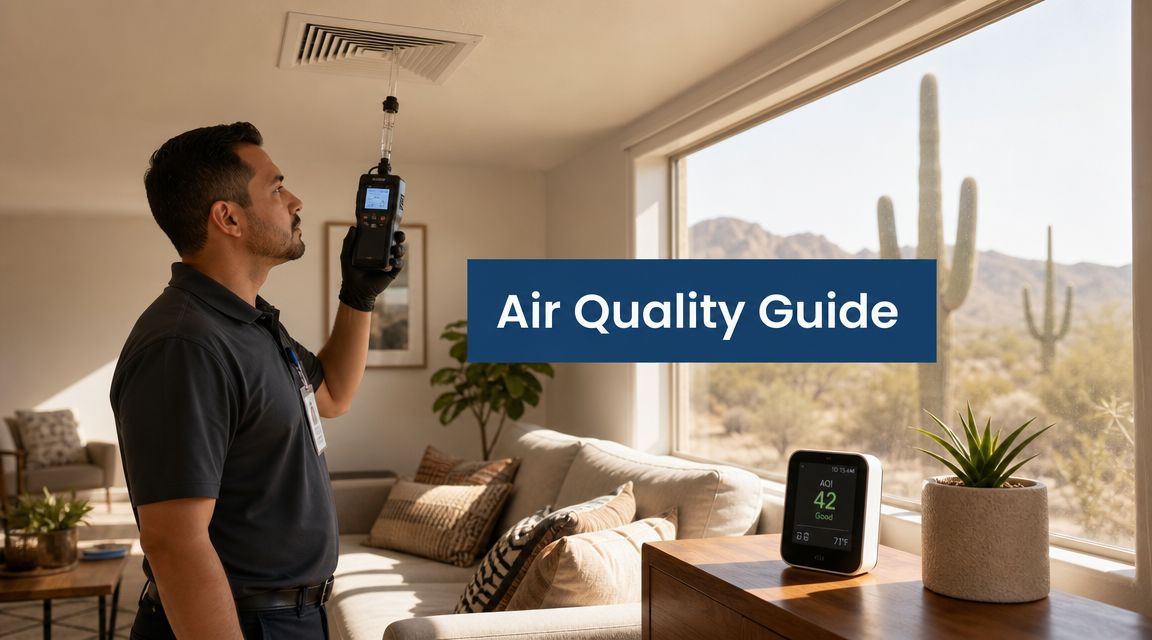
If you're reading this at the kitchen table because the house feels dusty, stuffy, or just off, you're not imagining it. Air quality testing services matter in Phoenix because what gets into a Valley home doesn't always stay outside, and what lingers indoors often needs more than a filter change to solve.
Why Phoenix Air Quality Is Uniquely Challenging

You come home after a summer dust storm, wipe the kitchen counter, and by morning there is a fresh film of grit on it again. A week later, monsoon humidity rolls in and one hallway starts to smell musty, even though the rest of the house feels normal. In Phoenix, those two problems can belong to the same home.
Phoenix houses deal with a combination you do not see in many other places. Long cooling seasons keep homes closed up for much of the year. Fine desert dust finds small openings fast. Then monsoon season introduces short bursts of humidity that expose weak spots around ducts, insulation, roofs, and vent boots. Add seasonal smoke drifting into the Valley, and indoor air problems stop being simple.
Desert dust gets into places homeowners never expect
Dust here is not just a housekeeping issue. In the Phoenix area, fine particles can enter around worn weatherstripping, attic hatches, recessed lights, duct joints, and poorly sealed returns. I have seen homes where the supply vents looked clean enough, but the return side was pulling attic dust into the system every time the blower started.
That matters because the pattern tells you something. If one bedroom gets dusty faster than the rest, or furniture near a return grille always looks dirty first, the house may have an airflow or leakage problem instead of "just desert dust."
Portable air cleaners can help with airborne particles in a room. They do not fix a return leak in a hot attic.
Monsoon moisture changes the problem fast
The Sonoran Desert is dry, but Phoenix homes still get moisture problems. They just tend to show up in bursts. During monsoon season, humid outdoor air meets cold surfaces inside the house. A sweating grille, a small roof leak, or an oversized AC system that cools the home before it removes enough moisture can leave hidden damp areas behind walls or around vents.
Homeowners usually notice clues before they see growth:
- A musty odor near a closet, hallway, or supply register
- A clammy room even when the thermostat reading looks fine
- Allergy symptoms at home that ease up when you leave
- Dark staining near baseboards or vents that could be dirt, moisture, or both
Those details matter during an inspection. Good air quality testing is tied to what the house is doing, where the symptoms show up, and how the HVAC system is moving air.
Smoke season reaches indoors too
Phoenix homeowners do not need a fire in the neighborhood to deal with smoke. Regional wildfire smoke can hang in the air outside for days, and fine particles can still get indoors through door openings, envelope leaks, exhaust fan operation, and duct leakage. That is one reason filtration gets more attention here than it did a few years ago.
If allergy symptoms are part of the problem, our article on air purifiers for allergy relief explains where room units and whole-home options make sense, and where they fall short.
Generic advice misses the Phoenix part of the problem
A Valley home can have several air quality issues at once. Dust intrusion from a haboob. Chemical odors after remodeling. Smoke particles during fire season. Moisture near one register after a humid stretch. If you treat all of those with the same advice, you usually spend money before you find the source.
That is why Phoenix-specific context matters. The test itself is only part of the job. The other part is understanding how desert dust, extreme heat, monsoon humidity, and long AC run times interact inside this kind of house.
For homeowners who manage bigger properties or want a broader reference on environmental testing practices, this guide to water safety for facilities shows the same basic principle. Start with the source, then choose the right test.
Clean vents do not prove clean air. A dusty home does not automatically mean you need duct cleaning. In Phoenix, the cause could be outdoor dust, duct leakage, pressure imbalance, moisture, smoke, or a mix of all five.
A Guide to Professional Air Quality Tests
Most homeowners don't start by asking for a specific test. They start with a symptom, a smell, or a frustration. That's normal. You know what? The confusing part is that the market often bundles mold, VOCs, radon, lead, asbestos, allergens, and other concerns together even though they answer different questions and require different sampling methods. That confusion is well illustrated by Air Quality Testers' discussion of mixed testing menus.
Match the test to the problem
If you're choosing between a screen, a targeted test, or a more complete indoor environmental assessment, focus on the trigger. What changed? What room feels different? When did it start? Those answers matter more than broad labels.
Here's a practical comparison.
| Phoenix Home Air Quality Test Cheat Sheet | |||
|---|---|---|---|
| Test Type | What It Measures | Common Phoenix-Area Causes | Consider This Test If… |
| Particulate matter testing | Fine and coarse airborne particles such as PM2.5 and PM10 | Dust storms, leaky ductwork, attic infiltration, smoke intrusion | You dust constantly, feel irritation during smoky periods, or notice one area gets dirtier faster |
| VOC testing | Volatile organic compounds released as gases | Paint, flooring, cabinets, cleaners, adhesives, recent remodeling | The house smells chemical, symptoms started after renovation, or a room feels irritating without visible dust |
| Mold and spore testing | Airborne spores and related indicators, sometimes paired with surface sampling | Monsoon humidity, hidden leaks, condensation near vents, damp building materials | You smell mustiness, had water intrusion, or symptoms seem tied to a certain room |
| Carbon monoxide testing | Carbon monoxide levels and combustion safety concerns | Gas appliances, attached garage influence, venting problems | You want to rule out a combustion issue or have fuel-burning equipment in the home |
| Humidity and ventilation assessment | Moisture conditions, airflow patterns, and fresh-air performance | Tight homes, short AC run times, poor exhaust, pressure imbalance | Rooms feel stale, clammy, or uncomfortable even when temperature seems right |
| Duct leakage and HVAC assessment | Air leakage, pressure relationships, and system condition | Aging ducts, attic dust, disconnected runs, return-side leakage | One room is always worse, supply registers show buildup, or dust returns quickly after cleaning |
What works and what doesn't
A lot of false starts happen because people test the wrong thing. If the concern is a musty smell after a roof leak, jumping straight to a general particle reading may not tell you much. If the complaint is eye irritation after a kitchen remodel, mold sampling may miss the issue.
What tends to work better:
- Start with the event. Remodeling, smoke exposure, repeated dust, or a humidity issue each point in a different direction.
- Look at the room pattern. Whole-house symptoms and single-room symptoms usually don't have the same cause.
- Tie testing to the HVAC system. In Phoenix, the air handler, return paths, duct condition, and filtration setup often explain why a problem persists.
What usually doesn't work:
- Buying one consumer monitor and treating it like a diagnosis
- Ordering a broad test menu without a reason
- Assuming every symptom is mold
- Assuming every dusty house needs the same fix
Indoor air and water issues sometimes overlap
In some homes, indoor air complaints start after a plumbing leak, slab leak, water heater issue, or drainage problem. If you're managing a larger property or trying to think through contamination risks more broadly, this guide to water safety for facilities is a useful companion read because moisture control and air quality often intersect.
The right test should answer a specific question. If it doesn't, it's probably too broad or too narrow.
The Professional Air Quality Testing Process Step-by-Step
You call because the back bedroom smells dusty every afternoon, your daughter wakes up congested, and the problem got worse after the first monsoon storm. In Phoenix, that pattern already says a lot. Dust intrusion, pressure changes, wet spots around boots or registers, and HVAC run time all matter before anyone collects a sample.
Step one starts before anyone walks in the door
A useful visit begins with a plain conversation about what the house is doing. Which rooms feel worse. What time of day it changes. Whether the concern is dust, odors, headaches, throat irritation, visible spotting, or a stale smell after the AC starts.
Phoenix homes add their own clues. A recent haboob, wildfire smoke drifting in from outside the Valley, a roof leak during monsoon season, or a remodel done with the windows shut in July can each push the testing plan in a different direction. A good technician builds the inspection around that history instead of treating every house the same.
The on-site walkthrough should connect symptoms to the house
Once on site, the job is to inspect the home, the HVAC system, and the problem areas as one system. A quick handheld reading in the middle of the room is not enough. The technician should be looking at filter fit, blower condition, coil cleanliness, return air setup, accessible duct sections, supply and return balance, and any signs that attic air or garage air is getting pulled into the system.
In Phoenix, I pay close attention to dust tracks around return grilles, gaps at filter racks, disconnected or damaged ducts, and rust or staining near ceiling boots. Those details often explain why one room stays dirty or musty while the rest of the house feels fine.
A solid walkthrough usually includes:
- HVAC inspection for filter bypass, blower buildup, coil condition, and visible duct defects
- Room comparisons to see whether the complaint is isolated or house-wide
- Moisture checks around registers, windows, plumbing walls, and previous leak areas
- Airflow and pressure observations that can point to return problems or unwanted air being drawn from the attic
If the inspection suggests duct debris or leakage is part of the problem, this overview of duct cleaning in Mesa homes explains when cleaning helps and when another fix should come first.
Sampling should answer a specific question
Some homes need air samples. Some need surface samples. Some need VOC testing after new flooring, cabinets, paint, or adhesives. If gas appliances are involved, combustion safety checks may matter more than particle counts.
The best testing plan is targeted. If there is a musty odor after a leak, sampling may focus on the affected area and nearby HVAC components. If the complaint is irritation after smoke events or heavy dust, the technician may focus more on particulates, filtration performance, and whether outdoor contaminants are getting indoors through leaks or poor sealing.
Homeowners usually get the most accurate picture when they keep normal routines in place before testing, unless there is an immediate safety issue. That gives the inspector a look at how the house behaves on a typical Phoenix day.
Lab analysis turns observations into usable findings
Meters are screening tools. Lab work is what helps confirm what is present and whether it matches the conditions found in the home.
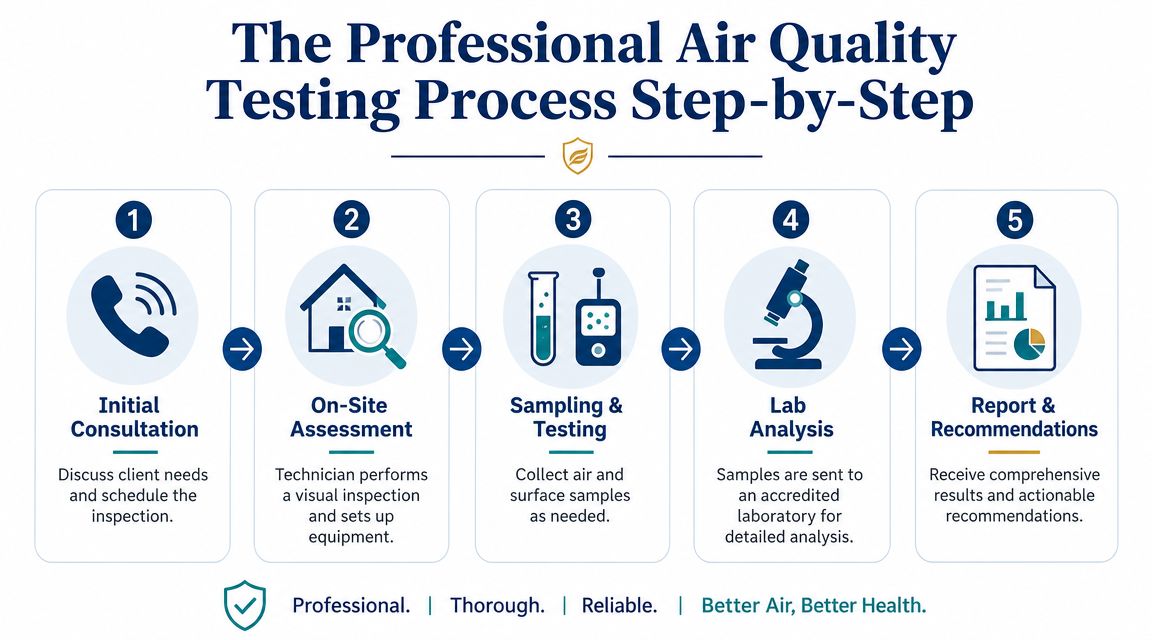
A typical process looks like this:
Interview and symptom timeline
The technician documents what changed, when it started, and whether it follows a room, a weather pattern, or HVAC operation.Visual and mechanical inspection
The home and system get checked for dust entry points, moisture clues, airflow issues, and visible contamination.Targeted sample collection
Samples are collected only where the inspection supports them.Laboratory analysis
Samples go to a lab when identification matters for the next decision.Findings tied to action
The report should explain likely sources, what is confirmed, and what still needs to be ruled out.
If mold is part of the concern, testing is only one piece of the picture. Homeowners dealing with symptoms after confirmed exposure may also find Dr. Jenny Root's guide to mold recovery helpful alongside the home-side investigation.
Good IAQ testing should leave you with a clearer cause, not a thicker stack of paper.
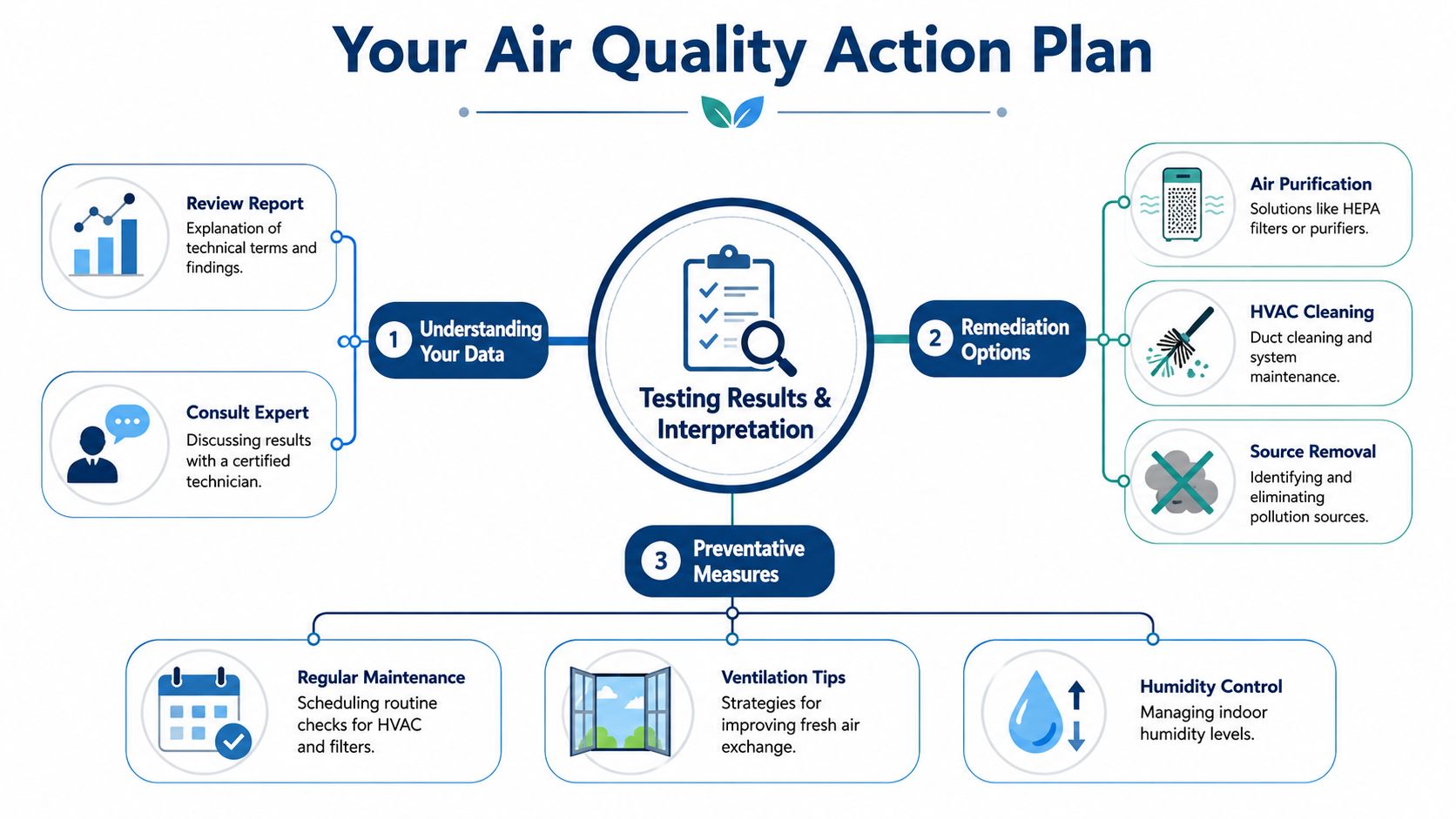
From Results to Remediation Your Action Plan
A report can be useful or overwhelming. The difference is whether somebody translates it into action. Most homeowners don't need more jargon. They need a plain answer to one question. What do we do next?
If the issue is dust and fine particles
When results and inspection findings point to particulate problems, the answer is usually a combination of filtration, duct integrity, and source control. In Phoenix, that often means looking at attic dust entry, return leaks, poor filter fit, or overly light filtration that lets fine material keep circulating.
Action steps may include:
- Upgrading filtration so the system captures more fine dust without choking airflow
- Sealing duct leakage to reduce attic or garage air getting pulled into the system
- Cleaning when contamination is confirmed rather than treating cleaning as the automatic first step
- Reducing indoor dust reservoirs such as damaged return boots, dirty blower compartments, or neglected filter tracks
If the report points toward VOCs
Chemical odors after remodeling, new furnishings, flooring work, or heavy cleaning product use can be frustrating because the house may look spotless and still feel unpleasant. In these situations, interpretation matters.
One EPA indoor-air testing specification calls for collecting samples on three consecutive days and averaging the results, with example limits such as total VOCs below 200 micrograms per cubic meter, which shows why a one-time spike from cooking or cleaning can distort the picture if you don't look carefully at context in the EPA specification document.
That changes the action plan. If VOCs are high, the next step isn't always to buy hardware right away. It may involve:
- Identifying the source such as cabinets, adhesives, paint, solvents, or stored chemicals
- Ventilation review to see whether stale air is lingering in a tight part of the house
- HVAC runtime and air distribution adjustments so pollutants don't stay concentrated in one zone
- Whole-home purification options when removal and ventilation alone aren't enough, such as whole-home air purification systems
If moisture or mold indicators show up
Homeowners often get nervous, and understandably so. The key is to stay practical. Air testing can point toward a moisture-driven problem, but the durable fix is almost always source correction first. Roof leaks, plumbing leaks, sweating vents, duct insulation failures, and room pressure issues all deserve attention before anyone starts talking about "treatments."
If you're dealing with confirmed mold concerns and also want a health-focused perspective on recovery after exposure, Dr. Jenny Root's guide to mold recovery is a useful supplemental read alongside the building-side remediation plan.
If the HVAC system is part of the cause
Sometimes the report isn't saying the air is dirty so much as the system is helping keep it that way. A return leak, poor filtration rack, dirty blower assembly, pressure imbalance, or badly sealed ducts can keep reintroducing the same problem.
That's where remediation becomes very specific. Comfort Experts offers options such as Aeroseal duct sealing, filtration upgrades, purification equipment, and humidity-related corrections when testing and inspection show those are appropriate. That isn't an upsell when it follows diagnosis. It's matching the fix to the cause.
What to remember: The best remediation plan removes or isolates the source first, then supports the home with better filtration, airflow, or purification as needed.
How to Choose a Qualified IAQ Provider in Phoenix
Indoor air concerns make people vulnerable to bad advice. If a contractor knows you're worried about your family's breathing, it's easy for that conversation to turn into fear-based selling. Don't let it.
What to look for in a provider
Start with basics. The company should be licensed and insured. For Arizona homeowners, that isn't paperwork fluff. It tells you the business is operating as a real trade professional, not showing up with a gadget and a sales script. Comfort Experts, for example, is licensed under ROC #275914.
Beyond that, look for someone who understands buildings, not just sensors. Phoenix homes have unique combinations of attic heat, duct runs through harsh spaces, long cooling seasons, dust intrusion, and occasional humidity swings. A provider who doesn't understand local HVAC behavior can misread the symptoms.
A trustworthy provider should be able to explain:
- Why a certain test is being recommended
- What that test can answer, and what it can't
- How HVAC conditions affect the results
- Whether lab analysis is needed or not
- What the likely next steps are if results come back high
Red flags that deserve caution
A few warning signs show up again and again.
- One-size-fits-all packages that skip questions about symptoms, timeline, or room pattern
- High-pressure language that tries to scare you into immediate equipment replacement
- Instant verdicts based only on one handheld reading
- No discussion of HVAC conditions even though the system controls airflow through the entire house
- No local references or local experience with Valley-specific conditions
Why local experience matters
Phoenix isn't just "hot." The way homes handle air here is shaped by dust storms, extreme cooling demand, closed-up interiors, garage adjacency, and monsoon swings. A contractor who works in this climate every day will usually think to inspect return leakage, attic infiltration, vent sweating, filtration fit, and room pressure issues before jumping to conclusions.
If you're comparing companies more broadly, this guide on choosing the best HVAC company near you can help you vet service quality beyond air quality testing alone.
Ask the provider what they do if the first reading doesn't match the symptoms. Their answer tells you a lot about how they diagnose.
Frequently Asked Questions About Home Air Quality Testing
How much does professional air quality testing cost in Phoenix
The honest answer is that cost depends on scope. A focused diagnostic for one concern is different from a broad investigation involving multiple sample types and lab work. The main price drivers are usually how many areas of the home need evaluation, which pollutants are being investigated, and whether laboratory analysis is required.
If a company gives a flat number before asking what happened, where the concern is, and what changed in the home, that's usually not a very customized process.
Are store-bought air quality monitors accurate enough
They can be helpful for awareness, but they usually aren't enough for diagnosis. A consumer monitor may alert you that something changes during cooking, cleaning, or a smoke event. That's useful. What it usually can't do is tell you whether the cause is infiltration, duct leakage, moisture, chemicals from materials, or a room pressure issue.
Use them as an early warning tool, not as the final answer.
Is air quality testing a one-time service or an ongoing process
For some homes, it is a targeted one-time diagnostic. You had a remodel, a water event, smoke intrusion, or a specific symptom pattern, and you want a clear answer. For other homes, especially those with recurring triggers, testing becomes part of a longer indoor air management plan.
That broader demand is one reason this service category is growing. The global indoor air quality testing service market is projected to grow from about $2.5 billion in 2025 to roughly $4.2 billion by 2033, a projected 7% CAGR, according to Data Insights Market's indoor air quality testing service report. The big takeaway for homeowners is simple. More people now see testing as a distinct service, not just an add-on to equipment replacement.
Should I test before replacing filters or cleaning the house
Usually, yes, if you want the clearest picture. If you deep clean, change products, and alter the system right before the visit, you can muddy the pattern you're trying to understand. Basic routine living is fine, but don't stage the house into looking different than it normally behaves.
If you're not even sure your filter is in the right place or being changed correctly, this homeowner guide on where to find your air filter is a good place to start before scheduling deeper diagnostics.
What if my symptoms are real but the first results seem normal
That happens. Air quality issues can be intermittent, room-specific, activity-driven, or tied to HVAC operation at certain times. A solid provider doesn't dismiss you because one simple reading looked fine. They go back to the building conditions, the timeline, and the source clues.
That patience is often what turns a frustrating mystery into a fix.
If your home in Phoenix feels dustier, smellier, or harder to breathe in than it should, a careful diagnosis can save a lot of guesswork. You can contact Comfort Experts by calling 480-207-1239 or use the schedule service form to set up an evaluation.