
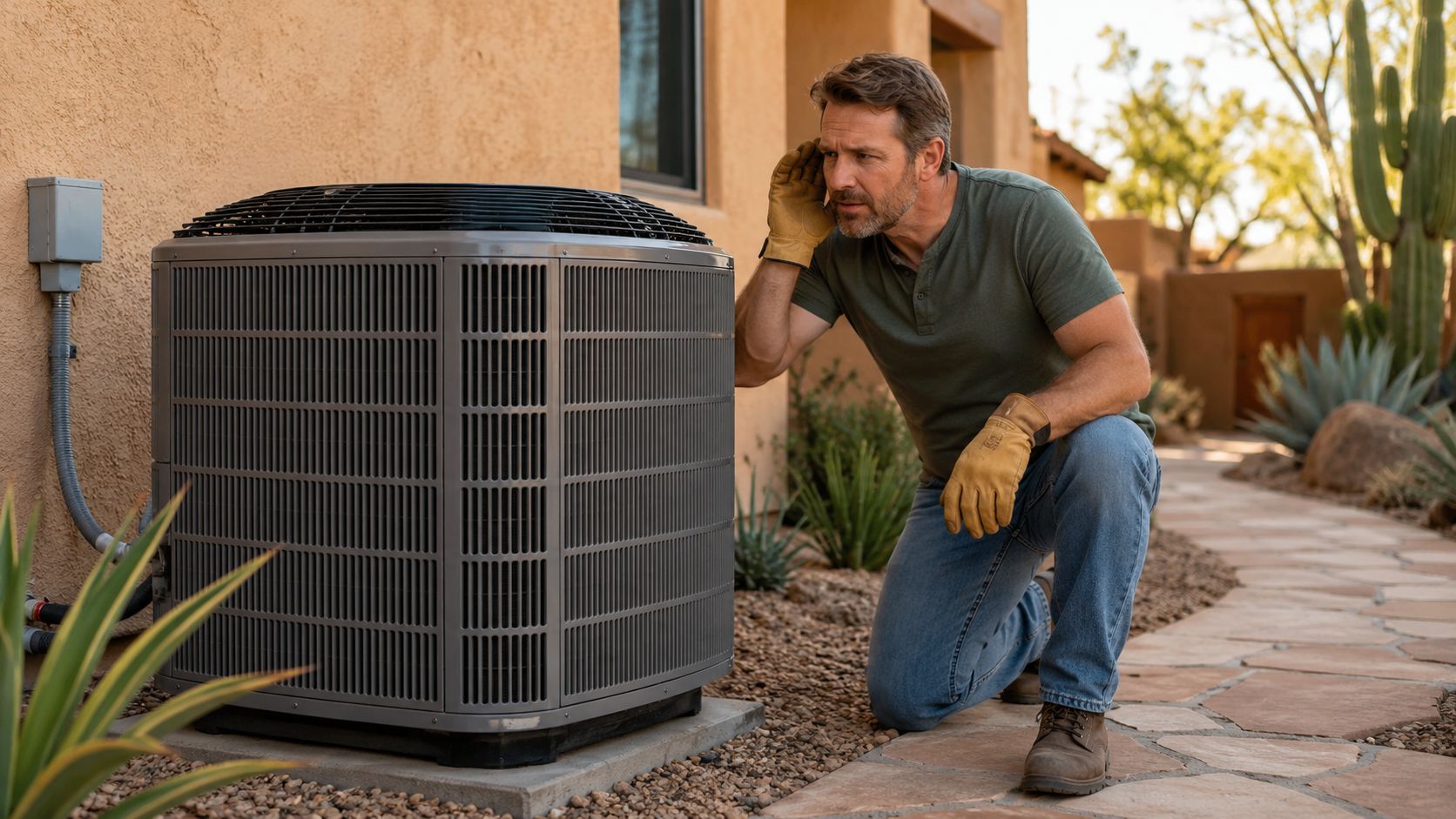
A strange sound from the outdoor unit gets a lot more stressful when it's 115 degrees in Mesa and the house is already warming up. When ac compressor noise changes suddenly, the useful move isn't guessing. It's listening carefully, checking a few safe basics, and knowing when the sound points to a real failure.
That Unsettling Noise from Your AC Unit
In the East Valley, people usually notice ac compressor noise at the worst time. Late afternoon heat, a unit that's been running hard for hours, or right after a dusty monsoon blow-through. A noise that wasn't there yesterday can mean anything from a loose panel to a serious compressor problem.
The good news is that the sound itself often gives clues. The more clearly a homeowner can describe what it sounds like, when it happens, and where it seems to come from, the faster an HVAC technician can narrow things down and avoid chasing the wrong issue.
What Is Your AC Compressor Trying to Tell You
The compressor is usually the loudest part of an AC system, and published ratings for some units can reach 55 dBA, roughly comparable to moderate rainfall, according to Daikin's explanation of AC noise ratings. A steady low hum is generally normal. A sudden shift to rattling, hissing, banging, or grinding isn't.
That's why the first question isn't “Is the unit making noise?” Every AC makes some noise. The actual question is whether the sound is steady and familiar or new, sharp, irregular, or harsh.
Common AC compressor noises and what they mean
| Noise Type | Likely Cause(s) | What to Do |
|---|---|---|
| Banging or clanking | Loose hardware, a component moving out of place, or internal compressor damage | Turn the system off if the sound is strong or repeated. A loud metal-on-metal sound usually needs professional diagnosis. |
| Hissing or bubbling | Possible refrigerant issue or pressure-related problem | Don't open the unit or try to handle refrigerant components. Schedule service. |
| Clicking | Normal startup or shutdown contact can be harmless, but repeated clicking can point to an electrical issue or a control problem | Note whether it's one click or repeated clicking. If repeated, have it checked. |
| Rattling | Loose access panel, loose screws, debris, vibration against the cabinet, or a mounting issue | Check for obvious loose exterior panels and debris after power is shut off. |
| Grinding | Internal wear, motor-related trouble, or serious compressor damage | Shut the system off and call for service. This is not a wait-and-see noise. |
| Squealing or screeching | Motor-related issue or another moving part under strain | Turn the system off and arrange diagnosis before more damage develops. |
| Humming that's louder than usual | Electrical strain, vibration, mounting issue, or a compressor struggling under load | Compare it to the unit's usual sound. If it's clearly louder or paired with poor cooling, have it inspected. |
What homeowners should listen for
A helpful description has three parts:
- Sound type: hum, rattle, bang, hiss, grind, click
- Timing: startup, continuous operation, shutdown, only in the afternoon, only after rain or dust
- Location: top fan area, side panel, refrigerant line area, or deep inside the cabinet
That last point matters because many people hear “compressor noise” and assume the compressor itself is definitely bad. Sometimes the sound is coming from a panel vibrating, a fan blade hitting debris, or the cabinet shaking on an uneven pad.
For Arizona homes, that confusion gets worse with rooftop package units and side-yard condensers surrounded by block walls. Sound bounces. What seems like an internal compressor knock can turn out to be cabinet vibration echoing off masonry.
For a better sense of how compressor design affects sound and performance, Comfort Experts' guide for AZ homeowners is worth reading. Variable-speed systems don't eliminate noise, but they often change the way noise presents itself compared with older single-stage equipment.
What works and what doesn't
Some fixes help. Others just cover up the symptom.
- Works well in simple cases: tightening loose exterior screws, clearing debris, correcting airflow restrictions, and addressing vibration
- Usually doesn't solve root problems: ignoring the noise because cooling still works, stuffing material around the unit, or trying to “soundproof” a system with an internal failure
- Needs a technician: refrigerant issues, electrical faults, compressor internals, capacitor or contactor testing, and anything involving disassembly
Safe On-Site Checks for Homeowners
A lot of service calls start with “it's making a weird sound somewhere outside.” That's understandable. But a 2024 study cited here found that 80% of homeowners who called technicians could not accurately describe the location or nature of the noise, which can slow diagnosis.
That doesn't mean a homeowner needs to become a technician. It means a few safe observations can be useful before the service call.
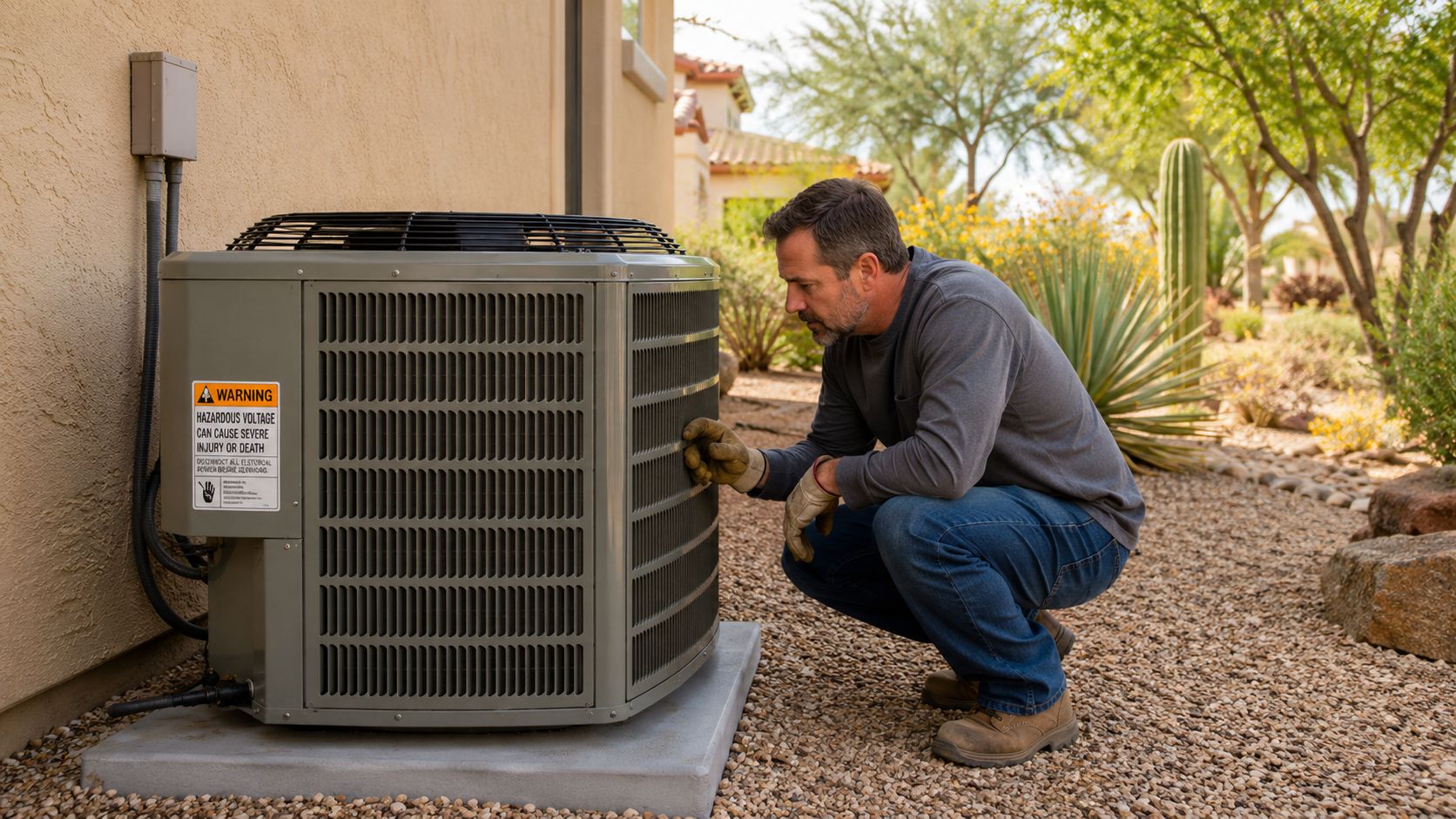
Start with power off
Before touching anything near the outdoor unit:
- Set the thermostat to off
- Shut off power at the outdoor disconnect
- Turn off the breaker if there's any doubt about safety
Don't remove panels and don't reach into the cabinet. The goal is visual checking only.
What to check outside
Walk around the unit and look for obvious issues.
- Debris around the cabinet. Cottonwood, leaves, palm litter, trash, and monsoon-blown debris can create rattles or strain airflow.
- Loose exterior panels or screws. A vibrating panel can sound much worse than it is.
- Unit level. If the condenser has shifted on the pad, vibration gets amplified.
- Contact with walls or objects. A refrigerant line, conduit, or loose screen panel touching the cabinet can transmit noise.
A second useful step is to note whether the sound happened after a weather event. In Mesa and the East Valley, dust storms and monsoon winds often leave behind the exact kind of light debris that creates rattling and buzzing.
What to write down before calling
Instead of saying “the compressor is loud,” give details like these:
- When it happens: only at startup, every cycle, or nonstop while running
- What changed: louder than normal, newly metallic, newly sharp, or paired with weak airflow indoors
- Where it seems strongest: top fan section, one side panel, or deep in the unit
For additional basic system checks, this guide for Phoenix homeowners' AC covers common symptoms without pushing into unsafe DIY work.
Distinguishing Normal Sounds from Warning Signs
Not every startup sound means the compressor is failing. That's where a lot of avoidable panic happens.
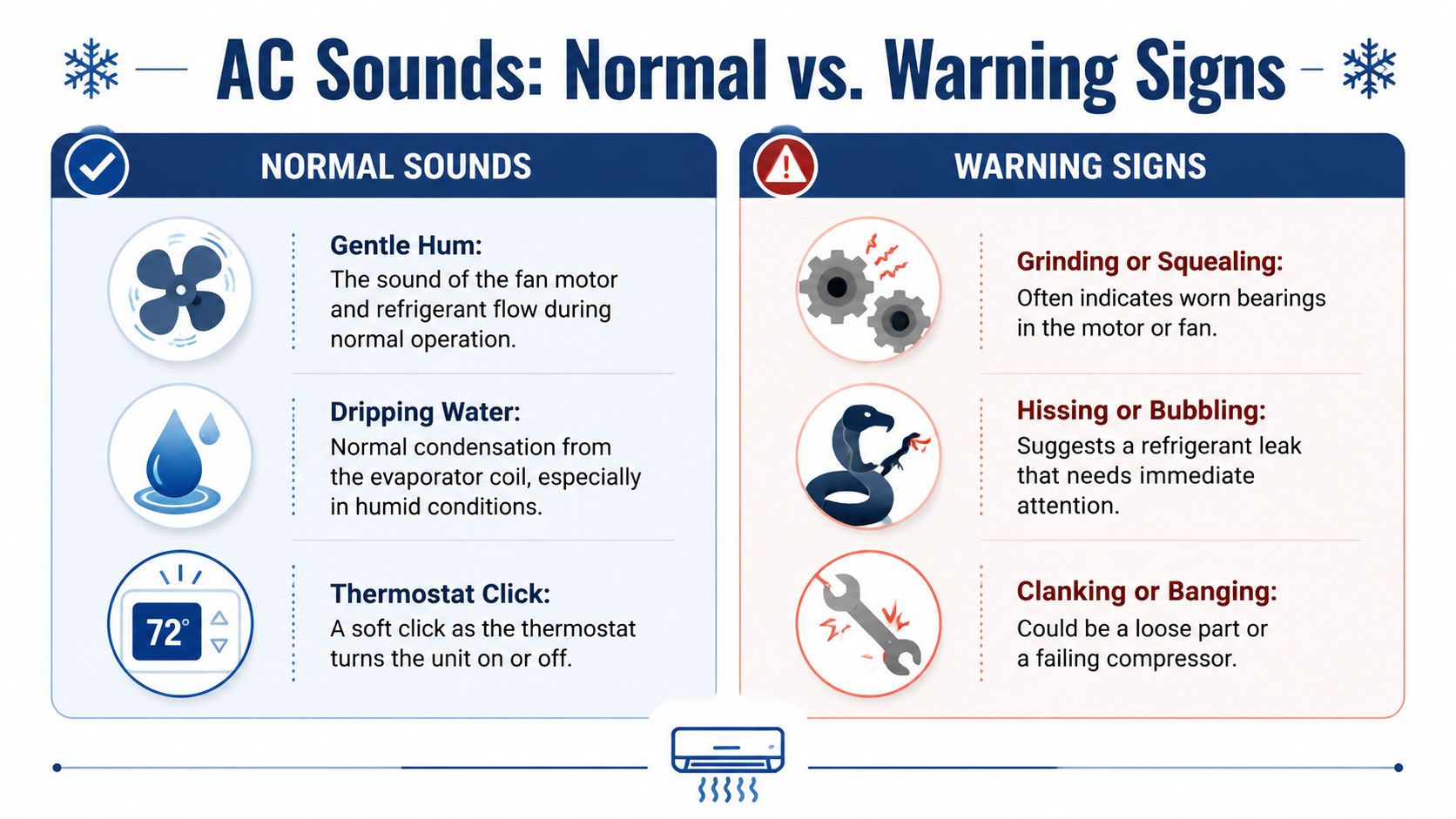
Sounds that are often normal
A healthy system can make a few routine noises:
- Steady humming during operation
- A soft click when the system starts or stops
- Air movement noise from the fan
- Brief startup refrigerant sounds
One sound that confuses people is liquid slugging, which can happen during startup because of refrigerant migration. It's described as a common phenomenon in this Sanden compressor noise document. Industry data in that same source suggests many homeowners mistakenly report it as a critical failure, even when the sound is related to startup conditions rather than immediate compressor death.
Sounds that should change the response
A warning sound usually has one or more of these traits:
- It's new
- It's sudden
- It's persistent
- It's harsh or metallic
- It comes with poor cooling, short cycling, or hard starting
Grinding fits that category. Repeated banging does too. A strong hiss that continues while the system runs should also be treated seriously.
A simple comparison that helps
Use this quick lens:
- Normal tends to be brief, consistent, and tied to ordinary startup or run cycles.
- Concerning tends to be irregular, aggressive, longer-lasting, or clearly worse than the unit's usual sound.
For homeowners who are hearing a low hum and aren't sure whether it's harmless or not, Comfort Experts' AC humming explanations give a more focused look at that specific symptom.
The Compressor Repair vs Replacement Decision in Arizona
Once a technician confirms the compressor is the actual problem, the decision usually comes down to one question. Is it smarter to repair this system, or is the compressor failure really a sign that the whole unit is near the end?
That answer looks different in Arizona than it does in milder climates. In Mesa, Gilbert, Chandler, Queen Creek, and the rest of the East Valley, AC systems don't get a gentle summer. They run hard for long stretches, often against extreme heat, dust load, sun exposure, and rooftop or side-yard conditions that add stress over time.
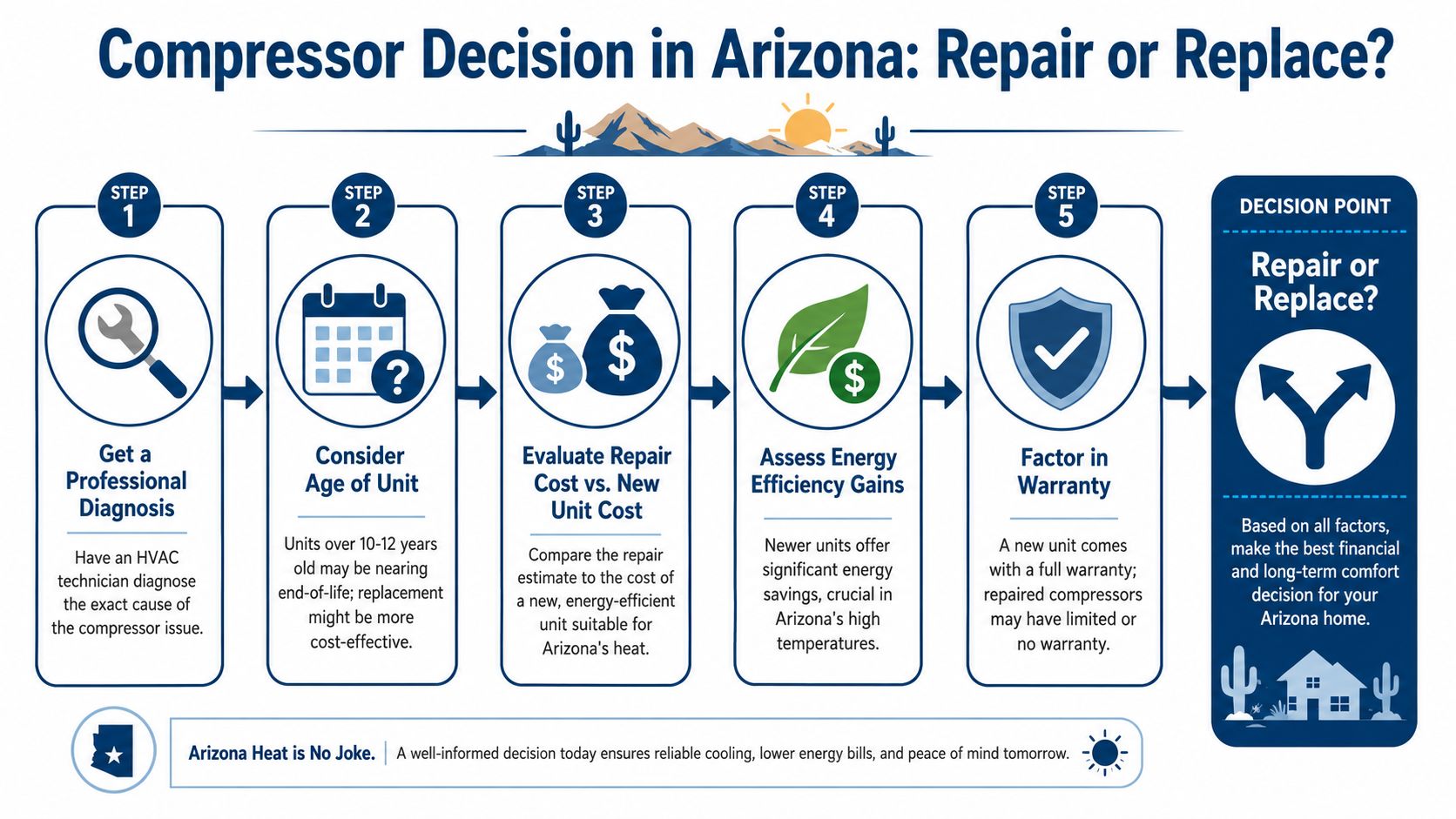
When repair can make sense
Compressor repair or replacement inside the existing system is easier to justify when:
- the system is otherwise in solid condition
- the unit isn't near the end of its expected service life
- the repair addresses a clearly isolated issue
- the rest of the equipment has been dependable
In those cases, a targeted repair may buy useful time without throwing money at a system that's falling apart.
When replacement deserves a hard look
Replacement moves higher on the list when several factors stack up:
- Older equipment that has already had repeated repairs
- Declining efficiency and high summer utility strain
- Poor parts condition elsewhere in the system
- Uncertain long-term value after a major compressor job
A compressor is a central part of the system. When it fails on an older unit, many homeowners are really deciding whether to keep investing in the whole platform.
That's especially true for Arizona homes with older ductwork, older thermostats, or rooftop package units that have lived through years of direct sun and monsoon exposure. A compressor repair might restore cooling, but it won't reverse the age of every other stressed component.
The practical way to decide
A strong diagnosis should answer these points clearly:
- Is the compressor the failed part?
- What condition is the rest of the system in?
- How likely is another major repair soon?
- Does the home need better performance, quieter operation, or lower utility strain anyway?
For a deeper look at that decision, AC repair vs replacement lays out the trade-offs in a way that fits Arizona conditions. Homeowners in Mesa who need actual troubleshooting and repair can also look at AC repair in Mesa when the next step is diagnosis rather than research.
When You Need a Professional Diagnosis
Some noises buy a little time. Others don't.
If the system is making grinding, loud banging, repeated hard-start noises, or an ongoing hiss, it's time to shut it down and have it checked. Compressor work involves high voltage, pressurized refrigerant, and components that can be damaged further by guesswork. This is not a good DIY category.
What homeowners can still do before the appointment
The highest-value homeowner steps are usually the simple ones. TCL's AC noise guidance points to restoring airflow and reducing vibration as major contributors to lower operating noise. That means:
- Replace or clean the filter if it's dirty
- Keep supply and return vents open and unobstructed
- Clear debris around the outdoor unit
- Check that the unit sits level on a stable base
Those steps won't fix internal compressor damage, but they can prevent avoidable strain and help separate a simple noise issue from a serious one.
What to tell the technician
A short, useful report sounds like this:
- The sound type: rattle, grind, hiss, hum, click
- The timing: startup, shutdown, constant run, hottest part of day
- Recent context: dust storm, panel was loose, filter was clogged, cooling dropped off
That kind of description helps the service call start in the right place.
For property managers and business owners trying to improve dispatch quality, reporting, and customer communication, tools like AI solutions for HVAC companies are also becoming part of how some service organizations handle intake and follow-up. On the homeowner side, the more useful move is still simple. Give precise observations and choose a contractor that diagnoses instead of guessing. This Comfort Experts' advice on choosing HVAC is a practical place to start.
The short version is simple. If the sound is mild and clearly tied to a loose panel or debris, a safe visual check may explain it. If the noise is sharp, persistent, or paired with weak cooling, stop running the unit and get a proper diagnosis.
If ac compressor noise is getting worse, or the system in Mesa or the East Valley is making a sound that clearly isn't normal, Comfort Experts can inspect the system and identify whether the issue is airflow, vibration, electrical, or compressor-related. Call 480-207-1239 or schedule service to take the next step.